
You know what sadness feels like. You’ve met it. Sadness has a shape you can locate in your chest, a weight you can describe to someone if they asked. Tears come. Heaviness settles. You feel something pressing down on you from above and you can point at it and say “that’s what’s wrong.”
This isn’t that.
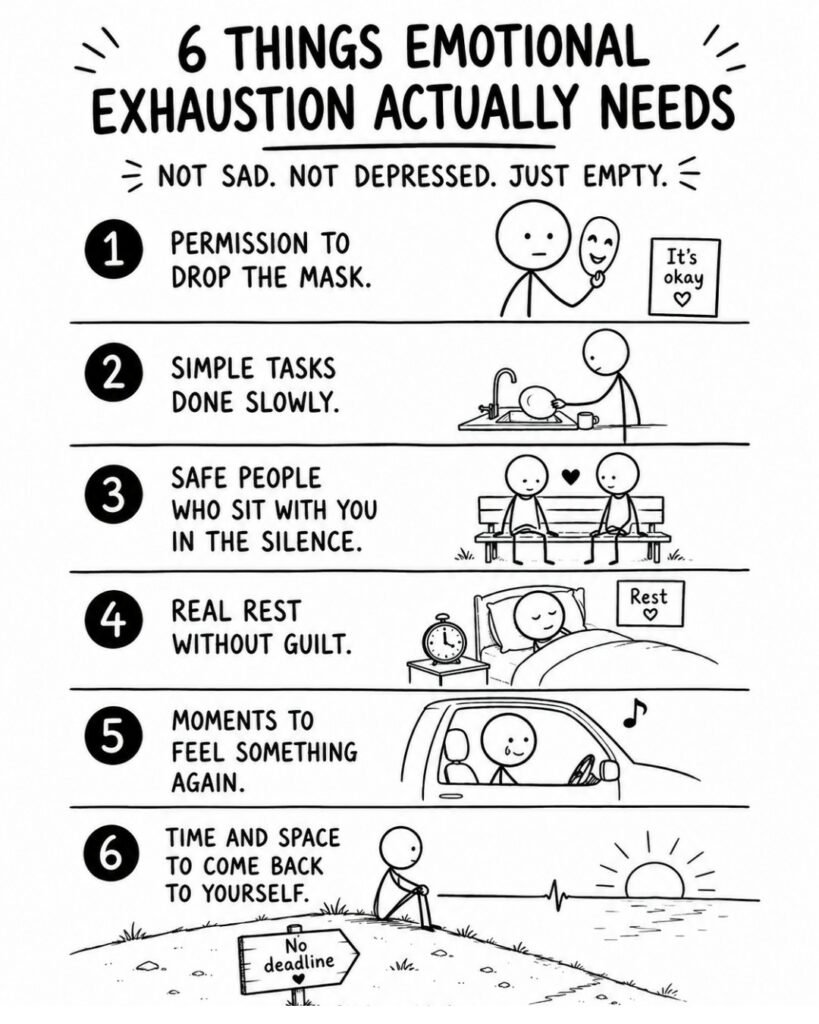
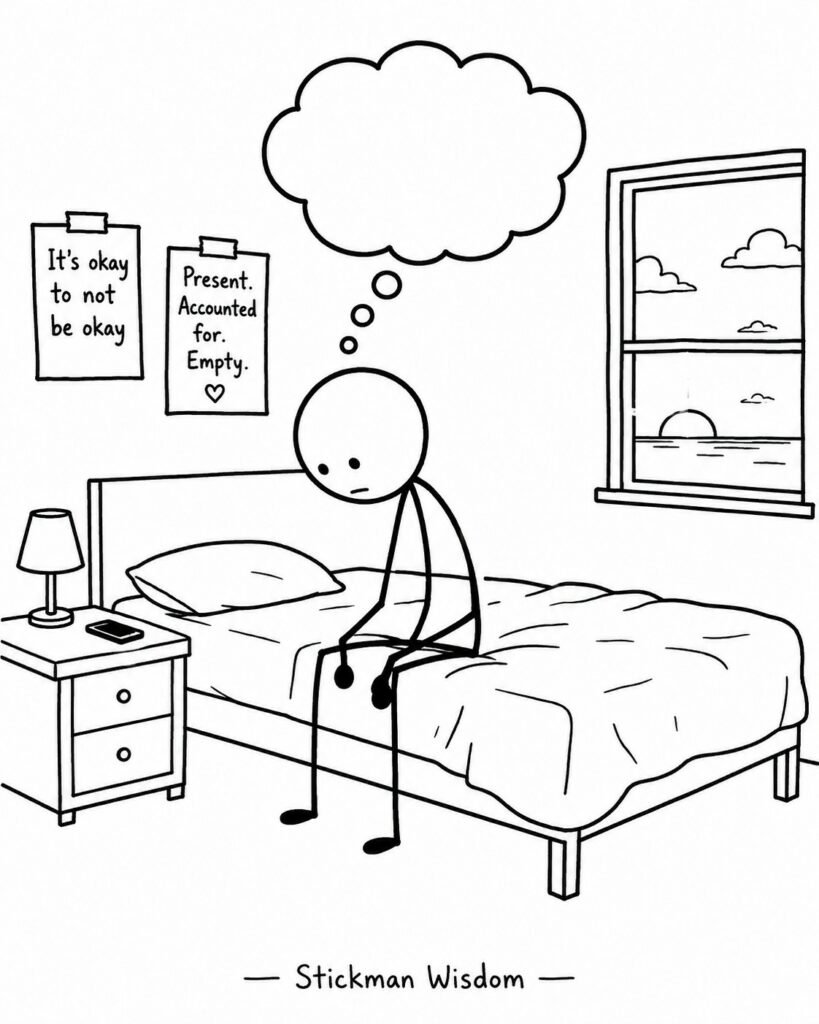
This is the thing that shows up after you’ve been feeling for so long that the feelings themselves got tired. What’s left isn’t sadness. It’s the absence of anything at all. A flatness that doesn’t hurt and doesn’t help and doesn’t produce any of the signals that would tell you or anyone around you what’s actually happening inside you. You’re not down. You’re not up. You’re standing in the emotional equivalent of a room with no furniture, present and accounted for and completely hollow.
And the worst part is the question that follows. The one that came flooding into the comments when I posted about this. The one that sat underneath every single response.
“Okay, I see myself in this. Now what do I do about it?”
I don’t have a magic fix. But I have the most honest answer I can give you, and I wrote the rest of this for the people in the comments who asked.
Part One: The Mirror
Before you can fix what’s wrong, you have to stop calling it the wrong thing.
Most people who are emotionally exhausted don’t use the word “exhausted.” They say they’re tired. They say they’ve been off lately. They say they just need a vacation, a better sleep schedule, a weekend without plans. They frame the problem as physical because physical problems have physical solutions and physical solutions feel doable.
But emotional exhaustion isn’t a body problem. Your body is doing what it always does. You’re sleeping, eating, showing up to work, answering texts, sitting in traffic, cooking dinner, loading the dishwasher. The machine is running fine. The operator inside the machine is the one who left the building three months ago without telling anyone.
Emotional exhaustion looks normal from the outside. From the inside, it looks like this.
The tiredness that sleep can’t touch
You’re tired in a way that sleep doesn’t fix. You slept eight hours and woke up the same. The alarm goes off and the first thing you feel isn’t rested. It’s continuation. Yesterday’s heaviness rolling into today without the reset that sleep was supposed to deliver. Your body was horizontal. Your brain was somewhere else entirely, running something in the background that consumed whatever recovery was supposed to happen before it could reach the parts of you that needed it most.
When small things become impossible things
Small tasks start carrying weight they shouldn’t carry. The single dish sitting in the sink. The email you’ve read four times without replying. The phone call that would take three minutes. You know how small they are. Your body processes them as enormous. The gap between knowing something takes thirty seconds and actually starting that thirty seconds becomes wider every week, and that gap itself is the thing that traps you. You’re not lazy. The wiring between “I should” and “I’m doing” has developed a delay that keeps growing and you can’t figure out how to close it.
The conversation you were present for but missed entirely
Conversations start happening around you instead of with you. Someone is talking. You’re looking at them. Your body is aimed at the right spot. But your mind packed up and left the room three sentences ago without telling you it was going. You come back when the silence hits, when they’re looking at you with that expression that says it’s your turn to respond, and the last thing you actually heard was one word from a sentence that finished ten seconds ago.
The flatline where feelings used to be
Things that used to feel good stop producing anything. The playlist you loved last month plays and registers as background noise. The meal you always look forward to tastes like something you’re putting in your body to keep the body going. The text from the friend who always makes you laugh arrives and the laugh doesn’t come with it. Same inputs. Something changed in the processing. Everything that used to produce a response now produces a flat line and you don’t know when the switch flipped.
You’re functioning but you can’t remember the last time you felt something fully. The job gets done. The routine executes. The days pass. And if someone sat you down and asked you to describe how any of it felt, you’d struggle to produce an adjective because the feeling component of your operating system has been running on background mode for so long that you stopped noticing the difference between being present and being on autopilot.
The cry that won’t come
You want to cry but the tears won’t come. The pressure is there. In your chest, behind your eyes, in the back of your throat. The full infrastructure of a cry is assembled and ready. The release valve won’t open. So you sit on the edge of your bed, dry-eyed, with everything right there behind the wall, and the wall won’t move, and eventually you stand up and walk into the next room and the day continues and nobody knows how close the water came to the surface because the surface held.
If you just read all of that and felt your chest get tight, that’s the mirror working. That’s your system telling you it recognizes itself.
Part Two: The Pattern
Emotional exhaustion doesn’t happen in a day. It happens in a pattern that plays out so slowly you don’t see it until you’re already deep inside it.
Where it starts
It almost always starts the same way. Something in your life begins demanding more from you emotionally than it’s giving back. A relationship that takes more than it returns. A job that drains more than it fulfills. A family situation where you’re the strong one, the reliable one, the one everyone calls when they need something solved. A season of your life where the hits keep coming and the space between the hits keeps getting shorter.
At first, you absorb it. Humans are built to absorb a surprising amount of emotional strain in short bursts. A bad week. A hard month. A painful conversation. Your system processes it, files it, recovers. You bounce back. You’ve always bounced back.
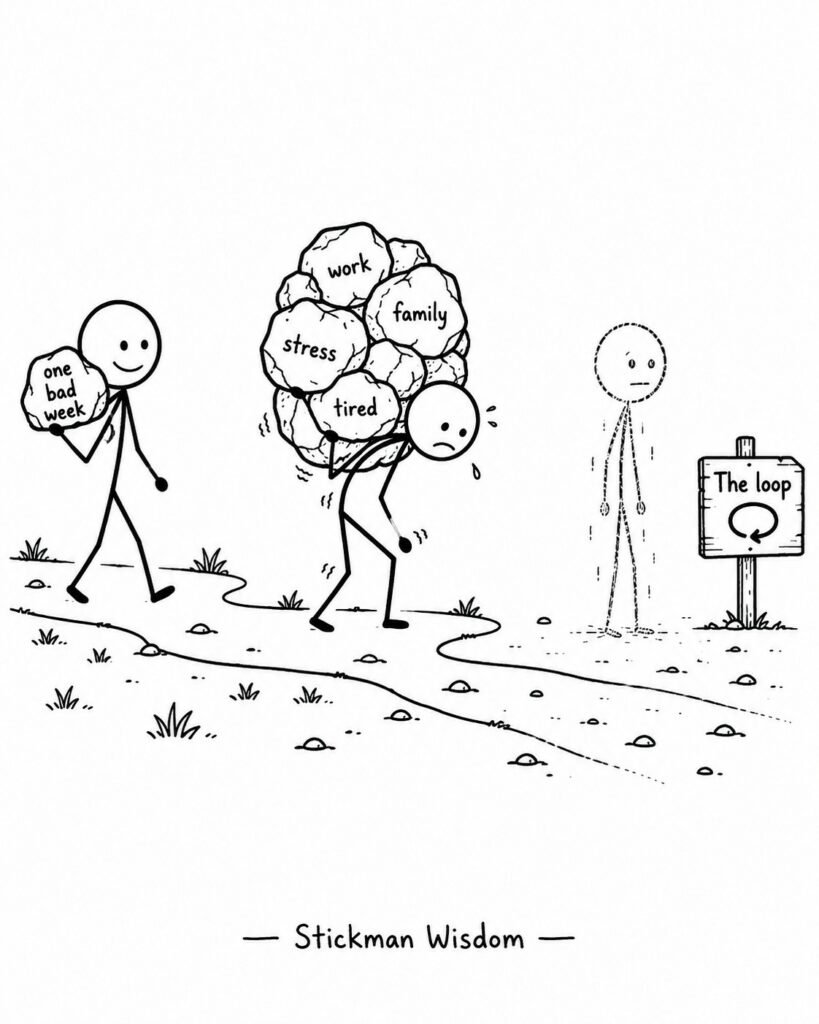
But somewhere along the way, the bad week becomes a bad stretch. The hard month becomes a hard quarter. The painful conversation becomes the tenth painful conversation and you’ve stopped processing them between rounds because the rounds are coming faster than the recovery. You’re still absorbing. You’re just not completing the cycle anymore. The feelings are going in but they’re not coming out the other side.
How the system degrades
This is where the word “exhaustion” earns its name. Your emotional system works like any system that runs without downtime. It doesn’t break all at once. It degrades. First, the responses get slower. You used to laugh faster, cry easier, feel things on the first pass. Now there’s a lag. Then the responses get smaller. The highs aren’t as high. The lows aren’t as low. Everything drifts toward the middle. Then the responses stop altogether and what you’re left with is the flatline, the nothing feeling, the empty room.
The pattern has a second layer that makes it harder to catch. Somewhere during the degradation, your brain starts building workarounds. You learn to function without feeling. You develop autopilot. You figure out what responses to give in conversations so people don’t notice you checked out. You learn to perform engagement without actually being engaged, and you get so good at simulating presence that even the people closest to you don’t realize you’re gone.
The longer the performance runs, the harder it becomes to remember what the real version felt like. You start to wonder if this is just how you are now. If this is what adulthood feels like. If everyone else is walking around this hollow and you’re just the one being dramatic about it.
You’re not being dramatic. You’re running a system that hasn’t had maintenance in months, maybe years, and you’ve confused the degradation for personality.
The loop that feeds itself
There’s a third layer too, and this is the one nobody talks about. The pattern feeds itself. The emptiness makes it harder to do the things that would help you recover. The things that used to refill your tank, like seeing friends, spending time outside, moving your body, doing something creative, now cost more energy than they give back because you’re trying to run them from a battery that’s already at zero. So you stop doing them. And stopping them speeds up the emptiness. And speeding up the emptiness makes you stop more. The cycle closes. You’re inside a loop that’s generating the very thing that’s destroying you.
That’s what makes emotional exhaustion different from a bad mood or a rough week. A bad mood lifts when the circumstances change. A rough week ends when the week ends. Emotional exhaustion is structural. It’s a loop that reinforces itself. And breaking the loop requires something more targeted than “just push through it” or “try to think positive” or any of the other advice that people hand out like flyers to someone who’s drowning.
Part Three: The Invisible Cost
Emotional exhaustion takes things from you that you won’t notice until someone points them out.
The patience you used to have with yourself
It takes your patience first. Not the kind you notice losing, not road rage or snapping at strangers. The quiet patience. The patience you used to have with yourself. You used to be able to sit with a problem for a while before it became unbearable. You used to tolerate your own mistakes without turning them into evidence that something is deeply wrong. Now the tolerance window has shrunk to almost nothing. You mess up at work and it doesn’t just register as a mistake. It registers as proof of the bigger failure you feel you’ve become. The gap between “I dropped the ball” and “I’m falling apart” collapsed and everything feels catastrophic even when it’s minor.
The good memories that stopped sticking
It takes your memory of good things. This one is particularly cruel. When you’re emotionally exhausted, your brain doesn’t stop storing memories. It stops storing positive ones with any emotional weight. You can remember what happened last weekend but you can’t remember how it felt. You can recall that dinner with your friend happened but the warmth that came with it didn’t stick. What sticks instead are the difficult moments, the stressful conversations, the things that went wrong. Your filing system is still working but it’s only filing one category and the category is “evidence that things aren’t okay.” Over time, this creates a deeply skewed picture of your own life. You look back at the last six months and see mostly heaviness even though there were good moments scattered throughout. They just didn’t attach to anything.
The glass wall between you and the people who love you
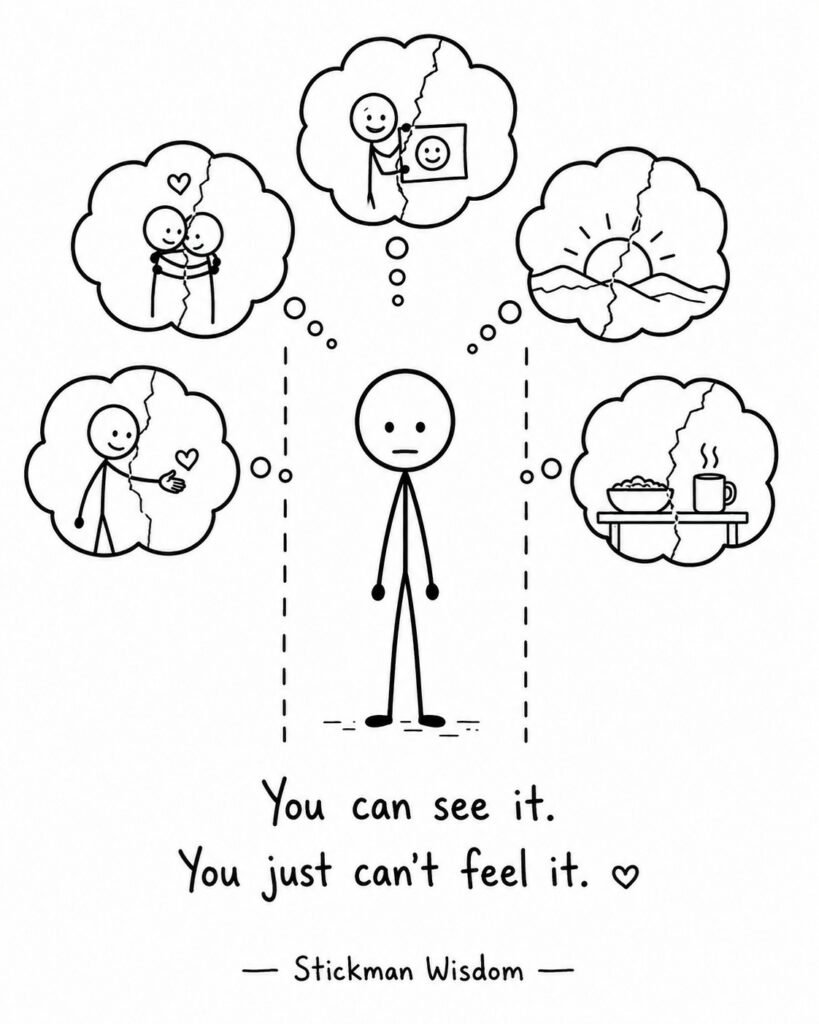
It takes your ability to receive love properly. This is the cost that damages relationships the most. When someone tells you they’re proud of you, the words arrive but they don’t penetrate. When your partner tries to comfort you, their arms are around you but you can feel the glass wall between their warmth and your ability to absorb it. When your kid hands you a drawing they made of your family, you feel the flicker of something trying to break through the flatness and then the flatness wins. The people who love you are doing everything right. You can see it. You just can’t feel it. And the guilt of not being able to feel what you know you should feel becomes another weight on a pile that’s already too heavy.
The future you stopped planning
It takes your ability to plan for the future. Emotional exhaustion traps you in the immediate present because looking ahead requires imagining that things will be different, and imagining takes energy you don’t have. So you stop thinking about next month, stop setting goals, stop wanting things for yourself because wanting requires hope and hope requires fuel and the tank is empty. People around you might interpret this as laziness or a lack of ambition. Your system is running a survival loop. Survival loops don’t plan vacations.
The person you stopped being
It takes your identity slowly enough that you don’t notice. You used to be the one who was always up for things. The one who had hobbies and called people back and cared about their appearance, their home, their health, their future. Piece by piece, those things fell away. Not because you decided to let them go but because each one required energy that was being redirected to basic functioning. One day you look around and realize you don’t recognize the person operating your life. They look like you. They live in your house. They walk through your routine. But the version of you who had interests and opinions and laughter and plans hasn’t shown up in a while and you can’t remember exactly when they left.
Part Four: The Shift
This is the part everyone in the comments was asking for, and I need to say something first that might frustrate you. The shift back from emotional exhaustion is not a single dramatic moment. It’s not a breakthrough or a motivational video that rewires your brain or an epiphany on a Tuesday morning that changes everything.
The shift is a process. Slow, quiet, and for a while, invisible. You won’t feel it working until it’s already been working for weeks. And the first step isn’t action. The first step is understanding.
The circuit breaker explanation
You have to stop treating yourself as broken. Emotional exhaustion is a signal, not a malfunction. Your system isn’t defective. It’s overloaded. The flatness is a circuit breaker that tripped because the load exceeded the capacity for too long. Your brain didn’t shut down your feelings because something is wrong with you. It shut them down because keeping them running at full power on an empty tank would have caused actual damage. The numbness is protection. Miserable, confusing, isolating protection, but protection.
When you understand that, the question changes. It stops being “what’s wrong with me?” and starts being “what has been drawing more from me than I’ve been putting back?”
That question is the actual starting point.
Naming the specific drains
The next thing is to get specific about the drains. Not “everything is stressful.” Everything is never the problem. Something is. Maybe two or three things. Write them down if you need to. The relationship that leaves you emptier after every conversation. The commitment you said yes to six months ago that you’ve been paying for every week since. The role you play in your family where you carry everyone else’s weight because you’ve always been the strong one and nobody thought to ask if the strong one needed help too.
You don’t have to fix all of them right now. You don’t even have to fix any of them right now. You just have to see them clearly. Emotional exhaustion thrives in vagueness. When the drain is “everything,” you feel helpless. When the drain has a name, it becomes something you can eventually address.
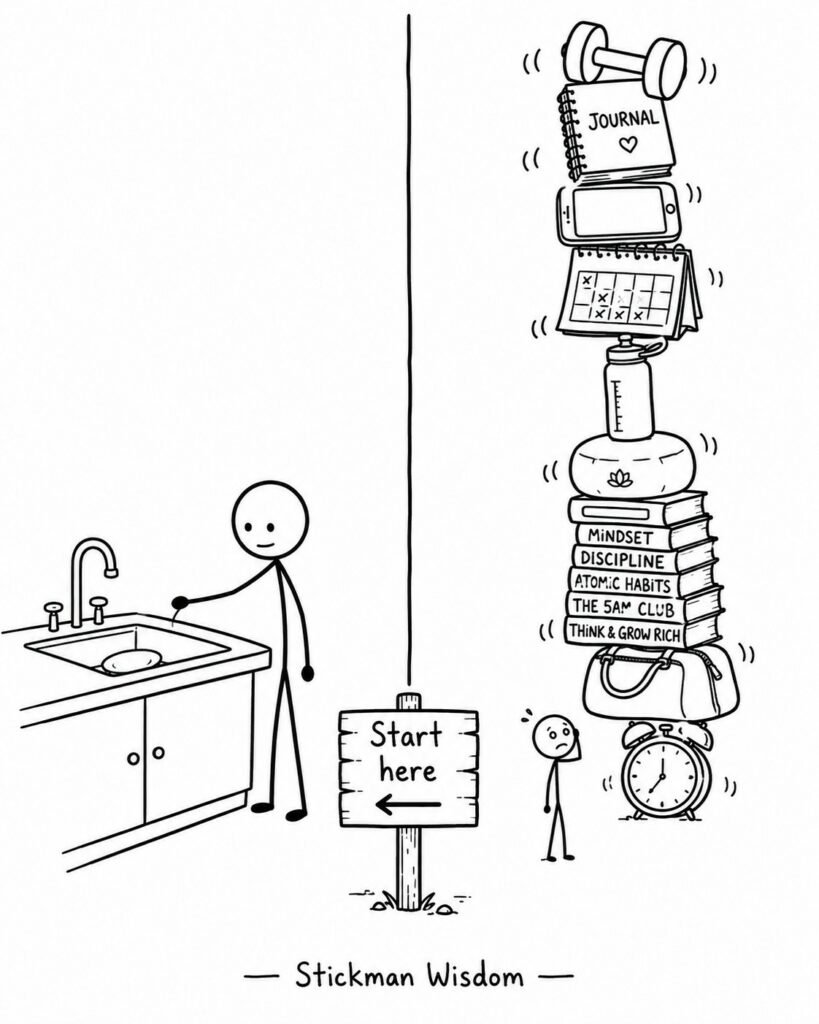
The dish in the sink
Then you lower the bar. Deliberately. This is the hardest part for people who are used to functioning at a high level. Your recovery does not start with a morning routine overhaul or a gym membership or journaling five pages a day and meditating for twenty minutes and drinking two liters of water and calling three friends and going to therapy and reading a chapter of a self-help book before bed.
It starts with the dish. One dish. Just the dish.
When your system is running on empty, the goal is not optimization. The goal is reintroduction. You’re teaching your brain that doing a small thing can produce a small feeling. That’s it. You’re looking for a flicker. A tiny signal that the circuit is coming back online. The dish goes from the sink to the rack and if you feel even a faint sense of completion, just the quiet hum of “I did a thing and it’s done,” that’s the signal.
Tomorrow, the dish and the email. The day after that, the dish and the email and the five-minute walk to the end of the street and back. You’re not building a productivity system. You’re rebuilding a feeling system. Every small completed action is a test signal your brain sends out to check if the emotional response network is ready to come back. If you overwhelm the network by demanding everything at once, it trips the breaker again.
When everyone has advice
There’s a trap that catches people who are surrounded by well-meaning friends and family during this process. Everyone has advice. Get out more. Try exercising. Think positive. Call someone. And you love these people for caring but the weight of performing wellness so they stop worrying about you becomes another drain on a system that’s already overloaded.
Your recovery doesn’t need to look good. It doesn’t need to be photographable or produce visible results on a timeline that makes other people comfortable. Recovery sometimes looks like canceling the plan so you can sit in silence for three hours. It looks like leaving the party early without explaining why. It looks like going to bed at 7:30 PM because your body told you it was done and for once you actually listened.
The people who love you will understand. And if they don’t understand yet, they’ll understand later when you come back and tell them that the reason you disappeared for a while was because you needed to stop performing life long enough to start feeling it again.
The first feeling back
When the numbness starts to thin out, and it will, slowly, in its own time, the feelings that come back might not be the ones you expected. You might not get joy first. You might get irritation. You might get sadness, or a sudden urge to cry over something completely disproportionate to the moment, like a commercial or a song lyric or a stranger being kind to their dog at the park.
Let it come. Every feeling that breaks through the flatness is a sign that the system is rebooting. It doesn’t matter if the first feeling back is grief or frustration or an ache you can’t explain. What matters is that something is registering again where nothing was registering before.
You might find yourself crying in your car over a song you’ve heard a hundred times. It’s hitting you because your system finally has enough resources to process it. The song isn’t new. Your ability to feel it is.
Two kinds of help
The last piece is about help, and the kind that actually works. There are two kinds of help people offer when you’re going through this.
The first is solution-oriented. “Have you tried therapy?” “You should exercise more.” “Maybe you need a career change.” This kind comes from a good place but it assumes you’re ready for solutions, and when you’re emotionally exhausted, you’re barely ready for sentences. Solution-oriented help, when it arrives too early, just adds more items to the list of things you can’t do right now, which reinforces the feeling that you’re failing at your own recovery.
The second is presence-oriented. Someone who sits with you without fixing. Someone who asks “how are you actually doing?” and then waits for the real answer without rushing to comfort you out of the uncomfortable truth. Someone who says “you don’t have to be okay right now” and means it without turning it into a therapy session. This is the kind that works. Because what emotional exhaustion takes from you most is the feeling of being seen without needing to perform. Presence gives that back.
If you have someone in your life who can do this, someone who can sit with you in the difficult middle without trying to rush you through it, tell them you need them. You don’t have to explain the whole thing. You can say “I’m going through something and I don’t need advice right now, I just need you to know.” That sentence, as small as it sounds, can crack the isolation open enough for air to get in.
And if therapy is available to you, consider it. A good therapist is someone trained in exactly this kind of presence-oriented support. They won’t give you a motivational speech. They’ll help you find the drains, understand the pattern, and rebuild the system without overwhelming it.
When it might be more than exhaustion
One more thing before we move on, and I think it’s important enough to say clearly. Emotional exhaustion and clinical depression can look almost identical from the inside. The flatness, the inability to feel pleasure, the fatigue that sleep doesn’t fix, the loss of interest in things you used to care about. Those symptoms overlap.
If what you’re reading in this article has been your reality for months and nothing is shifting, if the dish and the small steps and the rest aren’t producing even a flicker, that’s worth bringing to a professional. Not because you’re broken. Because some of what feels like exhaustion can be something that needs more targeted support, and a good therapist or doctor can help you tell the difference. There’s no weakness in getting someone qualified to look under the hood when the system won’t restart on its own.
Part Five: If You’re Reading This for Someone Else
One of the most common comments on the original post wasn’t “this is me.” It was “how do I help someone who is here?”
If you’re reading this for a person you love, someone you’ve been watching fade out in ways that are hard to describe but impossible to miss, here’s what I can tell you.
The most important thing you can do is the thing that feels the most useless. Sit with them. Not with an agenda. Not with a plan. Not with a list of suggestions you found online at 1 AM because you couldn’t sleep thinking about them. Just sit with them. And when the silence comes, let the silence stay.
What to say
You don’t need a speech. You need one sentence. Something like “I see that you’re going through something, and I’m here, and I’m not going anywhere.” Or “You don’t have to explain anything to me. I just want you to know I notice.” That’s it. You’re not fixing them. You’re letting them know that the performance can stop around you. That they don’t have to pretend to be fine so you’ll feel comfortable. Most people going through emotional exhaustion are spending enormous energy making sure the people around them don’t worry. Giving them permission to stop performing is one of the most powerful things you can offer.
What not to do
Don’t research their symptoms and present them with a diagnosis. Don’t send them five articles and a podcast and a therapist recommendation in one text. Don’t tell them about the time you felt something similar and how you fixed it, because the comparison, even when it’s well-meaning, can make them feel like their experience should have a faster timeline than it does. Don’t take it personally when they cancel plans or go quiet or seem distant. That distance isn’t about you. It’s about conservation. They’re running on fumes and every interaction costs something right now, even the good ones.
The long game
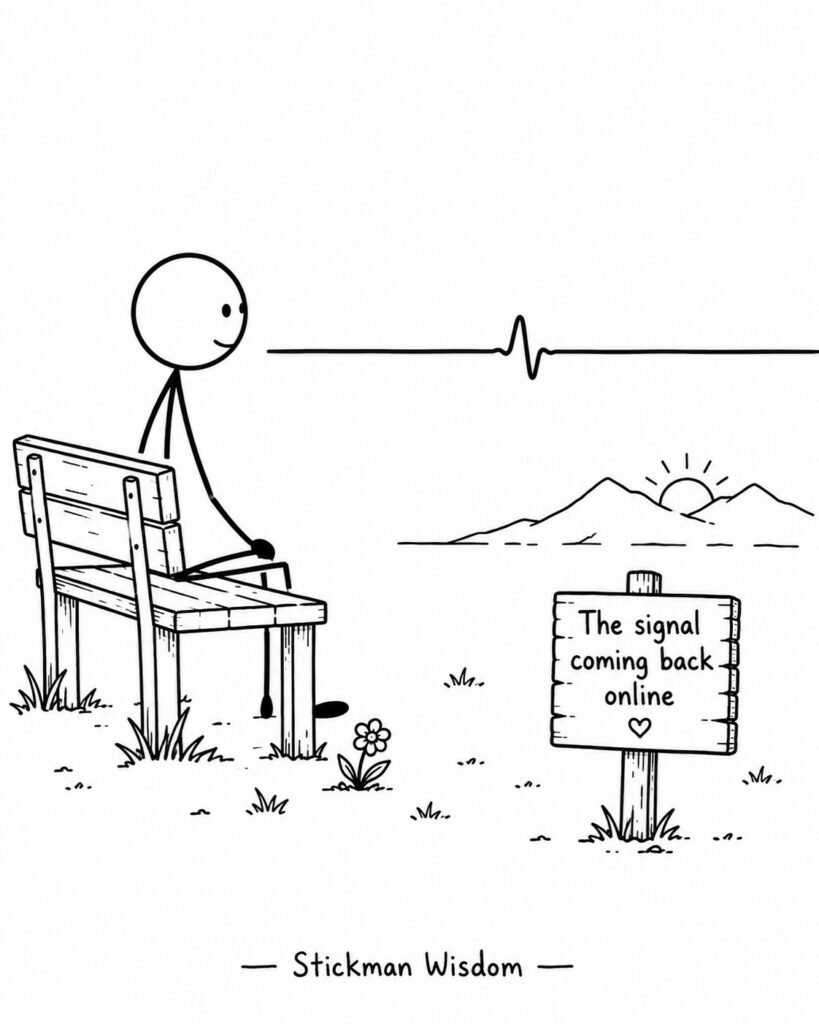
The person you love is going to come back. Not on your timeline and probably not in a straight line. There will be days where they seem better and days where they seem worse and days where you can’t tell at all. Your job isn’t to accelerate that process. Your job is to still be there when the signal comes back online. The people who stay, without pressure, without performance reviews on someone else’s recovery, are the ones who matter most on the other side of this.
Part Six: The Landing
I want to leave you with something honest, because I think you’ve had enough inspirational fluff from the internet to last three lifetimes.
Coming back from emotional exhaustion is slow. It is unglamorous. It doesn’t make for a good story while you’re in it. There is no montage. There is no rock bottom moment that turns into a phoenix rising. There is just you, doing one small thing today that you couldn’t do yesterday, and doing it again tomorrow, and slowly, over weeks that feel like months, noticing that the flatline has a tiny bump in it where there wasn’t one before.
The bump gets bigger. Not every day. Some days it shrinks back down and you think you’re back at zero and the whole thing was a waste. You’re not back at zero. Recovery from emotional exhaustion is not linear. It loops and dips and plateaus and sometimes goes backward before it goes forward. The backward days are part of the process, the same way a muscle gets sore before it gets stronger.
I’m not going to tell you that everything will be okay because I don’t know your life and empty promises from a page on the internet are part of the noise that got you here. What I will tell you is that the empty feeling you have right now is not permanent. It feels permanent because it’s been here long enough to feel like a roommate, but it’s not a resident. It’s a signal, and signals exist to be read and responded to.
You are not broken. You are not weak. You are a person whose emotional system has been running too long without maintenance, and the system needs attention. The quiet, patient, boring kind that nobody writes about because it doesn’t photograph well.
Start with the dish. See if the doing produces a feeling, any feeling, even one you can barely detect.
That is the signal coming back online. It won’t feel like a beginning for a while. But it is one, even if you can’t see it yet.
What helped you come back from a season of feeling empty? Drop it in the comments, your answer might be the one someone else needs to read today.