
They raised three kids, paid off the house, survived two job losses and one very long kitchen renovation. Then the youngest moved out and the dinner table got quiet. One evening she looked across at the man she’d been married to for thirty-one years and realized they had nothing left to say to each other, not about the kids, not about the future, not even about the weather.
A year later, they were divorced.
If that story sounds like someone you know – a friend, a cousin, maybe even your own parents – you’re not imagining a trend. Divorce after 50 has become so common that researchers gave it its own name: gray divorce. Overall divorce rates in the US have been falling for decades. Divorce among older couples has gone the opposite way.
So, let’s go through what the numbers actually show, who usually leaves, nine reasons more couples are splitting up after 50, and what happens afterward – the good, the hard, and the part about money that nobody likes to talk about.
What The Numbers Actually Show
The term gray divorce became popular after sociologists Susan Brown and I-Fen Lin at Bowling Green State University published their research on it in 2012. Since then, the trend has only grown. According to the Pew Research Center, the divorce rate for Americans 50 and older roughly doubled from 1990 to 2015, from 5 to 10 divorces per 1,000 married people.
For people 65 and older, the change is even bigger. A Bowling Green State University analysis reported by AARP found that their divorce rate tripled between 1990 and 2021. And people over 50 now make up a much bigger share of all divorces – about 36% in 2019, up from 27% in 2010.
Meanwhile, younger couples are divorcing less than they used to. So when you hear that “divorce is on the rise,” it’s really only true for one group. Ours.
Who Usually Leaves
Here’s a detail that surprises many men. In a well-known AARP survey of more than 1,100 people who divorced in their 40s, 50s or 60s, 66% of the women said they were the ones who started the divorce.
The reasons were different too. Women most often named physical or emotional abuse, infidelity, and drug or alcohol problems. Men more often said they had “fallen out of love” or that they and their wives had different values and lifestyles. And 26% of men said they never saw the divorce coming, compared with 14% of women.
That last number says a lot, honestly. Very often, by the time a wife says “I want a divorce,” she has been thinking about it quietly for years, often while everyone around her, including her husband, believed the marriage was perfectly fine.
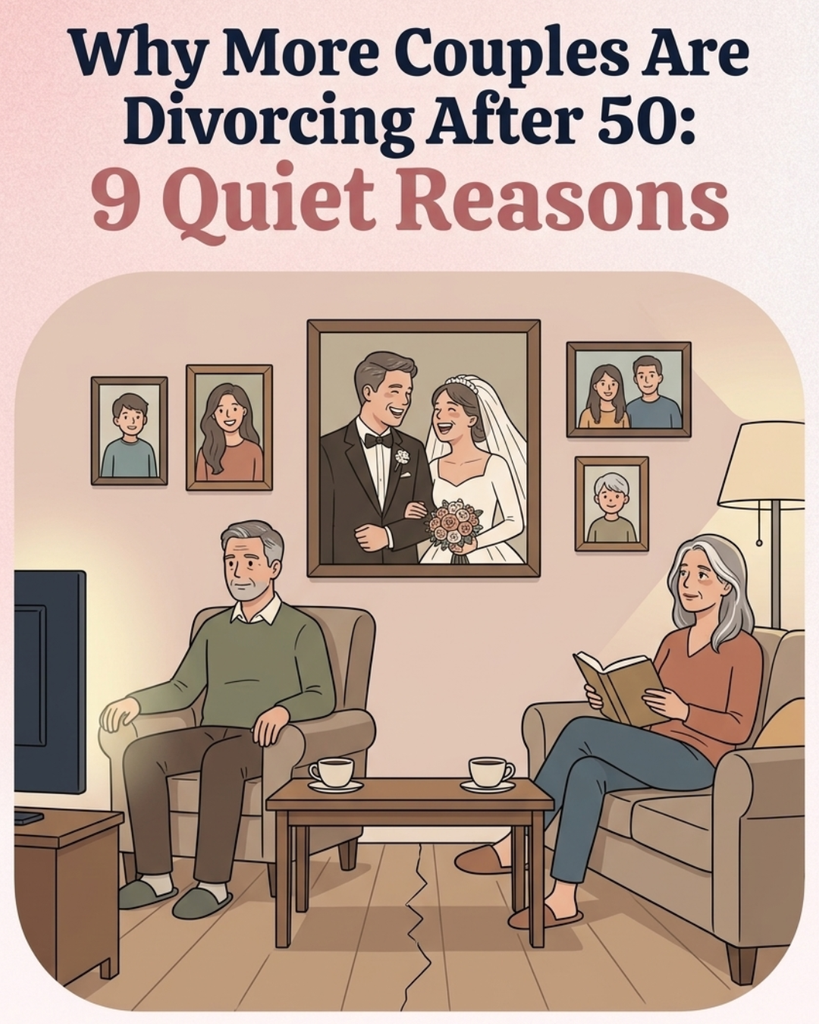
9 Reasons More Couples Are Splitting Up After 50
1. The Empty Nest Reveals An Empty Marriage
For twenty or thirty years, the kids gave the marriage its shape. School runs, homework, sports, college applications – there was always something to talk about and a shared job to do together, even on the days when the two of you didn’t feel especially close. Then the kids leave, and suddenly it’s just the two of you at the table.
Some couples rediscover each other in that quiet. Others realize the children were the only thing holding them together. Sociologist Brad Wilcox, speaking about the trend, pointed to couples who divorce once the children leave home, and it often isn’t sudden at all – it’s something that was waiting.
Many women describe the same moment. The house is finally quiet and the to-do list is shorter. But instead of relief, there’s a strange loneliness – sitting next to someone you love but no longer really know. If you feel that, it doesn’t automatically mean the marriage is over. It’s a signal worth taking seriously, though, and not ignoring for another ten years.
2. We’re Living Longer, And Healthier
A hundred years ago, a 55-year-old might reasonably expect another decade or two. Today, a healthy 55-year-old may have thirty or more good years ahead. Susan Brown explained it simply in an NPR interview – when people realize they may have decades left, some decide that the spouse who fit their life at 25 no longer fits it today.
Thirty more years is a long time to spend lonely inside a marriage. For many people, that thought is what finally moves them to act.
Better health plays a part too. People in their 60s today travel, start businesses, go back to school and even fall in love again. When one spouse wants a new chapter and the other just wants to slow down, the gap can feel enormous.
3. Women Have Their Own Money Now
Our mothers and grandmothers often stayed in unhappy marriages because they simply had no choice. No job, no savings, no credit in their own name. Most women over 50 today have worked for much of their adult lives, and that changes everything. As Brown put it, having a job gives wives the economic independence to be able to leave a marriage.
That doesn’t mean leaving is easy, as we’ll see below. But it is possible in a way it wasn’t for earlier generations.
Many women also have more education and longer careers than their mothers did. They know how to manage a budget, file taxes and make big decisions alone. That kind of confidence changes what a woman is willing to accept.
4. Divorce Isn’t A Scandal Anymore
When our parents were young, people whispered about divorced women. At church. At the family table. Today, almost everyone knows someone who divorced and went on to build a good life. The shame that once kept people in miserable marriages has mostly faded. And the idea that marriage must last forever, no matter what, is not as strong as it used to be.
Social media plays a small part too. Today you can see women in their 50s and 60s posting about new hobbies, new homes and new beginnings after divorce. It shows others that life doesn’t end with a marriage.
5. Retirement Changes Everything
For decades, he went to work and she went to work, and they saw each other in the evenings and on weekends. Then one or both of them retire, and suddenly they are together all day, every day. Small habits that were easy to ignore for two hours a night become impossible to ignore for sixteen.
Retirement can also bring big disagreements about money, where to live, how to spend the days, and how much time to give the grandchildren, and these are not small questions when you suddenly have twenty or thirty free years ahead of you. For a marriage that was already fragile, it can be the final push.
There’s even an old joke many retired wives tell: “I married him for better or worse, but not for lunch.” It’s funny because it’s true. Sharing every single hour of the day takes real adjustment from both people.
6. Second Marriages Are More Fragile
Many people divorcing after 50 aren’t leaving their first marriage. Pew found that nearly half of older adults who divorced in 2015 were in their second marriage or later, and that remarried people over 50 divorced at about twice the rate of those in their first marriage.
Second marriages often come with more complications – stepchildren, ex-spouses, separate money, different family traditions. Love is real in those marriages, but so is the extra pressure.
Susan Brown has pointed out that remarriages carry a higher risk of divorce than first marriages, and many baby boomers who divorced young went on to remarry. So part of today’s gray divorce trend is really the second chapter of the divorce wave of the 1970s and 80s.
7. Slowly Growing Apart
Not every gray divorce has a villain. Sometimes two decent people simply grow in different directions. He wants to travel, she wants to stay home. Someone finds faith, the other loses it. She wants to downsize, the other wants a lake house.
Over years, those small differences pile up until two people who once finished each other’s sentences barely know what the other is thinking, and neither of them can point to the exact day it happened. Many people describe it the same way. Nothing terrible happened. They just stopped being a couple and became roommates.
And the longer nobody talks about it, the harder it becomes to reach each other again.
8. Health Problems Put Pressure On The Marriage
This one is uncomfortable, but it’s real. Serious illness can strain even good marriages, and caregiving is exhausting. The AARP article on gray divorce mentions several studies finding that a wife’s serious illness or disability raised the risk of divorce, while a husband’s did not.
Nobody likes to hear that, and of course many husbands are devoted caregivers. But it’s one more reason why talking honestly about health, care and the future matters long before a crisis arrives.
9. Old Wounds Can’t Be Ignored Any Longer
For some women, gray divorce is the end of a long, painful wait. Emotional abuse, years of cheating, a husband’s drinking – many stayed for the children, for money, or because leaving felt impossible at a time when they had little money of their own and nowhere obvious to go. Then the children grow up, independence arrives, and the reasons to stay finally run out.
For these women, divorce after 50 is less about wanting something new and more about finally being free of something heavy.
Some of these women describe the first months after divorce as the calmest of their lives. No walking on eggshells. No waiting to hear the car in the driveway to know what kind of evening it will be.
Early Signs A Marriage Is Quietly Drifting
Gray divorce rarely comes out of nowhere. Looking back, many couples say the signs were there for years. Here are a few worth noticing:
- you talk mostly about logistics – bills, appointments, the grandkids;
- you’d rather spend free time with friends than with each other;
- small habits irritate you far more than they used to;
- you’ve stopped sharing your worries and your good news;
- physical affection has slowly disappeared;
- you can picture your future, but your spouse isn’t really in it.
Seeing one or two of these is normal in a long marriage. Seeing most of them is a sign that something needs attention, whether that means working on the marriage together or being honest, finally, about where it’s really going and what each of you actually wants.
What Happens After A Gray Divorce
So what does life look like on the other side? The honest answer is – it depends, but it’s often better than people fear.
In the AARP survey, 70% of those who started the divorce felt confident they had made the right decision, and 80% described their outlook on life as somewhat or very positive. Sociologist Deborah Carr found that distress usually doesn’t lift right away, but after several months many older adults recover and do quite well – especially when the marriage was full of conflict to begin with.
The biggest fear people named? Being alone. That was the top worry for 45% of people in the survey, and it’s a real one. Building a strong circle of friends, family and community makes a huge difference after a late divorce.
The Money Part Nobody Wants To Talk About
Here’s the hard truth. Gray divorce can be very expensive, and it usually hits women harder. A 2021 Bowling Green State University study found that after a gray divorce, women’s standard of living dropped by about 45%, while men’s fell by about 21%. For many women, things only improved after they found a new partner.
There’s less time to rebuild savings after 50, and one household’s retirement money now has to support two homes, two sets of bills and two separate futures. That’s why financial planners often recommend getting a clear picture of your finances – and good advice – before making any final decisions. In the US, a divorced spouse may also qualify for Social Security benefits based on an ex-spouse’s work record if the marriage lasted at least ten years, so that’s worth checking too.
If You’re Thinking About It
Try counseling first, if it’s safe. Many couples who feel like strangers can find their way back with help. Even if you still divorce, counseling can make the split calmer and kinder.
Get your finances clear. Know what you own, what you owe, and what your retirement accounts look like. Talk to a financial advisor and a lawyer before you sign anything.
Build your support system. Friends, siblings, a support group, a therapist. The people around you will matter more than ever in the first year.
Think about the family. Grown children are still affected by their parents’ divorce, sometimes more than people expect. Keep them out of the middle, and don’t ask them to choose sides.
And if your marriage involves abuse of any kind, please reach out for help. The National Domestic Violence Hotline at 1-800-799-7233 is there for people of every age, including those who have been married for decades.
If Your Marriage Feels Empty, But You Want To Stay
Not every quiet marriage needs to end. Sometimes it just needs attention. Try a new shared project, a weekly date that isn’t about the grandchildren, or a long walk where you talk about something other than bills. Don’t ignore physical closeness either – I wrote about what happens when couples stop being intimate, and it matters more than many people think.
Romance later in life comes with its own challenges, and I wrote about why romantic relationships can be challenging for older adults too. But plenty of couples find that their fifties and sixties become some of their best years together, once they decide to choose each other again, on purpose, the same way they did when they were young.
The Bottom Line
Gray divorce is rising because life after 50 has changed. We live longer, women are more independent, divorce carries less shame, and many people simply refuse to spend their last thirty years lonely inside a marriage that stopped feeling like one a long time ago. For some, divorce brings relief and a fresh start. For others, it brings financial strain and loneliness. And for many couples, the same quiet that pushes others apart can become a chance to start over together.
Do you know someone who divorced after 50? Let me know in the comments below.