
Nobody is fighting. That is the strange part.
You get along fine. You divide the shopping, you know exactly how the other one takes their coffee, and you can have an entire conversation about the boiler without either of you raising your voice. If somebody asked, you would say the marriage is good.
And yet some evenings you sit on opposite ends of the same sofa, each on your own phone, and it occurs to you that you have not really talked to this person in weeks. Not about anything that mattered, anyway.
You love them. You are just not sure when you last felt it.
If that sounds familiar, I want to start with something reassuring, because this is one of the most common things that happens to good couples, and it is very rarely a sign that the relationship is over. It is usually a sign that it got comfortable, and comfort has a cost that nobody mentions at the wedding.
So, let’s go through why it happens and what actually helps.
Why This Happens To Good Couples
Part of it is simply how brains work. We adapt to good things, all of them, and a person who was thrilling at twenty-eight becomes familiar by forty-eight – not because they changed very much, but because you saw them every single day for twenty years and your brain quietly filed them under known, safe, and not in need of attention.
Part of it is the years in between. Children, mortgages, ageing parents, two jobs, and a long stretch in the middle where the relationship ran almost entirely on logistics, because logistics were all either of you had the energy for by the time the children were finally asleep.
Then the children leave, or get old enough to stop needing constant attention, and the two of you look up from twenty years of managing a household and find yourselves slightly unsure what you have in common apart from it. I wrote more about how romantic relationships change for older adults, and this transition is one of the hardest parts of it.
But here is the hopeful part. Psychologist Arthur Aron, who has studied love for decades, surveyed couples nationally and found that around 40 percent of people married more than ten years still reported intense love for their partner. Brain scans of some of those long-married people looked remarkably like the scans of people newly in love.
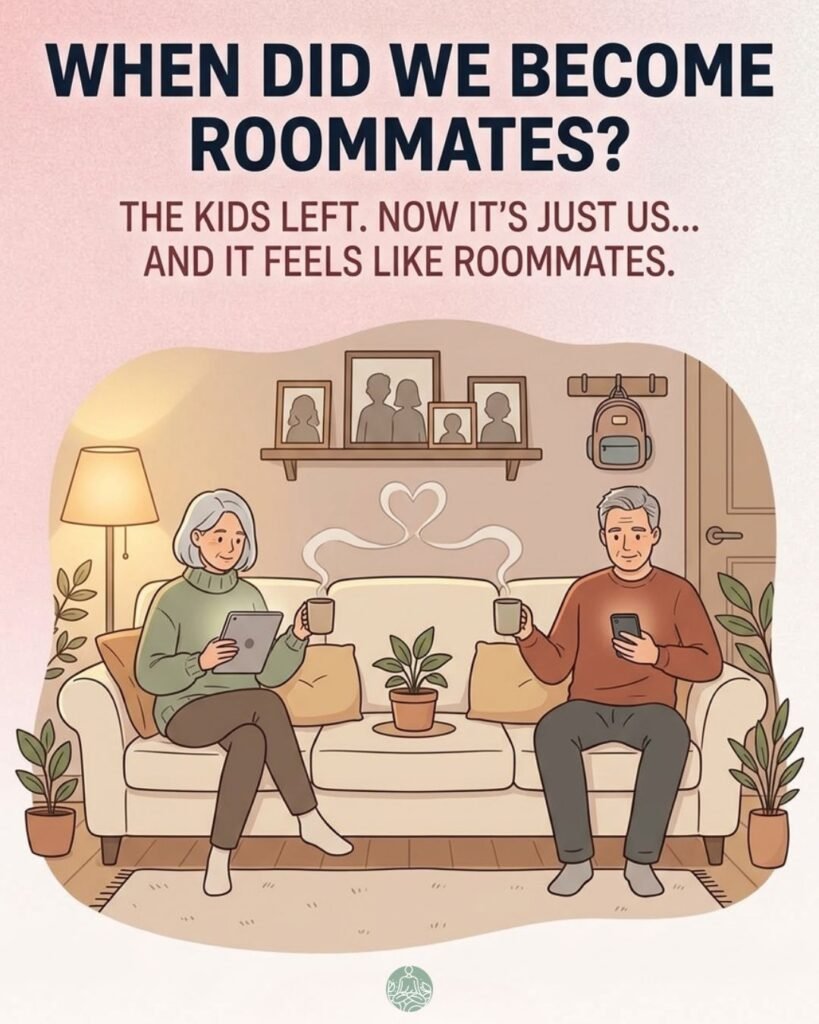
So passion fading is common. It is not inevitable. That difference is the whole reason this article exists.
1. Notice The Small Reaches
This is the one that surprised me most, and it has the most famous research behind it.
John Gottman spent years watching couples in an apartment laboratory in Seattle, and he paid close attention to something tiny. He called them bids. A bid is any small attempt to connect. Look at that bird. Did you see what your sister posted? Or just a sigh, said slightly louder than it needed to be.
Then he watched what the other partner did with it. They either turned towards it, ignored it, or snapped at it.
The famous finding is that couples still together six years later had turned towards each other’s bids about 86 percent of the time, while couples who divorced had managed only about 33 percent.
I should be honest about one thing. Those exact percentages come from Gottman’s popular books rather than from a single peer-reviewed paper stating them that way, and some of his broader predictive claims have been criticised since. But the underlying idea has held up well, and it matters here for a specific reason.
When bids keep getting missed, people stop making them. The silence on your sofa might not be the problem. It might be the result – two people who each quietly gave up reaching.
So look up when they point at the bird. It sounds ridiculous. It is not.
2. Stop Doing Only The Pleasant Things
Most couples who notice the drift respond with a date night. Same restaurant, same table, same two dishes, and the evening is perfectly nice and changes absolutely nothing.
There is a good reason for that, and Aron tested it directly. In a 2000 study, couples were split into two groups. One group spent time doing activities they had rated as pleasant. The other did activities they had rated as novel or exciting, even if those were less comfortable.
Only the second group showed a real improvement in how they felt about the relationship.
Pleasant is lovely, but it is maintenance. Novelty is what actually does the work, because when you do something new together your brain seems to link the small thrill of it to whoever happens to be standing next to you, and over time that person starts to feel a little bit new as well. Even silly novelty counts. In one of Aron’s laboratory tasks, couples simply had to move an awkward object across a room together without using their hands, and that was enough to register.
So skip the usual restaurant for once. Take a class neither of you is good at, drive somewhere you have never been, or learn something ridiculous together. It does not need to cost money. It needs to be new to both of you. That shift in thinking connects to what I wrote about how your mindset shapes your brain and body.
3. Ask Better Questions Than How Was Your Day
How was your day gets you fine. It has got you fine for about fifteen years.
The trouble is that after long enough together, we stop being curious, because we assume we already know. Gottman calls this knowledge a love map. It describes how well you know your partner’s inner world, and it goes out of date without either person noticing.
You probably know what your partner thought about their job in 2014. Do you know what they think about it now? What are they quietly worried about this year? What would they do if money were not a factor?
Aron also developed a well-known set of thirty-six questions that get gradually more personal, designed to build closeness between strangers in a laboratory. They work surprisingly well on couples who have stopped being strangers a long time ago.
You do not need a list, though. Just ask one real question a week and then actually listen to the answer rather than waiting for your turn.
4. Protect One Hour From The Phones
I am not going to lecture anybody about screens, since I am as guilty as the next person. But notice what a phone does to a bid.
Your partner says something small. You are looking at a screen. You say mm without looking up, and a bid just got turned away with a blue glow on it.
Multiply that by several times an evening, every evening, for years.
So pick one hour. Dinner, or the first hour after work, or the last hour before sleep, and put both phones in another room. Not face down on the table – another room entirely, because face down on the table still counts as present.
The first few evenings will feel strangely quiet. Stay with that, because that quiet is where the conversation starts coming back.
5. Touch That Is Not A Request
In a lot of long marriages, physical affection quietly turns into a signal that means one specific thing and only that thing. So one partner starts avoiding casual touch altogether, simply to avoid sending a message they do not mean, and the other partner reads the avoidance as rejection, and neither of them ever says a word about it.
And then there is no touch at all, outside the bedroom, for months.
Casual affection that leads nowhere is its own thing, and it matters on its own terms. A hand on the back walking past. Sitting close enough on the sofa that your legs touch. A long hug in the kitchen for no reason.
If you suspect this has happened in your house, say it out loud, because it is far easier to fix than it sounds. Sometimes I just want to hold your hand, and that is all it means is a perfectly good sentence, and it removes a surprising amount of pressure from both sides.
6. Talk About Sex Out Loud
This is the one most couples avoid entirely, which is exactly why it goes wrong.
Desire changes across a long relationship and it changes across a life. For many women, the years around menopause bring real physical changes that affect desire and comfort, and those are medical rather than emotional, which means they are often treatable. That is a conversation worth having with your doctor rather than quietly concluding that this part of your life is finished.
Men go through changes too, and they tend to talk about them even less.
Research by Amy Muise and colleagues found that doing new things together, the same self-expanding activities from point two, also increased sexual desire in established couples. So these nine points are not really separate. They feed each other.
You do not need a dramatic conversation. Something like I miss us, and I would like to figure this out together is enough to start, and it is braver than it sounds.
7. Watch Them Being Good At Something
Therapist Esther Perel asked people in more than twenty countries a simple question. When are you most drawn to your partner?
The answers were remarkably consistent. People felt most attracted when they saw their partner at a slight distance, absorbed in something they were good at. Giving a talk, fixing something, laughing with friends at a party, playing music.
Not when they were close and comfortable. When they were separate, competent, and a little bit unfamiliar.
Her point is that desire needs a little space to exist in, and a marriage that merges everything leaves it nowhere to breathe. So go and watch your partner do the thing they are good at. Let them have a life that is partly their own, and be curious about it.
Her TED Talk on this is one of the best nineteen minutes on the subject, and I have linked it below.
8. Have One Conversation That Is Not About Logistics
Count, honestly, how many conversations you had with your partner this week that were not about the house, the children, money, health appointments, or what is for dinner.
For a lot of couples, the answer is zero, and it has been zero for a while.
That is not a failing. It is just what a busy life does. But a relationship that runs entirely on logistics starts to feel like a business partnership, because that is what it has become.
So aim for one conversation a week about something else. An old memory, a film, a news story, what you would do with a free year. It sounds small, and it is small. But it is also one of the few things that separates a marriage from a well-run household, and it gives you back some of the energy that draining daily habits take out of you.
9. Get Help Before It Is Urgent
Couples therapy has a reputation as the last stop before divorce. That is exactly backwards, and it is why so many couples arrive too late.
Most people wait years after the problems start before they see anybody. By then, resentment has had a long time to set in. The couples who benefit most usually go early, while they still like each other and simply feel stuck.
Going to therapy because you feel like roommates is not a dramatic step. It is a practical one, like seeing a doctor about a symptom before it turns into something worse.
And if your partner will not go, going on your own still helps more than people expect.
When It Is Something More
I want to add one honest caution, because sometimes the roommate feeling is not really about the relationship at all.
Depression can look exactly like this from the outside. Flat, withdrawn, uninterested in things that used to matter, going through the motions. If one of you has changed like that across a few months, the distance might be a symptom, and the right first step is a doctor rather than a date night.
And occasionally the distance is the relationship quietly ending. Nine tips cannot fix that, and I am not going to pretend they can. But in my experience, most couples who feel like roommates are nowhere near that point. They are just out of practice.
The Good News
None of these nine things is complicated, and none of them is expensive.
Look up when they point at the bird. Do something new together. Ask a real question. Put the phones in another room. Touch without it meaning anything more. Say the difficult thing out loud.
The distance between you did not arrive in one dramatic moment that you could point to on a calendar. It built up quietly over years, across thousands of small missed moments that neither of you noticed at the time, and it comes back in exactly the same way – slowly, in small pieces, one ordinary evening at a time.
You already did the hardest part, which is choosing each other and staying. This is just remembering why.
Does this sound like your house right now? Tell me in the comments which of these nine you are going to try first. And if you have already come back from the roommate stage, tell us how, because somebody reading this really needs to hear that it is possible.