
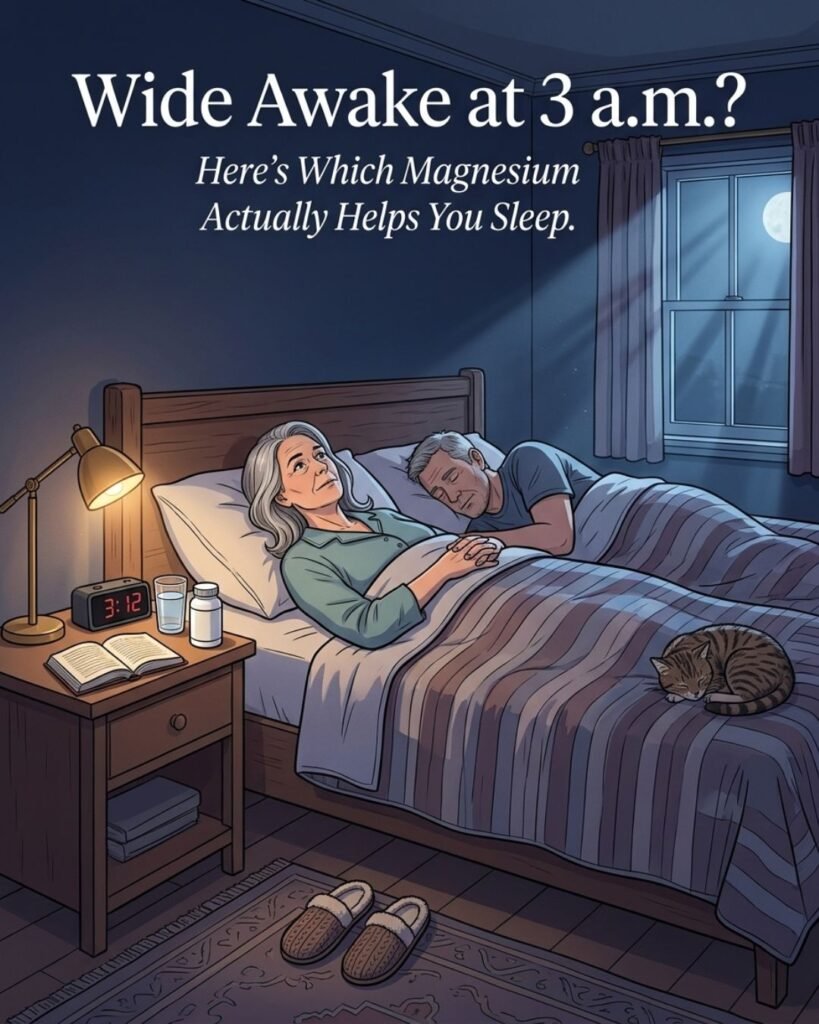
It’s 3:12 a.m. You know that because you’ve already checked the clock twice. The house is quiet, your husband is snoring in that slow, steady way that makes you a little jealous, and your mind has decided this is the perfect moment to wonder whether you paid the water bill and why on earth you said that silly thing to your sister back in 1994. You did. You’re almost sure.
At lunch last week, your friend Linda swore that magnesium changed her life. “I sleep like a baby now,” she said. So the next day you stood in the pharmacy aisle staring at nine different bottles. There was glycinate, citrate and oxide, plus something called L-threonate that cost twice as much as everything else. One bottle just said “Calm” in big, friendly letters. You walked out with nothing.
If that sounds like you, you’re in good company. Magnesium has become one of the most popular sleep supplements around, especially among women over 50. The shelves are full of confident promises. In this article we’ll look at what the research really says about taking magnesium before bed, how the different types compare, how much is safe and who should be careful with it. So, let’s go through it.
What Magnesium Does in Your Body
Your body uses magnesium in hundreds of chemical reactions. It helps make energy and keeps your muscles and nerves working the way they should. According to the NIH Office of Dietary Supplements, women over 50 need about 320 milligrams a day. Men need about 420.
Its link to sleep is more of a reasonable theory than a proven fact. Researchers think magnesium helps calm the nervous system, partly by supporting GABA, a brain chemical that helps you wind down. It also helps muscles relax after they tighten. That’s why so many people with night-time leg cramps reach for it.
This matters more as we get older. The NIH says older adults run low more often. With age, the body absorbs less magnesium from food and loses more of it through the kidneys. On top of that, many of us take medications that can lower it.
If you’d like a quick, friendly explanation of the basics, sleep specialist Dr. Michael Breus, known as The Sleep Doctor, talks about it in this short video.
What the Studies Actually Found
Most of the research on magnesium and sleep is small. Much of it involved older adults.
One of the most quoted trials took place in Iran in 2012. Forty-six people in their 60s and 70s who struggled with insomnia were split into two groups. Half swallowed 500 mg of magnesium daily while the rest got a dummy pill, and the study ran for two months. By the end, those on the real supplement drifted off sooner and spent more of their time in bed actually sleeping. Their melatonin went up, too, while their cortisol, a stress hormone, went down.
In 2021, a team of researchers pooled three trials like that one, with 151 older adults in total. Taken together, the supplement shaved roughly 17 minutes off the time it took people to drop off. Their nights also got about 16 minutes longer, but that gain was small enough that it could easily have been chance, so nobody can say for sure that magnesium adds any real sleep time to your night. The researchers were refreshingly blunt, too. They graded their own evidence as weak, at the bottom end of the scale scientists use, and in their view it simply wasn’t strong enough for doctors to make confident recommendations.
Seventeen minutes can feel like a lot when you’re lying there staring at the ceiling. Still, it’s a long way from sleeping like a baby.
Some of what Linda feels might also be the placebo effect, which tends to be surprisingly strong in sleep studies. That’s no insult to her, by the way, since taking a small calming pill at a fixed hour each night can become a little ritual that tells your body the day is over, and rituals like that genuinely help some people relax.
The Types, One by One
Magnesium can’t be sold on its own in a pill, so manufacturers always pair it with another substance. That partner gives each type its name. It also decides how much of the mineral actually reaches your bloodstream, and how kind it is to your digestion.
Magnesium Glycinate (or Bisglycinate)
This is the one you’ll see recommended most for sleep. There’s a bit more behind it than behind the others. This type pairs magnesium with glycine, an amino acid that may help sleep on its own. In a small Japanese study from 2007, people who took 3 grams of glycine before bed said they slept better and felt less sleepy the next day, and lab tests showed they fell asleep faster, which sounds promising, although a typical glycinate capsule holds far less than 3 grams of glycine, so you won’t get the dose from that study out of an ordinary bottle.
In 2025, researchers in Germany and Australia tested magnesium bisglycinate on 155 adults who said they slept poorly. For four weeks, they took 250 mg of magnesium each night, 30 to 60 minutes before bed. The capsules also held about 1.5 grams of glycine. Their insomnia scores improved more than with placebo, but the gap was small and only just reached statistical significance. The placebo group got better too.
People who said their diets were low in magnesium seemed to benefit more. The authors treated that as an early hint that still needs proper testing, though.
Magnesium Citrate
Citrate gets into the bloodstream easily. A classic 1990 study found that it dissolved far better than magnesium oxide. More of it also got into the body. But citrate also pulls water into your bowels, which is why it’s also on pharmacy shelves for constipation, and why plenty of women who take it at bedtime end up making an extra trip down the hall in the middle of the night, or first thing in the morning before the coffee is made. That’s useful if you’re constipated. It’s much less useful at eleven at night if you were hoping to stay in bed until morning.
Magnesium Oxide
Oxide is the cheapest and most common type, and it’s what you’ll usually find in multivitamins. In that same 1990 study, it barely dissolved in water, and the body took up very little of it. It can loosen the bowels as well.
Funnily enough, the Iranian sleep study used magnesium oxide. So the cheap type can still do something. But because so little of it gets into your body, you’d probably need a bigger dose to get the same effect, and a bigger dose of oxide is exactly the thing that tends to send people running to the bathroom, so it’s not the type I’d start with for sleep.
Magnesium L-Threonate
This is the expensive one, often sold under the brand name Magtein. It’s marketed mostly for the brain. A 2024 trial gave 80 adults aged 35 to 55 one gram a day for three weeks. The sleep-tracking rings they wore showed better deep sleep and REM sleep scores than with placebo. The volunteers also felt more alert and in a better mood in the mornings.
Before you rush out and buy it, look at who did the research. One of the study’s authors is vice president of research at ThreoTech, the company that makes Magtein. A 2025 trial in younger adults using a higher dose found that people felt their sleep troubled them less in their waking hours. Yet the sleep trackers found no difference in their other sleep measures. So it may help. But the evidence is thin and closely tied to the company, and it costs a lot more.
Epsom Salt Baths and Magnesium Sprays
Epsom salt is magnesium sulfate. Plenty of us grew up watching our mothers soak sore feet in it. Sprays and lotions make similar promises. A 2017 review looked at whether magnesium gets through the skin in any meaningful amount. Its conclusion was that the science doesn’t support it yet.
A warm bath before bed is a lovely way to wind down anyway. Just don’t count it as your magnesium for the day.
“Sleep” Blends
Some bottles mix magnesium with melatonin, valerian, L-theanine or other ingredients. Should one of those help you sleep better, you won’t know what actually helped. You could also end up taking melatonin without realizing it. Always check the label to see how much elemental magnesium you’re getting. That’s the real mineral content. The bigger figure on the front usually counts its partner substance too.
So Which One Should You Try?
If you’d like to give magnesium a go for your sleep, I’d start with glycinate. It has the most direct sleep research among the popular types. Most people’s digestion handles it well, too, and the glycine might add a small bonus of its own. If you also struggle with constipation, citrate could do double duty, though it’s better taken earlier in the evening, maybe with dinner, so that whatever it decides to do to your bowels happens well before you’re tucked into bed with a good book.
Most sleep trials gave people between 250 and 500 mg of actual magnesium. The NIH sets the upper limit for magnesium from supplements at 350 mg a day for adults. That limit doesn’t include what you get from food. In the Iranian study, doctors supervised the people taking the higher amount. So if you’d like to go above 350 mg, talk to your doctor first.
Take it 30 to 60 minutes before bed, the way the 2025 trial did. Then give it about four weeks before you decide whether it’s working. Each morning, jot down how long it took you to fall asleep and how often you woke up. Memory is not very reliable when you’re tired.
And don’t forget about food. According to the NIH, an ounce of pumpkin seeds has about 156 mg of magnesium. That makes them one of the best sources there is. An ounce of almonds has about 80 mg, and half a cup of boiled spinach has about 78. If you like the idea of a bedtime snack, I also wrote about honey before sleeping.
If you’d like a doctor’s honest look at the evidence before you spend money on a tub of powder, Dr. Alex George goes through it in detail in this video.
Who Should Be Careful
Magnesium is safe for most healthy people at normal doses, but there are some important exceptions.
Kidney disease is the big one. Healthy kidneys get rid of extra magnesium. When they don’t work well, it can build up in the blood, the NIH warns. If you have any kidney problems, talk to your doctor before taking magnesium in any form, and that includes the antacids and laxatives in your medicine cabinet, since many of them contain it.
Magnesium can also get in the way of some medicines. The pharmacists at GoodRx explain that some common antibiotics, including doxycycline and ciprofloxacin, can latch onto magnesium in your gut and end up working less well. So space them out. Swallow the antibiotic a couple of hours ahead of your magnesium, or wait a good four to six hours after it. Osteoporosis pills like alendronate need a two-hour gap too.
Other medicines work the other way around and lower your magnesium. Water pills (diuretics) can do it. So can acid reducers like omeprazole when you take them for more than a year. Those same acid reducers can lower your B12 as well. I covered that in my article on what each of the B vitamins does. On any of these medicines, ask your doctor before adding a supplement. They may want to check your levels first.
Diarrhea and stomach cramps are signs that you’re taking more than your body likes, so cut back. Very large amounts can cause serious problems, like an irregular heartbeat and very low blood pressure. These usually come from laxatives or antacids.
When Magnesium Isn’t the Answer
Sometimes poor sleep is a symptom of something a supplement can’t touch.
Do you snore loudly, wake up gasping, have morning headaches or feel worn out even after a full night in bed? If so, ask your doctor about sleep apnea. Picture a woman who has taken magnesium for months, still wakes up exhausted, and only finds out after a sleep study that she stops breathing dozens of times a night. No pill from the vitamin aisle was going to fix that.
If hot flashes and night sweats are waking you up, the cause could be hormonal. It’s worth reading about the signs of hormonal imbalance before your next appointment. And if aches or heartburn keep you up, even your sleeping position can help. I explained why in my article on sleeping on your left side.
For insomnia that has gone on for months, the American College of Physicians recommends a specific first treatment for adults. It’s called CBT-I, a talk therapy designed just for insomnia. It’s a structured program that changes your thoughts and habits around sleep, for example by limiting the time you spend lying awake in bed so that your brain starts to link the bed with sleep again, which sounds strange at first, because when you’re tired, the natural instinct is to spend more time in bed rather than less. You can do it with a therapist, in a group, online or with a self-help book.
And if you’re lying awake because of worry or sadness that has lasted for weeks, please tell your doctor. Sleep and mood affect each other a lot, and help with one often eases the other. If you ever have thoughts of harming yourself, call or text 988 in the US. That’s the Suicide and Crisis Lifeline.
Final Thoughts
So, back to Linda and her magnesium. She might be right, in her own way. A modest dose of glycinate is cheap and low risk for most healthy people. It may help you fall asleep a little faster, especially if your diet runs low in magnesium.
Just go in with realistic expectations, and if other medications are part of your routine, check with your doctor or pharmacist first. Pay attention to the rest of your evening routine too, from the late cup of coffee to the phone you scroll in bed, because magnesium works best, if it works at all, as one small part of a calmer evening and never as a magic fix in a bottle. Good sleep is one of those things that get harder with age. It usually takes more than one small change to get it back.