
You raised your own children. They turned out fine. So why does your daughter suddenly look at you as though you have done something truly terrible, the moment you lay the baby down on his tummy for a nap, exactly the way you laid her down thirty-odd years ago without anybody ever saying a word?
If you are a grandparent, you have probably felt that sting at least once.
It is not that you love the grandchildren less, or know less. It is that a surprising number of the rules have changed. They changed since you were the one walking the floor at three in the morning. Some of what doctors told all of us back then turned out to be genuinely unsafe. Today’s parents have learned that, sometimes very firmly, from their own doctors.
So this is not a list of ways grandparents get things wrong. It is a list of things worth a quick question first, because the answer may have changed, and because asking keeps the door to those grandchildren wide open.
So, let’s go through the seven that matter most.
First, Why Grandparents Matter So Much
Before the list, I want to say something that gets lost in all the family arguments about bedtimes and sugar.
Grandparents are not a nice extra in a child’s life. They make a real, measurable difference.
Professor Ann Buchanan at the University of Oxford studied more than 1,500 children and found that those with a high level of grandparent involvement had fewer emotional and behavioral problems. The link was especially strong for children whose parents had divorced or separated. There, a grandparent can be the steady presence holding things together.
A related study in an American Psychological Association journal linked more involved grandparents with fewer emotional problems and kinder, more helpful behavior in teenagers.
That is exactly why the seven points below matter. Nothing on this list is about doing less with your grandchildren. It is about protecting the relationship, so that you get to keep doing more. I wrote about this in the real power grandparents have in a family.
1. Give Them Any Medicine
This is the one I would put at the very top, because the stakes are highest.
A little fever, a cough at bedtime, a sore tummy after too much birthday cake. Your instinct, after decades of looking after people, is to reach straight into the bathroom cabinet for whatever worked when your own children were small and you were the one making every decision on your own. Please don’t, not without checking first.
Several things that were completely normal a generation ago are now firmly advised against. Doctors no longer give aspirin to children and teenagers. It is linked to a rare but serious condition called Reye’s syndrome. Over-the-counter cough and cold medicines are not recommended for young children at all – the FDA advises against them under age two, and many labels now say not under four.
Even ordinary children’s pain relievers can go wrong. The right dose depends on the child’s weight and the strength of the particular product, and it is very easy to give too much by accident, especially if the parents already gave a dose an hour earlier.
And one more that surprises people. Never give honey to a baby under twelve months old, not even a dab on a pacifier. It can cause infant botulism.
The simple rule is this. No medicine, remedy or supplement without a quick call to the parents first. Every time.
2. Change How The Baby Sleeps
Most of us put our babies to sleep on their tummies. Everybody said it was safest, that they would not choke if they spat up. Many of us also used soft bumpers, a pillow, a cozy blanket and a stuffed animal or two.
That advice has completely reversed.
Since the 1990s, doctors have recommended putting babies to sleep on their backs. Sudden infant death rates dropped sharply after that change spread. Today’s guidance from the American Academy of Pediatrics goes further. Babies should sleep on their backs, on a firm, flat surface, in a crib or bassinet with nothing else in it – no pillows, no blankets, no bumpers, no toys.
I know an empty crib looks bare, and even slightly cold and unloved, to anybody who raised babies the old way with soft bumpers all around and a knitted blanket tucked up to the chin. It is not cold. It is safe, and it is almost certainly what the parents’ doctor told them to do.
So follow the parents’ setup exactly, even when it feels wrong to you. If something about it genuinely worries you, ask them about it rather than quietly changing it.
3. Feed Them Foods The Parents Haven’t Introduced
Food is love in most families, and grandmothers in particular tend to show it with something sweet. A biscuit from the tin, an ice cream on a hot afternoon, a taste of whatever happens to be on your plate, slipped across the table with a wink while everybody pretends not to notice.
Most of the time this is harmless and lovely. But a few things are worth checking.
Allergy advice has changed dramatically. Doctors used to tell parents to keep peanuts away from children for years. Now, for most babies, doctors actually recommend introducing peanut-containing foods early, in a careful way that suits that particular child. Children with eczema or other allergies may need a doctor’s plan first. Either way, the parents and the pediatrician decide when and how. It should never be a surprise at grandma’s house.
There is also choking. Whole grapes, whole nuts, popcorn and hard sweets are serious choking risks for small children, which is why many parents cut grapes into quarters long after it seems necessary.
Sometimes the parents are simply trying to keep sugar low. Or a child has a condition nobody has mentioned to you yet. Asking costs ten seconds.
4. Drive Them Without The Right Car Seat
Many of us rode in the back of a car with no seatbelt at all, sliding happily from one side of the seat to the other on every bend, sometimes lying across the back window ledge on long journeys, and nobody thought twice about it at the time. Times have changed, and thank goodness for that.
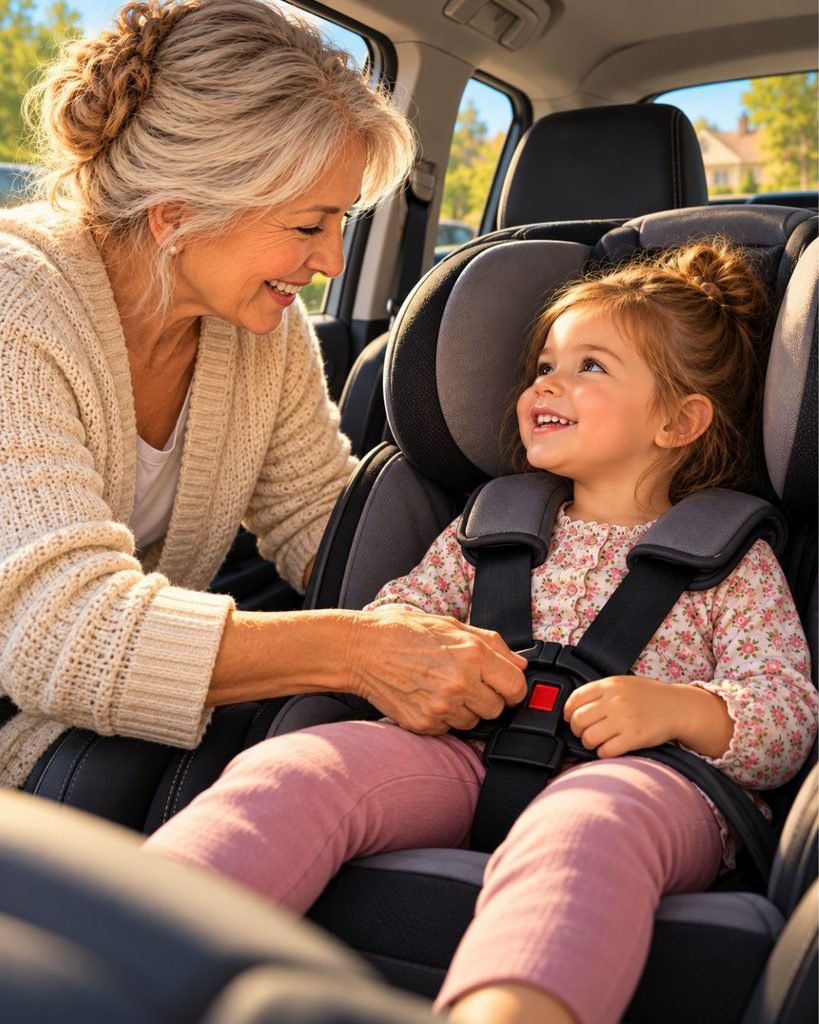
Car seat guidance has moved on even in the last few years. The American Academy of Pediatrics now advises keeping children rear-facing for as long as possible, until they reach the height or weight limit of their seat, which for many children is well past their second birthday. Older children then need a booster seat until the adult belt fits them properly, often until somewhere between eight and twelve years old.
Two traps catch a lot of grandparents. The first is the old car seat kept in the attic or garage. Car seats have expiration dates. An old one may have been through an accident or a recall, or simply worn out. Use the seat the parents give you, or buy a new one together.
The second is the just-a-short-trip exception. Five minutes to the shop without the proper seat is exactly when accidents happen. No exceptions, ever.
5. Post Their Photos Online
You are proud. Of course you are. That photo of your granddaughter in her first school uniform deserves an audience of everybody you have ever met.
Ask first anyway.
More and more parents are choosing to keep their children off social media, or to share only certain photos with only certain people. Some worry about privacy and where pictures end up. Some do not want their child’s school, street or daily routine visible to strangers. Others simply want their children to decide for themselves, when they are older, what exists of them online.
You may think it is overcautious. It is still their call to make. Posting without asking is one of the fastest ways to cause a real rift.
A simple message before you post solves it completely. Most parents will happily say yes to some photos. And you will have shown them you respect their wishes, which makes everything else easier.
6. Discipline Them Differently From The Parents
A lot of us grew up with a smack as a normal part of childhood. Some of us used it on our own children, because that is what everybody did.
Today, the American Academy of Pediatrics advises against spanking altogether. Most parents now use very different approaches – time-outs, calm consequences, explaining rather than punishing.
Even beyond physical punishment, it matters that the rules stay consistent. If the parents do not allow something, and grandma does, the child quickly learns to play the adults against each other. That makes life harder for the parents long after the visit ends.
That does not mean grandparents have no say. Your house, your rules for some things is perfectly reasonable. Shoes off, no jumping on the sofa, please and thank you at the table. But on the bigger questions of discipline, follow the parents’ lead. If you disagree, talk to them privately, never in front of the children.
7. Ask Them To Keep A Secret From Their Parents
It usually starts completely innocently. An extra cookie after dinner, a bedtime that slides an hour later than it should, one more cartoon than the parents allow, and then a wink and a little whisper as you tuck them in. Don’t tell Mommy.
It feels harmless, even sweet. But it is worth stopping, and the reason is bigger than one cookie.
Many parents now teach their children a simple safety rule: we do surprises in this family, but never secrets from Mom and Dad. A surprise is something fun that everybody finds out about soon, like a birthday present. A secret is something a grown-up asks a child to hide from their parents.
Parents teach this because it helps protect children. A child who knows they can tell their parents anything, and that no grown-up should ever ask them to hide things, is a safer child.
When a grandparent, with the very best intentions, asks a child to keep something from their parents, it quietly muddies that lesson. So turn it into a surprise instead. We had a special treat today, shall we tell Mommy all about it when she gets here? Same fun, and nothing hidden.
And One More: The Big Firsts
Some moments belong to the parents, and it is worth knowing which ones before you accidentally take them.
The first haircut is the classic. Plenty of grandparents have trimmed a toddler’s bangs out of pure kindness, to get the hair out of those little eyes, and then discovered too late that the parents had been looking forward to that first haircut for months, with a camera ready and a tiny envelope set aside to keep the first curl.
The same goes for ear piercing, a first phone or tablet, a pet as a present, or a big outing the parents wanted to share. None of these are wrong. They are just better with the parents’ blessing, and often better with the parents there.
Screens deserve a special mention here, because many parents have firm views about them, often for good reason. I went through some of that research in screen time and child brain development.
This Goes Both Ways
I want to be fair, because grandparents are often on the receiving end of rules without much thanks.
Parents have their part to play too. Grandparents are not free, unlimited childcare. They can say no, have their own plans, and be tired. And they deserve to hear about a new rule before anybody criticizes them for breaking it, not afterwards.
The families that get this right tend to talk about it calmly and early, ideally before the baby even arrives, rather than in the heat of an argument over a cookie or a nap. A ten-minute conversation over coffee about medicine, sleep and car seats can prevent a great deal of hurt later.
When grandparents and parents fall out over these things, the people who lose most are usually the grandchildren. Distance in families tends to grow quietly, one small hurt at a time, which I looked at in the reasons grown children stop visiting their parents.

Ask, And The Door Stays Open
None of this is about grandparents being wrong. You raised a family, and you know things about children that no parenting book could teach.
But medicine, sleep, food, car seats and safety advice really have changed, sometimes completely. And the parents are the ones who have to live with every decision once you have gone home.
The good news is that the fix for all seven is the same, and it takes about ten seconds. Ask first.
Parents notice when you do. It tells them you respect them. And parents who feel respected tend to say yes far more often, and invite you round far more often too.
Which of these rules surprised you most?