
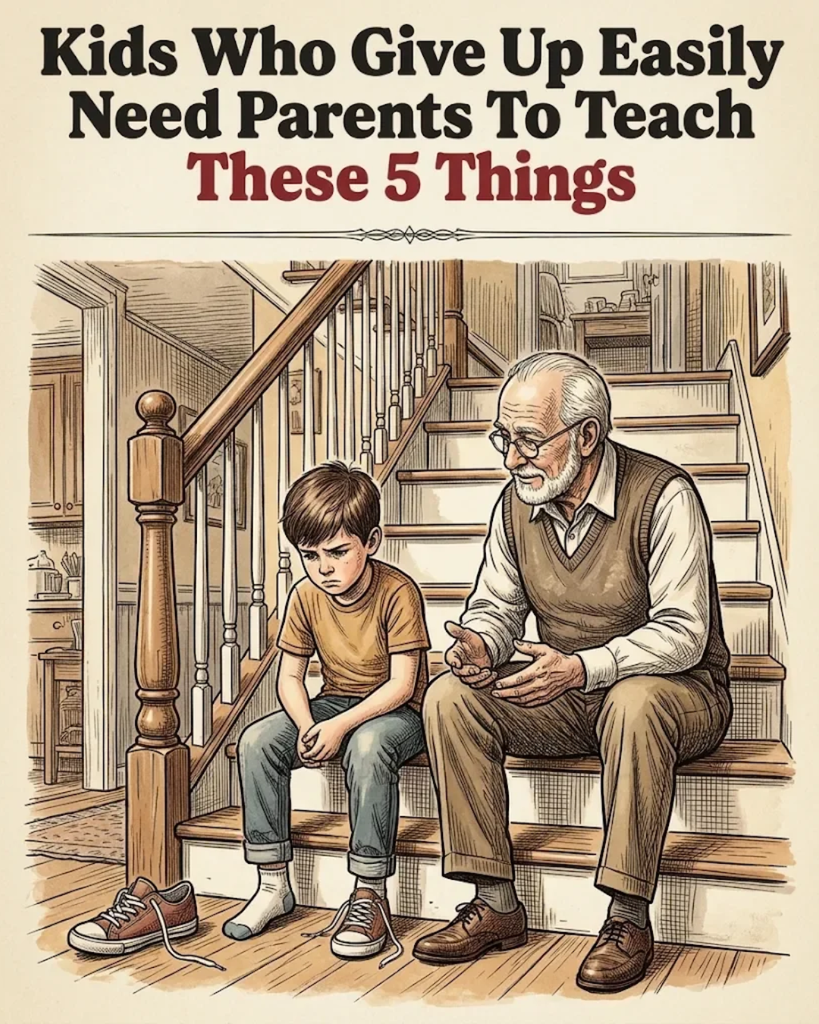
Your grandson sits on the bottom stair with one sneaker on. He makes the first loop, wraps the other lace around it, and the whole knot slides apart. That was try number four. He pulls the shoe off, flings it down the hallway and mutters, “I’m just bad at this.”
Maybe that scene feels familiar. A half-built Lego rocket sits on the shelf, and the piano book has lived under the couch since spring. Kids who give up easily are rarely lazy. Most of them simply haven’t learned what to do in the sour minute after something goes wrong. The good news is that this minute can be practiced at home, by parents and grandparents alike.
Why Kids Who Give Up Easily Aren’t Being Lazy
Quitting fast is mostly a way to make a bad feeling stop. When a task turns hard, a child gets a hot rush of frustration, sometimes with a little shame mixed in. Walking away makes that rush fade right away. So the brain files a quick note: leaving works. Next time, the exit comes a little earlier. That’s how kids who give up easily end up quitting sooner and sooner.
Grown-ups do the same thing, of course. Think of the exercise video you switched off after six minutes, or the half-knit scarf in the closet. The difference is that a child’s habits are still setting. Whatever they repeat now, quitting or staying, tends to follow them into school, sports and, years later, the office.
Scientists have studied this for decades, and their results keep pointing at a short list of skills. None of them need special toys or money. They only need an adult who is willing to slow down for a few minutes.
1. That Grown-Ups Struggle Too
In 2017, researchers at MIT set up a small test with 15-month-old babies. One group watched a woman pull a toy frog out of a container and unhook a key chain with no trouble at all. The other group watched her fumble for about half a minute before each one finally worked.
Afterward, every baby got a musical toy with a big button that did nothing. The babies who had watched the woman struggle pressed that dead button about twice as often as the others, according to the MIT News report. Professor Laura Schulz noted that many parents feel pushed to make life look easy in front of their kids.
So let them see you wrestle with things. Say it out loud while you fight the new phone settings: “This is annoying. Let me try a different menu.” When the jar lid won’t budge, run it under hot water and tell them why. A child who watches you stay with a problem learns that being stuck for a while is normal. It is part of the deal, and it doesn’t mean you’re bad at it.
2. That Effort Matters More Than Being Smart
Psychologist Carol Dweck and her student Claudia Mueller ran a classroom test that came out in 1998. They handed 128 fifth graders a page of pattern problems. When the page was done, some children heard that they must be smart. Others heard praise for how hard they had worked. Then the kids could pick their next set of problems.
The “smart” group was far more likely to choose the easy ones. Later, after a much harder round, those same children enjoyed the work less, kept at it for a shorter time and did worse on the next set. You can read the full study from Columbia. Being called smart had made every mistake feel risky.
A later study at the University of Chicago went into real homes. Elizabeth Gunderson and her team filmed 53 toddlers with their parents at ages one, two and three. Five years later, children who had heard more praise for their actions and strategies were happier to take on hard tasks, as the university explained. The total amount of praise didn’t matter much. Its kind did.
In practice, swap “You’re so clever” for something specific. “You tried three ways before that one worked.” Or try the tiny word Dweck loves: yet. “You can’t tie it yet.”
3. How To Calm Down Before Trying Again
Nobody solves a puzzle while their face is red and hot. A frustrated child has a body full of stress, and that body needs to settle before the thinking part of the brain can work again.
The pediatricians’ site HealthyChildren.org, run by the American Academy of Pediatrics, suggests two simple moves. First, put the feeling into words for them. Something like “You look really frustrated right now, am I right?” helps a child feel more in control. Second, slow the breath down, with long, easy breaths out. A little one can put one hand on the belly and one on the chest and feel them rise.
Try it with your grandson on that bottom stair. Sit next to him. Say, “That knot made you mad.” Then breathe out slowly together, three or four times, nice and long. After that, the shoe is still there, and he usually is too.
4. That There Is Usually Another Way
Here is where loving adults often slip. A child gets stuck, so we take over. We finish the drawing, pick the right puzzle piece, fix the wobbly tower. It feels kind, but it quietly tells the child that hard things belong to someone else.
A 2018 study by Nicole Perry at the University of Minnesota followed 422 children from age two to age ten. Parents who kept steering their toddlers’ play, telling them what to touch, how to use it and how to tidy up, had kids with weaker control over their feelings and behavior at five. By ten, those kids had more trouble at school and with friends, the American Psychological Association reported. Perry was careful to say parents still matter a great deal. The trick is knowing when to step back.
So instead of fixing it, ask a question. “What else could you try?” “Which part is the tricky part?” Break the big job into one small piece, such as “Let’s only do the first loop today.” Then keep your hands in your lap. Waiting two silent minutes while a seven-year-old fiddles with a zipper is hard for grandparents. It is also how they learn.
5. That Finishing Is A Skill Too
Angela Duckworth, the University of Pennsylvania psychologist who wrote the book Grit, raised her two daughters with a family rule she calls the hard thing rule. Everyone in the house, parents included, picks one hard thing that takes real practice. Nobody chooses it for you. And you can’t drop it halfway through a commitment, such as in the middle of a sports season or a set of lessons you already paid for.
Quitting is allowed at the natural end. Duckworth told Guy Kawasaki on his podcast that she once suggested her daughter stop playing the viola and pick a different hard thing. The point was never to stay with something forever. The point was to stop leaving on the worst day.
You can copy this at home in a small way. If your granddaughter signs up for eight swimming lessons, she finishes all eight, even if she cries after lesson three. Once the last lesson is over, she gets a real vote on what comes next.
When A Child Seems To Give Up On Everything
Some quitting goes deeper than frustration. If your child stops caring about things they used to love, seems sad or tired for weeks, or says things like “I’m stupid” over and over, talk with their pediatrician. Ask the teacher, too, whether the same thing shows up in class. Trouble with reading, attention or hearing can make every task feel twice as hard, and a check-up can spot what a pep talk can’t.
For more on what children carry from their early years, read our piece on quiet ways children feel truly loved. You might also enjoy our look at what parents in the ’70s got right, when kids spent whole afternoons figuring things out alone.
In this short TED talk, Carol Dweck explains why the word “yet” can change how a child handles a hard problem.
Final Thoughts
Picture the bottom stair one more time. The sneaker lands in the hallway, and this time you don’t rush over to tie it. You sit down, say the knot was annoying, and breathe out slowly with him. Then you mention the jar you couldn’t open this morning.
He picks the shoe back up. Maybe the bow works on try five, or maybe it waits until tomorrow. Either way, he learned something bigger than shoelaces. Kids who give up easily don’t need a lecture about trying harder. They need a calm adult nearby, a few kind words about effort and a little room to fail.
What helped you or your kids stop quitting when things got tough? Let us know in the comment box below.