
Ask any married woman about her mother-in-law and watch her face for a second before she answers. Very often you’ll see a small smile, or a small sigh, and then a story. And the story is almost never about something big. It’s about one sentence at a family lunch fifteen years ago, or the way her mother-in-law held the baby the first day home from the hospital, or one phone call that she still remembers word by word.
That’s the thing about this relationship. Daughters-in-law remember the details, the bad ones and the good ones, and they often carry them for decades.
In this article I want to go through seven things mothers-in-law do that daughters-in-law never forget. Some of them hurt for years. Some of them are the reason a daughter-in-law ends up loving her mother-in-law like a second mom. If you are a mother-in-law yourself, and I know many of you reading this are, I hope you read it as a kind of map and not as an attack. So, let’s go through it.
Why These Moments Stick So Long
First of all, this relationship is hard for almost everybody, so if yours isn’t perfect, you’re in good company. Cambridge psychologist Terri Apter, who studied in-laws for many years, found that more than 60% of married women feel long-term stress around their mother-in-law, while only about 15% of men say the same about theirs.
There is also a simple reason why the hurtful moments stay in our heads longer than the nice ones. Psychologists Roy Baumeister and his colleagues reviewed a huge amount of research in a well-known paper called “Bad Is Stronger Than Good”, and the main finding is in the title. Negative experiences usually have a stronger effect on us than positive ones, and we tend to remember them more. One unkind comment can easily outweigh ten nice dinners.
Honestly, I find this both a little sad and a little hopeful. Sad, because one careless sentence can undo years of kindness. Hopeful, because it also means one warm, well-timed gesture can matter far more than you would ever expect, and stay in her memory long after you have forgotten you even did it.
And many of these moments happen on very emotional days, like the wedding, the birth of a baby, a funeral or the first Christmas together, the days when everybody is tired and nervous and a little too sensitive, which is exactly when one wrong sentence does the most damage. Those are exactly the days our memory holds on to the most.
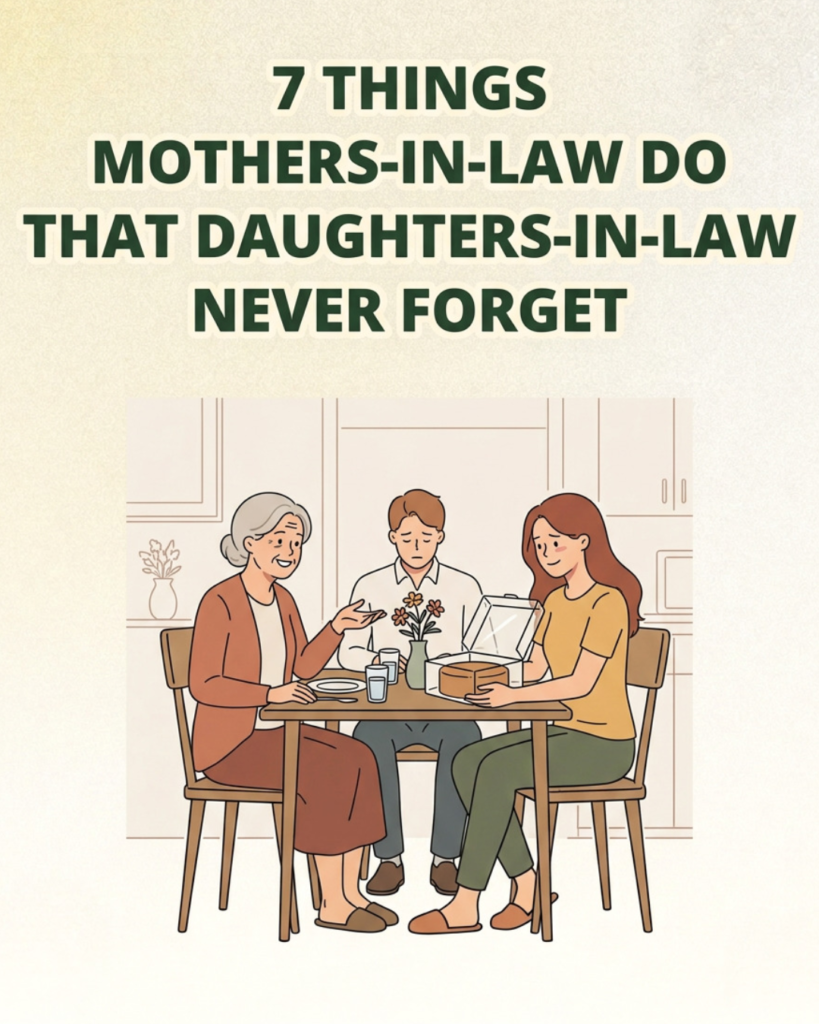
7 Things
1. How She Treated You On The Wedding Day
A wedding is supposed to be about the couple. But some mothers-in-law turn it into their own event without even noticing it. Maybe she changes the guest list at the last minute. Or she cries in a way that makes everyone look at her. Some will criticize the dress, quietly, but loud enough. Or she simply leaves the bride out of the family photos, as if the new wife is a guest and not a member of the family.
Daughters-in-law remember this for a very long time, and not because they are dramatic. The wedding is the first official day of the new family. Whatever happens there feels like a message about where she stands. If that message was “you’re not really one of us,” it’s very hard to forget.
Of course, the opposite is true as well. A mother-in-law who hugs the bride at the door and says “welcome to the family” in front of everyone gives her something she will remember just as long.
The same goes for the first Christmas, the first Sunday lunch, the first time the new wife comes to the house alone. These first moments set the tone for years, and honestly, most people don’t realize it while it’s happening. A warm “come in, sit with me” in the kitchen costs nothing, and it gets remembered.
2. The Comment In Front Of Everybody
“Oh, you bought the cake? I always bake mine.”
“He used to be so thin before he got married.”
“Is that what young women wear these days?”
One comment like this at a family table, with everybody listening, can stay with a daughter-in-law for twenty years. Nobody else even remembers it a week later. She does. She remembers what she was wearing, who laughed, and that her husband said nothing.
Often the comment is only half of the memory. The other half is the silence around it. Nobody at the table said “that’s not fair.” Nobody even changed the subject. So the daughter-in-law walks out feeling that the whole family agreed. So if you’re a mother-in-law who notices someone else making a comment like this, you have a chance to do something really kind. Just say something.
Most mothers-in-law don’t mean these comments as an attack. Many of them just say what they think, the same way their own mothers did. But said in front of others, a small remark feels like a public judgment. That’s very different from an honest conversation in private.
3. Undermining Her As A Mother
This is probably the one that hurts the most, and it’s also the one that causes the biggest fights.
“At Grandma’s house you can have candy before dinner.” “Your mom is too strict, don’t listen to her.” Or holding the newborn for hours and not giving the baby back when the mother asks. Or ignoring the rules about sleep, screens, food, and then telling everyone she raised three kids and they all turned out fine.
For many young women, being a mother is the center of who they are at that point in life. Interestingly, University of Michigan researcher Terri Orbuch followed 373 couples for 26 years and found that when wives were very close to their husband’s parents, the risk of divorce actually went up by 20%. Her explanation was that many women experience comments and advice from in-laws as interference in their role as a wife and mother. So when a mother-in-law questions how she raises her children, it doesn’t land like advice. It lands like a challenge to who she is.
I know it’s hard to watch someone raise your grandkids differently than you would. But the rules in her house are her rules, even when you disagree with them.
4. The Comparison
“His ex-girlfriend was such a good cook.” “Your sister-in-law always calls me on Sundays.” “When I was your age, I worked full time and still kept the house spotless.”
Comparisons are poison in any family. Between a mother-in-law and a daughter-in-law they’re even worse, because there’s no long history of love to soften them, nothing like the thousands of good moments a mother and daughter share before they ever start arguing about anything. The daughter-in-law hears one thing only: you are not good enough. And from then on, every visit feels like a test she might fail.
Being compared with the ex is the worst version of all. Sadly, it happens more often than people think, sometimes even as a joke at the table. Nobody laughs inside.
And it doesn’t stop with her. Some mothers-in-law also compare the grandchildren – whose kids are better at school, whose kids visit more, whose kids have better manners. Mothers notice this immediately. Very few things make a daughter-in-law pull back faster than feeling that someone ranks her children.
Every woman is different, and so is every family. Let her be who she is.
5. Going Around Her, Straight To The Son
Something bothered her mother-in-law, but instead of saying it to her, she called her son. Maybe to complain about how the house looked, or how she dressed the kids, or why they didn’t come for Easter.
Daughters-in-law usually find out about these calls, because husbands are not very good at keeping them secret. And once she knows, it changes everything. She starts to feel like there are conversations about her marriage happening behind her back, and that two women are now pulling her husband in different directions.
If something bothers you, it is almost always better to talk to her directly, kindly, and only to her. As I mentioned in a previous article about the respectful ways of a great mother-in-law, going directly to her is one of the biggest signs of respect you can give.
There’s also the opposite version of this. She tells her mother-in-law something private, about money, about a pregnancy, about a fight with her husband, and two days later the whole family knows. After that, she simply stops sharing. Not out of anger, mostly. She just learned that it isn’t safe.
6. How She Showed Up After The Baby Came
Now let’s talk about the good ones, because daughters-in-law remember those too, and sometimes even more.
Many women will tell you about the first weeks after giving birth. Exhausted, sore, crying for no reason, a baby who doesn’t sleep. And then there are two kinds of mothers-in-law. The first kind comes over, holds the baby for three hours, gives advice, and leaves the dishes in the sink. The second kind comes over, puts a pot of soup on the stove, folds the laundry, asks “what do you need?” and leaves when she sees the new mom is tired, without waiting to be asked twice and without taking it personally.
Guess which one she remembers with love twenty years later?
This is the moment where a lot of good relationships are born. A mother-in-law who supports the mother, and doesn’t only enjoy the baby, earns a kind of gratitude that lasts a lifetime.
Just a tip for grandmothers-to-be. Ask before you come to the hospital, let the new parents have the first hours alone, and when you visit, hold the baby so the mother can take a shower or sleep, not so you can show the baby around. Small things, but she will notice every one of them.
7. The Day She Took Her Side
And this one is my favorite. Maybe there was an argument at a family dinner, and someone said something unfair to the daughter-in-law. Or the son was clearly in the wrong in some argument, and everyone knew it. And the mother-in-law said, calmly and in front of everyone, “No, she’s right.”
Just once can be enough. A daughter-in-law who sees her mother-in-law defend her, even against her own son, never looks at her the same way again. It tells her something very simple. You are family now, and in this family we are fair to you.
Sometimes taking her side is quieter than that. It can be inviting her parents to Christmas so they don’t feel left out, or remembering that she doesn’t eat meat and cooking something for her without making a big deal of it. These things tell her the same message, just in a softer voice.
The Small Things She Remembers Too
Not every memory is a big moment. A lot of what daughters-in-law remember is very ordinary, and that’s good news, because ordinary things are easy to do. For example, she remembers if you knew her birthday without your son reminding you. She remembers if you learned how she likes her coffee. She remembers if you called her by her name, or if you always said “his wife” when you talked about her to other people. And she remembers if you ever asked how she was doing, not only how the kids or your son were doing.
None of this takes a lot of money or effort. It just takes attention. People feel attention very clearly, even when nobody says a word about it.
If You’re The Mother-in-Law And You Recognized Yourself
Maybe while reading this you remembered a comment you made at the wedding, or a time you called your son instead of her. First of all, don’t panic. Almost every mother-in-law has said something she regrets, and most daughters-in-law know that relationships are complicated.
What helps a lot is a short, specific apology. Something like “I’ve been thinking about what I said about the cake at Christmas, and I’m sorry, that wasn’t fair.” Not a long speech, and not “I’m sorry if I offended you,” because that doesn’t really count as an apology. One honest sentence can heal much more than you think, even years later.
Other than that, try to create new memories. Ask about her work, her friends, her plans. Praise her as a mother in front of your son. Offer help instead of advice. Remember that she will be the one taking care of your son, your grandchildren and maybe one day you too, so every kind memory you give her now is also an investment in the years ahead of all of you.
If You’re The Daughter-in-Law
Holding on to every hurtful moment is understandable, but it is also heavy to carry. Some mothers-in-law really don’t know how their words land. They come from a generation where nobody talked about feelings at all, where you just swallowed whatever your own mother-in-law said and kept cooking. If the relationship matters to you and your husband, a calm and honest conversation, just the two of you, can change more than years of silent hurt.
Also remember that many mothers-in-law come from a time when nobody asked young women what they wanted. Their own mothers-in-law were often much harder on them. That doesn’t make the hurtful things okay, but sometimes it explains why she doesn’t see what she’s doing.
And if it’s really disrespectful, if the comments are constant and cruel, then protecting your peace is completely okay. I wrote more about how to deal with those who disrespected you, and a lot of it applies inside the family too.
The Bottom Line
Daughters-in-law don’t remember the big gifts or the fancy dinners. They remember the small moments. Whether you welcomed her at the wedding or left her out of the photos. A comment at the table, or a pot of soup after a sleepless night. Whether you compared her or defended her. If you’re a mother-in-law, the good news is that you still have a lot of chances to create the kind of memories she’ll talk about with a smile one day.
What is one thing your mother-in-law did that you never forgot? Let us know in the comment box below.