
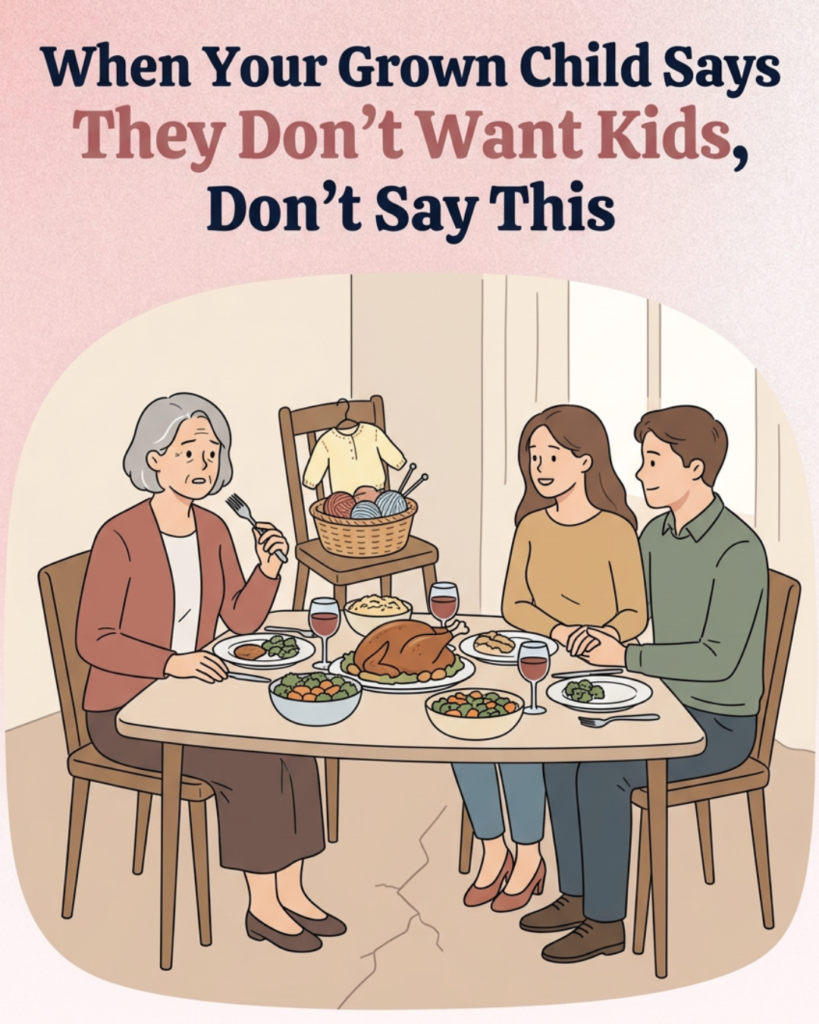
It usually happens at a normal moment. Sunday lunch, a phone call on the way home from work, or a quiet evening when everybody is sitting on the couch. Your daughter, or your son, says it almost casually. “Mom, we decided. We’re not going to have kids.”
And your fork stops halfway to your mouth.
Maybe you smiled and said “okay.” Maybe you said something you regret a little bit now. Either way, if you are reading this, there’s a good chance that sentence is still sitting somewhere in your chest, together with the little sweaters you imagined knitting and the Christmas mornings you pictured with small feet running down the stairs.
I want to say first that what you feel is normal. You are allowed to be sad about it. But how you react in the next weeks and months can shape your relationship with your grown child for a very long time, much longer than one awkward afternoon, so it’s worth thinking about it carefully before you say anything you can’t take back. In this article I’ll go through why more and more adults are choosing not to have children, what is usually behind that decision, what is better not to say, and what can actually help you and your child stay close. So, let’s go through it.
You Are Not The Only Parent Hearing This
First of all, this is becoming very common. According to a 2024 Pew Research Center report, 47% of American adults under 50 who don’t have children say they are unlikely to ever have them. In 2018 that number was 37%, so it went up by ten points in only five years.
That means a lot of mothers and fathers around you are having the exact same conversation, even if nobody talks about it at the church coffee hour or at family gatherings. You are definitely not the only one.
The same report also found that the topic comes up a lot between friends, especially for women. 41% of women under 50 without kids said it comes up with their friends at least sometimes, compared with 26% of men. So your daughter or son has probably already heard every question and every opinion about it, many times, long before they told you.
Why They Usually Decide This
When parents hear this news, the first reaction is often to look for a reason that can be fixed. Is it money? Is it the partner? Did something happen? Sometimes there is a reason like that, but very often the answer is much simpler.
They Just Don’t Want To
In the Pew survey, the most common major reason was exactly this – 57% of those adults said they just don’t want to have children. Among women under 50, it was even higher, 64%.
I know this one can be the hardest to accept, because there’s nothing to solve. No problem to fix, no argument to win. But honestly, a person who knows they don’t want to be a parent and says so out loud is being very responsible, much more responsible than having a child just because everyone expected it.
Other Plans For Their Life
44% said they want to focus on other things, like their career or their interests. For some people that’s travel, for others a business, a hobby that takes all their free time, or simply a calm life with their partner and maybe a dog. It doesn’t mean their life is empty. It just looks different from ours.
Think about your own life for a second. How many things did you never get to do because you were busy raising kids? Maybe a trip you always wanted, a hobby, a degree. Some young people look at that honestly and decide they want the other road. That’s not a judgment of your life. It’s just a different choice for theirs. And that’s okay, even if it takes us parents some time to really feel that it’s okay.
Worry About The World And Money
This part surprised me a little when I first read it. 38% named concerns about the state of the world as a major reason, 36% said they can’t afford to raise a child, and 26% mentioned the environment and climate change. When you think about the price of housing, daycare and college today, compared to when many of us raised our kids, the money worry makes a lot of sense.
Sadly, many young couples today work two jobs and still feel like they are only just getting by. When a child feels like a financial risk instead of a blessing, a lot of people simply decide not to take that risk.
Things They Might Not Tell You
And then there are the reasons that don’t always get said out loud. Sometimes “we don’t want kids” is easier to say than “we can’t have kids.” According to the CDC, about 19% of married women between 15 and 49 who have never given birth are infertile, which is a lot more than most people think. A health problem, a difficult pregnancy loss, or a hard medical situation can sit behind a short sentence that sounds like a simple choice.
Some grown children also make this decision because of their own childhood. That doesn’t always mean something bad happened, but sometimes they remember how stressed and tired their parents were, and they don’t want that life for themselves. This is not something to argue about. It’s just good to know that the reason might be deeper than it looks.
When It’s A Couple’s Decision
If your son or daughter is married, the couple usually makes this decision together, and this is where many parents make a big mistake. It’s very tempting to think the partner is behind it. “He was always going to have kids, she talked him out of it.” Or the opposite way around.
Even if that were true, saying it, or even hinting at it, will hurt your relationship with both of them. Your child chose this partner, and they chose this life together. Blaming the son-in-law or the daughter-in-law only makes your child defend them, and it can make the partner feel unwelcome at your table for years. Treat it as their shared decision, because that’s what it is.
What You Might Be Feeling
Let’s be honest about this part too, because nobody talks about it. Many parents feel a kind of grief when they hear this news. Not because their child did something wrong, but because a picture they carried for many years suddenly disappears. The grandchildren you would spoil. Those family recipes you wanted to teach someone. And that warm feeling that the family goes on after you.
Some parents also feel embarrassed when friends show photos of their grandkids, or angry, or even guilty, as if they did something wrong in the way they raised their child. All of that is normal, and you don’t have to pretend you’re fine.
I think many of us also grew up in a time when having children was simply what everybody did after the wedding. Nobody asked if you wanted to. So when our own kids make a different choice, it can feel strange, almost like they are breaking a rule we never questioned, even though no such rule ever really existed.
The important thing is where you take these feelings. Talk about them with your partner, a good friend, or a counselor if it’s heavy. Your grown child is the wrong person to carry your grief about their own life decision, because it puts them in an impossible position.
What Is Better Not To Say
Most parents say these things with love. But here is how they usually sound on the other side of the table.
“You’ll change your mind.” This is probably the most common one, and it’s the one adult children hate the most. It tells them you don’t believe they know themselves. Some people do change their minds, of course. Many never do. Either way, it’s their mind.
“Who will take care of you when you’re old?” It sounds practical, but it turns a child into a retirement plan. And honestly, having children is no guarantee of that either.
“It’s selfish.” Please don’t. Choosing not to bring a child into the world is not selfish, and for some people it is the most honest choice they will ever make.
“But your sister has two already, why can’t you?” Comparisons hurt at every age. They also put siblings against each other, and that’s the last thing you want at the next family lunch.
“I just want to be a grandmother before I die.” This one comes from a real and very human place, I know. But it puts your wish on their shoulders, and it turns their life decision into something they now have to feel guilty about. It’s better to say this to a friend than to your child.
And the quiet one – bringing it up again at every holiday, every birthday, every baby shower. Even small hints like “one day when you have kids” can feel like pressure. After a while, grown children start to avoid family gatherings just to avoid the topic, and nobody wants that.
What Actually Helps
Here is what I would suggest, based on what tends to keep families close.
Start with something simple, like “Thank you for telling me.” Your child probably thought about this conversation for a long time, and maybe they feared your reaction. Telling them you’re glad they were honest with you is a gift.
You can ask one gentle question if you really want to understand, something like “What made you sure?” But ask it once, listen to the answer, and then let it go. This isn’t a negotiation.
Next, show interest in the life they are building. Ask about their work, their trips, their plans, their partner, their pets. Many adults without children feel that their families treat their lives as somehow less important, as if nothing really counts until there’s a baby. Don’t be that family.
Celebrate their milestones the way you would celebrate a new baby. The new house, the promotion, the business they finally opened, the marathon they ran. Bring a cake, make a fuss, call the relatives. These moments matter to them just as much, and they will notice that you noticed.
And if you have other children with kids, be careful not to put all your attention on the grandchildren when everybody is together. The child without kids notices it right away, even when nobody says anything.
When Friends Keep Asking About Grandkids
Then there are the friends and relatives. “So, any grandchildren yet?” You will probably hear it at weddings, at the hairdresser, in the church parking lot. And every time, it can sting a little.
It helps to have a short, warm answer ready, one that protects your child’s privacy. Something like “No, but my daughter just opened her own little bakery, you should see it,” and then you talk about what is actually happening in her life. You don’t owe anyone an explanation, and your child’s reasons are theirs to share, not yours.
Pro tip: if a certain aunt or cousin keeps asking your child directly at family lunches, have a quiet word with them before the next holiday. One sentence from you can save your child a lot of awkward moments.
Finding Other Ways To Be A Grandparent
If your heart really wanted grandchildren, there are other ways to share that love. Nieces and nephews, the neighbor’s kids, a friend’s grandchildren who don’t have grandparents nearby. Many communities also have volunteer programs where older adults read with children at school or mentor young people, and some of those relationships become very close over the years.
Purpose matters a lot as we get older. I wrote about the Japanese longevity habits that can add years to your life, and having a reason to get up in the morning is one of the biggest ones. That reason doesn’t have to be grandchildren. It can be a garden, a choir, a class, or other people’s children who need someone kind in their life.
And don’t laugh, but plenty of parents become very proud grandparents to a dog or a cat. Pet photos on the fridge count too!
A Word About The Future
Many parents worry about what their childless son or daughter will do when they get older. It’s a fair worry. In the same Pew report, 26% of adults 50 and older without children said they often worry about having someone to take care of them.
It’s also interesting that not everyone in that older group chose it clearly. About 38% said there was a time when they wanted children, 32% said they never did, and 25% weren’t sure. Life doesn’t always follow the plan, in both directions, and that’s worth keeping in mind before we judge anybody’s path.
But the report also showed the other side. Most of them said not having kids made it easier to afford the things they want, to have time for hobbies, and to save for the future. So their life is not a sad story waiting to happen. It’s just a different one, with its own good parts and its own worries, like every life.
And yes, some people do change their minds later, especially in their thirties. But waiting for that, or hinting about it, usually pushes them away. Love the life they have now, not the one you hoped for.
The Bottom Line
When your grown child says they don’t want kids, it can feel like a door closing. But it’s really just a different door than the one you expected. Give yourself time to feel sad about the picture you carried, talk about it with someone other than your child, and then try to step into the life your child is actually living. A parent who respects that decision is usually a parent their child keeps calling, visiting and confiding in for many years, through every new chapter of a life that turned out a little differently than anyone planned at the beginning.
Has one of your grown children told you they don’t want kids? Let us know in the comment box below.