
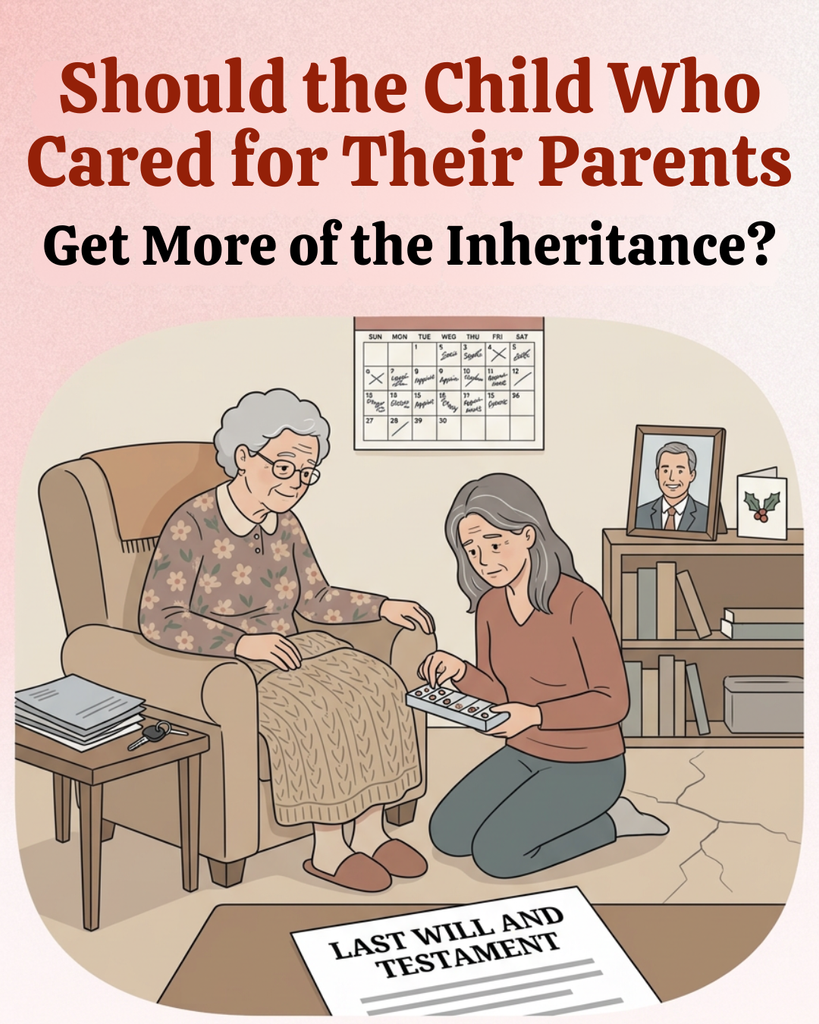
For seven years, she drove her mother to every doctor’s appointment. She sorted the pills into the little plastic boxes every Sunday, learned how to talk to the insurance company without crying, and slept on her mother’s couch more nights than she can count. Her brother lived three states away. He called on Sundays and came home for Christmas.
Then the will was read. Equal shares. Fifty-fifty.
Some families hear that and think, of course, that’s fair, they are both her children. Other families hear it and something breaks between the siblings that never really heals. That’s exactly why this question is so emotional. Maybe the most emotional one a parent faces near the end of life.
In this article I want to go through what research says about family caregivers and inheritance, the honest arguments on both sides, some options in between that many families don’t know about, and what both the caregiving child and the siblings can do to keep the family together. So, let’s go through it.
One important note first. I am not a lawyer or a financial advisor. Also, inheritance rules are very different from one state or country to another. This article is here to help you think and talk about it. For the actual decisions, please sit down with an estate planning or elder law attorney.
How Common This Situation Is
Much more common than most people think. According to the AARP and National Alliance for Caregiving report Caregiving in the US 2025, about 63 million Americans are family caregivers, roughly one in four adults. That is an increase of 45% in just ten years.
And it’s not only about time. The same report found that just over one-third of caregivers have stopped saving money, 23% are in debt because of caregiving, and 30% have been doing it for five years or more. So when we talk about the child who cared for their parents, we are often talking about someone who paid for it with their career, their savings and sometimes their own health.
What Most Parents Actually Do
For a long time, the unwritten rule in most families was simple – everything gets divided equally. But that is slowly changing. Research based on surveys of older Americans, summarized by the Center for Retirement Research at Boston College, found that unequal wills have become much more common. In a study led by Robert Pollak of Washington University in St. Louis, the share of parents over 50 with wills who planned to divide things unequally rose from 16% in 1995 to 35% in 2010. So about one in three.
Stepfamilies were the biggest factor, but not the only one. The researchers also suggested that parents sometimes use the will to reward a child who helps them in old age, and contact with the children and the parents’ health played a part too.
There was another number in that research that honestly shocked me a little. About two in five parents had no will at all. Without a will, the law decides how to split things. That usually means equal shares, no matter who did what during those last years. So if this question matters to you, the very first step is simply to make a will.
Why This Question Hurts So Much
Inheritance fights are rarely just about money. Most of the time the money is a symbol for something older and deeper.
Think about it. Siblings carry their childhood roles for their whole life. The responsible one, the baby of the family, the one who always got away with everything. When a parent gets old and sick, those roles usually show up again. The responsible one becomes the caregiver, often without anyone deciding it out loud. And when the will is read, it can feel like a final grade on the whole story of the family.
Add grief on top of that, because people read wills right after losing a parent, when everybody is tired and raw. Small things feel big. A number on a paper can suddenly feel like the answer to a question nobody dared to ask while Mom was alive – who did she really love more?
The Case For Leaving More To The Caregiver
Let’s start with the side many caregivers quietly feel but rarely say out loud.
Caregiving costs a lot. Not only in hours, but in real money. Some caregivers reduce their working hours or quit their jobs. They miss promotions, stop putting money into retirement, and pay for gas, groceries, medicine and small home repairs out of their own pocket, often for years. When the parent passes away, the other siblings simply receive their share. The caregiver, meanwhile, starts from a much weaker financial position.
There’s also the simple question of fairness. Equal is not always fair. If one child gave five years of their life and another gave five phone calls a month, treating them exactly the same can feel to the caregiver like their sacrifice didn’t count. Many parents who leave a little more to the caregiving child say they did it as a way to say thank you, and to make sure that child isn’t left worse off because they stayed.
Picture a daughter who is 58. She left a good job at 52 to take care of her father, and now she has almost no retirement savings. Her brother kept working the whole time. Splitting everything equally might look fair on paper, but in real life, she will feel those lost years for the rest of her life.
The Case For Keeping It Equal
But the other side has good arguments too, and it’s important to hear them.
First of all, parents don’t always see everything. The son who lives far away may have sent money every month, paid for a home aide, or handled all the paperwork by email. The daughter who couldn’t help may have had her own sick child, a demanding job or health problems nobody talks about. Caregiving looks different for different children. An unequal will can feel very unfair to someone who helped in a way that wasn’t visible.
Another thing is that money in a will is often read as a message about love. “Mom loved her more.” Even when that is absolutely not the reason, that’s how many siblings experience it, and the hurt can last for decades, long after the money is spent.
And some caregivers themselves don’t want it. For them, taking care of a parent was an act of love, not a job. Being “paid” for it in the will feels strange. They would rather keep the peace with their brothers and sisters than receive more.
Not Every Child Could Be There
And what about the child who simply couldn’t be there? Not every adult child has the freedom to move back home or to leave a job. Some live on the other side of the world, some are single parents, and some have a difficult past with that parent that nobody else in the family fully understands. An unequal will can feel like punishment for things they never chose.
There’s also another side that families sometimes forget. In some cases, the caregiving child lived in the parent’s house for years without paying rent, or the parent helped them with money along the way. When you add that up honestly, the difference between the siblings may already be smaller than it seems.
Options In Between
Here is the part many families don’t know about. It doesn’t have to be all or nothing.
Paying The Caregiver While You’re Still Alive
Some parents sign a written personal care agreement with the child who takes care of them. AARP describes this as a kind of employer-employee agreement between the care recipient and the caregiver, where the parent pays the child for care like cooking, driving, shopping and paying bills.
This has real advantages. The caregiver gets paid fairly at the time they’re doing the work, not years later. And it can matter for Medicaid, because money given to a family member without a written agreement may count as a gift during Medicaid’s five-year look-back period. However, AARP is clear that the pay has to be reasonable and at market rate, you can’t pay for past care retroactively, and the payments count as taxable income for the caregiver. So please, don’t do this one yourself. An elder law attorney and a tax professional should help.
Other Ideas Families Use
Some parents keep the will equal, but first reimburse the caregiving child for documented expenses they paid out of their own pocket. Others leave a specific thing to the caregiver, like the house they lived in with the parent, or name them as the beneficiary of a life insurance policy, while the rest is split equally. These solutions recognize the caregiver without making the whole will feel unequal.
Just a tip. Be careful with putting the caregiver’s name on the house or on bank accounts as a shortcut. It can create tax problems and affect Medicaid. It can also cause big fights later if the other siblings feel it happened behind their backs. Again, this is something to plan with a lawyer, not at the kitchen table.
Questions To Ask Yourself Before You Decide
If you are a parent thinking about this, here are some questions that might help. Who is actually doing the daily work, and for how long? Has that child lost income, a job, or their own savings because of it? Have the other children helped in ways you don’t see every day, like money, paperwork, or calls to the doctors? Did one child already receive more help from you earlier in life, like money for a house or a wedding?
And maybe the most important one. How would each of your children feel reading your will, and could you explain your choice to them face to face? If the answer is no, it might be worth thinking about it a little longer, or talking to them first.
Whatever You Decide, Explain It
The biggest family fights usually don’t come from the decision itself. They come from the surprise.
Decided to leave more to one child? Then try to tell your children while you are still alive, ideally all together. Explain your reasons calmly. Some parents also write a short letter to go with the will, something like “I left more to your sister because she gave up her job to take care of me, and I want her to be able to rebuild her savings. I love all of you the same.” A letter like that won’t stop every hurt feeling, but it can stop a lot of guessing.
Wills also need updating. If you wrote yours fifteen years ago, before anybody needed care, it may not reflect your family today at all. A quick review with a lawyer every few years, or after a big change like a diagnosis, can prevent a lot of heartache later.
And if you decide to keep everything equal, explaining that can help too, especially for the caregiver. “I want you to know I see everything you do for me, and I’m thankful every day” can mean more to a tired daughter than any number in a will.
If You’re The Caregiving Child
Please don’t wait for the will to make things fair. Talk to your siblings now about sharing the work and the costs. Keep simple records of the hours you spend and the money you pay. And look after your own health and money too, because burnout is very real. Caregivers are often so busy taking care of everybody that they forget about themselves completely. Many caregivers are eldest daughters who ended up managing everything, something I wrote about in why the eldest daughter ends up managing the family.
It also helps to say out loud what you need, instead of hoping your siblings will notice. “Can you take Mom every second weekend?” or “Can you cover the pharmacy bills this month?” is much easier for them to answer than a long, quiet resentment that only comes out after the funeral. Many brothers and sisters honestly don’t realize how much the caregiver carries until someone tells them.
If your parent wants to discuss a personal care agreement or a different split, let them talk to a lawyer on their own, without you in the room. That protects them, and it protects you from anyone saying later that you pushed them into it.
If You’re The Sibling Who Lives Far Away
You can still do a lot. Pay for a few days of respite care so your sister can rest. Come home for a week and take over completely. Call the caregiver, not only your parent, and ask how she is doing. These things matter more than you think.
Sending money also counts. If you can’t be there in person, offering to pay for a cleaner, a few hours of home care, or the gas your sister spends driving to appointments every week is a real way to share the load. It also tells her that you see what she’s doing, which is sometimes the thing caregivers need most.
And if one day the will is unequal, try to read it as a thank-you to the person who was there every day, not as a judgment of your love. That’s very hard, I know. But it may be the thing that keeps your family together after your parents are gone.
The Bottom Line
There is no single right answer to whether parents should leave more inheritance to the child who cared for them. Equal can feel fair to some children and deeply unfair to others. What helps almost every family is having a will, getting proper legal advice, thinking about options like a personal care agreement, and talking openly while everyone is still here to hear it. The money will be spent one day. The relationships between your children are what you really leave behind.
Do you think the child who cares for the parents should get more? Let us know in the comment box below.