
When you’re a child, you often wonder how to behave like an adult.
How is their world different from yours?
In your blank slate status, you will learn to deal with the different emotions.
As you grow older, you will slowly realize there are things your parents are saying is not right.
You thought what they’re saying makes sense, but in fact, it’s irrational.
Parents are human too, but there are some of them whose parenting requires emotional manipulation.
They may or may not mean it; however, it becomes damaging on your part.
It can be under the guise of discipline, of respecting the elders, and of their love for their children.
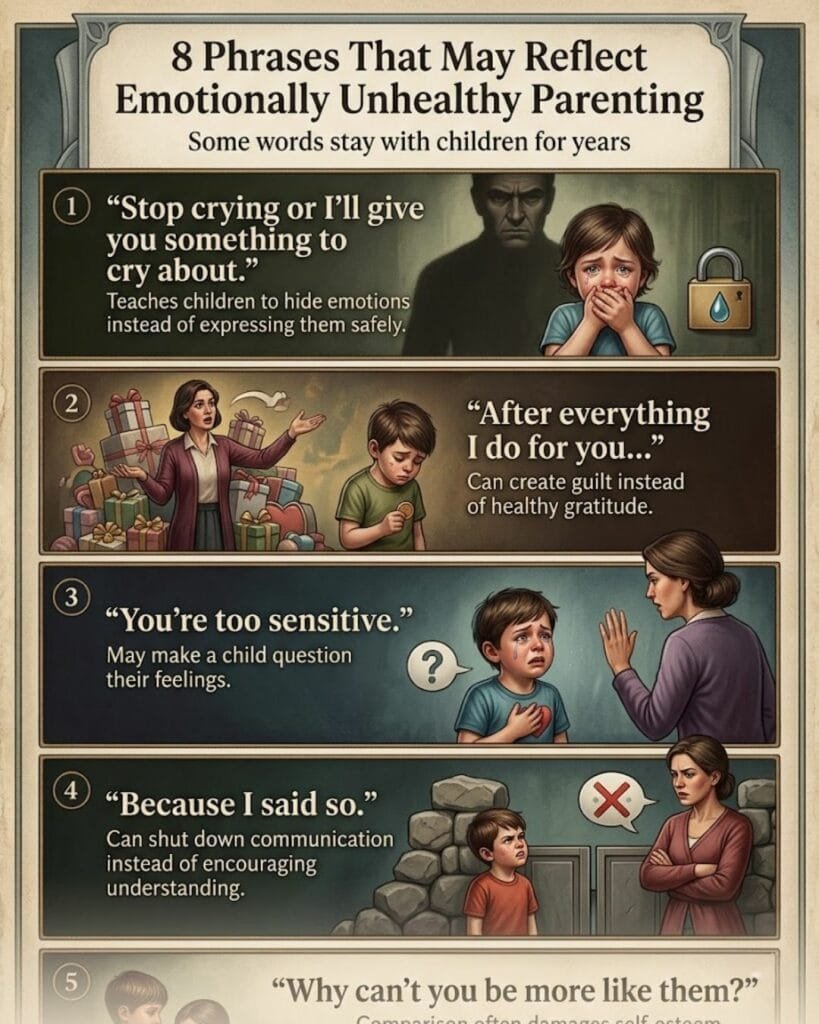
These statements not only hurt your feelings, but they can also affect your development growing up.
That’s why some adults have a challenging time dealing with:
- Emotional guilt
- People-pleasing personality
- Anxiety levels
- Fear of being involved in a conflict
- Low confidence
- Unable to say “no” when necessary
You might have heard some of these phrases when growing up, and there’s a way to overcome these emotionally manipulative ways.
Here are the 8 common phrases (segmented by cases) that we can hear from our parents:
Case No. 1: “After All I Did for You…”
This phrase is often heard as parents try to guilt-trip their children about a specific event.
Parents use this card to remind their children of their sacrifices and responsibilities, as if it were not part of their duty.
You may have heard this line when your parents demand something from you, just because they did everything for you out of love.
Such a phrase dismisses the opinion of their children and would label them as either selfish or ungrateful.
This may take effect on the children who grow up feeling:
- Messianic about everyone’s emotions
- Prioritize others to further their advantage
- Constantly over-explain themselves
- Becomes guilty about creating boundaries
- Blindly following due to debt gratitude
Some parents don’t know that love and guilt are two distinct variables in parenting.
Although parents and children must provide love, care, and sacrifice to each other, this should be done willingly, and not because of debt gratitude.
We must remember that reciprocity is not forced nor given under pressure, for familial love should be genuine.
Case No. 2: “Why Are You So Sensitive?”
Have you ever heard your parent questioning your response?
Dismissing the fact that you are offended by something personal to you.
It labels the children to doubt what and how they feel.
Some parents call you sensitive when you are:
- Cry easily
- Feel easy to be embarrassed
- Offended by destructive criticism
- Overreacting
- Affected by insults in the guise of jokes
It makes the children feel that their feelings are shallow and undeserved to be heard about their sentiments.
Consequently, this will make the children believe that their emotions are always invalid.
When these children grow up, they become people pleasers and keep apologizing for feeling bad.
Emotional sensitivity does not automatically mean that you are weak.
Case No. 3: “Because I Said So…”
Nothing beats this line, which parents usually utter.
This card is commonly used when they demand direct obedience from their children.
The issue is that the children become unwilling to obey the will of their parents when they communicate a problem.
Healthy communication becomes unhealthy because some parents feel that raising a concern is equivalent to questioning their parenting.
Children who grew up constantly listening to this line may often feel:
- Questioning authority brings harm
- Children’s opinions do not have a bearing
- Obedience and loyalty are prioritized over being heard
This line proves that children grew up fearing their parents instead of loving them.
Although our parents are our main guides growing up, it should come from a position of love and concern, not by domination and intimidation.
Parenting is not about being bossy to your children, but providing a balance of the need to respect your parental authority and being attentive to their needs.
Case No. 4: “I Guess I am a Bad Parent Way Back Then”
When you are making a point, but then your parent suddenly says the line, that could sound dramatic.
But little do we know, this can be a form of emotional manipulation of their children.
Parents do this not to entirely recognize their mistake, but rather strategically deny that they should be held responsible for doing it.
Recognizing it as bad parenting, but they sound insincere and would evade personal accountability for it.
Instead of saying that they recognize their mistakes, they instead resort to saying this line.
As if the guilty parent becomes the real victim of the situation they created.
This phrase suggests that they are competing with their children to see who feels the real hurt.
Children who are used to hearing this line will grow up believing this is harmless and would rather evade accountability for hurting others.
The issue has been reversed, making the children become the bad persons for raising the issue.
Case No. 5: “Without Me, You Won’t Make It”
This phrase has a ring to it, but it is not mostly based on truth.
Parents who use this card to guilt their children when they’re out of their control.
Children will eventually have to make plans of their own.
But parents who want to retain control over the lives of their children will do it under the guise of protection.
They want their children to remain dependent on them just to retain their authority.
You may hear similar things from your parents, like:
- You can’t thrive without me.
- You won’t be successful without my help.
- Nobody will accept you as much as I do.
- You can’t decide on your own without me.
This emotional manipulation can influence children to become indecisive individuals as they grow up.
When this happens, they become adults who will mostly commit:
- Seeking approval from others
- Unable to trust themselves
- Stay in toxic relationships
- Being dependent
- Fearful of making personal decisions
Good parenting doesn’t revolve around controlling or intervening in their children’s affairs.
When you value your children’s independence, you also value their trustworthiness.
Case No. 6: “Stop Crying, or I’ll Give You a Reason to Cry”
Many children thought this phrase was normal.
In the long run, it teaches the children that expressing is dangerous.
This line taught you to suppress your emotions most of the time.
When these children become adults, they may end up doing:
- Being avoidant
- Bottle up feelings or stress
- Refuse to participate in emotional conversations
- Have episodes of emotional shutdown
Parents who often say this line believe that suppressing their children’s emotions could make them behave well.
This is a big mistake.
A good parent must understand that children need guidance to process their emotions.
Case No. 7: “Why Can’t You Be Like Your Sibling?”
A common line among families with sibling competition is the fact that parents pit their children against each other.
Although it’s normal for your siblings to be better role models than you are, that doesn’t mean you have to copy them.
Some parents see sibling comparison as a way to motivate their children to do better, but it becomes detrimental to their emotions.
Children who grew up in this kind of environment tend to believe that:
- Someone is better than you
- Love comes with conditions
- Being obedient is not enough
Another problem with this line is that it comes with labeling and bad portrayal.
This could be the reason some children grew up:
- Insecure
- Afraid to fail
- Having unresolved issues
- Doubting oneself
- Becomes jealous easily
- Being a perfectionist
- Chasing validation
Healthy parenting does not require sibling competition and favoritism; it requires recognizing that every child is unique.
Case No. 8: “Remember That You Owe Me”
Parents who often use this phrase believe that every sacrifice they made is either conditional or transactional.
Under the guise of love and concern, other parents would utter such a line to remind their children of that sacrifice.
Although parents sacrifice a lot for their children, resorting to emotional guilt is nothing but a form of manipulation.
If your parents perceive their sacrifice as a tool to plant debt gratitude, that’s no longer a sacrifice out of love and duty.
Children who will grow up hearing this line would likely become:
- Become a martyr to a toxic relationship
- Afraid to set personal boundaries
- Unable to resist saying “No.”
When parents choose to weaponize their sacrifice as debt gratitude, it will end up with the children becoming gullible for favors.
Why Parents Should Be Careful?
Children don’t just end up witnessing the emotional manipulation; they will grow up thinking that those are normal phrases.
It’s not because the children are overreacting.
Parents who dismiss the emotional aspect of their child will end up being reciprocated at them.
Those phrases have the power to break a child’s progress or to pass it on to their children.
Words have power.
That power can either heal or break a person’s character.
When you become a parent, learn also how to be attentive and patient with your family.
Manipulation is a Chameleon
Children who grew up with emotionally manipulative parents will eventually realize the mistakes of their parents.
Emotional manipulation is like a chameleon.
It makes the parents feel in control under the guise of positive acts.
The more that parents often say these lines, the more damage they will cause to their children’s lives and behavior.
When children grow up, they will also acquire your mannerisms, attitude, behavior, and conversation tone.
As future parents, let’s learn from the mistakes of our parents.
Let healthy family dynamics so that manipulation can never occupy a space in your home.