
Robert Kiyosaki once said that our mind is the single most powerful asset we have.
It contains our memories, acquired knowledge, emotional centers, and every detail that shaped our lifetime.
I was born in a family where our minds are sharper than the average person’s.
People often assume that I have the sharpest mind among my family, and I was fortunate enough to be the firstborn son.
That’s the reason they keep informing me to read a lot and protect my mind from what can degrade it.
At first, I didn’t mind it that much because I didn’t intend to boost my ego from these compliments.
Not until I have forgotten essential dates in my life, family recipes that I once memorized by heart, or favorite songs I used to sing with my friends.
I cannot help but think if dementia is starting to creep on my mental wellness, or if I’m just overthinking it a lot.
However, there are early signs of dementia that we must not ignore.
Recognizing the early signs of dementia can be challenging, but it’s better to be aware, especially if you’re at a prime age.
Dementia doesn’t just affect your mental stability; it causes a real impact on your physical, social, emotional, and financial well-being in the long run.
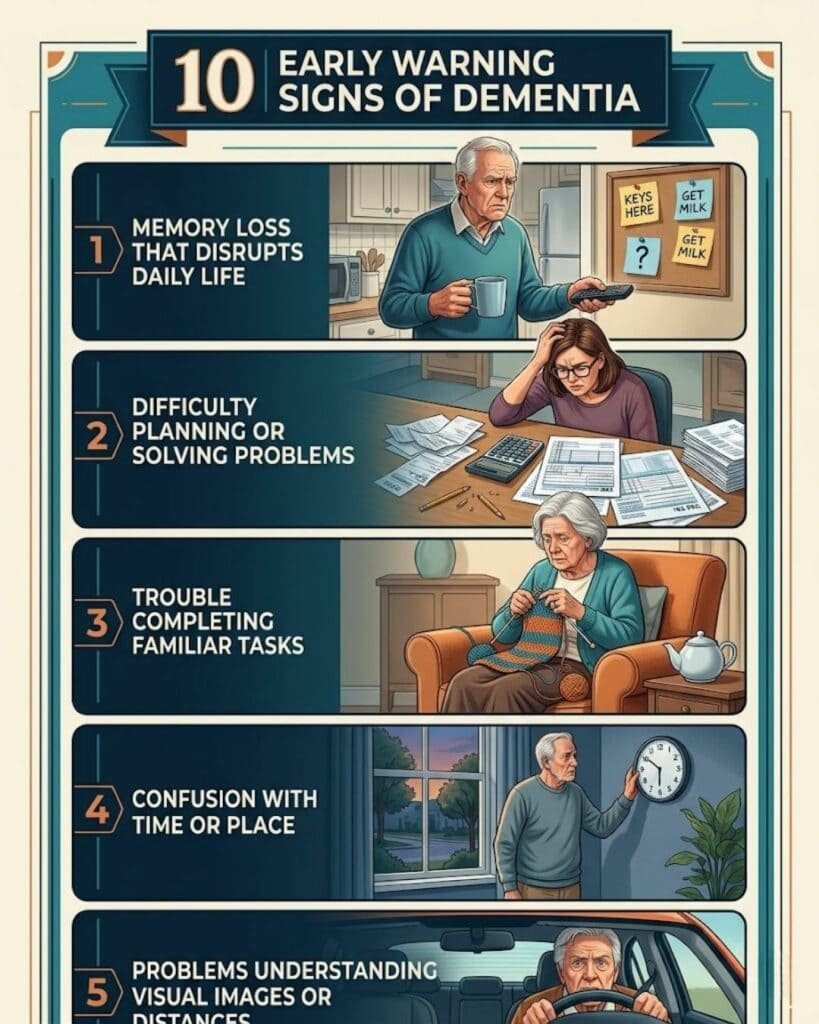
These 10 early signs of dementia are worthy of our attention. Avoiding the possible risks while it’s not too late.
Sign #1: Frequent Memory Loss
I usually forget things when my brain is filled with information, or I am preoccupied with a lot of work throughout the day.
That’s completely normal.
There are moments when we can misplace, forget, or unintentionally fail to remember something.
However, being frequently forgetful could indicate that you may have dementia.
Having frequent memory loss can cause you to:
- Forget trivial details often
- Unable to retain the learned information for a longer period
- Heavily relies on family members for reminders
- Struggle to remember a friend’s last conversation
- Asking the same question for the nth time
This sign should not be ignored as it affects your daily routine, emotional wellness, and mental stability.
It’s concerning because forgetting a conversation that happened even recently isn’t a normal action.
Sign #2: Problematic in Finishing a Familiar Task
Everyone takes no time to finish a task that is familiar to them.
We have tasks that are too manageable to accomplish; they could provide us with relief from our busy day.
In my experience, it took less than an hour to accomplish a familiar task.
Although there are times it feels like the Bruno Mars energy – a feeling where we don’t do anything.
It’s not the same experience as others who are at risk of dementia.
An early sign of dementia is that simpler tasks are challenging to finish.
Most of these tasks are personal habits that we usually feel confident doing.
That includes:
- Following a cookbook instruction
- Cooking for the family
- Managing bills and expenses
- Using electronic devices and appliances
- Traveling to familiar routes
Dementia makes it challenging for you to move confidently and finish the task effortlessly because your memory is slowly fading away.
Your ability to finish a task easily is deeply connected to your brainpower, which can be affected when a person has early signs of dementia.
Sign #3: Got Lost During Conversation More Often
Have you ever imagined having a great conversation with a random person?
As someone with strong interpersonal skills, interacting with a wide range of topics can be fulfilling.
However, when dementia strikes, your ability to showcase an eloquent and articulated self is deeply affected.
When you have a healthy brain, there are instances when you are about to say the right term on the tip of the tongue.
Lost in thought. But you are still invested and connected to the conversation.
Those who have early signs of dementia may start to struggle in responding to the conversation.
Expect a language barrier, physical difficulty, and mental barrier during the interaction.
A person may experience:
- Frequent stops in mid-sentence
- Wrong terminology usage
- Difficulty in labeling things
- Inaccurate replies
- Repeating response
A conversation with someone who shows early signs of dementia is challenging.
Sign #4: Places Suddenly Become Unfamiliar
When I travel to different places, my mind holds memories of that terrain.
In this way, I can easily remember the places I have visited so far.
The only challenge I have experienced is that I might have lost my way the first time going to that specific location.
However, being suddenly unfamiliar with or getting lost frequently in the places you’ve been in your entire life is an early sign of dementia.
People who show early signs of dementia may often feel confused about the places they’ve been in the past.
Aside from that, they may experience:
- Disorientation
- Excessive forgetting
- Struggle in remembering
- Wander for no reason
This can be an alarming sign to your family and friends, who are usually aware of your routine and frequent location.
It can happen to everyone, but it is more frequent among those who have dementia.
This cannot be taken lightly as part of aging.
Sign #5: Distrustful Decision-Making
Some people are known for their keen judgment and wise decision-making.
A skill that is highly crucial, regardless of your current status.
Discernment is a valuable tool that makes you trustworthy to other people.
When a person is hit by dementia, their ability to decide and make judgments will be directly affected.
Once it happens, a person may experience:
- Being vulnerable to scammers
- Forget essential routine
- Poor choices in clothing
- Getting the risk of being victimized
- Carelessly agree to make risky decisions
A person with dementia will frequently make more dangerous decisions because they cannot properly evaluate the risks associated with them.
Aside from being extremely forgetful, their ability to be rational is also deeply affected.
Poor judgment and decisions often result in a person being perceived as unworthy of trust.
Sign #6: Frequent Personality Changes and Mood Swings
Life isn’t always happiness and sunshine. We all know that.
There are moments when we must endure our negative mood and deal with personality changes.
However, people who have dementia may have sudden changes that affect their mood and behavior.
This sudden change often manifests in the person through:
- Suspicious
- Dismissive
- Irritable
- Anxious
- Blank Emotions
Their mood swings and personality changes usually appear in parts of their daily routine, such as:
- Doing their favorite hobby
- At the height of interacting with someone
- During their leisure
- Resting time
Families don’t have to assume it’s just having a bad day when it happens to the person frequently.
Having a bad phase is normal, but experiencing it too often can indicate that a person has an early sign of dementia.
Sign #7: Unable to Match on Conversations
Dementia can affect how well you can hold up a conversation.
However long, a person with a healthy mind can do that.
But for someone who shows early signs of dementia, talking for too long can feel overwhelming.
That’s why some people who have dementia tend to:
- Frequently lost in conversations
- No retention on what was discussed
- Provide repetitive response
- Sudden leave from an ongoing conversation
When their conversation is always unmatched, or the responses are highly irrelevant to the conversation, that’s because communication skills are also affected.
Sign #8: Misplacing Items A Lot
It is too rare for me to misplace my personal items.
When it does, those misplaced items are usually left where they are dropped.
Although misplacing some items can be normal, doing it consistently isn’t.
People who show early signs of dementia tend to forget a lot because their memories are switching on and off.
Aside from dealing with a misplaced item, people with dementia will experience sudden emotional outbursts and become extremely emotional about it.
Sign #9: Forgetting Dates or Times Becomes Usual
A typical person would remember dates or times that have a great impact on their lives.
These are the periods when:
- You were the happiest
- You were the loneliest
- You were the saddest
- You were the angriest
Timelines are deeply connected with your emotions; that’s why you tend to remember them.
But for people with dementia tendencies, they struggle to remember dates and times often.
It’s typical for them to:
- Miss appointments inevitably
- Lost track of time
- Gets confused easily with schedules
- Often forget about the dates
The difference between someone with early signs of dementia and someone with a healthy mind is the frequency level of their forgetfulness.
Sign #10: Always in “Off Socialization” Mode
People with early signs of dementia will experience frequent “off” in any interactions, gatherings, or socialization.
It’s not because they don’t want to, but because their emotional and mental capacity prevents them from doing so.
When they do, they can’t help but act awkwardly in the middle of a conversation.
With no intention to be rude, they either join in or suddenly stop during the interaction.
The difference between extreme introversion is how they act.
Introverts converse selectively, having the capacity to converse, but would prefer to keep it short to avoid being overwhelmed.
On the other hand, people with dementia have a sudden energy shift that is quite noticeable.
Consultation: The Right Time?
Being forgetful does not mean you already have dementia.
But frequent forgetfulness can be an early sign that you may have dementia.
This can only be confirmed through medical evaluation, especially in the early stages.
Medical evaluation may usually ask for details, such as:
- Frequent occurrence
- Intensity
- Safety concerns
- Routine interference
- Communication impact
- Family history
If you suspect someone of having dementia, you may advise the affected person to consult a doctor.
Even if you have a gut feeling that you’re having one in your prime, you may ask for a doctor’s consultation.
You must be a supportive family member or a friend who may assist others with dementia as they face a challenging experience.
Excessive Forgetfulness? Don’t Take it Lightly.
Dementia often starts small, but an overlooked act – excessive forgetfulness.
At first, it may seem like you tend to forget a lot.
You may easily dismiss it, family and friends shrug it off, and some people don’t notice something strange.
Until your conversational skills, emotional stability, memory, and recent actions started to make you look obviously awkward.
These early signs may feel minor, but become major when dementia starts to creep on your brain.
The goal is not just to warn you about the early signs, but to inform you that a healthy lifestyle and diet can protect your brain from vulnerabilities.
Pay attention to your mental wellness, be a supportive family or friend, and share this information with everyone.