
Imagine you are traveling and you’re rushing to find a restroom.
You’re doing it as fast as you can because you’re about to pee.
But as you look at the doors, you haven’t seen signboards like:
“Restroom”
“Bathroom”
“Washroom”
However, one door has two letters on it: “WC”
If you found this one, don’t hesitate to come inside.
WC doesn’t mean:
“Washroom”
“Wheelchair”
“Women’s Closet”
But it stands for “Water Closet.”
In short, toilet.
The WC might be old-fashioned in our modern vocabulary, but it holds an interesting story that everyone must know.
What story does WC hold, and why is it essential to know more about it?
No Other Than Toilet
Cambridge Dictionary defines WC as “Water Closet” or a room that contains a toilet and its fixtures.
It is a compartment or small room that has the toilet itself and the things associated with it.
The next time you see the “WC” sign, that says one thing:
“Here’s the toilet!”
Since it is mostly used in British English and is an older term in American English, non-native English speakers may look confused when they see it.
However, it’s understandable that millions of people missed “toilet” because they thought of WC as another room.
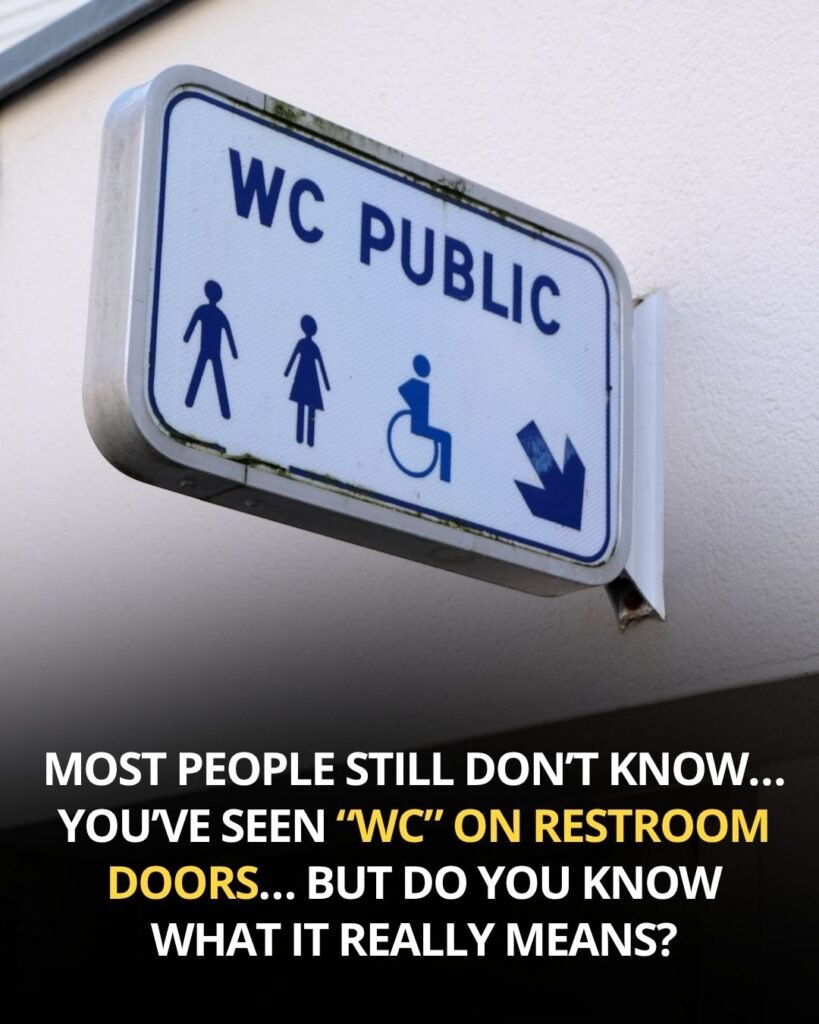
Now, even non-native English speakers can identify that “WC” is clearly a toilet.
Why is it “Water Closet?”
People are often confused when they hear the meaning of WC because of the term “closet.”
It confuses most of us because modern vocabulary understands closet as where our apparel, footwear, or accessories are housed.
But closet is originally meant as an enclosed space or a small, private room.
Even in Merriam-Webster, the term “closet” is defined as a small room.
Combine the terms “water” and “closet” together, and you’ll understand the idea.
Water closet is defined as a small, private space that contains a toilet that uses water to flush away waste.
Logically, a closet with a water-flushing toilet.
The first definition of water closet appeared in Merriam-Webster in 1736. That’s quite an old term that many establishments still use today.
WC’s Historical Development
The modern toilet didn’t just exist as a concept as we know it today; it has developed throughout the centuries/
The process we know about toilets today: press, flush, and waste disappear.
In 1596, an English courtier, Sir John Harington, described a flushing-toilet design.
However, in 1775, Scottish inventor Alexander Cumming patented an improved flushing toilet design. His design has an S-shaped trap that prevents unpleasant sewer gases from coming back to the surface.
Cumming’s plumbing principle has been an essential standard of plumbing ever since. The goal was to promote comfort and indoor sanitary practices.
The toilet was a critical concept because there were few in the early modern times, which led to sewerage problems.
How Common is “WC” Used in Other Countries?
In Britain and other countries that were once part of it (or used British English as their standard), the abbreviation “WC” was widely used.
The Oxford Dictionary notes that the term is used as a British or old-fashioned North American term.
Most European countries still use the abbreviation on public signs, transportation, and even terminals.
However, the use of “WC” across the United States and in countries that use American English as their standard might not be familiar with the term.
Instead of WC or Water Closet, Americans prefer to use terms such as “restroom” or “bathroom.”
By the way, when you encounter a door that has “WC” on it. Don’t hesitate to come in.
Because you already know what it means.
A WC Travel Hack to Remember
Aside from WC, other countries have different names for a toilet.
Here are some of the terms that have a similar definition to WC:
- Washroom
- Bathroom
- Restroom
- Lavatory
- Toilet Symbol
- Comfort Room (CR)
Different countries may have different names for WC for cultural and linguistic reasons, but they mean the same thing.
When WC is not in use, that suggests that such a specific location or country may have used another term.
Now that you know the relative terms of WC, you no longer have to endure your waste for long periods.
It Doesn’t Mean “Wheelchair”
Another misunderstanding about WC is that it signifies “wheelchair.”
Because of that, other people mistake it as:
- A toilet intended for individuals who have mobility difficulties or physical disabilities.
- A room that contains extra wheelchairs.
- Another type of area.
Always remember that WC is only meant as “water closet.” Nothing else.
A Space with Numerous Names
The toilet is an essential part of our routine.
It’s where we release our body waste, take a shower, and cleanse ourselves.
However, humans have different names for that specific, small but private space.
Another term for toilet is “loo.”
However, the interesting thing about the variation of WC terms is what’s inside that room.
For example, a restroom doesn’t have a bed inside it.
A bathroom doesn’t always contain a bathtub.
Aside from the toilet’s evolution, WC itself became proof that English developed terminology variations as well.
Once used as relevant to grooming and apparel, it has now been understood as a symbol of sanitation and freshness.
Tiny Space, Bigger Impact
The use of WC isn’t just a mere understanding of what it is. But a symbol that deals with our daily routine, sanitation, and the need to be clean.
The water closet has a great impact on our sewer systems, access to clean water, and sanitary practices.
It was invented because there is a need to prioritize cleanliness, even in how we deal with our bodily waste.
Currently, the World Health Organization is promoting the critical role of sanitation practices and clean water access to billions of people.
It’s a way to inform people that it’s not just a right, but a necessary part of our daily routine that no one should be deprived of.
WC as Welcome
Now that you know the definition, historical development, variation, and impact of WC.
You are dearly welcome to share it with other people.
It could mean a lot to people.
Water closet might be a term older than your grandparents; it bears a history that makes it a successful and necessary invention for mankind.
Imagine a life without a WC; it’s hard to find a spot and might contaminate both land and water. No overthinking about these two letters next time; you already know that it means “toilet.”