
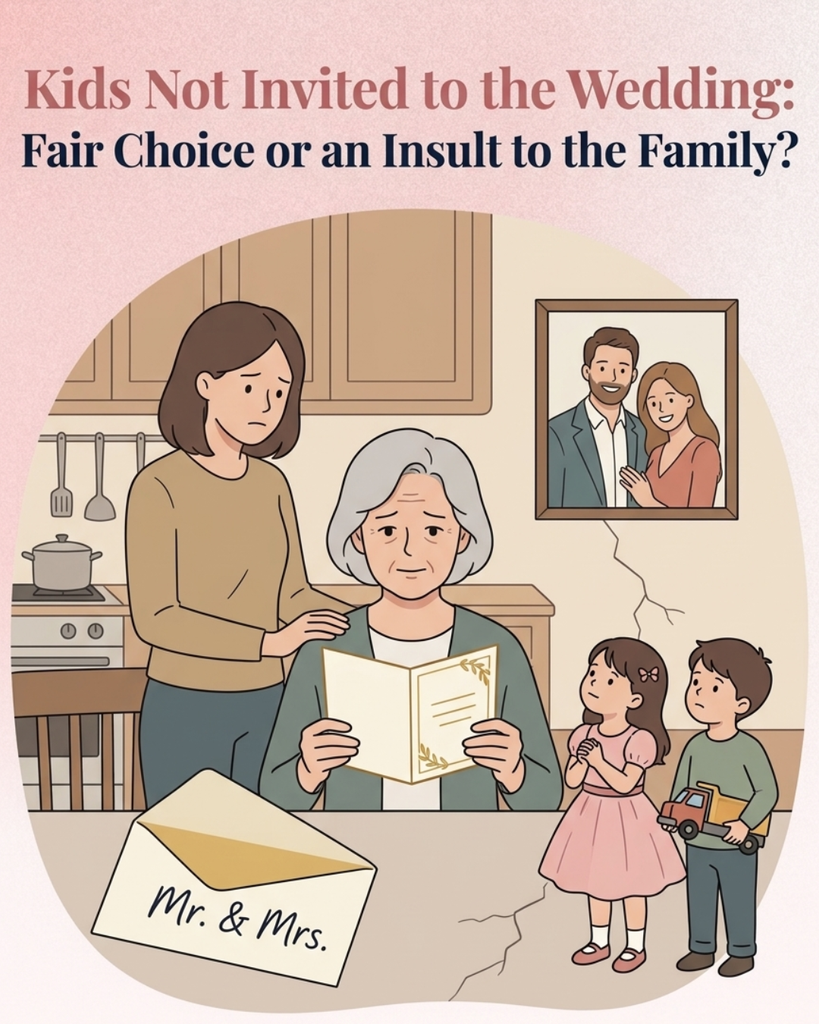
The envelope looks lovely. Thick cream paper, a little gold on the edges, your nephew’s name and his fiancée’s name in fancy letters. Then you read who it’s addressed to. Just you and your husband. No grandchildren, no “and family,” nothing.
An hour later your daughter calls. She got the same invitation, and her two kids, the ones who were supposed to be the cutest guests at the whole party, are not invited either. “So my children are not good enough for his wedding?” she asks, and you don’t really know what to say.
If that sounds familiar, you are not alone. No-kids weddings, or adults-only weddings as many couples call them, have become very common, and they cause more family arguments than almost anything else on the guest list. Some people think it’s a completely fair choice. Others feel it’s a quiet insult to the whole family. And honestly, both sides have a point.
In this article I want to look at why so many couples choose an adults-only wedding, why it can hurt so much, what usually goes wrong, and how everybody, from the couple to the parents to the grandmother in the middle, can handle it without a family fight that lasts longer than the marriage. So, let’s go through it.
How Common Are No-Kids Weddings?
Pretty common. And not only in big cities. Wedding planners say they get asked about it all the time, and the wedding forums are full of couples asking how to word it politely. In the UK, a survey by the wedding blog Love My Dress suggested that around one in three weddings there are child-free. I couldn’t find a big official number for the United States, so take that one as a rough idea rather than a fact carved in stone.
What we do know is how people feel about the rules once they’re set. When a story went viral about a bride who asked two guests to leave because they brought their baby and toddler to a wedding where the invitation said no children, YouGov asked Americans what they thought. 56% agreed with the bride, 27% disagreed, and the rest weren’t sure. So most people seem to think that the couple’s rule is the couple’s rule, even if they wouldn’t make the same choice themselves.
Why Couples Choose It
When you are the one who wasn’t invited, or whose grandkids weren’t, it’s easy to think the couple simply doesn’t like children. Sometimes that’s true. But most of the time the reasons are much more boring than that.
Money, Mostly
Weddings are expensive, and every single guest costs money. According to The Knot 2025 Real Weddings Study, the average wedding in 2024 cost $33,000, with an average of 116 guests. If you simply divide that, it comes to around $284 per person. A five-year-old doesn’t eat like an adult, of course. Still, many venues charge for the seat, the meal and sometimes a special kids’ menu.
Now imagine a family where all the cousins have children. Twenty kids can easily turn into several thousand dollars. For a young couple paying for the wedding themselves, often while saving for a house, that’s a lot of money. Cutting kids from the list is one of the few ways to keep the budget without cutting adults they really love.
The Venue And The Night They Imagine
Some venues have a strict number of people they can hold. Others, like vineyards, breweries or places with a pool or a lake, are simply not great for small children. Weddings also often run late, there’s alcohol, and the music gets loud after ten. Many couples picture a long evening where their friends can relax, dance and stay until midnight without anybody leaving at eight because a toddler is falling apart.
Then there’s the ceremony itself. Every couple has heard a story about a baby crying right in the middle of the vows. Most guests laugh about it later. But for the couple, that’s a moment they waited for their whole life, and they don’t want to hear it over a screaming two-year-old in the video forever.
Keeping It Simple And Fair
Another thing is that the line has to be drawn somewhere. If you invite your cousin’s kids, what about your best friend’s kids, or your coworker’s? Once you start choosing which children are “close enough,” somebody will be hurt anyway. For many couples, no kids at all simply feels like the fairest rule, because nobody can say their child was the one left out.
And some couples just don’t have many children around them yet. Their friends are single, or newly married. A wedding full of kids would feel a little strange to them. That’s simply the stage of life they’re in.
Why It Can Feel Like An Insult
That being said, I completely understand why so many families find it hurtful, especially families where children have always been part of everything.
In a lot of families, weddings are exactly where the kids are. The little ones dancing on Grandpa’s feet, the cousins hiding under the tables, the flower girl falling asleep on two chairs pushed together by the end of the night. For many of us over 40, that’s what a family wedding looked like when we were growing up. Some of our best memories come from those nights. An adults-only wedding can feel like the couple is saying our family isn’t welcome as it is.
There are practical problems too. Parents with a nursing baby may not be able to leave for a whole day. A family flying across the country now has to find a babysitter in a strange city, or leave the kids with someone at home for three or four days. For a single mom, it can mean she can’t come at all. Babysitting for a full wedding day and night isn’t cheap either. The guest ends up paying a lot just to attend.
And sometimes the hurt is deeper. If there are a lot of tensions between the families already, a no-kids rule can feel like one more sign that “they don’t really want us there.” Even when that isn’t true, it’s how it lands. Feelings don’t always follow logic, especially at family events.
Where It Usually Goes Wrong
Most of the time, the problem isn’t the rule itself. It’s the exceptions.
The couple says no kids, but then the bride’s niece is the flower girl, the groom’s boss brings his teenage son, and a friend’s baby somehow shows up at the reception. Suddenly your daughter, who paid a babysitter and drove three hours without her children, sees other kids running around the dance floor. That’s when “we just wanted an adults-only night” starts to sound like “we just didn’t want your children.”
This is why the etiquette experts at The Emily Post Institute say to make no exceptions once you’ve decided. If the couple really wants kids in the wedding party, like a flower girl or a ring bearer, or wants only their own nieces and nephews there, that’s a choice many families accept. But it has to be clear, explained early, and the same for everyone in the same group. Nobody likes to find out at the reception. Trust me on that one.
Babies are the other gray area. Some couples allow a breastfeeding infant, some don’t. Either way, it’s much better to say it clearly than to leave new parents guessing. A simple line on the wedding website, like “nursing babies under six months are welcome,” saves a lot of awkward phone calls.
How Couples Can Do It Without Hurting Anyone
If you have a son or daughter planning a wedding right now, these ideas might be worth passing on.
First of all, address the invitations carefully. According to Emily Post, the names on the envelope tell guests who is invited, so “Mr. and Mrs. Hayward” means the parents only, while “The Hayward Family” means everyone. They also advise against printing “no children” or “adults only” right on the invitation. Many couples put a kind note on their wedding website instead, something like “We love your little ones, but we’ve decided to make our wedding an adults-only celebration.”
Then pick up the phone. For close family, especially siblings with kids and the grandparents, a personal call before the invitations arrive makes a huge difference. It’s much easier to hear “we’re doing adults-only, and I wanted to tell you myself” than to find out from an envelope.
Other than that, couples can make it easier for parents to come. A list of local babysitters, a booked room at the hotel with a sitter for all the kids together, or a separate kids’ room at the venue with a hired caregiver – these small things show that the rule is about the night, not about the children.
And finally, couples need to accept that some people won’t be able to come. That’s not rudeness, it’s just the price of the choice. A gracious “we’ll miss you, let’s celebrate together when we’re back” keeps the door open.
If You Are The Parent Who Isn’t Happy About It
Let’s say you are the one with the kids, or the grandkids. What can you actually do?
Is it disappointing? Sure. Is it worth losing a relationship over? Probably not.
Well, you have a few honest options. You can go without them and treat it as a rare night out with your partner. When was the last time you danced until eleven without anyone needing a snack? You can ask family nearby to watch the kids, or share one babysitter with the other parents who are invited. Or you can decline politely, send a nice card and a gift, and leave it at that. All of these are perfectly fine.
What is not fine is bringing the children anyway. Yes, people still do it, hoping nobody will make a scene. But it puts the couple in an impossible position on their own wedding day, and remember that YouGov poll. Most people would side with the bride.
I’d also gently say, don’t post about it on Facebook. A vague post like “some people forget what family means” might feel good for five minutes, but everybody knows who it’s about, and those posts are remembered for years.
If You’re Stuck In The Middle
Many women reading this are not the couple and not the young parents. You are the mother of the bride or groom, or the grandmother, and suddenly everyone is calling you. Your sister is upset that her grandkids aren’t invited. Then your son calls, stressed about the budget. And your future daughter-in-law feels like the bad guy in the whole story, even though she never meant to hurt anyone.
It’s a tough spot, I know. Nobody wants to pick sides. But it’s important to remember whose wedding it is. You can share your feelings with your son or daughter once, privately and calmly. “I’ll miss seeing the little ones there, but I understand, and I’ll support you” is enough. After that, it’s better to step back and not carry messages back and forth between relatives, because that’s how a small disagreement turns into a family war.
Also, be careful with your future daughter-in-law or son-in-law. How you behave during wedding planning is something many of them never forget, as I wrote about in 7 things mothers-in-law do that daughters-in-law never forget. If you push hard against the no-kids rule, she might remember it much longer than one wedding day.
If your own grandchildren aren’t invited, that hurts in its own way. Just a tip. Plan something special with them for that weekend, even a small thing like a sleepover or pancakes on Sunday morning. They won’t feel left out, and neither will you. Kids usually get over these things quickly. Adults, not always.
So, Fair Choice Or An Insult?
I personally think that in most cases, a no-kids wedding is a fair choice. It’s the couple’s day, they’re usually the ones paying, and wanting one evening where adults can relax is not a crime. Most people who choose it are not anti-children at all. Many of them will have children of their own later, and they’ll probably invite yours to their kids’ birthday parties.
But fair can still be done in a rude way. When the rule is announced through an envelope, when there are quiet exceptions for some kids but not others, or when nobody thinks about the parents who have to travel, that’s when it starts to feel like an insult to the family. So the answer is usually not in the decision itself but in how it is explained and how it is handled.
And for those of us on the older side of the family, it’s also a good moment to remember that our children are building their own lives now, with their own rules, the way we once built ours. That can be hard to accept, as I mentioned in a previous article about why some sons change completely after they get married, but it’s usually easier on everyone when we try.
The Bottom Line
No-kids weddings are here to stay, and they don’t have to break a family apart. Couples can make the choice kindly by telling people early, keeping the rule the same for everyone, and helping parents find a sitter. Guests can respect it even if they don’t love it, by coming alone, declining politely, or finding a way to make that weekend special for the kids at home. One wedding is just one day, while the relationships around it are supposed to last a lot longer than that.
Would you go to a wedding where your children or grandchildren weren’t invited? Let us know in the comment box below.