
Imagine that it’s your first time walking into the therapist’s office.
As you enter the room, you see those empty seats.
The therapist said:
“Take a seat where you’re feeling comfortable.”
As you looked at the seats, there were:
- A chair in front of the therapist.
- One in the corner.
- Another is close to the door.
- Some on either side.
- Another with extra space.
Now, you have a few seconds to choose a seat.
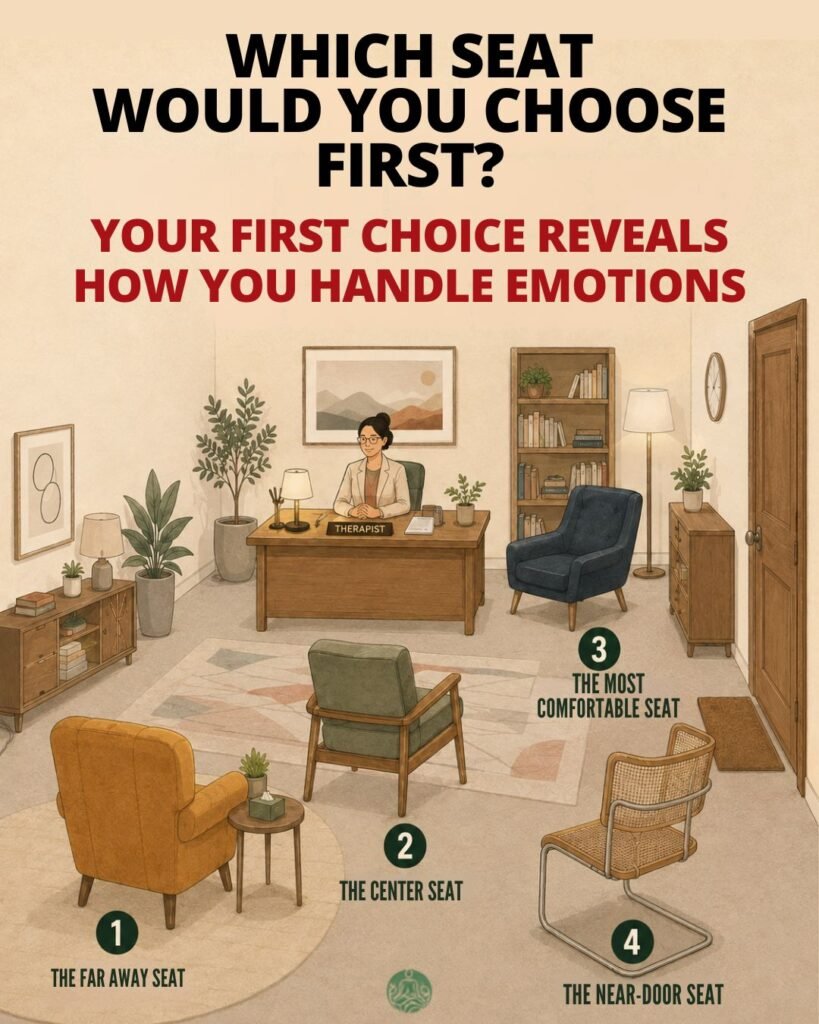
No need to overthink.
After that, proceed to where you believe you’re rightfully seated.
Did you know your chosen seat is linked to your personal space, vulnerabilities, and emotions?
But this is not an actual clinical assessment, only a fun, psychological brain teaser to assess how your mind works with unfamiliar situations.
Have you decided which seat you’ll sit in? If yes, hold on to your answer.
Never Change Your Answer
Be warned!
Never make changes to your first answer.
Hold on and never change it, even if you know what it means.
This brain teaser is only meant to provide a fun fact about the seat.
It tests how your brain works, but it can’t define your entire self.
The Carefully Chosen Seat
Choosing this seat means that you didn’t choose on a random basis.
This seat is proven to be favorable for you for many reasons:
- Provides a great view of the entire room.
- A perfect angle to converse with the therapist.
- Not the most exposed seat.
- Personal-level comfort.
You didn’t randomly select this seat but backed it with a strategy.
This choice suggests that you love to observe first before making a move.
You carefully evaluate the environment before interacting because you want to understand what’s going on around you first.
This seat revealed that you decide with caution, avoiding others by taking advantage of your vulnerabilities.
In short, your priority is your safety and welfare before opening up.
The Most Comfortable Seat
You chose this seat without any complicated reasons.
This seat reflects that you prioritize comfort and practicality above all else.
In your perspective, this seat prioritizes your comfort, which is where you rightfully are.
Instead of being strategic about where to sit, you prefer to choose without relying much on reasoning.
The seat reveals that you are straightforward and prefer to cut unnecessary things in a conversation.
You want to know how people felt in a certain situation rather than to know what happened.
The Center Seat
Choosing this seat means you didn’t worry about being in the most exposed position in the entire room.
You don’t mind sitting directly at the therapist’s seat.
Choosing this seat means you prioritize direct communication and clear answers.
Instead of circling, you prefer to talk things through directly and know what’s wrong.
Choosing this seat means you value honesty, but at some point, you also tend to keep your emotional privacy.
You’re comfortable in discussing the problem, but mostly at the level of confrontations.
This seat appears to be for someone who communicates often about the problem, but there’s no guarantee it’s resolved or that it involves open communication.
The Far Away Seat
What if you chose the seat farther from the therapist’s seat?
The seat represents the need to prioritize personal space, even though their emotional distance could become a possible challenge.
This choice symbolizes that you can provide limited emotional availability, partly to avoid rejection or abandonment.
Because you believed that too much availability could lead to being taken advantage of, especially when you are investing so much.
Avoidance became the only way to prevent a possible form of unrequited feeling.
The Near-Door Seat
When you chose the seat near the door, that means you take “exit” as a weapon you can use if necessary.
From your perspective, leaving is an excuse to escape an overwhelming situation or a way to relax from what stresses you.
Whether that’s a conversation, relationship, commitment, or emotions they can’t face.
You take the exit as a chance to avoid serious matters if it’s necessary for your welfare.
The seat represents your strong avoidance attachments and your ability to exit as your mechanism for anything uncomfortable.
However, not every exit you make is always negative.
Sometimes, it could mean that people around you should pause, as it matters too.
What if Your Seat Tells Something About You?
Each seat has corresponding positive and negative attributes.
Some people don’t see closure as a problem, but avoidance could also be a shield.
The seat you’ve chosen wants to tell you that in every situation, there should be a better response.
However, you must be attentive to their responses.
The seat emphasizes your emotions and perspectives about attachments and relationships.
Although people have different responses, you must be careful and attentive to how they feel about you.
That’s your guide on how to treat them accordingly.
Not everyone is worthy of your closeness and emotional investment.
Don’t fear rejection and abandonment the most. But rather, fear wasting your time and effort on someone who doesn’t see your emotions.
Seat is Only a Representation, Not an Entire Reflection
Your chosen seat assesses how stable your emotional security is in unfamiliar patterns or circumstances.
But remind yourself that it’s not a diagnosis of who you are as a person.
Whatever seat you chose, remember that it may or may not inform something about you.
The seat may be your partial reflection, or not at all.
Don’t worry about it.
These seats are limited to representing emotional security and attachment levels that you may have, so they can improve your responses to things related to them.