
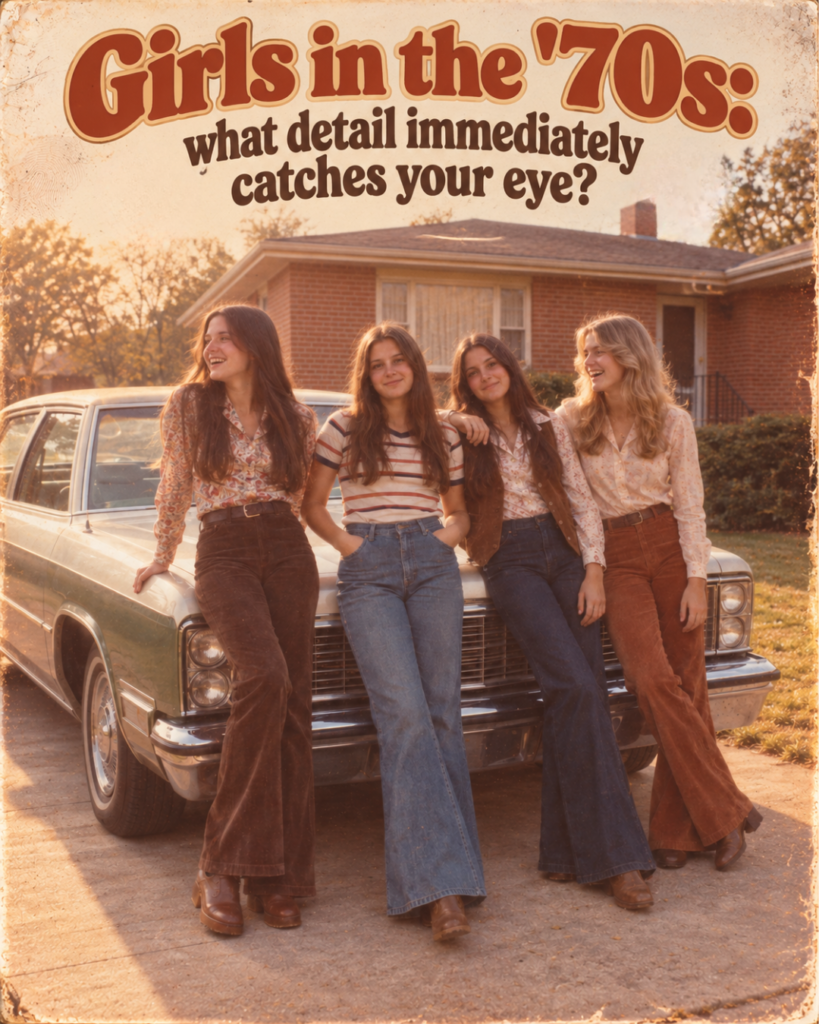
Somebody hands you a photograph from 1974. Four teenagers lean against the hood of a car in front of a brick house. One of them is laughing at something outside the frame. The colors have shifted toward orange, the corners are soft, and there is a thumbprint on the sky.
Where do your eyes go first?
Most people say the clothes, or the hair. A few say the car instead. Almost nobody says “their hands,” and yet the hands are the most revealing part of the picture. They are empty. One holds a bottle, one rests on a shoulder, and two hide in pockets. Nobody is holding a screen, because there was no screen to hold. That single absence explains more about the distance between 1974 and today than any bell-bottom ever could.
This article walks through what a 1970s photograph actually shows, what it hides, and why the ordinary snapshots from that decade have become some of the most shared images on the internet fifty years later.
The clothes are the easy clue
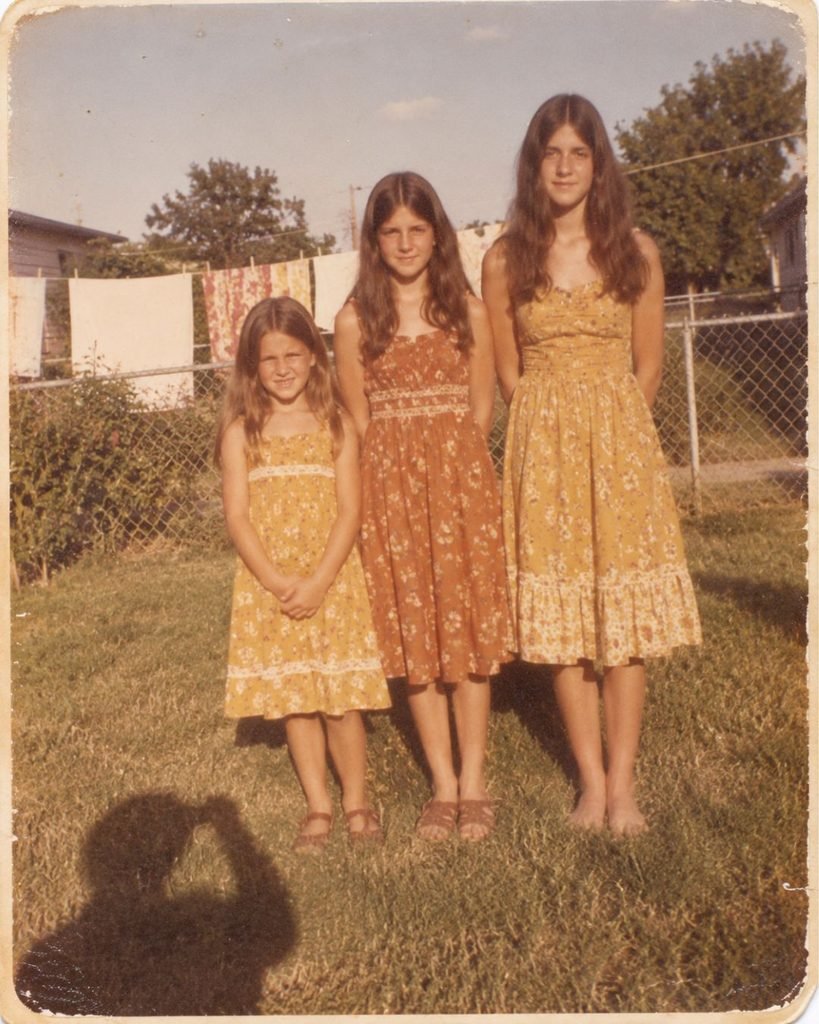
Start with what you noticed first. Fashion in the seventies moved fast and moved in several directions at once, which is why a photo from 1971 and a photo from 1978 can look like they came from different decades. Early in the decade, the sixties still hung around in the fabrics and the cuts. By the middle years, trousers flared, collars widened, and ordinary department stores sold colors that would look like a dare today. Toward the end, the lines cleaned up again, and the polyester gave way to denim and simpler shapes.
So clothing dates a photograph within a few years, even when the back carries no date. That is useful for anyone sorting a shoebox of family prints, and it is also the reason vintage photo pages on Facebook can ask “what year do you think this is?” and get thousands of confident answers.
Hair does the same work, too. Long, natural, and heavy for both men and women in the first half of the decade, then feathered and shaped in the second half. A man’s sideburns alone can narrow the date. If you are trying to place a photo, look at the hair before you look at the clothes. After all, anyone could borrow an outfit for a party, but hair took months to grow.
The camera changed what people did in front of it
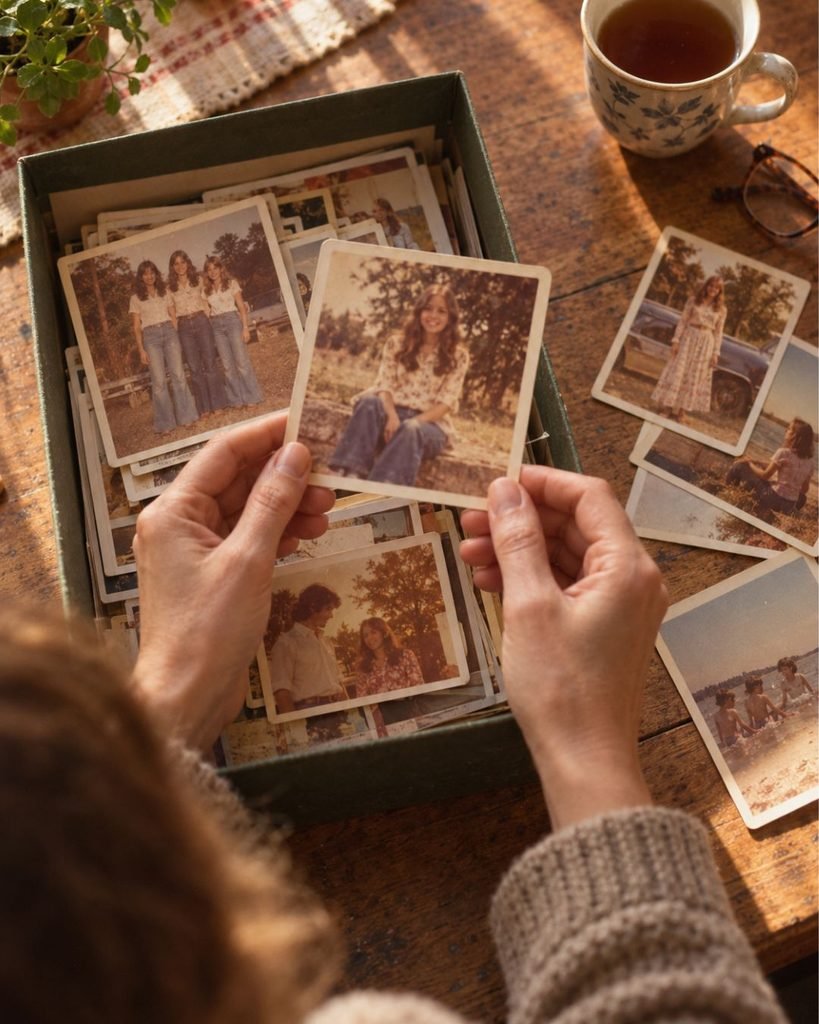
However, here is a detail that is easy to miss: almost everyone in a 1970s snapshot is looking at the camera. Group shots look posed, and people stand in a row. Someone says “ready?” and the shutter clicks once.
That is not a style choice. Instead, it comes from film. A roll held 12, 24, or 36 pictures; the roll cost money, and developing it cost more. You did not see the result for days, sometimes weeks, and you could not delete a bad frame. So people made each frame count, and they planned for it. They gathered, they faced the lens, they held still. The candid, mid-motion, forty-attempts-to-get-one-good-shot approach that fills a modern camera roll was simply too expensive to practice.
As a result, this changes how you should read the pictures. A 1970s photograph is rarely a random moment. It is a chosen moment. Someone decided that this afternoon, this gathering, these people were worth one of the 24 exposures. That decision is part of the image, and it is one of the reasons the pictures feel weighted even when nothing dramatic is happening in them.
If you want to understand the difference in your own life, look at how many photos you took at the last birthday you attended. Then imagine someone had given you three.
What the frame leaves out
Now look at the negative space, the things that would be in a modern photo and are missing here.
First, there is no phone on the table. Nobody is looking down. Nobody is half in the conversation and half somewhere else. A text will never call the kids in from the yard; instead, a voice from the porch will. The adults at the table are talking to the people at the table, because the people at the table were the only people available.
It is tempting to treat this as a moral lesson, and most articles about vintage photographs do exactly that. A fairer reading is that the seventies simply did not have a choice. Presence was the default because nobody had built the distractions yet. People were not more disciplined than we are. They were less tempted.
Still, the effect on the photographs is real, because the rooms shaped the pictures. Faces turn toward each other, and bodies lean into the group. The pictures look social because the rooms were social, and the rooms were social because there was nowhere else to be while sitting in them.
Rooms built for conversation
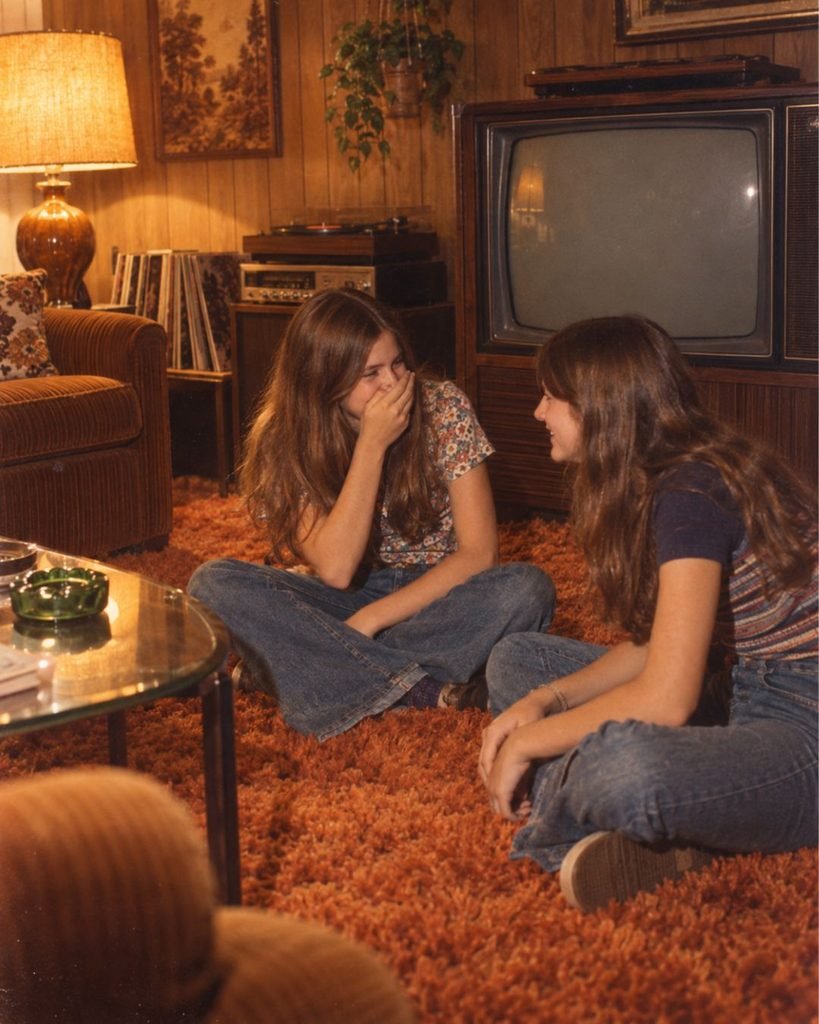
Interior shots tell the same story from a different angle. Look at a 1970s living room, and you will usually find one television, often in a wooden cabinet, sitting where the fireplace would have been in an older house. The furniture faces inward or toward that one screen. There is a stereo cabinet or a turntable, sometimes with records leaning against it. There is also a bookshelf, a lamp with a heavy shade, and a carpet in a color nobody has made since.
What you will not find, however, is a second screen or a third. A modern living room might contain a television, two laptops, a tablet, and four phones, each one pulling a different person into a different place. The seventies living room had one shared point of focus and a lot of seating aimed at other people.
Kitchens photographed the same way, too. You see a table for eating, a radio on the counter, and a wall phone with a cord long enough to reach the pantry so someone could talk with a little privacy. The layout assumed that talking happened in a fixed place, at a fixed time, with one person at a time.
Music you could hold
Records show up constantly in 1970s photographs: on shelves, on the floor beside a teenager, tucked under an arm on the walk home from a shop. That is because music in the seventies was an object before it was a sound.
You bought an album and carried it home. Then you read the sleeve while the first side played, and you got up to flip it. If a song came on the radio that you loved, you listened to the whole thing, because there was no way to hear it again on demand. Later, cassettes made music portable, but even then you recorded the radio and waited through the DJ talking over the intro.
That is also why a photograph of a stack of records can make someone in their sixties go quiet. Each sleeve carries a room, a person, a year. Music that arrives as an infinite stream is harder to attach to anything. The seventies did not have better music than any other decade, but it had music that stayed put.
The street, the car, and the kid who came home at dark
Outdoor photos from the decade nearly always include a car, and the car nearly always dates the picture faster than anything else in it. Long hoods, chrome bumpers, vinyl roofs, and paint colors named after fruit or metals. For many families, the car was the thing they photographed most, because it was the most expensive thing they owned that could sit in front of the house.
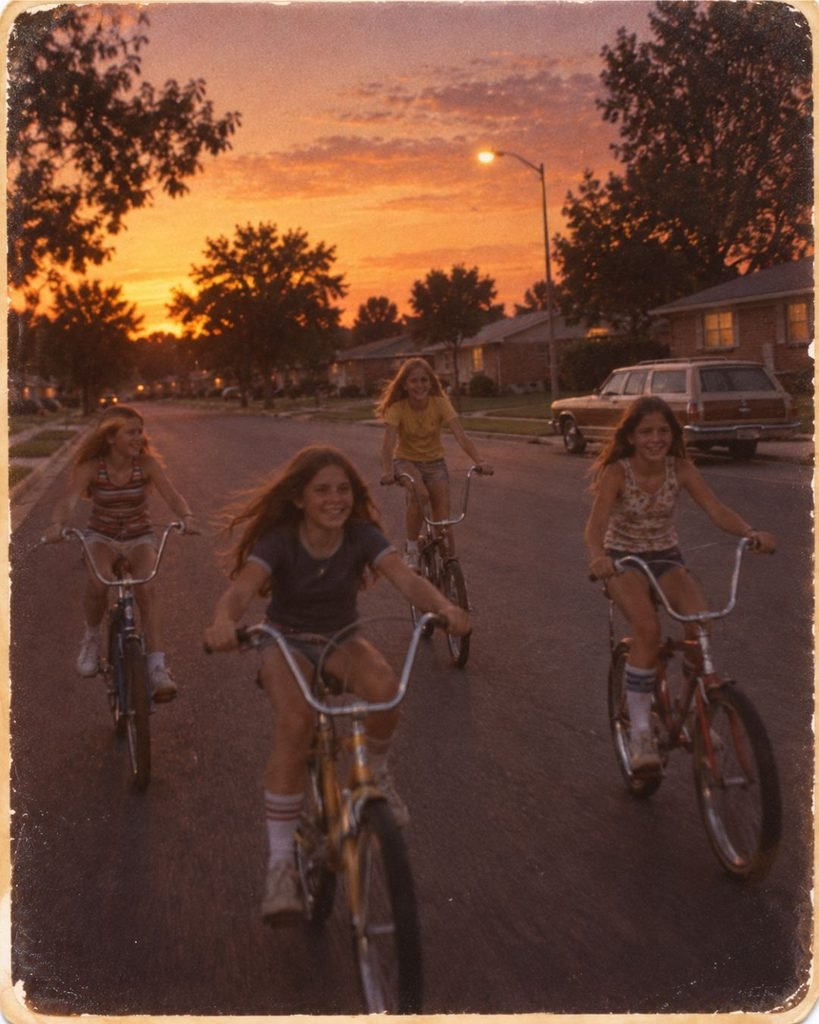
Next, look at the street behind the car. Children are often in it, or on the sidewalk, or on a lawn, without an adult in the frame. That is not neglect, though. It reflects a period when children moved through their neighborhoods on their own schedule and came home when the streetlights came on. Parents could not track them, and did not expect to. That freedom came with real risks that the photos do not show, and it also produced a kind of childhood that many people who lived it describe as the best part of the decade.
Beyond the yard, the neighborhood itself worked as a network. People knew the names of the families four doors down. News moved over fences and across porches. A photograph of a block party or a backyard barbecue from 1976 will usually show more neighbors than most of us could name today.
Nobody was taking the picture for strangers
Here is the difference in mindset that sits underneath everything else. When someone raised a camera in 1975, the audience for that photograph was the people in it, plus whoever might flip through the album on a holiday. That was the entire reach.
No one was calculating how the photo would perform, either. No one chose the angle that would get the most reactions from people they had never met. The picture was not content. It was a record, made for a small circle, and the small circle is visible in the pictures themselves. People look relaxed in a way that is hard to fake. They are not posing for a crowd. They are posing for their mother.
Of course, this did not make people vain-proof. They still fixed their hair and sucked in their stomachs. But the scale of the audience was a dozen, not a thousand, and a dozen is a number a person can actually be comfortable with.
The decade was not a postcard
Any honest look at 1970s photographs has to stop here for a moment. The warm color cast, the empty hands, the kids on bicycles: all of it invites nostalgia, and nostalgia edits.
For example, the seventies carried inflation and fuel shortages that hit ordinary households hard. Political trust collapsed in several countries. Many groups lived with limits and unfair treatment that photographs from the period rarely capture, because those people were often not the ones holding the camera. Medical care was thinner, too. People also knew far less about health risks, from smoking to seatbelts, or chose to ignore them. A lot of the smiling faces in those photos were smiling through problems we would not accept today.
So the value of these images is not that they prove life was better. They prove life was different, and they let us see the shape of that difference clearly enough to think about our own.
Your camera roll is somebody’s future shoebox
There is a second thought hidden inside every vintage photograph, and it is about you.
The teenagers on the hood of that car were not thinking about 2026. They were thinking about the weekend. Nobody told them that strangers would one day study their jeans, their hair, and their car for clues about how people used to live. At that moment, they were just living.
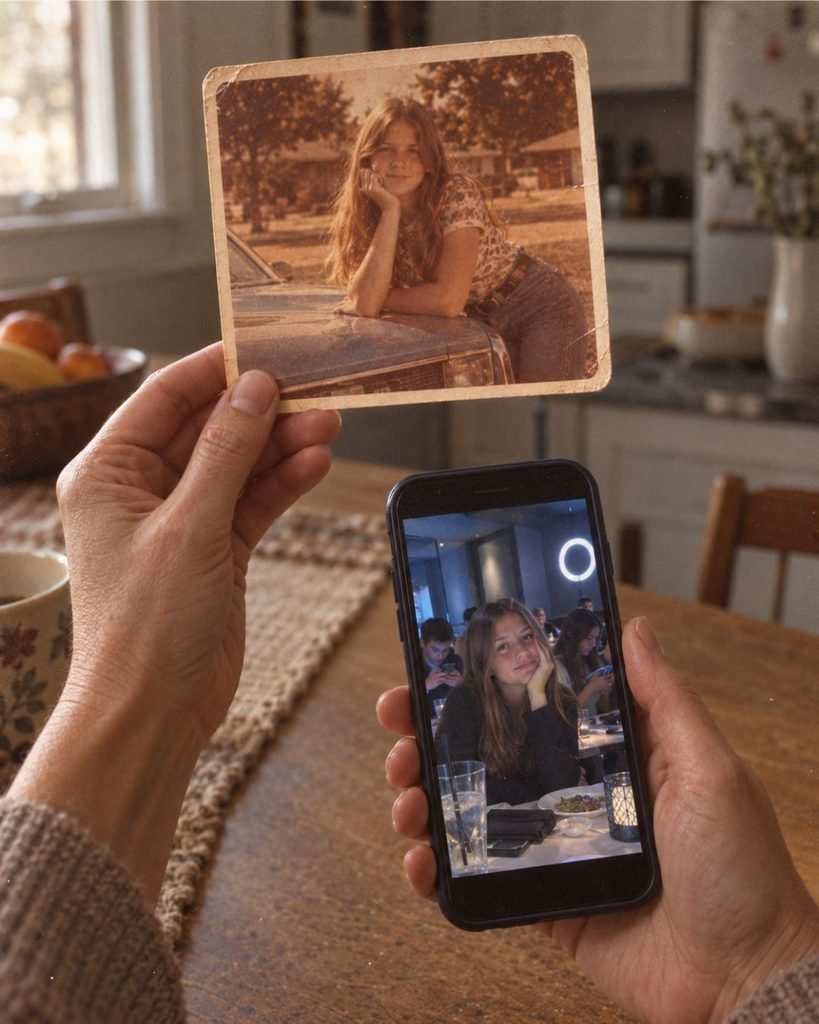
Meanwhile, the same thing is happening on your phone right now. Fifty years from now, someone may scroll through your photos and stop on the details you never noticed: the size of the phones, the way everyone in a restaurant is looking down, the ring light in the corner of a bedroom, the specific shade of gray that covered every kitchen for about eight years. Eventually, those will look as strange to them as avocado-colored appliances look to us.
The habits we consider invisible are the ones the future will find most interesting. That is the real lesson of an old photograph, and it points forward, not back.
What to borrow without going back
Nobody needs to give up a phone or buy a film camera to take something useful from these pictures. Still, a few habits from the decade carry over directly, and none of them require nostalgia.
First, take fewer photos at the events that matter most. Decide before a birthday or a dinner that you will take three, then put the phone away and be one of the people in the frame instead of the person outside it.
Second, print a handful of pictures each year and put them somewhere physical. A photo in a drawer gets looked at, but a photo in a cloud folder with 14,000 others usually does not.
Third, aim the furniture at people. If your living room faces the screens, try one week with the chairs facing each other and see what changes in the conversations.
Fourth, let one evening a week be unreachable. The seventies had this by accident. You can have it on purpose.
Finally, listen to a whole album, in order, without skipping. It takes forty minutes, and it will attach that music to this season of your life in a way a playlist never will.
None of these are old-fashioned. They are simply what people did before something easier arrived, and the photographs suggest they worked.
Back to the photograph
Look at the picture one more time. The four teenagers, the car, the brick house, the thumbprint on the sky.
You probably noticed the clothes first, and that is fine. But the thing worth carrying away is the laugh caught mid-frame, aimed at someone we will never see, on an afternoon nobody planned to remember. One exposure out of twenty-four, spent on an ordinary day, and fifty years later it is still doing its job.
So whatever you photograph this week, choose it like it costs something. Someday it will be the only frame left.
So which detail caught your eye first in the photo: the clothes, the car, or the hands?