
My grandmother never used the word frugal once in her life.
She would not have known what a no-spend challenge was. She did not track anything in an app; she never once posted her pantry online, and if you had tried to explain to her that people now make a comfortable living filming themselves reusing a jam jar, she would have looked at you over her glasses as though you had completely lost your mind and then gone back to what she was doing.
Instead, these were simply things she did. So did most of her generation. Not as a lifestyle, and certainly not as an aesthetic – as the ordinary, unremarkable way a house was run.
And here is what gets me. Those habits worked. They kept families afloat through much harder years than ours. Nobody felt deprived, because nobody thought of them as sacrifices. They were just normal.
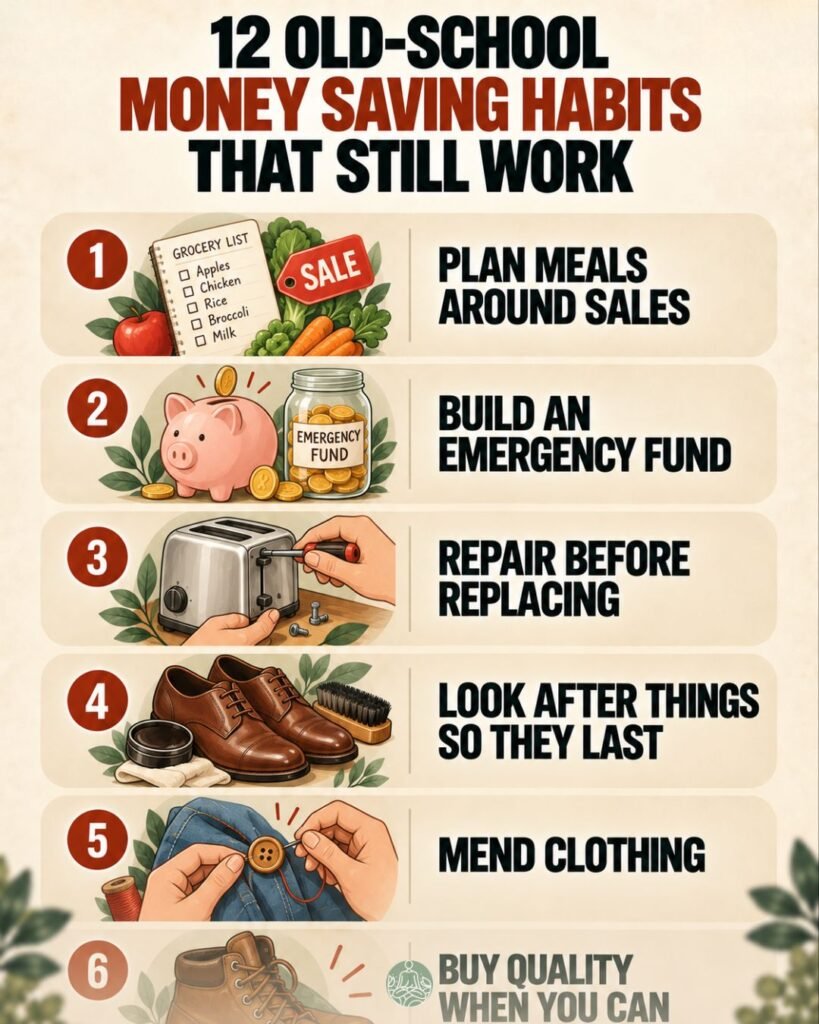
So, let’s go through twelve of them.
1. Save First, Spend Second
This is the one that holds all the others up, so it goes first.
Most of us do it backwards. The money comes in, the bills go out, we spend on whatever the month throws at us, and whatever happens to be left over gets saved. Which, most months, is nothing.
The older way flipped that around. A portion came off the top the moment the money arrived, before anything else could get anywhere near it, and it usually went into an envelope, a biscuit tin on a high shelf, or a separate account at the little bank on the corner where the cashier knew everybody by name. The rest of the month then had to fit around what was left.
It sounds like a small change in order. It is not. Saving whatever happens to be left over depends on willpower every single month, and willpower tends to run out right around the time the washing machine breaks and the school trip money is due. Saving first depends on willpower exactly once, on the day you set it up.
Today you can automate it, which is the modern version of the tin. Set a transfer for the day your money lands, and let it happen before you ever see it.
2. Keep An Emergency Fund
Nobody called it an emergency fund. It was the money for when things go wrong, and everybody assumed things would.
That assumption is the part we have lost. The Federal Reserve surveys American households every year, and in its most recent report only 63 percent of adults said they would cover an unexpected $400 expense using cash or its equivalent. Just 55 percent had three months of expenses set aside.
Four hundred dollars is not a catastrophe. According to Kelley Blue Book, the average car repair in 2025 costs $838, more than double that.
The money pressure that comes from having no cushion at all takes a physical toll too, which I went through, in the warning signs your heart is under too much stress.
Start small if the full amount feels impossible. A few hundred is a different life from nothing. I am not a financial advisor, so for anything bigger than a starter fund, talk to somebody who is.
3. Repair Before Replacing
A wobbly chair got a screw. A toaster that stopped working got opened up on the kitchen table to see what had come loose. A lamp got a new plug.
The first question was never Where can I buy another one. It was, can this be fixed, and it was asked about almost everything, from a radio to a pair of shoes to a chair that had been in the family for forty years.
Somewhere along the way we swapped that question round, partly because things got cheaper and partly because manufacturers made them harder to open. But a surprising amount still can be fixed, and there is almost always a video online, usually made by a patient retired engineer somewhere, showing exactly how to do it with tools you already own.
There is a second benefit nobody mentions. You learn how things work. And a person who understands how things work spends a great deal less money for the rest of their life.
4. Look After Things So They Last
This is the quieter cousin of repairing, and it saves even more.
Shoes got polished and re-heeled. The car got its oil changed on time. Good knives were dried by hand and never went near the dishwasher, and once a year somebody pulled the fridge out and dusted the coils at the back, whether anybody felt like it or not.
None of it is exciting, and none of it will ever go viral. All of it means the thing does not break in the first place, which is cheaper than any repair and a great deal less annoying than being without a car for a week while you wait for a part.
Think of it as the difference between owning a thing and renting it from the shop until it wears out.
5. Mend Clothing
A button came off, so a button went back on. A hem dropped, so somebody got the sewing tin out that evening. Knees went through on the children’s trousers and came back with a patch.
It took five minutes at the kitchen table, usually with the radio on, and it kept perfectly good clothes in use for years longer than they would otherwise have lasted.
Today most of us would simply throw the shirt away over a button, which is a strange thing to do when you think about it for more than a second.
You do not need to be a seamstress. Learn to sew on a button and fix a hem, and you have covered most of what actually goes wrong with clothes.
6. Buy Quality When You Can
The old logic was simple. Pay more once rather than less three times.
A good coat lasted fifteen years. A cheap one lasted two, and then you bought another cheap one, and then another, and by the end of those fifteen years you had spent considerably more than the good coat would have cost you in the first place, and you had been noticeably colder the entire time as well.
I want to be honest about the catch, though, because this habit has a cruel side. Buying quality needs money up front, and when money is tight, you often cannot afford the good version. So you buy the cheap one, and that cheapness quietly costs you more over the years. Being poor can end up expensive in exactly that way.
So the habit is when possible, not always. Where you can stretch for something you will use every day – shoes, a mattress, a decent pan – it usually pays for itself many times over.
7. Cook From What You Already Have
Before anybody went shopping, somebody opened the cupboard and asked What can I make with this.
Most modern cooking works the other way round. You choose a recipe, then buy everything it needs. That includes the half jar of something you will use once and bin in March.
The older approach started with what was already there. Half a cabbage, some potatoes, the end of a piece of cheese, two eggs. And somebody who had been cooking for thirty years could look at that small collection of odds and ends, think for about ten seconds, and turn it into a perfectly good dinner without opening a single recipe book.
Try one night a week where you shop only in your own kitchen. You will be surprised what is already in there.
8. Save The Leftovers
Leftovers were not a sign that you had cooked too much. They were tomorrow’s lunch, and everybody planned for them.
The roast became cold meat on Monday and a soup by Wednesday. Stale bread became breadcrumbs or bread pudding. Nothing went in the bin that could still become something else.
The trick was having the right containers and a habit of actually eating what went into them. Push it to the back of the fridge, and in a week it turns into a science experiment.
9. Waste Less Food
This is where the old habits add up to real money, and the numbers are bigger than most people expect.
In 2025, the US Environmental Protection Agency updated its estimate of household food waste. It came to $728 per person every year, or $2,913 for a family of four. That nearly doubled the old figure of $1,500 that people still quote, which was based on 2010 grocery prices.
Nearly three thousand dollars. Every year. Scraped into a bin.
Researchers at Penn State reached a similar conclusion from a different direction, finding that American households waste close to a third of the food they buy. Almost none of that is dramatic. It is the bag of salad that went slimy, the half loaf that went green, the leftovers nobody got round to.
The fixes are almost boring. Shop with a list. Put new food at the back of the fridge and old food at the front. Freeze bread before it goes stale. And use soft fruit rather than binning it – overripe bananas are the best part of a good banana strawberry smoothie.
10. Carry Lunch From Home
A sandwich wrapped in paper, a flask of tea, an apple. That was lunch for a working life.
Now a bought lunch can easily run to ten or fifteen dollars a day. Across a working year, that becomes a genuinely large number – the kind of sum people struggle to find for a holiday, and then spend without noticing, one sandwich at a time.
You do not have to do it every day. Three days a week from home is still a real saving. It is usually healthier too, since you know exactly what went into it.
11. Reuse The Jars
Every house had a cupboard full of them.
Jam jars became storage for screws and buttons. Pickle jars held leftover soup. Glass bottles got washed and filled with homemade lemonade. Nobody ever bought a matching set of storage containers from a shop, because perfectly good containers arrived free of charge with the shopping every single week, and throwing them away would have seemed faintly ridiculous.
It is a small habit, and it saves small amounts, I will admit that. But it trains something much bigger than the jar itself, which is the instinct to stop and ask whether a thing still has a use before it goes anywhere near the bin.
12. Borrow What You Rarely Use
One ladder on the street. One hedge trimmer. One pressure washer, owned by the man at number six, who lent it out and got a bottle of something in return.
Nobody needed their own of everything, because they knew their neighbours and they trusted them.
That last part is the real loss here, and it is not about money at all. We buy a drill that gets used for about eleven minutes in its entire working life, because asking to borrow one would mean knowing the people next door well enough to knock.
Try it. Knock on a door. The neighbour almost always says yes. And you might get a friendship out of it worth considerably more than the drill.
Why This Feels Hard Now
If these habits were so sensible, why did we drop them?
Partly time. Mending, cooking from scratch, and fixing a toaster all take time. Most households now have two working adults and very little time spare.
Partly price. When a new shirt costs less than an hour’s wages, sewing on a button can feel like a poor trade. It usually is not.
And partly something quieter. Many of these skills simply were not passed on. If nobody ever showed you how to darn a sock or rescue a stale loaf, it never occurs to you that you could.
That is fixable. None of these skills are difficult. They just need somebody to decide they are worth learning again.
What They Understood
None of this was ever really about money, not underneath.
It was about respecting the things you had, the food on the table, and the work it took to earn both. Throwing something away that could still be used felt wrong to them, and I think they were right about that.
I should be honest that some of these habits came out of genuine hardship rather than virtue. Plenty of people mended clothes because they had no choice at all. There was nothing romantic about it at the time.
But the habits outlived the hardship, and they still work. You do not need to adopt all twelve at once or turn your life into a project. Pick two. Do them until they stop feeling like effort and start feeling normal, which is exactly how your grandmother got there.
Much of this wisdom lived with an older generation, and I wrote about the real value grandparents bring to a family.
Which of these did your mother or grandmother do without ever thinking twice? Tell me in the comments below. I would love to collect the ones I have missed.