
Everyone at the funeral said what a wonderful mother she was.
And you stood there nodding, holding a paper cup of coffee, listening to people describe somebody you had never met in your life.
That is the particular loneliness of growing up with a parent like this. It is not just what happened at home. It is that nobody outside the house ever saw a single minute of it, so you spent forty years as the only living witness to a version of your own mother that everybody else in the room would have called a lie if you had ever been brave enough to describe it.
There is a real difference between a parent who is good and a parent who needs to look good, and the gap between those two things is where a lot of childhoods quietly disappear.
So, let’s go through what that gap actually is, why the research has a name for it, and what it did to you.
One thing first, and I mean it. I am not a therapist, and nobody should diagnose a parent from a health blog. Narcissistic personality disorder is a clinical diagnosis; plenty of image-conscious parents do not have it, and these patterns hurt just as much either way.
The Research Has A Name For This
Most people picture a narcissist as somebody loud and arrogant. I am the smartest person in this room, that sort of thing. But psychologists identified a second version a while ago, and it is the one that produces this kind of parent.
In 2012, Jochen Gebauer and colleagues published five studies in the Journal of Personality and Social Psychology describing what they called communal narcissism. The core motives are identical to the loud kind – grandiosity, entitlement, a need for admiration, and power. What differs is the route.
Instead of I am the most intelligent person, the internal script reads I am the most helpful person. I am the most caring person anybody knows. People will remember how much I gave up for other people.
Read those again, slowly. They sound like humility. They are not. Underneath, each one is a grandiose statement wearing the language of selflessness, which is exactly why they are so impossible to argue with.
And here is the detail that explains your entire childhood. In Gebauer’s work, communal narcissists rated themselves as extraordinarily high in warmth and caring. The people around them did not agree.
So the gap is not something you imagined. Researchers have measured it.
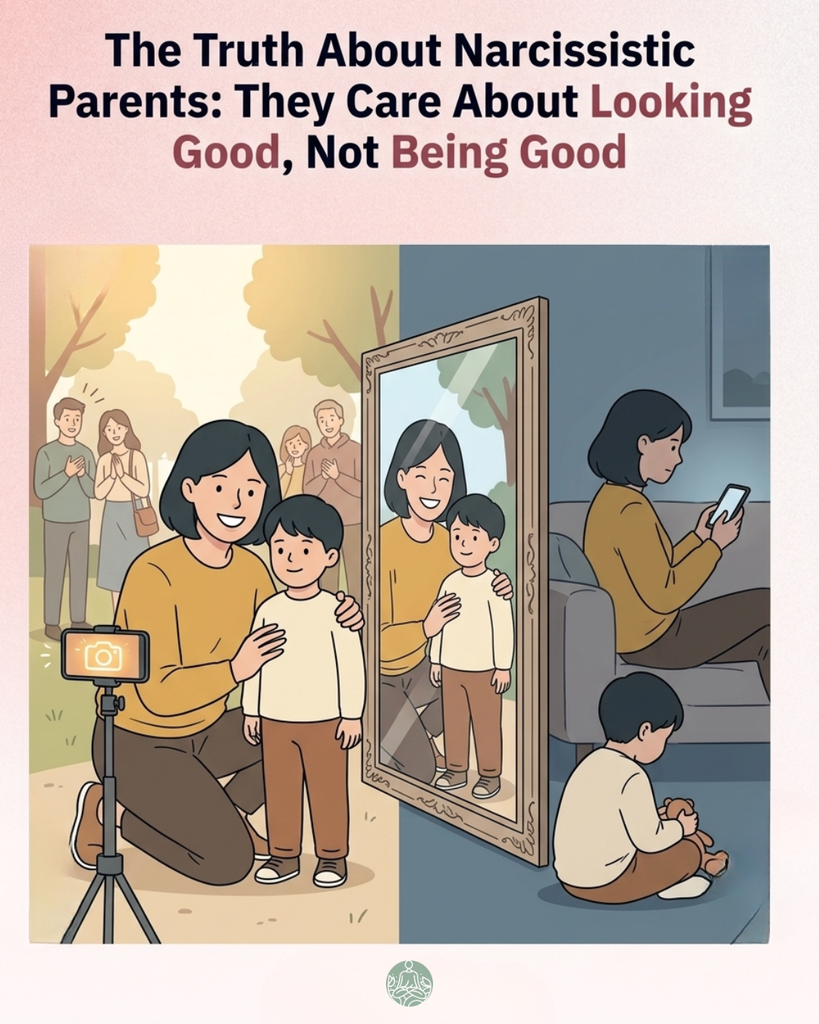
The Public Version And The Private Version
You know both of these people. Most other people have only met one.
In public she is generous, funny, endlessly patient. She remembers the neighbour’s operation. She organises the collection at church; she is the first to bring food when somebody is ill, and people genuinely mean it when they say she would do anything for anybody.
At home, the moment the door closes and the audience is gone, something switches off. The warmth goes. What is left is short, cold, critical, or simply absent, and there is no transition between the two – it is more like a light going out.
This is the part that makes people doubt themselves for decades. If she were cruel all the time, at least it would be simple, and you could describe it in one sentence. The switching is what does the damage, because it proves beyond any argument that she was capable of warmth the entire time. She simply did not spend it on you when there was nobody there to see her do it.
A child cannot hold that thought for long, because it is far too frightening. So the child does the only thing available, which is to decide quietly that the problem must be them.
Why Nobody Ever Believed You
Try telling somebody about it. You already know how that conversation goes.
Your mother? She is lovely. You are so lucky. I wish my mum were like that.
So you stop saying it out loud to anybody. And that silence becomes its own long-term problem, because when nobody believes you for long enough, and you have no way of checking your own memory against anybody else’s, you eventually stop believing yourself.
Then there is the evidence problem. What she actually did was mostly small and mostly deniable. A tone of voice. A comment about your weight at a family lunch, said with a smile so that objecting would make you the difficult one. Being warm to your friend and then silent with you on the drive home.
None of that survives a description out loud. Read a list of it to somebody, and you sound petty, which is why so many people carry this on their own for their whole adult life.
Love That Arrived With Conditions
This is where the research gets genuinely useful, because it puts a name on something you probably could not name.
Psychologists studying self-determination theory describe a pattern called parental conditional regard. It means a parent hands out warmth and attention, or takes them away, depending on whether the child performs, complies, or makes the parent look good.
Here is the finding that surprised me most. Even the positive version is harmful – the version where a parent gives extra love when a child does well, rather than punishing them when they do badly. It looks benign. It looks like encouragement. But researchers found it produced self-esteem that rises and falls with performance, rigid and anxious achievement, poorer well-being, and quiet resentment toward the parent that surfaces years later.
So the good grades got you warmth. The trophy got you a phone call to the relatives. And somewhere in there you learned that love was something you earn by producing results, which is an exhausting way to go through life.
The same research found that parents with contingent self-esteem – parents whose own sense of worth depends on how things look – are more likely to use this pattern. That is the whole mechanism, in one sentence.
You Were A Reflection, Not A Person
Think about which of your achievements got attention.
The visible ones. The ones she could mention to somebody. Exam results, the school play, the job title, the wedding photos, the grandchildren.
Now think about which parts of you got nothing. Your actual opinions. What you were frightened of. The thing you loved that nobody could see a point in.
A parent who needs to look good is not really raising a child. They are managing an exhibit, and the exhibit has to stay presentable.
Which is why they treat leaving as betrayal. Moving away, choosing the wrong partner, leaving the church, leaving the family business, or just telling an outsider the truth – all of it damages the display, and the reaction is usually out of all proportion to what you actually did.
Why They Cannot Apologise
Most people reading this are still waiting for one particular sentence, even if they would never admit it.
It is not coming, and it helps to understand why rather than to keep hoping.
For somebody whose whole identity rests on being seen as a good person, an apology is not a small social gesture that costs nothing. It is a confession that the image is false. Admitting they hurt you means admitting they are not who they have told everybody they are for fifty years, and that is not a price they can pay.
So you get the substitutes instead. I did my best. I gave up everything for you. Other children would be grateful. You always were too sensitive.
Each of those is the image defending itself. None of them is an answer.
When you stop waiting for the apology, something shifts. You are no longer asking a person for the one thing they are structurally unable to give, and you can grieve that as its own loss instead of chasing it.
What Happens With The Grandchildren
This catches people completely off guard, and it deserves its own warning.
Your difficult parent becomes a grandparent, and suddenly they are warm. Patient. Generous. They say encouraging things to your child that were never once said to you.
Two feelings arrive at the same moment. Relief, because somebody is finally treating your child the way you wanted. And something much closer to grief, because you are watching live proof that it was always possible.
That second feeling is not jealousy, and you have nothing to apologise for. It is old sadness arriving late, and it can knock you sideways at a birthday party for no visible reason.
Sometimes it is genuine, and a good grandparent is a real gift to a child – I wrote about the power grandparents have in a family. Sometimes it is a new audience. Watch whether they enjoy the child or display the child.
What It Left You With
A childhood spent performing for love does not stop affecting you at eighteen. It follows you into work, into friendships, and into your own marriage, usually without announcing itself.
You may find that you cannot rest without feeling guilty, because rest was never the thing that earned approval. You may over-explain yourself constantly, since you learned young that your version of events would be questioned. And you may apologise for things that are nobody’s fault, because apologising defused the atmosphere at home and the habit never left.
Compliments might make you uncomfortable, because praise always used to come with an invoice attached.
There is often a strange split as well. You can be extremely competent at work, where the rules are clear, and effort produces results, while feeling completely lost in situations where somebody simply likes you for no reason at all and wants nothing back.
A lot of the eldest daughters I hear from carry this particular version of it, and I went through that pattern in why the eldest daughter ends up managing the whole family.
None of this is permanent. But it does help to see it as a set of habits you were trained into rather than personality traits you were born with, because habits can be unlearned and personality feels like a sentence.
What Actually Helps
I want to be careful in this section, because a lot of writing about narcissistic parents tips into contempt, and telling readers their elderly mother is evil helps nobody.
Four Things That Work
Stop trying to convince people who were not there. You will not convince the aunt who thinks your mother is a saint, and every attempt costs you something. Let them have their version. You know yours.
Separate the care from the relationship. You can arrange good medical care, handle the practical things properly, and still not offer emotional closeness to somebody who has never handled it well. Those are two different jobs, and you may do only one.
Find the one person who does believe you. A sibling, a friend, a therapist. Not a crowd – one person who has the whole picture and does not need convincing. That single relationship does more than any amount of explaining to everybody else.
And decide your contact level while you are calm, not during a bad phone call. A short monthly call you can keep for years beats a guilty three-hour visit followed by two months of avoiding them. Guarding your own energy through this is not cold, and I wrote about it in how to protect yourself from negative energy.
The Part That Is Hard To Hear
Two honest things, and then I will stop.
The first is that not every difficult parent is a narcissist. Plenty of people care what the neighbours think, or were cold, or were simply overwhelmed for twenty years by things you never saw. People use the word for almost everything now, and reaching for it too quickly can close a door that did not need closing.
The second is harder. A review of research on parental narcissism published in 2025 found consistently poorer relational and psychological outcomes for the children, and the patterns behind that are stable. A parent like this may soften a little with age. They will probably not transform.
So the useful question is not whether they will finally see you. It is what you want the next ten years to look like, given that they probably will not. That distance often grows slowly rather than in one dramatic break, which I looked at in the reasons grown children stop visiting their parents.
What You Should Take From This
You were not too sensitive. You were accurate, and being accurate about your own mother is a lonely thing to be at nine years old.
The confusion you grew up with was not a flaw in your perception. It came from watching two different people wear the same face, while everybody outside the house insisted that only one of them existed.
You do not need anybody to confirm it now. Not the aunt, not the neighbours, and not the parent.
Being good and looking good were never the same thing, and you have known the difference since you were small. That is worth something.
If this sounds like your family, tell me in the comments what nobody outside your house ever saw. You do not have to name anybody. I think a lot of people are about to find out they were not the only one.