
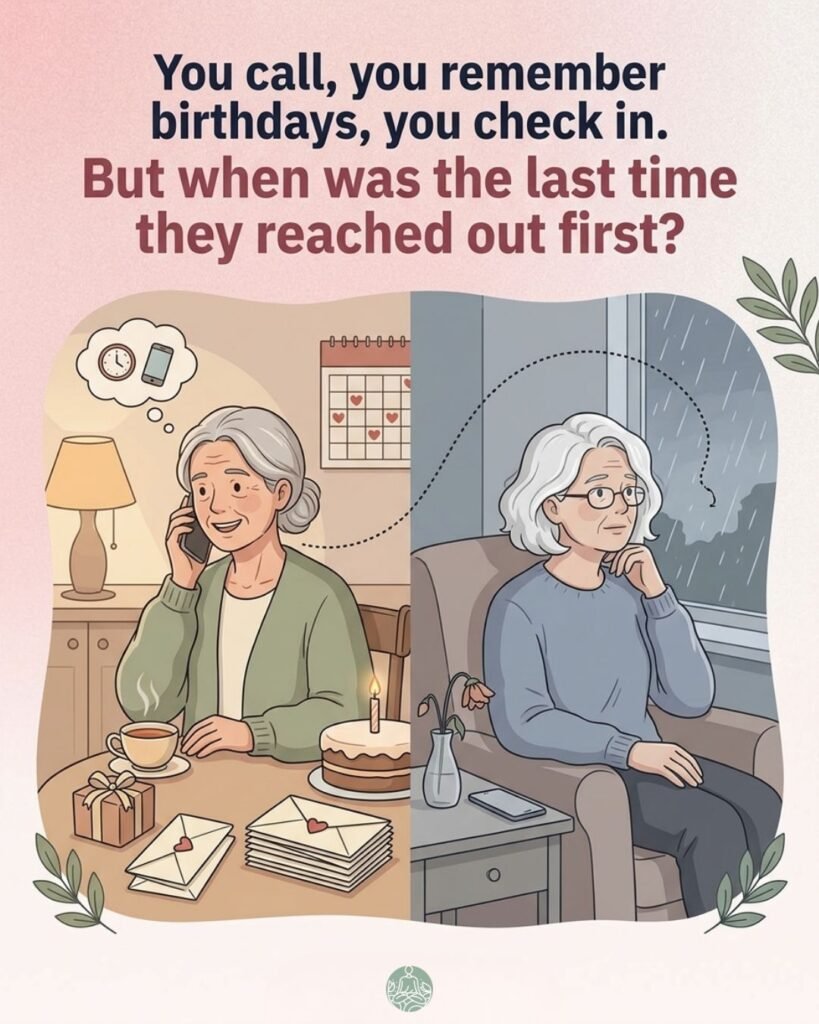
You text first, suggest coffee, and remember the birthday. You ask how the hospital appointment went, and you are the one who notices when it has been two months and nobody has called.
So one day you try an experiment. You just stop.
And then nothing happens. A week goes by, then a month, then a whole season, and the friendship that felt so important to you simply goes quiet, as though it had only ever been running on your battery the entire time, and the moment you stopped charging it, it just switched itself off without anybody noticing.
That is a particular kind of hurt. It is not dramatic enough to talk about, and there is no fight you can point to. So most people carry it quietly and feel a bit foolish for minding.
But before the signs, I want to tell you about a piece of research that changed how I think about this. It complicates things in a genuinely useful way.
So, let’s start there.
Before You Decide, Read This
In 2023, a group of researchers led by Peggy Liu at the University of Pittsburgh published a set of thirteen experiments with nearly six thousand people. They were looking at something very simple. When you reach out to somebody just to say hello, how much do they appreciate it?
The answer was consistent across every single experiment. The people doing the reaching out significantly underestimated how much it would be appreciated. It held for texts and for small gifts, for close friends and for distant ones, and an independent team later replicated it, which is rarer in psychology than it should be.
Now think about what that means for your friend who never calls.
She may be sitting there right now, thinking about you, and deciding not to text because she assumes you are busy. She is making exactly the same mistake the people in the experiments made, and in exactly the same direction.
Psychologist Marisa Franco, who wrote a whole book about adult friendship, argues that people chronically underestimate how much others like them – and that assuming you are liked tends to make it true. I wrote about that kind of internal shift in how your mindset shapes your brain, body, and life.
So not initiating, on its own, proves very little. Some people are simply bad at it. The nine signs below are about telling the difference.
Why This Happens So Often After 40
It is worth saying that this gets more common in midlife, and not because anybody became a worse person.
Life simply rearranges itself. Children leave, or need more. Parents get old and need care. Marriages end, jobs change, people move away, and each of those shifts can quietly pull somebody’s whole attention in a new direction for a year or two, often without them noticing that the friendships at the edges of their life have stopped getting any of it.
So a friendship that ran easily for fifteen years suddenly needs one person to hold it together. Often that is whoever has a little more room at that moment.
That is not always a betrayal. Sometimes it is just a season.
The question is whether the season ends. A friend going through something hard is allowed to be absent for a while. A friend who is absent for eight years, while living a perfectly ordinary life, is telling you something different.
1. You Always Make The First Move
This is the one everybody notices first, and it is also the weakest of the nine, for the reason I just explained.
Being the only one who initiates matters much less than what happens after you do. A friend who never calls but is delighted every time you ring is a different person entirely. Compare her with one who never calls and sounds faintly inconvenienced when you do.
Pay attention to the answer, not just the silence before it. Are they warm? Do they ask how you are? Do they seem genuinely glad to hear your voice, or do they sound like somebody who has been caught on the way out of the door?
If they are, you may have a friend who is simply not a planner, and you may decide you are happy to be the planner. That is a perfectly reasonable arrangement, and plenty of lifelong friendships run on it. Some of us just end up being the organiser, in friendships as in families, and I wrote about why the eldest daughter so often ends up managing everyone.
2. They Only Appear When They Need Something
Now we get to the real signs.
Months of silence, and then suddenly a warm, chatty message. Three lines in, it becomes clear they need a lift to the airport, or a reference, or somebody to listen to them about their divorce for two hours.
There is nothing wrong with needing help. Friends are for that. The pattern to watch is when the only times they appear are the times they need you, and the moment the need is met, the silence returns.
That is not a friendship running quietly in the background. It is a service you are providing, and they have your number saved under useful.
3. Every Conversation Somehow Ends Up About Them
You mention your week. Within about forty seconds, you are hearing about theirs.
You start telling them something that genuinely matters to you, and they wait for a gap – you can almost see them waiting – and then they take the conversation back to whatever they were thinking about before you started talking.
An hour later you are driving home, and you realise, with a small sinking feeling, that they never asked you a single question about your own life the entire time.
Everybody has self-absorbed days, particularly in a crisis, so do not judge anybody on one bad afternoon. But if you could not tell a stranger three things that are currently going on in your friend’s life, while they could not name one of yours, that imbalance is telling you something.
4. They Cancel Easily And Never Reschedule
Life happens. Children get ill, work runs late, people get tired. One cancellation means nothing at all.
The sign is what comes next. A friend who values you cancels and immediately offers another date, because they would rather not miss seeing you. A friend who does not value you cancels, apologises, and leaves the rescheduling with you, indefinitely.
So watch who does the rescheduling. If it is always you, and plans with you are always the first to be dropped when something better turns up, that is information.
5. They Do Not Remember What You Told Them
You told them about the scan results. Three weeks later they have no idea there was ever a scan.
You mentioned your mother’s operation, your daughter’s exams, the thing at work that was keeping you awake. None of it seems to have gone in.
Memory is not a perfect measure, and plenty of busy, loving people are simply forgetful, so give some grace here. But remembering is one of the clearest ways people show that your life matters to them.
A friend who asks how the appointment went without being prompted is telling you something important. A friend who never does is telling you something too.
6. You Feel Worse After Seeing Them
This is the most honest test on the list, and it does not require analysing anything at all.
Notice how you feel on the drive home. Lighter, or heavier? Understood, or slightly smaller than you felt when you arrived?
Some friendships leave you with more energy than you started with. Others take it, reliably, every single time, and you only realise how tired you are once you are back in your own kitchen. I went through this in more detail in my article on energy-giving and energy-draining habits, because the effect on your body is real and it builds up over years.
Your body usually knows before you do. Trust it.
7. They Disappear When Things Go Wrong For You
Friends reveal themselves in bad weeks rather than good ones.
When your life fell apart – the illness, the divorce, the redundancy, the bereavement – who showed up? Who brought food, sent a message, sat with you, or at least asked?
Some people are genuinely awkward around grief and simply do not know what to say, so they say nothing at all and hope you understand, and that is a real limitation in them rather than a lack of love for you. But if the same person is always present for your celebrations and always absent for your crises, that pattern is hard to explain any other way.
You needed them once, and they were not there. Remember that the next time you rearrange your week around them.
8. Your Good News Makes Them Go Quiet
This one is subtle, and it stings in a very specific way.
You tell them something good. A promotion, a new relationship, a holiday you saved two years for. And instead of being happy for you, they go flat. They change the subject, or find something wrong with it, or quickly mention something better that happened to them.
A real friend is glad when good things happen to you, even when they are going through something hard themselves. A competitive friend treats your good news as a small loss for them.
If you have started keeping good news to yourself around a particular person because it is not worth the reaction, notice that. You are already protecting yourself from them. If there is a pattern of disrespect underneath it, I wrote about how to deal with people who have disrespected you.
9. The Relief Test
Here is the last one, and it is the simplest.
Imagine they texted tomorrow to say they were moving to the other side of the world and would probably not be in touch much. What is the very first thing you feel? Before you have time to be polite about it.
If it is sadness, the friendship still matters to you, whatever its imbalances, and it may be worth working on.
If it is relief, even a small flash of it, then you already know the answer. You probably knew it before you started reading.
The Experiment That Settles It
If you are genuinely unsure, there is a simple way to find out, and it costs you nothing.
Stop initiating for about six weeks. Not as a punishment and not as a test you announce, just quietly. Answer warmly when they reach out, but let them be the one to reach out.
Then watch. A friend who values you but is bad at initiating will eventually get in touch, often with something like I realised we have not talked in ages. A friend who was only there because you kept the thing going will not notice you have gone.
Either answer is useful. And both are far kinder to you than spending another five years lying awake wondering, rearranging your weekends around somebody, and quietly feeling foolish for minding.
What To Do About It
You have three real options, and none of them requires a dramatic ending.
Say something. Plenty of one-sided friendships are one-sided by accident, and a gentle, honest sentence fixes more of them than you might think. Something like I miss you, and I have noticed I am usually the one who gets in touch – is everything all right? That is not an accusation. It is an invitation, and how they respond will tell you a great deal.
Adjust your investment. You do not have to end anything. You can simply match their level, see them occasionally, keep it light, and put your energy into the friendships that give it back. Protecting your energy like this is not cold, and I wrote about it in ” How to protect yourself from negative energy.
Or let it fade. Most friendships that end do not end with a conversation. They drift, and drifting is allowed. You do not owe anybody a formal closing speech.
One more thing worth knowing. Close friendships take a lot of time to build. Communication researcher Jeffrey Hall found it takes roughly 50 hours together to become casual friends, 90 to become friends, and more than 200 to become close ones. So the time you stop pouring into a one-sided friendship is not wasted. It is time you can finally give to somebody who will give it back.
You Deserve Friends Who Reach Back
Being the one who always reaches out usually says something good about you. You are loyal, you remember things, and you notice when people go quiet. Those are lovely qualities, and you should not stop having them.
You just deserve to spend them on people who notice.
And somewhere, quite possibly, there is somebody who has been wanting to call you for months, who picks up the phone every so often and then puts it down again, and who has been talking themselves out of it the whole time because they assumed you were far too busy to want to hear from them. Maybe text them first this time. The research says they will be happier to hear from you than you think.
Are you the one who always reaches out? Tell me in the comments which of these nine signs you recognised, and whether you have ever tried the six-week experiment. I would genuinely like to know what happened.