
Most people take B vitamins the same way. They grab a “B-complex” or a “stress formula” at the pharmacy because someone said B vitamins are good for energy, swallow one every morning, and never think about it again. I was the same, honestly. Then I started reading the labels more carefully and realized there are eight of them hiding under that one letter – and that most of us are taking them a little bit wrong.
Eight different vitamins. Eight different jobs.
They do share some things, of course, and they like to work as a team. But each of the B vitamins has its own role in your body, its own favorite foods, and in a few cases its own risks when you take too much of it from supplements, which is the part almost nobody puts on the front of the bottle.
And for those of us over 40, a couple of them matter more than they used to, because the way the body absorbs and uses them changes with age. If you have ever wondered whether your tiredness could have something to do with your diet, I wrote about what your body is trying to tell you with vitamin and mineral deficiencies, and B vitamins are a big part of that picture.
Some people take far more than they need. Some take the wrong one. And some, often the ones who need it most, take nothing at all.
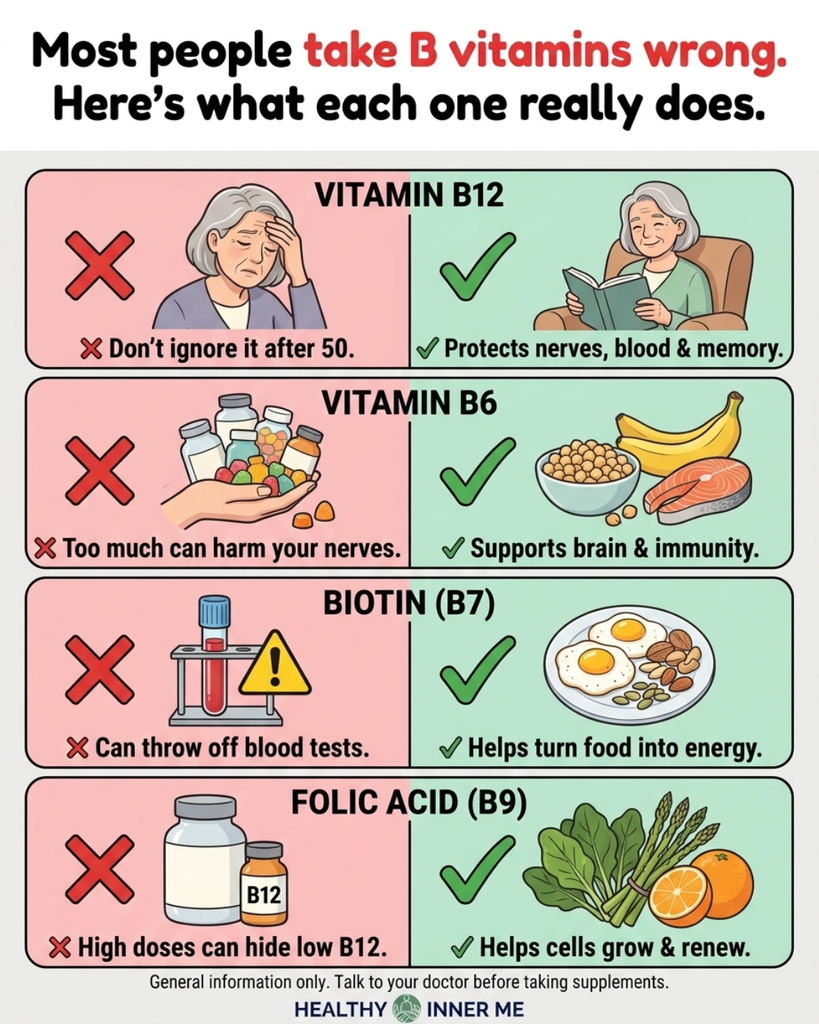
So, let’s dive into it – all eight B vitamins, one by one, what each one actually does, where you find it, and the most common mistakes people make before they even open the bottle.
What All B Vitamins Have In Common
Before we go through them, a few things are true for the whole family. All B vitamins are water-soluble, which means your body doesn’t keep big reserves of most of them, and whatever you don’t use mostly leaves through your urine. That’s why you need a steady supply from food, more or less every day.
B12 is the big exception. Your liver can store it for years, which is good news, but it also means a deficiency can creep up slowly and go unnoticed for a long time.
Another thing they share is energy. Almost every one of the B vitamins helps your body turn the carbohydrates, fats and proteins from your plate into energy your cells can actually use. They don’t give you energy the way coffee does, though. Think of them more like the workers in a factory – without them the raw material just sits there.
Wondering why the numbers jump from B3 to B5, and from B7 to B9 and B12? You’re not alone. Over the years scientists numbered a few substances that later turned out not to be true vitamins. Those numbers simply got dropped. A small mess from history, nothing more.
1. Vitamin B1 (Thiamin)
Thiamin was the first B vitamin scientists discovered. Its main job is helping you turn food – especially carbohydrates – into energy. It also matters for your nerves, your muscles and your heart. Women need about 1.1 mg a day and men 1.2 mg, says the NIH Office of Dietary Supplements.
Most people get enough from their regular food. But some people are more likely to fall short, including older adults, people with diabetes, people who have had weight-loss surgery and, especially, people who drink a lot of alcohol. Alcohol makes it harder for the body to absorb and use thiamin. A serious shortage can even damage the brain and memory.
Where to find it: pork, fish, beans, lentils, seeds, nuts, whole grains and fortified bread, cereal and rice. Pork, surprisingly, is one of the best sources out there. I keep a small jar of sunflower seeds on the kitchen counter, partly for thiamin, partly because I like them.
2. Vitamin B2 (Riboflavin)
Riboflavin helps your cells grow and work properly, and like its brothers it helps release energy from food. Women need about 1.1 mg a day and men about 1.3 mg.
Here is a fun fact. The name comes partly from the Latin word for yellow, and if you have ever taken a B-complex and then noticed your urine turning a bright, almost neon yellow – yes, that’s riboflavin. It’s harmless. It also breaks down quickly in light, and according to the NIH fact sheet for health professionals, that is one reason milk usually isn’t sold in clear glass bottles anymore.
You may also have heard that riboflavin helps with migraines. Some studies say it might. A few medical groups even call it “probably effective” for preventing migraine headaches, but overall the results go both ways. So if migraines are your thing, it’s worth a conversation with your doctor rather than a guess.
Where to find it: eggs, milk, yogurt, lean meat, liver, mushrooms, spinach and fortified cereals. People who avoid dairy and eggs, like vegans, may need to pay a bit more attention.
3. Vitamin B3 (Niacin)
Niacin is another one of the energy workers. It also matters for the growth and function of your cells. Women need 14 mg a day and men 16 mg. Interestingly, your body can make some niacin on its own. It uses tryptophan, an amino acid found in protein foods like turkey and eggs.
Before food fortification, a severe niacin shortage called pellagra was common in parts of the American South. Doctors described it with the “four Ds” – dermatitis, diarrhea, dementia and, sadly, death. Today it is rare in developed countries, which tells you how much fortified bread and cereals quietly changed things.
Now here’s the part I find most interesting. For years, high-dose niacin was used to improve cholesterol, and it does improve the numbers. But here’s the problem. In large studies, those better numbers didn’t lower heart attacks or strokes, as the NIH explains. Better on paper, not better in real life. Supplements with 30 mg or more of niacin can also cause “niacin flush” – red, burning, itchy skin on the face, arms and chest – so the upper limit for adults is 35 mg a day from supplements.
Where to find it: chicken, turkey, beef, pork, fish (tuna and salmon especially), peanuts, legumes and fortified grains.
4. Vitamin B5 (Pantothenic Acid)
This one has my favorite name. “Pantothenic” comes from a Greek word meaning “from everywhere,” and that’s exactly the point – it’s found in almost every food, in small or large amounts. Adults need about 5 mg a day.
Pantothenic acid helps your body pull fuel out of every meal, and it also has a hand in building and breaking down fats. According to the NIH, a real shortage of B5 is very rare in America. When it does happen, usually with severe malnutrition, one odd symptom is numbness and burning in the hands and feet.
Honestly, this is the B vitamin you can mostly forget about. With a reasonably varied diet on your plate, you’re covered.
Where to find it: beef, chicken, eggs, milk, mushrooms, avocados, broccoli, potatoes, oats, brown rice, peanuts, sunflower seeds and chickpeas. See what I mean? Everywhere.
5. Vitamin B6 (Pyridoxine)
Vitamin B6 is a busy one. Your body needs it for more than 100 enzyme reactions, mostly connected to how you use protein, and it also supports your immune system and your brain. Adults up to age 50 need 1.3 mg a day. After 51, women need 1.5 mg and men 1.7 mg. It’s one of those small changes with age that nobody tells you about.
But this is also the B vitamin where more is definitely not better. The NIH warns that taking high amounts of B6 from supplements for a year or longer can cause serious nerve damage, with numbness and trouble controlling your movements. Luckily, it usually gets better once you stop. The US upper limit for adults is 100 mg a day, while Europe’s food safety authority set a much lower limit of just 12 mg, which tells you experts still don’t fully agree on where the safe line is.
Where to find it: chickpeas, salmon, tuna, chicken, turkey, potatoes and bananas. You almost never get too much from food.
6. Vitamin B7 (Biotin)
Biotin is probably the most famous B vitamin right now. Thank all the hair, skin and nail products for that. Its real job is less glamorous. Like the others, it helps your body unlock the fuel stored in carbohydrates, fats and proteins, and adults need only about 30 mcg a day – micrograms, not milligrams.
And the hair and nails? The NIH says there is little scientific evidence for those claims. A few small studies found harder nails in some people with thin, brittle nails after high doses. That’s about it. If you’re not low in biotin, and very few people are, extra biotin probably won’t give you thicker hair.
There’s something more important, though. High-dose biotin can mess with certain blood tests. That includes thyroid tests and troponin, the test doctors use to check for a heart attack. The FDA has warned about this more than once. A falsely low troponin result could mean a doctor misses a heart attack. So if you take biotin, please tell your doctor before any blood work.
Where to find it: eggs, liver, salmon, seeds, nuts, sweet potatoes, spinach and broccoli. Cook your eggs, though – raw egg whites contain a protein that blocks biotin. I wrote a whole piece of egg hacks for your kitchen if you need new ideas.
7. Vitamin B9 (Folate)
Folate is the natural form found in food. Folic acid is the man-made form used in supplements and fortified foods. The name comes from the Latin word for leaf, which is a nice hint about where to find it. Your body needs folate to make DNA and help cells divide. That’s why it matters so much before and during pregnancy.
Adults need 400 mcg a day, and pregnant women need 600 mcg. Since 1998, folic acid has been added to enriched grain products in the US, and according to the NIH, neural tube defects in babies have dropped since then. That’s one of the quiet public health wins most people never hear about.
Here’s the catch for those of us over 40. Large doses of folic acid can fix the anemia caused by a B12 deficiency, but not the nerve damage. So a high-dose folic acid supplement can hide a B12 problem while the nerves keep getting hurt in the background. The upper limit is 1,000 mcg a day from supplements and fortified foods, unless your doctor says otherwise.
Where to find it: spinach and other leafy greens, asparagus, Brussels sprouts, beans, peas, oranges, nuts and fortified cereal.
8. Vitamin B12 (Cobalamin)
I left the most important one, at least for our age group, for the end. B12 protects your nerves, helps you build red blood cells, and plays a part in copying your genetic code every time a cell divides. Adults need just 2.4 mcg a day, which sounds tiny – and it is. Getting it absorbed is the tricky part.
To absorb B12 from food, you need enough stomach acid and a protein called intrinsic factor. Both can drop as we age. Depending on the study, between 3% and 43% of older adults may be low in B12, according to the NIH. Two common medications can lower it too: metformin for diabetes, and acid-reducing drugs like omeprazole for heartburn. If you have taken either one for years, it’s worth asking your doctor about a B12 test.
The signs creep in slowly – tiredness, weakness, pale skin, tingling in the hands and feet, balance problems, a sore tongue, poor memory and even depression. I wrote more about the signs of vitamin B12 deficiency in a separate article. It really deserves its own space.
For people over 50, the NIH suggests getting most of your B12 from fortified foods or supplements, because the body absorbs that form more easily than the B12 naturally found in food.
Where to find it: clams, oysters, beef liver, fish, meat, poultry, eggs and dairy, plus fortified cereals. Plant foods don’t contain B12 unless it’s added, so vegans need a supplement, full stop.
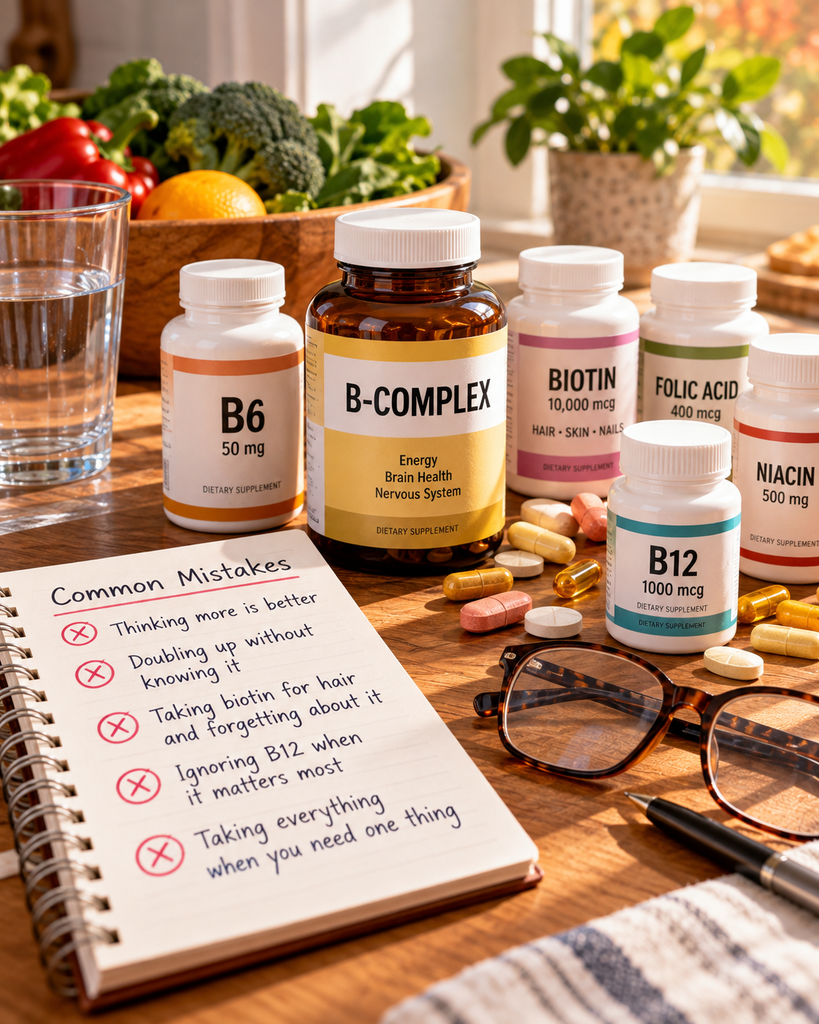
Where Most People Go Wrong With B Vitamins
Now that we have gone through all eight, let’s talk about the mistakes. I see them all the time, and to be honest, I made a couple of them myself before I started reading labels properly.
Thinking more is better. This is the big one. Too much B6 can damage nerves, too much niacin causes flushing, and too much folic acid can hide a B12 problem. Your body doesn’t need ten times the daily amount just because the bottle offers it.
Doubling up without knowing it. A B-complex in the morning, a magnesium blend at night, an energy drink in the afternoon, a hair gummy on top. Each one looks harmless alone, but together they can add up to a lot more B6 than you would ever guess, and nobody does that math for you.
Taking biotin for hair and forgetting about it. If you’re not low in biotin, it probably won’t do much for your hair, and it can quietly throw off thyroid and heart tests if you don’t tell your doctor before blood work.
Ignoring B12 when it matters most. This is the opposite mistake. Many people over 50, or on metformin or acid reducers for years, never check their B12 at all, even though they’re exactly the ones most likely to be low.
Taking everything when you need one thing. Food first, always. If a blood test shows you’re low, ask your doctor which B vitamin you actually need, because the answer isn’t always a B-complex. I also wrote about how to take nutrients the right way, if you want more from the vitamins you already take.
A Simple Day Of B Vitamins On Your Plate
Just to show you how easy this can be, here’s what a normal day might look like:
- breakfast: two eggs, a slice of whole grain toast and a glass of milk;
- lunch: a big spinach and chickpea salad with sunflower seeds and some avocado;
- snack: a banana and a small handful of peanuts;
- dinner: baked salmon, a potato and steamed broccoli.
That’s it. Nothing fancy, and almost every B vitamin shows up somewhere. Many of these foods also appear on my list of anti-inflammatory foods your body will thank you for. A little bonus.
The Bottom Line
Most people take B vitamins wrong not because they’re careless, but because nobody ever sits down and explains them – not the pharmacy, not the label, and certainly not the ads. They aren’t one vitamin but eight, and each one has a job – from thiamin helping your nerves to B12 keeping your blood and brain healthy. Most of us can get what we need from ordinary food. But after 40, and especially after 50, it’s smart to keep an eye on B12 and B6, to read supplement labels carefully, and to ask your doctor for a blood test if something feels off, instead of buying the biggest bottle on the shelf.
Which of these B vitamin mistakes have you made? Let me know in the comments below.
This article is for general information and isn’t medical advice. Please talk with your doctor before starting any new supplement, especially if you take medication.