
You’re sitting on a beach chair on a vacation you saved for all year. The sun is warm, the drink is cold, and for a few minutes you feel genuinely, completely happy. And then, out of nowhere, a small tight feeling shows up in your chest.
You shouldn’t be enjoying this so much. Somebody, somewhere, will be upset about it.
If you grew up with a narcissistic mother, you probably know that feeling well. Good news comes with a second thought – “Mom won’t like this.” A great evening ends with a strange little dread. Even resting on a Sunday afternoon can feel like you’re getting away with something.
It’s not that you don’t want to be happy. It’s that, somewhere along the way, happiness started to feel dangerous. So, let’s go through what this guilt actually looks like, seven reasons it happens, what research says about it, and how to slowly give yourself permission to enjoy your own life.
Just one thing before we start. I’m not a therapist, and nobody can diagnose a parent from an article. When I say “narcissistic mother” here, I mean a pattern of behavior many people recognize, not a clinical label. Take what fits your story and leave the rest.
What This Guilt Actually Feels Like
This kind of guilt rarely announces itself. It hides inside small habits that most people around you would never notice. See if any of these sound familiar:
- you downplay your good news, or don’t share it at all;
- you wait for something bad to happen right after something good;
- resting feels lazy, and fun feels like something you have to earn;
- you check on your mother in the middle of a happy moment, just in case;
- you hide new purchases, trips or plans from her;
- compliments make you uncomfortable instead of happy;
- you feel responsible when someone near you is in a bad mood.
None of these on their own mean something is wrong with you. But when several of them show up together, they often point back to a childhood where your happiness had a price.
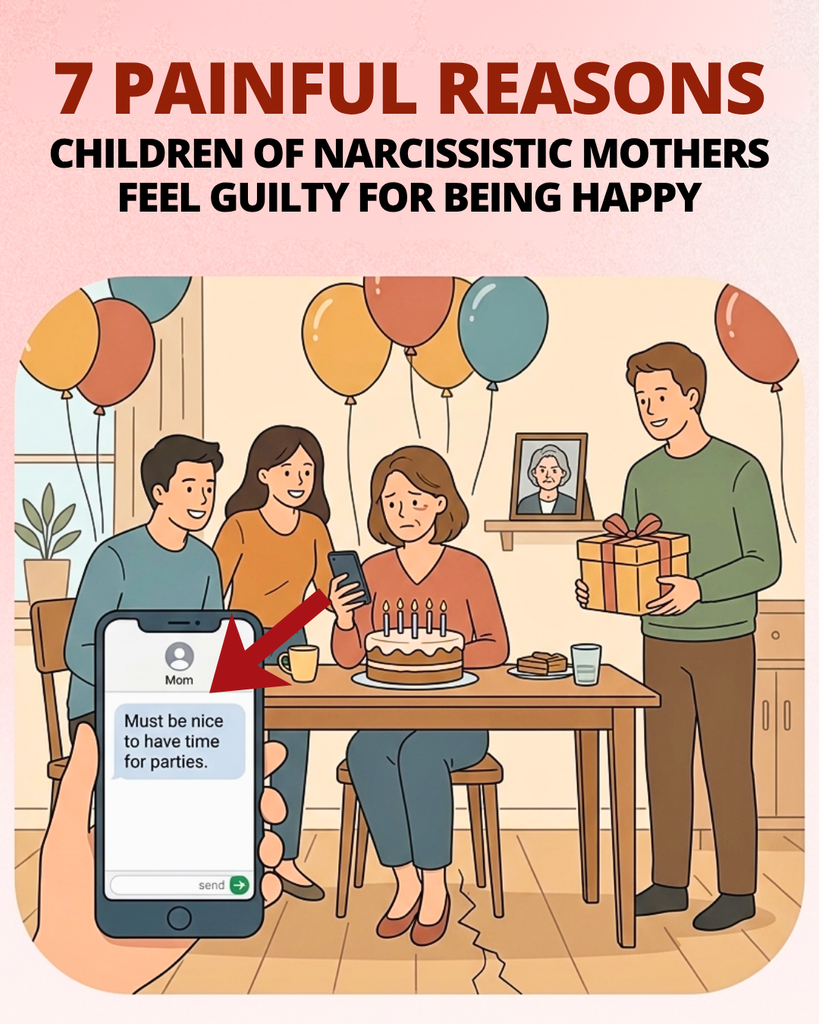
7 Reasons Children Of Narcissistic Mothers Feel Guilty For Being Happy
1. Your Happiness Was Treated Like Competition
In a healthy family, a child’s happiness is good news for everyone. A mother sees her daughter excited about a new dress or a good grade and feels proud. But a narcissistic mother may experience your joy very differently – almost as if there’s only so much attention in the house, and you just took some of hers.
So your good moments were met with a cold “That’s nice,” a change of subject, or a story about something better that happened to her. Sometimes she found a flaw in it right away. Over time, you learned a simple and painful rule. When I’m happy, Mom gets upset. And a child who learns that rule early often carries it into adulthood without ever questioning it.
What it can look like today: You get a promotion and wait days before mentioning it to anyone. When you finally do, you add something like “It’s not a big deal” or “I probably won’t keep it long.” Shrinking your own good news has become so automatic that you don’t even notice you’re doing it.
2. Her Moods Were Your Job
Many children of narcissistic mothers grew up taking care of their mother’s feelings. They learned to read her face the second she walked in, calm her down, cheer her up, and keep the house quiet. Psychologists call this parentification, when a child takes on an emotional role that really belongs to the parent.
If that was you, being happy while she’s unhappy can feel like abandoning your post. I wrote about something similar in why the eldest daughter ends up managing the family, because the pattern often starts there. A 2023 meta-analysis of 51 studies found that parentification is linked with more emotional problems later in life – the link was small but real, and it was stronger when children felt the burden was unfair.
What it can look like today: You’re laughing at a dinner with friends and suddenly glance at your phone to see if your mother called. Or you sit in a cafe on a Saturday and feel strangely uneasy, as if someone at home needs you and you forgot to ask. Your attention drifts back to her mood, even when she’s miles away.
3. Guilt Was Her Main Tool
“After everything I’ve done for you.” “I guess I’ll just be alone again.” “You always have time for your friends.” Sound familiar?
Researchers have a name for this style of parenting. They call it psychological control, and one of its main tactics is guilt induction – getting a child to do what you want by making them feel guilty. In a major review of this research, psychologists Bart Soenens and Maarten Vansteenkiste from Ghent University describe how psychological control, including guilt induction and withdrawing love, is consistently linked with anxiety, depression and low self-esteem in children.
When guilt was the way your mother kept you close, your brain learned to treat guilt as normal background noise. So now, when something good happens, the guilt switches on almost automatically, even if nobody is there to make you feel it.
What it can look like today: A simple text from her – “Must be nice to have time for that” – can change your whole afternoon. You know exactly what she means, even though she didn’t say it, and the fun drains out of whatever you were doing.
4. Good Moments Often Got Ruined
Think back to your birthdays, graduations, holidays or your wedding day. For many children of narcissistic mothers, those days are remembered not for the joy, but for the drama. Maybe a fight right before the party. Or a sulk during the ceremony. And that one comment that hurt so much you still remember the exact words.
After enough of these, your mind connects the dots. Happiness comes first, then pain follows. And so you start bracing for the fall the moment things start going well.
What it can look like today: You can’t fully relax on your own birthday. You plan everything carefully, keep expectations low, and feel a little relieved when the day is over, because a part of you is still waiting for someone to spoil it.
5. Love Came With Conditions
A narcissistic mother may have been warm when you were close, needy and agreeable, and cold when you were independent. When you made your own friends, chose your own clothes or loved something she didn’t, the affection quietly disappeared.
That teaches a child that being happy on your own terms – away from her, without her – is a kind of disloyalty. As an adult, you may notice the guilt is worst when your happiness has nothing to do with her: a trip with friends, a new relationship, a career she doesn’t understand.
What it can look like today: You call her right after a lovely weekend away, half to share and half to check if she’s angry. If she sounds cold, the whole trip suddenly feels like a mistake. Her approval still decides, at least a little, whether your happiness was allowed.
6. Your Needs Were Called Selfish
Wanting a nap, a new pair of shoes, a quiet hour or a different opinion – in some homes, any of these could earn you the label “selfish.” If you heard that word enough, you may have absorbed it as a fact about yourself.
So now, when you do something just for you, a voice whispers that you’re being selfish again. Here’s the thing worth remembering. Taking care of your own needs is not selfish. It’s what healthy adults do every single day, usually without a second thought.
What it can look like today: You buy yourself something nice and immediately explain the price to anyone who sees it, or you stay up late finishing chores before you let yourself sit down. Rest has to be earned first, and somehow you never quite feel you’ve earned enough.
7. Having A Better Life Than Her Feels Like Betrayal
This one is quiet but powerful. Maybe your mother had a hard life, an unhappy marriage, or dreams she never reached. And now you have a kind husband, a job you enjoy, or simply more peace than she ever had.
Part of you may feel that your happiness is somehow taken from her, or that you’re leaving her behind. Some therapists call this separation guilt. It’s the feeling that you don’t have the right to be okay when she isn’t – even though her unhappiness was never yours to fix.
What it can look like today: You catch yourself downplaying your nice home, your trip or your happy marriage when she’s around. You may even exaggerate small problems so your life doesn’t look too good next to hers. It feels kind, but it often comes from a deep, old fear of being the one who has more.
Why Your Body Still Reacts, Even Now
You may understand all of this in your head and still feel the guilt in your body. That’s normal. Your nervous system learned these lessons long before you had words for them, and old lessons take time to unlearn.
Researchers have even studied something called fear of happiness. British psychologist Paul Gilbert and his colleagues found that fearing positive feelings is closely linked with depression, and as Scientific American reported, Gilbert explained that “it is not uncommon for people to fear that if they are happy about something, it will be taken away.” His suggestion was that some people may need to practice allowing pleasant feelings, little by little, the same way you’d slowly face any other fear.
I find that very hopeful, honestly, because it means this isn’t a flaw in your character or something you were simply born with, no matter how deep it feels. It’s something your mind learned, and what was learned can slowly be unlearned.
How To Start Letting Yourself Be Happy
In The Moment
Name it when it happens. Next time the guilt shows up in a good moment, say to yourself, “This is the old guilt again.” Just naming it puts a little space between you and the feeling.
Ask whose voice it is. Is it really your belief that you don’t deserve rest? Or is it your mother’s voice, still talking after all these years? You don’t have to argue with it. Just notice that it isn’t yours.
Practice joy in small doses. Let yourself enjoy one small thing fully each day – a coffee on the porch, a song, ten quiet minutes with a book – without explaining it to anyone. Small, repeated moments teach your body that happiness is safe.
Over Time
Share good news with safe people first. Tell a friend, a sister or a partner who will simply be glad for you. You don’t have to tell your mother everything, and you definitely don’t have to tell her first.
Set small boundaries around information. If every piece of good news gets criticized or turned into her story, it’s okay to share less. That’s not lying. It’s protecting something that matters to you.
Write down the good moments. At the end of the day, note one thing that made you happy and how it felt. Over a few weeks, that little list becomes proof that good things can happen without anything bad following them.
Expect the guilt to come back sometimes. A holiday, a phone call or a big life event can stir it up again, even after months of feeling better. That doesn’t mean you failed. It just means an old habit is knocking on the door, and you’re getting better at not letting it in.
Get support. A therapist who understands family trauma can help you untangle these patterns much faster than you can alone. And if the guilt has turned into constant sadness, hopelessness or trouble getting through the day, please talk to your doctor or a licensed mental health professional.
On the harder days, I also find it helps to protect yourself from negative energy, even when that energy comes from someone you love.

Small Signs You’re Starting To Heal
Healing from this kind of guilt doesn’t happen in one big moment. It usually shows up quietly, in small changes you might only notice if you’re looking for them.
- you share good news without adding an apology;
- you can take a compliment and simply say thank you;
- a happy day doesn’t fill you with dread about the next one;
- you rest without needing an excuse first;
- her bad mood no longer ruins your whole week.
If you see even one of these in yourself, take a moment to notice it. That’s real progress, and it’s worth being proud of – yes, proud, without the guilt.
If You’re A Mother Reading This
Maybe you’re reading this and something in it made you uncomfortable, because you recognized yourself in a few lines. If so, that discomfort is actually a good sign. It means you care.
It’s never too late to change the message. Tell your grown child that you’re happy for them, and stop there – no “but,” no story about yourself, no reminder of what you’ve sacrificed. Let their good news be theirs. For many adult children, hearing that just once can mean more than you’ll ever know.
You’re Allowed To Be Happy
The guilt you feel when you’re happy didn’t start with you. It was taught, one cold reaction and one ruined birthday at a time, until it felt like part of who you are. But it isn’t. It’s a leftover from a house where your joy wasn’t safe.
You’re an adult now, and you get to decide what’s safe. You’re allowed to enjoy the beach chair, the quiet Sunday and the good news, without asking anyone’s permission, and without paying for it afterward.
And if you slip back into the old guilt now and then, be gentle with yourself. You spent years learning that joy was risky. It’s okay if learning the opposite takes a little time too – every happy moment you allow yourself is a small step toward a life that finally feels like your own.
Do you ever feel guilty for being happy? Let me know in the comments below.