
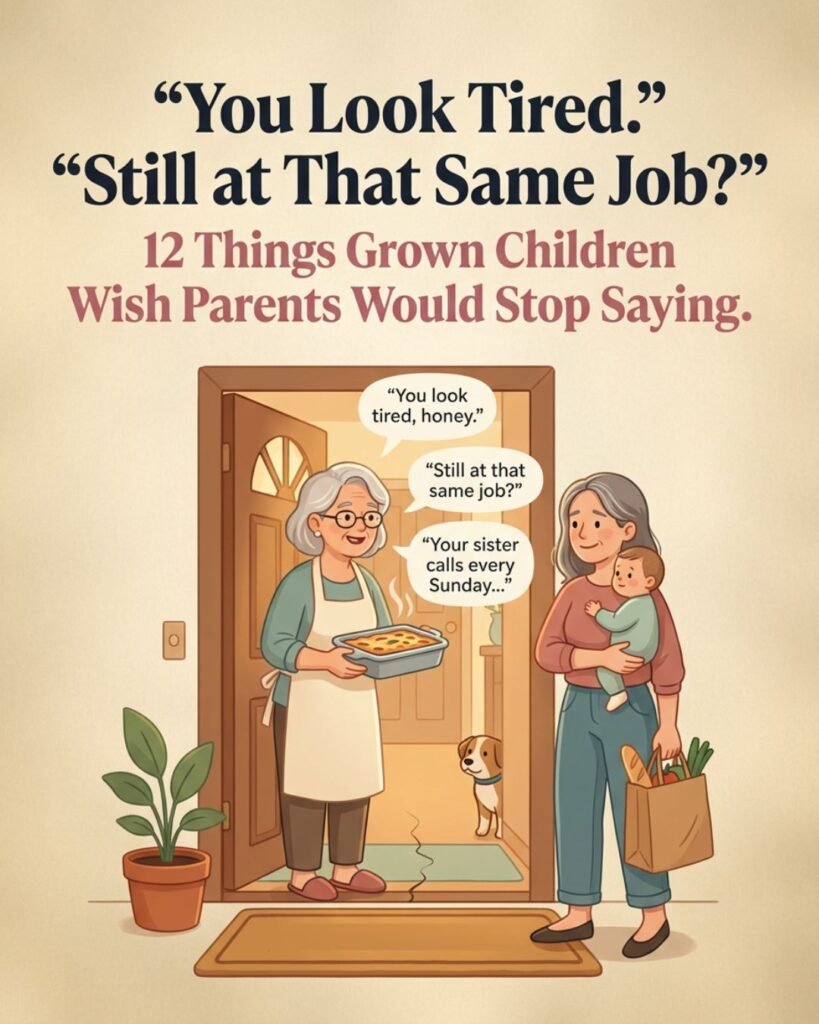
Your daughter arrives for Sunday lunch with the kids, a bag of groceries and that tired look she’s had since the new baby. Within ten minutes, you’ve told her she looks exhausted and asked whether she’s “still at that same job.” You meant it kindly. You felt worried.
But she goes quiet. She checks her phone more than usual, and they leave an hour earlier than you expected. Later that week, your son mentions, very gently and while staring at the floor the way he used to when he broke something as a boy, that his sister was upset after lunch. “Mom, you always say that stuff.”
If you’ve had a moment like that, you’re far from the only one. Most of us say these things out of love or plain worry. We have no idea they land like small stones. In this article we’ll look at the phrases grown children most often wish their parents would drop, why they sting more than we think and what to say instead. So, let’s go through it.
One thing before we start. This isn’t about blaming parents. Our kids say plenty of things that hurt us too, and that’s an article for another day.
Why Small Words Cause Big Tension
Researchers at the University of Michigan asked 474 parents and adult children what caused tension between them. Parents were more bothered than their children overall, especially about how the children ran their lives, from money to housekeeping. But the problems that lasted longest came from two places. One was basic personality differences. The other was unsolicited advice.
The study also found that both sons and daughters reported more tension with their mothers than with their fathers, particularly over advice nobody asked for. Lead researcher Kira Birditt suggested that mothers may simply want more closeness, and that wish can come across as intrusive.
There’s a gap in how the two sides see things, too. In a 2024 Pew Research Center survey, 77% of parents of young adults described their relationship as excellent or very good. When Pew asked the young adults, only 59% said the same about their relationship with a parent.
Part of it is simply habit. For eighteen years or more, our job was to correct and to warn, and nobody sends us a signal when that job quietly ends. Many of us also grew up with mothers who said exactly the same things to us, so the words come out before we’ve even thought about them.
That doesn’t mean our children don’t love us. It means some of what feels like caring to us feels like pressure to them.
The Phrases They Wish We’d Retire
“When Are You Going to Give Me Grandchildren?”
This one comes from such a hopeful place. But your grown child may be struggling with fertility, money or a shaky marriage. Or they may have made a decision they aren’t ready to tell you about. According to Pew, 47% of U.S. adults under 50 without children now say they’re unlikely to ever have them, up from 37% in 2018.
Each time you ask, you might be pressing on a bruise you can’t see, and the person who’s hurting will usually just change the subject and drive home feeling a little more alone with whatever they’re carrying. If you suspect your child doesn’t want children, we wrote about what to do when your grown child doesn’t want kids.
“You Look Tired” and Comments About Weight
You notice everything, because you’re their mother. But “You look tired” usually translates to “You look bad” by the time it reaches their ears. And “Have you put on a few pounds?” is almost never news to the person you’re saying it to, who has probably already noticed and already felt bad about it in a dressing room mirror long before you said a word.
If you’re truly worried about their health, that’s a private, gentle conversation. It starts with a question about how they’re feeling rather than how they look. Otherwise, try “It’s so good to see you.” It costs nothing, and they’ll remember it.
“After Everything I’ve Done for You”
Most mothers have sacrificed a great deal, and it’s fair to want that recognized. Still, this phrase turns years of love into a bill, and nobody enjoys feeling like they’re behind on their payments.
Grown children usually know what you gave up. They often just don’t hear it from you as a gift anymore. They hear it as a debt they can never quite pay off, and that feeling tends to push people away rather than pull them closer, which is the opposite of what any of us want when we say it.
“Why Don’t You Ever Call Me?”
Something interesting turned up in the same Pew surveys. Over a third of parents said they talk with their young adult child less often than they’d like. And 27% of the young adults said the same thing about their parents. So many of them want more contact too.
But opening every call with “Oh, so you remembered I exist” makes the next call harder to pick up. Try ending calls on a warm note instead, like “I loved hearing about your weekend.” Then see whether the calls start coming a little more often.
“Your Sister Would Never Do That”
Comparing siblings can feel harmless, even motivating. The research says otherwise. In a study of 275 families led by Cornell’s Karl Pillemer and Purdue’s J. Jill Suitor, adult children who saw their mother favoring or rejecting one child were more likely to show depressive symptoms in middle age.
And it hurt all of them, including the favorites, who carried the resentment of their siblings and heavier expectations. Interestingly, 70% of the mothers could name a child they felt closest to. Only 15% of the grown children believed their mother treated them all equally.
Comparisons can also lock each child into a role, like the responsible one or the difficult one. If your eldest has always been the one everyone leans on, our article on why the eldest daughter ends up managing the family might ring a bell.
“Well, That’s Your Choice”
On paper, this sounds respectful. In real life, it usually comes with a sigh or a raised eyebrow, and everyone at the table knows what it means.
Grown children can handle honest disagreement. What wears them down is disapproval they can’t answer, because it was never said out loud. If you have a real concern, say it once, kindly and clearly, and then let it go. If you don’t, a simple “I hope it goes well for you” leaves the door open.
“In My Day, We Just Got On With It”
It’s true that we did. We worked hard, often without much help, and we’re proud of it. But housing, college costs and job security look very different now, and when grown children hear “in my day,” they usually hear “you’re not trying hard enough.”
Pew found that 39% of young adults disagree with their parents at least sometimes over financial choices, and 37% over their careers. A question like “What’s the hardest part of your job right now?” will tell you far more than a story about how things used to be.
“You’re Too Sensitive”
Sometimes it comes after a joke that didn’t land. Sometimes it follows “I’m just being honest.” Either way, it tells your child that the problem is their feelings rather than your words.
If your grown child says something hurt, the simplest response is often the best one. “I didn’t mean it that way, but I can see it hurt you. I’m sorry.” That’s it. You don’t need to defend yourself or explain your intentions for twenty minutes. You might find the air clears surprisingly fast when you skip both.
“You’re Doing It All Wrong” (About the Grandkids)
Car seats, bedtimes, screen time and sugar have all changed since we raised our children. Some of the new rules seem silly, and some of ours worked fine. But your child is the parent now.
Pew found that 40% of young adults with children disagree with their own parents at least sometimes about raising them. Criticizing their parenting in front of the grandchildren is one of the fastest ways to see less of everyone. We put together a list of things grandparents should never do without asking, and it’s worth a look.
“I Never Liked Him Anyway”
Criticizing your child’s partner puts your child in the middle. It doesn’t matter whether it happens during a fight or in a casual aside at Thanksgiving. If they stay together, your child will remember what you said. If they split up and later reconcile, they’ll remember that too.
Sons in particular often get caught between their mother and their wife, and it rarely ends with anyone feeling better. Our article on why sons change after marriage looks at that tug-of-war from both sides.
“I Won’t Be Around Forever, You Know”
Usually it’s said to get someone to visit, call or come for the holidays. And it’s true, of course. But using our own mortality as leverage turns every visit into an obligation wrapped in guilt, and visits made out of guilt are rarely the warm, easy afternoons we were hoping for when we said it.
If you want your children home for the holidays, say so directly. “It would mean so much to me if you came for Christmas, and I’ll understand if it doesn’t work this year.” If they can’t make it, our article on couples who skip Christmas with their parents may help you see it from their side.
“I’m Fine, Don’t Worry About Me”
This one surprises a lot of parents, because we say it to protect our children. But many grown children find out about a fall, a worrying test result or a money problem weeks later, sometimes from a neighbor or a cousin, and it hurts them more than the news itself would have.
They want to be trusted with the real story. You don’t have to share every ache. But when something serious happens, telling them early lets them help in their own way, and it shows that you see them as adults who can handle hard news, which is exactly what most of them have been hoping you’d notice for years.
When Words Add Up to Distance
Most families never come anywhere near estrangement. But it’s more common than many of us realize. In a national survey by Karl Pillemer at Cornell, about 27% of American adults said they’d cut off contact with a family member. For 10%, it was a parent or a child. Common paths included harsh parenting, favoritism and fights over money or in-laws.
A 2021 study from Ohio State University surveyed 1,035 mothers in estranged relationships with a grown child. Most blamed someone else, like an ex-husband or the child’s spouse, for turning the child against them, and only 18% said they were at fault themselves. Earlier research with adult children found they more often pointed to emotional abuse, clashing expectations about family roles and personality conflicts. The lead researcher, Sarah Schoppe-Sullivan, said there’s “a real disconnect” between how mothers and their adult children see what happened.
None of us wants to end up on either side of that gap. And one comment never ends a relationship. Years of the same comments, though, can quietly wear it thin.
If you’re already facing distance from a grown child, Pillemer’s research offers some hope. People who managed to repair things often talked with a relative who stayed neutral, wrote about the conflict from the other person’s point of view or tried counseling, either alone or together. Even when the attempt didn’t fully work, many of them said they felt more at peace for having tried.
Karl Pillemer talks about estrangement and the steps toward reconciliation in this short video from Cornell University.
What to Say Instead
The good news is that small changes in how we talk can make a real difference, and it’s never too late to start.
Ask before you advise. “Do you want my thoughts, or would you rather I just listen?” might be the most useful sentence a parent of grown children can learn. Most of the time, they’ll tell you, and when they do want advice, they’ll actually hear it.
Swap judgments for questions. Instead of “Are you still at that job?” try “How’s work going these days?” Instead of “You look tired,” try “You’ve got a lot on your plate. How can I help?”
Apologize when you get it wrong. A short, honest “I’m sorry, that came out wrong” can repair more than an hour of explaining what you really meant. In Pillemer’s research, the people who managed to reconcile often stopped needing the other person to agree with their version of the past, and they focused on the present and the future instead.
Let them be the expert on their own lives, too. Your daughter knows her marriage, her job and her children far better than you do, even if you’ve lived longer, and treating her that way is one of the most loving things you can do for a grown child.
And notice the good. Tell your son you admire how patient he is with his kids. Tell your daughter she’s handling a hard year better than you would have. Grown children rarely tire of hearing that their parents are proud of them.
Final Thoughts
If you recognized yourself in a few of these phrases, you’re in very good company. Most of them come from love and from habits we picked up from our own parents. Very few come from anything unkind. Changing them doesn’t mean you’ve been a bad mother. It means you’re willing to keep growing, even now, so that your grown children look forward to Sunday lunch instead of bracing themselves for it.