
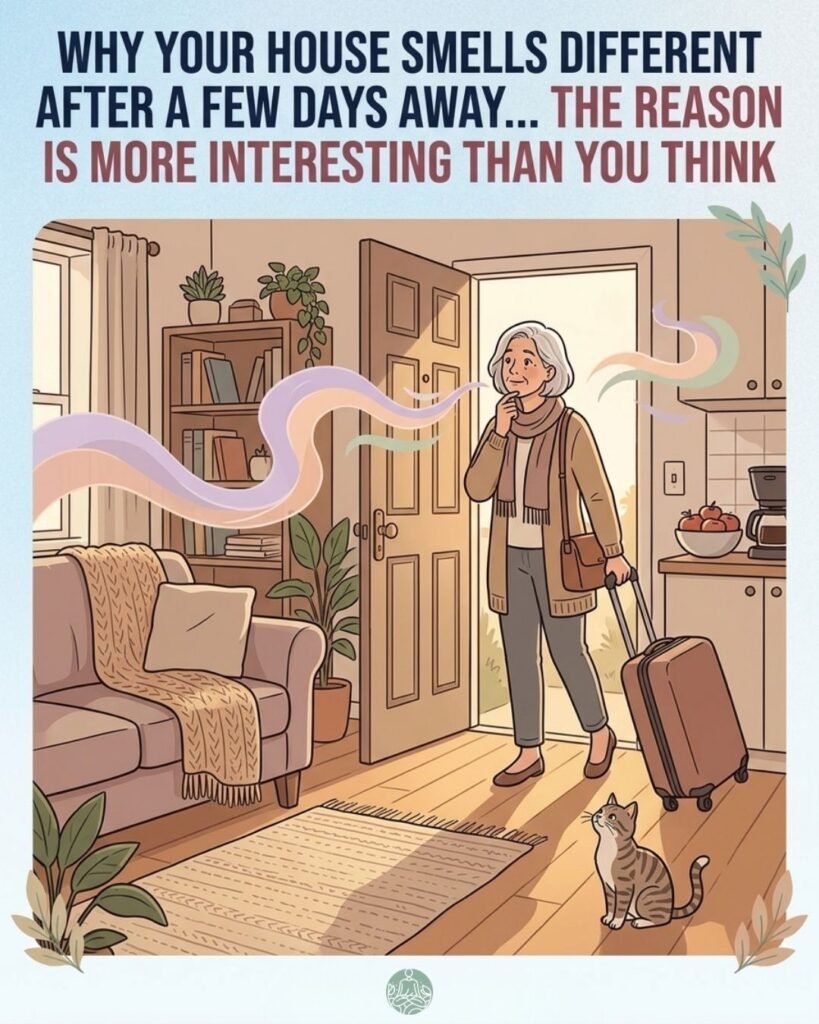
You unlock the door after a week away, drag the suitcase over the step, and there it is.
A smell. Not a bad one, necessarily. Just one you have never once noticed before, even though you have lived in this exact house for years and walked through this exact door thousands of times. Something warm and slightly unfamiliar, a mix of wood and fabric and old cooking and something else underneath it all that you cannot quite put a name to, however hard you try.
And then, within about ten minutes of putting the kettle on, it is gone. You cannot smell it at all.
Nearly everybody has had this experience, and almost nobody knows why it happens. The answer turns out to be one of the more quietly fascinating things your brain does every single day without ever asking your permission, and it comes with a handful of practical lessons about your own home that are genuinely worth knowing, including one that could save you from a nasty surprise.
So, let’s get into it.
Your Nose Stopped Noticing Your House
The short answer is that you have been smelling your house all along. You just stopped being told about it.
Scientists call this olfactory adaptation. Most people know it by a friendlier name, nose blindness.
Pamela Dalton, a researcher at the Monell Chemical Senses Center in Philadelphia, has spent much of her career studying it. She explains that the intensity of a smell drops by roughly half within the first minute, and that it can begin on your very second sniff.
She describes two separate places where this happens. The first is in the nose itself, and it is fast. The second is in the brain. It gradually starts filtering out signals it has decided are no longer worth your time.
Your home is the most familiar smell in your entire life. You breathe it every night and every morning, for years. So your brain, very sensibly, long ago filed it away under known, safe, and not worth mentioning, and then it simply stopped bothering to send you the message, the way you stop hearing a clock that has ticked in the same room for a decade.
Why Your Brain Bothers Doing This
It sounds like a flaw. It is actually a very clever piece of design.
Your sense of smell exists partly to keep you alive. Smoke, gas, spoiled food, something rotting nearby – these are the smells that matter, because they can signal danger.
If your brain kept shouting about the smell of your own sofa all day long, it would be considerably harder to notice the one smell that genuinely needed your attention, like a pan starting to burn on the hob or a faint whiff of gas from the kitchen. So it mutes whatever is constant and keeps the channel open for whatever is new.
Dalton has noted that familiar and pleasant smells are among the first to fade, precisely because they carry no warning. They leave room for the ones that do.
Your nose is not lazy. It is prioritising, the way a good receptionist stops announcing the people who come in every single day.
So What Does Your House Actually Smell Like?
Every home has its own smell. It is as individual as a fingerprint, and built from far more ingredients than most of us realise.
There is you, to start with. Skin, hair, and the bacteria that live on every one of us all leave a trace. It lands in the air and on everything we touch.
Then there is everything you cook. Years and years of onions, strong coffee, garlic, frying bacon and Sunday roasts gradually settle deep into the curtains, the cushions, the carpets and even the paint on the walls, building up in layers so slowly that nobody who lives there ever notices it happening.
Add your washing powder, your soap, and whatever you use to clean the floors. Then your pets, if you have them. Then the house itself. Old timber smells completely different from new plasterboard.
Mix all of that together over years, and you get a scent that belongs to your household, and nobody else’s. Which is exactly why other people’s houses always smell so different to you. Your own seems to smell of nothing.
Why You Get It Back When You Leave
When you go away, your nose gets a rest from all of that.
For a week or so, it breathes hotel corridors, a relative’s spare bedroom with the heating turned up too high, sea air, other people’s cooking and other people’s washing powder, and all the while the adaptation to your own home is quietly wearing off in the background without you noticing a thing. Your brain stops filtering the signal because the signal is no longer there.
Then you walk back through the front door, and for a few precious minutes you smell your home the way a visitor does. Dalton says that is exactly what is happening. You are finally meeting your house as a guest would.
She has also said that if you genuinely want to know what your home smells like, the most reliable way is simply to go away for about two weeks.
Why It Vanishes So Fast
Here is the part that surprised me.
You might expect it to take another week to stop noticing the smell again. It took a week to start, after all. It does not work that way.
According to Dalton, you re-adapt much faster the second time, because your brain already knows what your home smells like. It has met this smell thousands of times. It recognises it almost immediately and goes straight back to ignoring it.
So that lovely, strange, homecoming smell lasts only a few minutes. Your brain has simply filed it away again.
If you want to catch it, pay attention in the first moment you open the door. That is your window.
Stand still for a second. Breathe in slowly through your nose. Then notice what you notice, before the kettle, the post, and the unpacking pull your attention away.
When The Smell Is Telling You Something
Most of the time, what you notice is simply your home. But sometimes a few days away reveals something your nose has been politely hiding from you. A few of these are worth acting on.
A Sewer Smell From The Drains
This one catches a lot of people out. Every sink, shower, and floor drain has a curved section of pipe underneath, designed to hold a small amount of water. That water acts as a seal, stopping gases from the sewer rising back into your home.
When a drain goes unused for a while, particularly in a warm house, that water can slowly evaporate. The seal disappears, and you come home to a smell like rotten eggs coming from the spare bathroom nobody uses.
The fix is simple. Run the tap for a few seconds in every sink, shower, and bath, and it refills the seal.
Do not forget the ones you rarely use. The guest bathroom. The utility sink. That shower nobody has touched since the children moved out. Those are usually the culprits.
A Musty, Damp Smell
An earthy, stale smell that is stronger in one particular room can point to damp or mould, often somewhere you do not usually look. Behind furniture, under a sink, in a cupboard against an outside wall.
This is worth taking seriously. Mould can irritate the lungs and aggravate asthma and allergies. Look for dark patches, peeling paint or a bubbling wall. Then fix the source of the moisture, rather than just covering the smell.
Something From The Kitchen
The obvious suspects are the fridge and the bin. A forgotten bag of salad or a bin nobody emptied before the trip can make its presence felt remarkably quickly.
And if you ever notice a smell of gas, leave the house straight away and call your gas provider from outside. That is the one smell your nose is designed never to ignore, and you should not either.
Why The Air Feels Stale
Part of what you notice is not really a smell at all. It is stillness.
A lived-in house breathes constantly. Doors open and close all day long, people wander from room to room, windows go up for an hour, the kettle steams, the extractor fan runs while dinner cooks, and every single one of those small things keeps the air moving and quietly swapping with the air outside.
Shut a house up for a week and all of that stops. Whatever the furniture, carpets, and cleaning products give off simply accumulates in still air, along with humidity. So the house smells heavier and slightly stuffier than it ever does while you are living in it.
The solution is refreshingly easy. When you get home, open a few windows. Ten minutes is enough to let the house breathe out.
The Air Freshener Trap
This is where nose blindness catches a lot of kind, house-proud people out.
You buy a plug-in air freshener because you want the house to smell nice. For the first day or two, it does. Then you stop noticing it.
So you turn it up. Or buy a stronger one. Or add a candle and a spray by the front door.
But you have not stopped smelling it because it ran out. You have stopped smelling it because your nose adapted, exactly the way it adapted to the rest of your house. It is probably still going perfectly well.
Your visitors, meanwhile, walk into a wall of vanilla and lavender that you genuinely cannot detect. The same thing happens with perfume, which is why so many people wear far more of it than they realise.
And some people are sensitive to strong fragrances, finding that they bring on headaches or irritate their breathing. So if you use them, use less than you think you need. A house that smells faintly of nothing is usually more welcoming than one that smells strongly of something.
Does Your House Smell Bad, Or Just Different?
I want to reassure you here, because articles like this can make people anxious.
Noticing a smell when you come home does not mean your house smells bad. It means it smells like a home, which is to say it smells like people live there. That is not a problem to fix.
A normal home smell is mild, familiar, and fades within minutes. That is completely fine.
The smells worth acting on are the specific ones. Sewer or rotten eggs, which usually means a dry drain or, much more rarely, gas. Musty and damp, which can mean mould. Sour or rotting, which means something forgotten in the kitchen.
Anything else is simply your life, soaked gently into the soft furnishings over the years. Honestly, I would not change it.
How To Smell Your Own Home Without Leaving
You do not have to go on holiday to find out what your home smells like, although it is certainly the most pleasant method.
Step outside for a few minutes of fresh air, then come straight back in and pay attention to that first breath. It works a little, because you have briefly given your nose something different.
Smell soft things directly. Curtains, sofa cushions and the inside of a coat cupboard hold odours much more than hard surfaces do, and pressing your nose right up to them can cut through the adaptation.
Or simply ask somebody you trust, and ask them to be honest. Visitors notice what you cannot, and a kind friend will tell you.
Choose the right person, though. You want somebody who will tell you the truth, not somebody who will say it smells lovely to be polite. A sister is often ideal for this.
Why Home Smells Like Home
There is one more reason that first breath through the door hits you so hard, and it has nothing to do with chemistry.
Smell has an unusually direct line into the parts of the brain that handle emotion and memory, more direct than sight or hearing. That is why a single smell can carry you back decades in an instant, before you have even had a chance to think about it – your grandmother’s kitchen on a Sunday, a school corridor, the coat of somebody you loved very much who is no longer here.
So when you walk in after a trip and catch the smell of home, you are not only noticing a scent. You are recognising a place where you belong, before your conscious mind has even caught up.
It is one of the nicest feelings there is, and it only lasts about as long as it takes to put the kettle on.
Next time you come home, try not to rush past it. Stop at the door for a moment. It is the only time you will ever smell your house the way everybody else does.
Have you noticed this when you come home? What does your house smell like to you in that first moment? Tell me in the comments below – I would love to know whether other people notice the same thing.