
Have you ever wondered about how your body works?
Your body is composed of numerous systems that function well to keep you healthy.
From the intricate cells to your delicate organs, the body shows consistency in its finest performance.
Whether you are at rest or in motion, your body never stops working.
- Your heart keeps pumping blood.
- Your lungs breathe in some oxygen.
- Your brain transmits messages throughout your body.
- Your cells repair, renew, or reproduce themselves.
Among many other functions.
But despite all of it. You didn’t think it through.
Surprisingly, your body can perform lots of wonders.
It may sound unbelievable, but all of these facts are backed by evidence.
Learning these fun facts is not just words for thought.
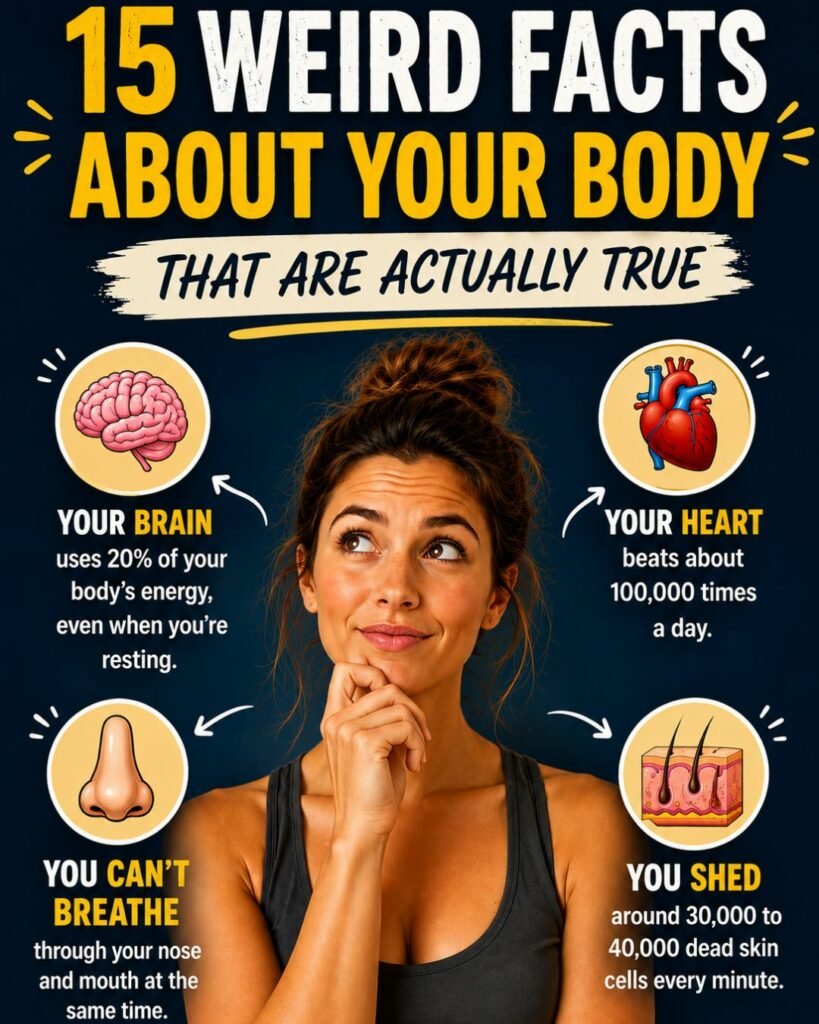
The intention to learn these facts may lead to the realization that taking care of your health matters greatly.
15 Weird But True Facts About Your Body
Here are the 15 weird but surprising facts about your body that you must know:
The Largest Organ Sheds Daily
It’s a given fact that your skin is your body’s largest organ.
This organ serves as:
- Protection from instant contact with germs and microorganisms.
- Reduces the risk of getting instant injuries
- Stabilizes your body temperature.
- Allowing you to feel sensation.
- A natural shield that separates your internal and external organs.
About a million tiny skin cells are falling off your body every day.
It’s your skin’s way of making itself fresh.
The Brain Operates for About 20 Watts
When you are resting, your brain doesn’t shut down.
It’s not the same way as shutting down your computer.
Your brain has the capacity to operate your entire body for about 20 Watts.
That’s about charging two smartphones or lighting an LED lightbulb in your home.
Heart Beats 100,000 Times a Day
There is no more hard-working muscle in your body that hasn’t ceased to function than your heart.
The heart pumps oxygen-rich blood to distribute it to every tissue and organ in your body.
In a day, the heart beats about 100,000 times.
Regardless of whether you are engaging in physical activities or resting.
Your Bones Get Tougher Frequently
Bones are described as solid and hard.
But many don’t know that it’s a living tissue.
It gets tougher over time, like steel, because it replaces itself with a tougher one.
This is its way of keeping you healthy and strong.
A Lifetime Produces 20,000 Liters of Saliva
Every day, you are producing about one to two liters of saliva.
The role of saliva is crucial, particularly in the digestive system.
It is responsible for:
- Breaking down meals
- Protect your teeth
- Keeping your mouth wet
- Makes swallowing easier
In your entire lifetime, you can produce about 20,000 liters of saliva.
That’s about a small pool, 40,000 bottles of wine, and 53 to 90 full bathtubs.
Stomach Protects Itself from Its Acid
The stomach has a protective lining of mucus that is replaced every 3-7 days by itself.
This is its defense mechanism to prevent damage from the powerful acid it has that breaks down the food you consume.
The stomach acid is powerful enough that it can damage your stomach if its protective lining is not renewed.
The Eyes Blink 15 to 20 Times per Minute
Your eyes have their way of protecting you and themselves.
It blinks for about 15 to 20 minutes every minute to secure itself.
This can help them:
- Keep the eyes from getting dry.
- Prevent the tiny bits of dust from entering.
- Keep itself clean.
To prevent your eyes from drying out, don’t spend the longest hours on something that blinks you less often.
Blinking is something you rarely notice because it happens automatically.
The Gut is Home for Good Bacteria
For many who are unaware, a body needs bacteria.
Yes, the good ones.
They deserve to stay in the digestive system for numerous reasons.
- A great help for your digestion
- Strengthen your immunity
- Releases vitamins needed for the body
- Keeps your body in good condition.
Recent studies show that the gut is your “second brain.”
It can affect your body and health once it is attacked.
Goosebumps are an Inherited Survival Instinct
Goosebumps were recorded all the way back in ancient times.
This is linked to our ancestors’ survival instinct from environmental changes, temperature shifts, and the presence of predators.
The goosebumps we feel today are often warning signals of fear.
Although it has historically changed, it has been inherited even by modern humans.
The Nose Remembers a Scent
Have you ever familiarized a scent before?
In my case, I usually describe petrichor like the fresh smell of cassava cake.
That has been a familiar scent to me since childhood.
The nose has the power to remember a scent.
Even if that scent has never been smelled for a long time.
Liver Can Regrow Itself
The liver is known for its function in filtering your blood from harmful substances and digesting food well.
Aside from that, it can regenerate itself.
Even if it is damaged or injured, it can still repair itself.
Hair Fall is a Natural Phenomenon
Each day, we naturally lose dozens of hair strands.
There are lots of reasons for it, most of which are:
- Age increase
- Weaker strands
- Dead hairs
- Regeneration
As we grow older, more hair will be lost so that new hair can grow healthier and stronger.
Your Body Replaces Old Cells Every Day
The body is capable of replacing old cells every day.
This is necessary to keep your body well.
Replacing old cells can do a lot of good.
It can:
- Make your organs functional and intact
- Heal wounds or injuries
- Repair the affected tissues
Your Ears Keep You Balanced
The ears are responsible for your hearing.
But they work not just actively, but also passively.
They may also work continuously even when you are sleeping.
The inner ear contains some tiny structures to help the brain determine your current activity.
That’s how ears keep your body in balance.
Human Body Glows Naturally
Another unheard fact about your body is that it has the natural ability to glow.
The body can emit minimal amounts of light, but it is too faint to see with the naked eye.
It is confirmed in numerous studies that this glow has something to do with your metabolic rhythm and the reactive molecules found in your body.
The Price of Knowing
The body is composed of an incredibly complex system that keeps you healthy.
Every organ has its own responsibility and function that surprises you in the name of health.
Overall, your body is a testament to the amazing works of your organs.
Knowing these facts will lead you to the realization that taking care of it is a necessary step.
Always remember to keep your body healthy by doing healthy lifestyle habits such as:
- Eat well-balanced meals
- Drink enough water to be hydrated
- Get enough rest or sleep
- Manage your stress
- Be physically active
- Be interactive when needed
Among many other healthy habits.
Knowing these facts or other things not mentioned made you realize that there is a living environment within you.
A Working Body That Deserves Care
Now that you appreciate the wonders in your body, you may realize what you’re doing is keeping you healthy.
It’s a great conclusion that you have acknowledged these things.
After everything you’ve learned, ask yourself.
What would be your next steps?
Would you prioritize self-care through having healthy habits?
Or would you compromise your health since it’s capable of healing itself?
But the reality is this.
Your body needs to be taken care of more than it takes care of you.