
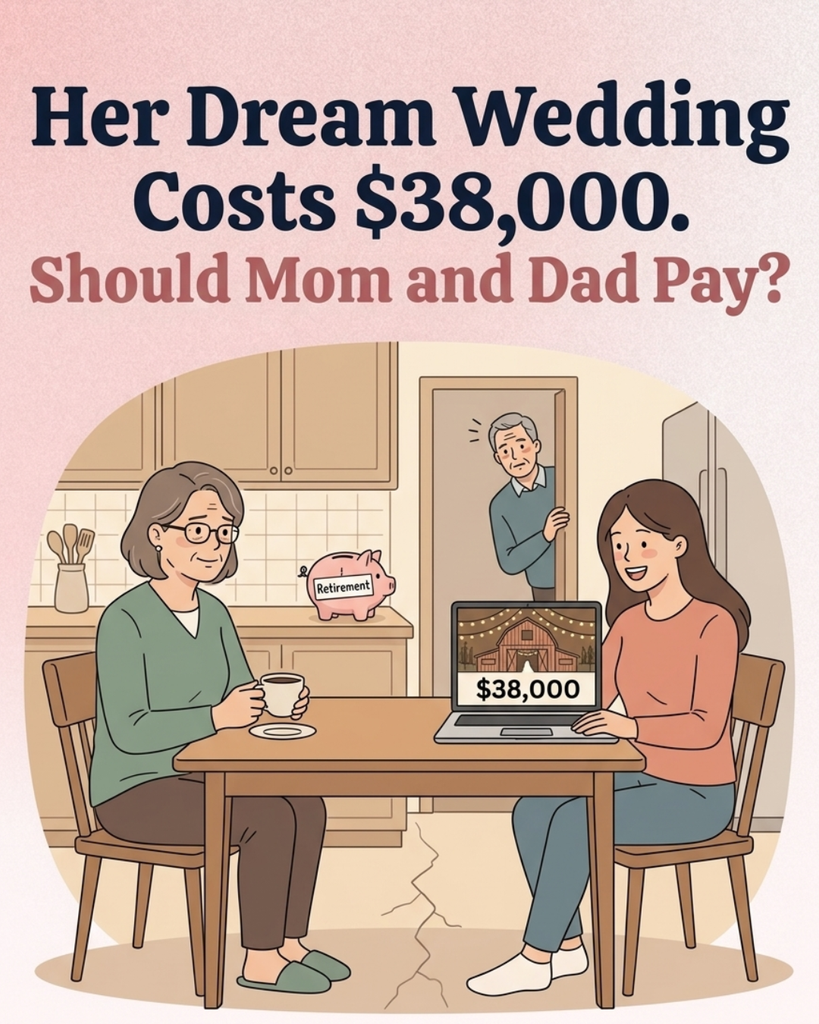
Your daughter comes over on a Sunday afternoon, still glowing from the engagement. She opens her laptop on the kitchen table and shows you photos of a beautiful old barn venue with lights hanging from the ceiling. Then she scrolls down to the price. You see the number, and she sees you seeing the number. And there’s that small, awkward silence where both of you are wondering the same thing, while the coffee goes cold and you try to do the math in your head without your face giving anything away.
Are you paying for this, or not?
For a lot of parents today, this is one of the most uncomfortable money questions they’ll ever face. We grew up with the idea that the bride’s family pays for the wedding, full stop. But weddings now cost much more, couples get married later, and many of us are also trying to save for retirement, help aging parents, or simply keep up with the price of groceries. In this article I want to go through who usually pays for weddings today, what’s fair, and how to have this conversation without anybody getting hurt. So, let’s go through it.
One quick note first. I’m not a financial advisor, and everybody’s situation is different. If you’re thinking about a big gift, it’s worth talking it through with a financial planner, especially if you’re close to retirement.
Who Pays for Weddings Today?
Let’s start with how things used to work, and how different it looks now.
The Old Rules
Traditionally, the bride’s parents paid for most of the wedding, usually the ceremony and the reception, and the groom’s parents covered the rehearsal dinner and a few smaller things. That tradition goes back to a time when women married very young and didn’t have their own income, so the family “gave” her away with a party.
Those days are mostly gone. According to Fidelity, the median age at first marriage in 1960 was about 20 for women and 23 for men. Today it’s closer to 29 and 30. Most couples already have jobs, apartments and sometimes even mortgages by the time they get engaged.
What Families Actually Do Now
Parents still help a lot, just not always in the old way. The Knot editor Sarah Hanlon told the Associated Press that parents contribute a little over half of the wedding budget on average, and the couple pays the rest. And the average wedding isn’t cheap. According to Fidelity, The Knot’s 2025 Real Weddings Study found the average cost was $33,000.
It also depends a lot on age. Data from The Knot shows parents of Gen Z couples pay about 63% of the wedding, parents of millennials about 52%, while Gen X couples get only around 18% from their parents. So the older the couple, the more likely they are to pay for most of it themselves, which makes sense.
Why This Question Feels So Complicated
If it were only about money, it would be easier. But it rarely is.
For many parents, helping with the wedding feels like part of being a good mom or dad. Maybe your own parents paid for yours, and you always imagined doing the same. Saying “we can’t” can feel like failing your child at one of the most important moments of their life, even when it’s simply the honest truth.
Then there’s everything else going on. Some parents are divorced and remarried, so suddenly there are three or four sets of parents with very different budgets. Some have other children and worry about being fair. And some are quietly carrying their own debts, or helping their own elderly parents, while everybody assumes they have plenty of money because they own a house.
So, Should Parents Help Pay?
I personally think the honest answer is this. Parents should help if they can afford it and want to, and they should never feel obligated to. There’s no rule anymore, and there’s definitely no amount you “owe.”
When Helping Can Make Sense
If your retirement is on track, your house is in order and you have money set aside that you won’t miss, contributing to the wedding can be a beautiful gift. Many parents say it’s one of the happiest ways they ever spent money, watching their child dance at a party they helped make possible. Some families even start a small wedding fund years ahead, so it doesn’t come as a shock. Others decide, quietly and without telling anyone, that this is the moment they’ve been saving for, and that seeing their son or daughter happy on that day is worth more to them than a new car or one more cruise, which is a perfectly lovely choice when the numbers truly allow it.
When It’s Okay To Say No
If paying for the wedding would mean pulling money from your retirement, taking on credit card debt, or skipping things you really need, it’s okay to say no or to give less. Your grown child is an adult with an income. You’re the one who has a limited number of working years left to save.
Lizzie Post of the Emily Post Institute put it simply in that same AP article, saying couples should “never assume that anyone else is going to contribute to your wedding.” Etiquette experts today agree that it’s a conversation, not an expectation.
Don’t Put Your Retirement On The Line
This is the part I want to say clearly, because a lot of loving parents do it anyway. According to a Bankrate survey reported by PlanAdviser, 68% of parents with adult children said they had made a financial sacrifice to help them, and 43% said it involved their retirement savings.
Bankrate analyst Ted Rossman summed it up very well. “You can get loans for a lot of things, but retirement isn’t one of them.” Your daughter can take out a smaller loan, choose a cheaper venue, or invite fewer people. You can’t get back the years of saving you lost at 62, and nobody, not even the happiest bride, wants to find out ten years later that her beautiful barn wedding is the reason her mom can’t afford to retire or has to keep working at a job that hurts her back.
And think about it this way. The best gift you can give your children in the long run might be not needing their financial help when you’re 80.
What’s Fair When You Have More Than One Child?
This is where a lot of families get into trouble later. You gave your oldest daughter $20,000 for her wedding ten years ago. Now your son is getting married, and money is tighter. Or your youngest decided to elope at the courthouse and never asked for anything.
Equal Money Or Equal Treatment?
Some parents decide on one amount per child and stick to it, no matter how big or small the wedding is. That’s often the simplest and fairest way, because nobody can say you loved one child more. If one child has a $10,000 wedding and another a $50,000 one, the same gift goes to both. What the couple does with it is up to them. Some put it all into the party, others keep the wedding small and use the rest for their first home.
What If One Child Doesn’t Have A Wedding?
It’s worth thinking about the child who elopes, marries later, or never marries at all. Many parents offer them the same amount for a house down payment or something else that matters to them. Money and fairness between siblings can leave deep scars, as I wrote about in my article on inheritance and the child who cared for the parents. Whatever you choose, it helps to say it out loud so nobody has to guess.
If You’re Divorced Or Remarried
Weddings can get even more complicated when the parents aren’t together anymore. Should Mom and Dad split the cost? What about stepparents? And what if one parent has a lot more money than the other?
There’s no perfect formula here either. Many divorced parents simply decide privately what each of them can give, without comparing. Try not to turn the wedding budget into a second round of an old fight. Your child already worries enough about where everybody sits at the reception. If you can, agree on the big things with your ex directly, so your son or daughter doesn’t have to be the messenger between you.
What About A Second Wedding?
Traditionally, parents weren’t expected to pay for a second marriage at all, and most etiquette experts still see it that way. By the time someone remarries, they’re usually older, more settled, and often planning something smaller anyway. That doesn’t mean you can’t help if you want to. A generous gift, hosting a small dinner, or paying for the cake can be a lovely gesture. It just isn’t an obligation.
Ways To Help Without Writing A Huge Check
Helping doesn’t have to mean paying for half the wedding. There are lots of smaller ways that still mean a lot.
You can pay for one specific thing, like the photographer, the cake, the flowers or the dress. That keeps the amount clear and limited. You can host the rehearsal dinner or a casual welcome barbecue in your backyard. Some moms cook for the bridal shower, sew the veil, or make the centerpieces with their friends. And honestly, your time is worth something too. Handling the guest RSVPs, driving out-of-town relatives from the airport or finding a local baker can save the couple hundreds of dollars and a lot of stress.
Just a tip. If you can only give a small amount, give it early. A couple planning their budget will be much more grateful for $3,000 in January than a surprise $5,000 check at the reception, when everything is already paid for.
Supporting A Smaller Wedding
More and more couples are choosing small weddings, courthouse ceremonies with a nice dinner afterward, or backyard parties with thirty guests. If your child is leaning that way, don’t push them toward something bigger just because it’s what you imagined. Some parents even offer a deal. “We’ll give you the same amount either way, so if you keep it small, you can use the rest for your house.” For a young couple starting out, that can be the most useful gift of all.
Does Paying Give You A Say?
This one causes more family fights than the money itself. Traditionally, whoever paid had a big say in the guest list, the venue and the menu. Many parents still quietly expect that, while many couples today very much do not.
The best thing is to talk about it before any money changes hands. Is it a gift with no conditions? Or do you expect to invite your cousins and your church friends? Both can be fine, as long as everybody knows. Decisions like an adults-only wedding or a small guest list can get very emotional when a parent feels they paid for the right to decide.
And if you’re the groom’s mother, be extra careful here. A daughter-in-law usually remembers how her future in-laws behaved during wedding planning, sometimes for years. I wrote more about that in 7 things mothers-in-law do that daughters-in-law never forget.
How To Have The Conversation
Most wedding money fights don’t start with the money. They start with the guessing.
If You’re The Parent
Don’t wait for them to ask. Many grown children feel embarrassed to bring it up, and they spend months guessing. Sit down early, ideally soon after the engagement, and tell them honestly what you can do. “We’d love to help, and we can give $8,000” is so much kinder than vague promises that never turn into a number.
If you can’t give anything, say that too, with love. “We wish we could, and we’re so happy for you. We’d love to help in other ways.” Most adult children understand much more than we expect. Many of them have watched their parents worry about money for years, and they’d rather have you healthy, calm and present at the wedding than stressed about a loan you took out to pay for the flowers.
If You’re The Couple
Ask, don’t assume. Talk to each set of parents separately, and let each person talk to their own family. Give them some time to think, and accept whatever answer you get gracefully, even if it’s smaller than you hoped. Remember that your parents may be dealing with things you don’t see, like medical bills, a mortgage they haven’t finished paying, or money they’re quietly sending to your grandmother every month, so a small gift can still be a big effort. And whatever they give, a sincere thank-you note goes a long way.
When The Two Families Give Different Amounts
This happens all the time, and it’s usually fine. One family has more money, or simply values a big wedding more. Etiquette experts today say each family should contribute what they wish, and nobody should be shamed for giving less. The trouble starts only when one side uses their bigger check to take over. Thank both families equally, keep the decisions with the couple, and try not to compare. A mother who sewed the veil by hand gave something just as real as a father who paid for the band.
The Bottom Line
Should parents help pay for a grown child’s wedding? If you can afford it without hurting your own future, it can be a wonderful gift. If you can’t, that’s okay too. Today there’s no fixed rule. Most families split the costs in their own way, and the couples who are getting married older often pay for most of it themselves. What matters most is talking openly and early, being fair between your children, and protecting your retirement. The wedding is one day. Your financial security has to last for the rest of your life.
Did your parents help pay for your wedding, or are you planning to help your kids? Let us know in the comment box below.