
You’re driving the grandkids home on a Sunday afternoon. It’s quiet in the back seat, but not the good kind of quiet. Both of them are looking at screens, and the only sound is a cartoon voice coming out of a tablet that somebody turned up way too loud.
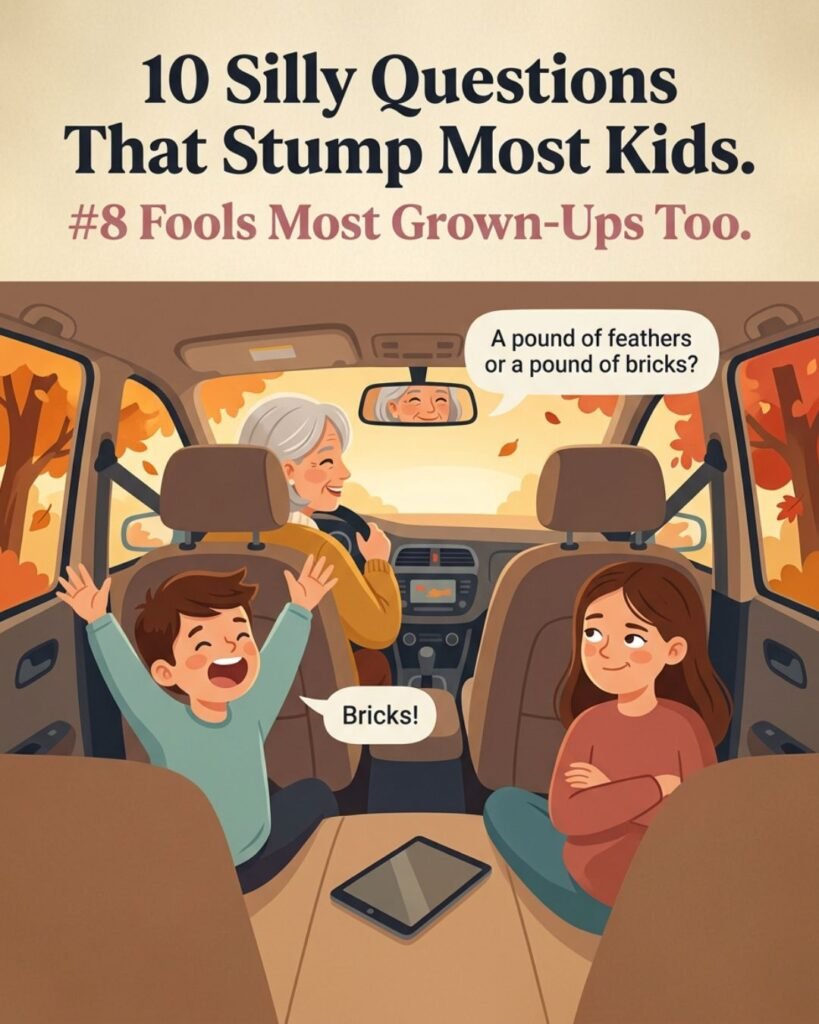
So you try something. “If I had one bag with a pound of bricks in it and another bag with a pound of feathers, which bag would be heavier?”
“The bricks!” your grandson shouts. He’s seven, and he answers before you’ve even finished the question. His big sister rolls her eyes, says “they’re the same, genius,” and then the two of them argue about it all the way to the next traffic light. Nobody touches a screen for the next twenty minutes, and by the time you pull into the driveway they’re asking you for “one more, just one more.
That’s the magic of a silly question. It costs nothing and works on kids from about five to fifteen, and honestly on a few grown-ups too. Below are 10 of my favorite silly questions to stump your kids, grouped by how sneaky they are, plus a bit of research on why they’re actually good for kids. So, let’s go through it.
Why Silly Questions Are Worth Your Time
First of all, there’s more to this than killing time in the car. Back in 1998, psychologist Nicola Yuill and her colleagues at the University of Sussex found that children who were good at understanding and explaining riddles also had better reading comprehension. Even more interesting, training kids to understand and make up riddles improved their general reading comprehension on a standard test. The idea is simple. A riddle forces a child to notice that a word can mean two different things, and that’s exactly the skill a struggling reader often lacks.
Age matters too. Humor researcher Paul McGhee describes a “riddle stage” that starts around six or seven, when kids discover that words can have double meanings. Before that, they’ll happily repeat riddles they’ve heard from older kids without understanding them at all. McGhee even calls the phase that follows “the riddle disease,” because once it starts, they tell riddles constantly. If you’ve spent a weekend with a first-grader, you know.
And then there’s the laughing. The Mayo Clinic notes that a good laugh first raises and then lowers your heart rate and blood pressure, which leaves you feeling relaxed. That goes for you as much as for the kids.
The Back-and-Forth Is the Point
The researchers at Harvard’s Center on the Developing Child talk a lot about something they call “serve and return.” It’s the back-and-forth between a child and a caring adult, like a game of tennis, and it helps build the brain’s wiring for language and much more. Their work focuses mostly on babies and little kids, but I personally think a silly question is serve and return in its purest form, even with a ten-year-old who swears he’s much too old for this and then asks for another one the second you stop. You ask, they guess, you laugh, they ask you one back.
This short video from the Center explains the idea in under two minutes.
A Few Ground Rules Before You Start
Just a tip. The goal is never to make a child feel stupid. If they get it wrong, laugh with them and give a hint, then let them try the same question on their mom when she picks them up. That’s half the fun anyway.
Also, match the question to the age. A five-year-old won’t get a riddle that plays on words, and that’s fine. They’ll laugh at your face when you tell them the answer, which is good enough.
How to Ask So It Actually Works
Timing is everything. The best moments are the boring ones, like waiting for food at a restaurant or standing in line at the pharmacy, when kids would normally reach for a phone. Nobody wants a riddle in the middle of their favorite show.
Then give them time to think. Grown-ups have a habit of jumping in with the answer after three seconds, because the silence feels awkward. Don’t. Let them squirm a little. I like to say “I’ll give you until the next red light,” which turns it into a small game. Just don’t get so into it yourself that you miss the green light and the car behind you starts honking.
And keep a straight face when you ask.
It matters more than you’d think.
Three Old Tricks That Still Work
These are the ones your own parents probably used on you. They work because kids answer fast, before their brain has caught up with their mouth.
1. “Put a pound of feathers on one side of a scale and a pound of bricks on the other side. Which side goes down?”
Almost every young child picks the bricks. But the scale stays perfectly level, of course, since both sides weigh one pound. Expect an argument. Some kids will insist the bricks are still heavier “because they’re bricks,” and honestly I’ve met adults who think the same way and will argue about it at the dinner table long after the kids have gone off to play.
2. “Quick, count them for me. How many months of the year have 28 days in them?”
They’ll say one, February. But every month has at least 28 days, so the answer is all twelve. This one usually gets a long “heeey” from the back seat.
3. “A rooster climbs up to the highest point of the farmhouse and lays an egg up there. Does it roll down the front side or the back side?”
Watch them think hard about the wind and the slope. Then break the news. A rooster has never laid an egg in his life, because that’s the hen’s job. Farm kids get this one instantly, so it’s better for city grandkids.
Riddles Where a Word Means Two Things
These are perfect for kids in that riddle stage, from about seven up. They’re also the ones the Sussex researchers would like best, since each one hides a second meaning.
4. “I spend my whole life drying things, and every time I do, I end up wetter. What am I?”
A towel. Kids often need a hint here, so pretend to dry your hands on your shirt and count how long it takes them.
5. “Everybody can catch it, but nobody has ever thrown one. What is it?”
A cold. You’ll hear every kind of answer first, from a fish to a bus, and a few of them will actually be pretty clever. If a child gives you a smart answer you didn’t expect, give them the point. They earned it.
6. “A dog runs straight into a forest. How far in can it get before it stops running in?”
This one takes a second. The answer is halfway. Once the dog passes the middle, every step is taking it back out again. Older kids love it, and then they spend the rest of the week trying it on their friends at school and on anybody else who stands still long enough, which in my experience includes a very patient cashier at the grocery store.
The Ones That Catch Grown-Ups Too
These three are sneaky. Try them on the kids first and then on their parents at dinner, and see who does better. Most of the time it isn’t the grown-ups.
7. “Mary’s dad has five girls. Four of them are called Nana, Nene, Nini and Nono. So what’s the name of girl number five?”
“Nunu!” Everybody says Nunu. But the answer is Mary, since she’s the one we started with. Say the names slowly and in a sing-song voice, which makes it work even better.
The Race Question
8. “Imagine you’re in a running race, and you overtake the runner who is second. Where are you now?”
Most people say first. But you only got ahead of the runner who was second, so now that spot is yours. You’re second. I’ll admit it, the first time somebody asked me this I got it wrong too, and I was well past the riddle stage.
Silk, Silk, Silk
9. This one works best out loud. Ask your grandchild to say “silk” five times, fast. Let them go, “silk, silk, silk, silk, silk.” Then ask right away: “What do cows drink?”
“Milk!”
Nope. Cows drink water. Calves drink milk. The look on their face when they realize it is worth the whole car ride, and they will immediately want to do it to somebody else.
And One Nobody Can Answer
10. “What sound does the color purple make?”
There’s no right answer here, and that’s what makes it fun. You’re both stumped, so you both have to make something up. I’ve heard everything from “a cat purring” to “a trumpet that’s sad,” and that kind of answer tells you a lot about how a child’s mind works. You can keep going with the same idea, so ask what Tuesday tastes like, or what a cloud would say if it could talk.
Picture your granddaughter in the back seat, thinking about it for a long minute. Then she says, very seriously, “Purple sounds like when you hum with your mouth closed.” You’ll probably never forget that, and neither will she, because you’ll remind her of it at her wedding.
This is the kind of question that turns into a real conversation. Sometimes it goes on for half an hour, and you learn more about your grandchild than you would from asking “how was school?” a hundred times.
When They Turn the Tables on You
Of course, kids are excellent at stumping us right back. In a 2025 survey of 2,000 parents with children up to age six, run by Talker Research for a childcare company, parents said they answer about 46 questions a day. And they didn’t have an answer about 35% of the time.
It’s a commercial survey, so I wouldn’t take the exact number too seriously. But anybody who has spent a rainy afternoon with a four-year-old knows it’s not far off. Some of the questions parents shared were wonderful, like “If time had a smell, what would it smell like?” I have no idea. Do you?
Then there are the riddles little kids invent themselves. “What did the banana tell the doctor? Purple!” It makes no sense at all, and that’s completely normal. Remember McGhee’s pre-riddle stage? Kids around five copy the shape of a riddle long before they understand how one works, so the punchline is often random and they laugh hardest at it anyway. Laugh with them. It’s still a joke, just not a grown-up one yet.
When that happens, don’t feel like you have to know everything. “I don’t know, what do you think?” is a perfectly good answer. Sometimes it’s the best one.
Grandparents, This Works on the Phone Too
Not every grandmother lives around the corner. According to Pew Research Center, the average grandparent in the U.S. is 68 and has six grandchildren, and about seven in ten grandparents 65 and older are in touch with their grandkids at least a few times a month, whether that’s in person or through a phone call or a text.
A riddle is a great way to start one of those calls. Instead of “what did you do today?” and a one-word answer, try “I have a question nobody in our family can answer.” Kids will stay on the line for that.
If your grandkids are a bit older and like a real puzzle, TED-Ed has a whole series of animated riddles. This one, about lions and wildebeest crossing a river, is a nice one to watch together and then solve before the answer comes up.
Just remember the parents’ rules. A few riddles at bedtime are lovely, but an hour of giggling past lights-out is the kind of thing that belongs on the list of things grandparents should never do without asking. And if you want to make it part of your day, take them on a walk and save the questions for the way back. Walking is good for you too, as I wrote in how to lose weight by walking.
One Honest Note
Not every child enjoys being tricked. Some kids feel embarrassed when they get things wrong, especially in front of brothers and sisters, and some take language very literally. That can include kids who are still learning English, and some autistic children. For them, a trick question can feel like a trap instead of a game.
If you see that, switch to the open questions like the purple one, where nobody can be wrong. Or let them be the one asking. Kids who hate being tricked often love tricking you, and that’s a perfectly good way to play.
When They Run Out of Yours, Let Them Make Their Own
Sooner or later you’ll run out of riddles, or they’ll know them all by heart. That’s actually the best moment, because now you can ask them to invent one.
Remember the Sussex study? The kids didn’t only answer riddles. They were also trained to make them up, and that’s part of what helped their reading. To build a riddle, a child has to find a word with two meanings and then hide one of them, which is surprisingly hard work for a brain of any age.
Start simple. Pick a word together, like “bark,” and ask what it could mean. A dog barks, and a tree has bark. Then help them turn it into a question, something like “What do trees and dogs both have?” It doesn’t need to be good.
Mine usually aren’t either.
Some families keep a little notebook in the car or on the kitchen counter just for the riddles the kids come up with, and years later it becomes one of those things nobody would ever throw away, right next to the height marks on the door frame and the handprint from kindergarten.
Why It’s Worth Trying Tonight
None of this needs a plan or a special book. It needs one adult who is willing to look a little silly and one child who isn’t staring at a screen for a minute.
I think that’s why these questions stick around for generations. The same rooster riddle your grandfather used is now working on a kid who has never seen a barn. If you like little habits that keep the mind young and the family close, you might also enjoy my article on the Japanese longevity habits.
Try one at dinner tonight. Then wait for them to try it on you tomorrow.
What’s the one silly question that always stumped your kids, or you?