
You and your sister used to share a bedroom. You fought over the radio, covered for each other when one of you came home late, and cried together the night the dog died. Now you’re both in your fifties, and you can’t remember the last real conversation you had.
There was never one big fight. It just slowly got colder. Every time your mother called, there was a little something. “Your sister thinks you’ve changed since the divorce.” “She was hurt you didn’t call on her birthday.” Then, at your cousin’s wedding last summer, your sister walked past you and said, “Mom told me what you said about my husband.”
You never said anything about her husband.
If that sounds familiar, there’s a good chance your siblings aren’t really the problem. In families with a narcissistic parent, brothers and sisters are often pushed against each other on purpose, sometimes for decades, and most of them never realize it’s happening. In this article I want to go through why a narcissistic parent does this, the most common ways they do it, and how brothers and sisters can find their way back to each other. I also added two short videos from psychologist Dr. Ramani Durvasula that explain it really well. So, let’s go through it.
This Happens In More Families Than You’d Think
First of all, a little favoritism exists in almost every family, even loving ones. Sociologists Jill Suitor and Karl Pillemer spent years studying mothers in their late 60s and 70s and their adult children, and found that most mothers named the same favorite child even seven years later. According to Purdue University, the adult children who were their mom’s emotional favorite actually had more tension with their brothers and sisters, not less.
And here’s the strange part. As TED Ideas reported, only 39% of adult children correctly guessed which sibling their mother was most proud of. So a lot of us are walking around with the wrong idea about who Mom liked best, and that confusion alone can create plenty of distance.
Now imagine a parent who doesn’t just have a favorite, but uses it. That’s a whole different story.
One honest note. Narcissistic personality disorder is a real diagnosis that only a professional can make. Here I use the word the everyday way, for a parent with very strong narcissistic behavior. Your mom may never have seen a psychologist, but the pattern can still be very real.
Why Would A Parent Do This?
It’s a hard question, because most of us can’t imagine wanting our own children to dislike each other. But for a narcissistic parent, close siblings are a risk.
Think about it. If you and your brother talk openly, you start comparing notes. “Wait, she told you that? She told me the opposite.” Suddenly the stories don’t match anymore, and the parent loses control of the version everybody believes. When the kids are busy being angry at each other, nobody looks too closely at the person in the middle.
Another thing is attention. When two siblings are competing for a parent’s approval, that parent is always the most important person in the room. As I wrote in the truth about narcissistic parents, for many of them looking good matters more than being good, and a family where everybody needs them is a family that makes them look important.
The Most Common Ways They Do It
Every family is different, of course. But some of these will probably sound very familiar.
Playing Messenger
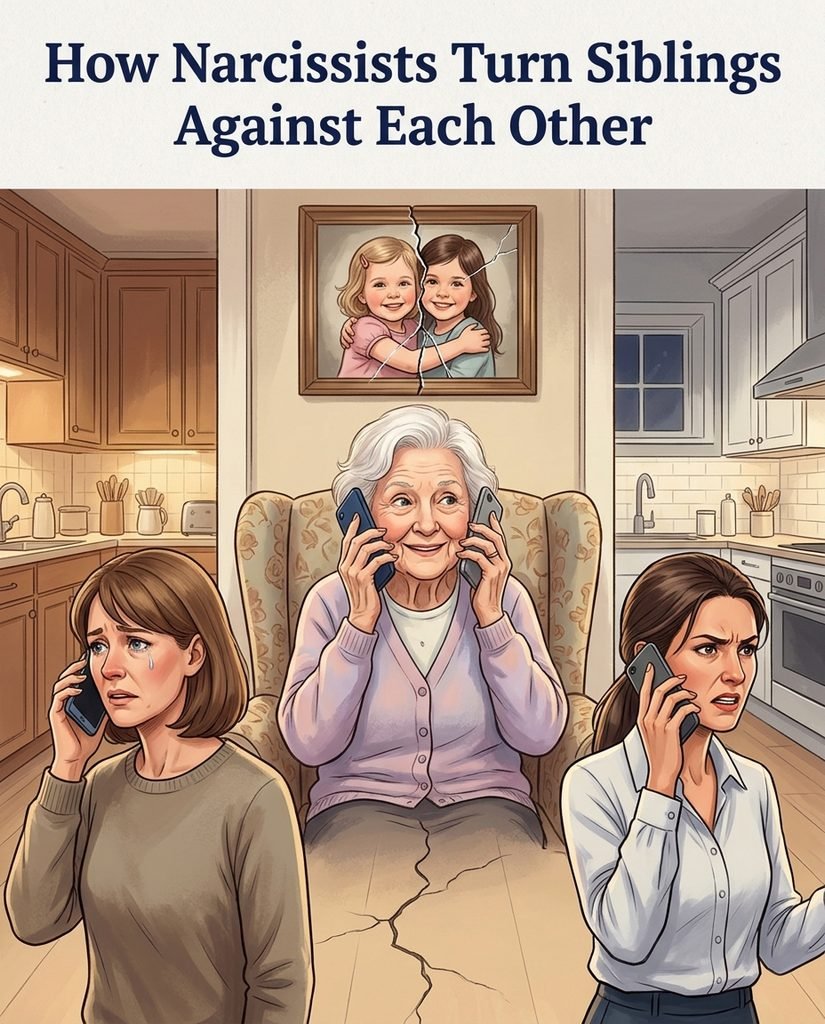
This is the big one, and psychologists call it triangulation. Instead of the siblings talking to each other, everything goes through the parent. Mom tells you what your brother “really” thinks about you, and then tells your brother what you “really” think about him. Often it’s just a little twisted, maybe 20% true, which is exactly why it’s so believable.
You might notice that whenever you call your sister directly, your mother suddenly gets upset, or calls you right after to ask what you two talked about.
The Golden Child And The Scapegoat
In many narcissistic families, one child can do no wrong and another one gets blamed for everything. The golden child gets the praise, the help with the down payment and the excuses. The scapegoat gets the criticism, the comparisons and, very often, the blame for every family fight. Sometimes there’s a third child who just quietly disappears into the background, and Dr. Ramani calls that one the invisible child.
What makes this so painful is that the siblings usually end up resenting each other instead of the parent who set it all up. The scapegoat thinks the golden child had it easy. The golden child, on the other hand, often feels huge pressure, and guilt, and is terrified of falling out of favor. Dr. Ramani explains all three roles in this short video.
Comparing You Out Loud
“Why can’t you be more like your brother?” Some of us heard that so many times growing up that we still hear it in our heads at 50. And it doesn’t always stop when you’re grown. It just changes. Now it’s your brother’s nice house, his successful kids, the way he calls every Sunday.
Picture a Thanksgiving table where your mother tells everybody, loudly enough for you to hear, that your brother’s son got into a good college “because his parents really pushed him.” Your own son is sitting right there, he just started at the community college, and you can see him look down at his plate. One sentence, and two families now feel a little bit like competitors.
Secrets And Special Alliances
“Don’t tell your sister, but…” When a parent shares secrets with one child about another, it feels like closeness. It’s actually a way of building a team, and it always means someone else is on the outside.
Maybe your mother tells you your sister is having money problems again, “but don’t say I told you.” The next week she tells your sister that you think she’s bad with money. You never said that, of course. But now your sister is cold on the phone, and you have no idea why, because you’re not supposed to know about the money in the first place.
Money, The House And The Will
Money is one of the easiest ways to divide grown children. One gets help with a car, another gets nothing. One is promised the house, another hears about it from a cousin. And sometimes the will itself becomes the final move, leaving brothers and sisters to fight long after the parent is gone. I wrote more about how inheritance can tear families apart in my article about the child who cared for the parents.
Signs It Might Be Happening In Your Family
Sometimes it’s hard to see when you’re inside it. A few questions might help.
Do you mostly hear about your siblings through your parent, and almost never from them directly? Does your parent seem a little too interested every time you and your brother talk, wanting to know exactly what was said? Have you ever been angry at your sister for something she supposedly said, without ever asking her if she really said it? And when the family is together, does it feel like there’s a team, and you’re not on it?
If you answered yes to a few of these, it doesn’t prove anything on its own. But it might be worth having a quiet, honest coffee with your sibling, just the two of you.
What It Looks Like When You’re All Grown Up
A lot of people think this kind of thing is over once the kids move out. Unfortunately, it often gets worse.
When the parent gets older, there’s the question of who takes care of them, who pays for what, and who gets called in an emergency. The parent may complain to one child about the other, or tell everyone that “nobody helps me” while one daughter drives over three times a week. If you want to know more about how this changes with age, I wrote about what happens when a narcissist gets older.
Holidays can turn into small battles too. Who hosts, who brings what, who was or wasn’t invited. And very often there’s one sibling who still defends the parent no matter what, and another one who has started to see the pattern, and those two can barely sit at the same table.
Dr. Ramani talks about how these old roles and fights carry into adulthood, including fights over caregiving and inheritance, in this video. It’s worth watching if you have a brother or sister you can’t seem to get along with.
It Was Never Really About Your Sibling
This is probably the most important thing in this whole article. Your brother or sister was a child too. They didn’t choose to be the favorite, and you didn’t choose to be the one who got blamed. You were both kids trying to survive in the same house, each in your own way.
That doesn’t mean everything they did was okay. Some golden children grow up and keep scapegoating their siblings, sometimes even worse than the parent did. But understanding where it started can soften a lot of the anger. Most of it belonged to someone else all along, to the parent who was supposed to protect the bond between their children and instead, for their own reasons, quietly kept pulling it apart year after year, holiday after holiday, until two people who once shared a bedroom could barely say hello at a wedding.
How To Find Your Way Back To Each Other
It’s not always possible. But it’s possible more often than people think.
Talk Directly, Without The Parent In The Middle
Call your sister yourself. Meet your brother for coffee without telling Mom. Most of the time, the first real conversation is a bit awkward. But at some point one of you says, “Wait, she told me you said that?” and things start to make sense. Many siblings are surprised when they finally compare stories.
It might start very simply. “Hey, can I ask you something? Did you really say you didn’t want me at Christmas?” And your brother says, “What? No. Mom told me you didn’t want to come.” That one minute can undo years of quiet hurt, and you’ll probably both laugh a little, a bit sadly, because suddenly so many things make sense.
Make One Simple Rule
Agree that you don’t pass messages through your parent anymore. If Mom says “your brother is upset with you,” you call your brother and ask him. You’d be surprised how quickly the triangle falls apart when nobody plays the messenger.
Your parent might not like it. Some will get upset, say you’re “ganging up” on them, or suddenly get sick that week. Try to stay calm and kind, but don’t go back to the old way. You’re not doing anything against your parent. You’re just talking to your own brother.
Give It Time
Don’t expect the golden child to see everything overnight. They may still feel very loyal, or guilty, or simply not ready. Just a tip. Start with small, normal things, birthdays, a funny photo of the grandkids, a call about nothing special. Trust usually comes back slowly, the same way it disappeared.
And please, don’t make the first conversation a big trial about the past. You don’t need to agree on everything that happened when you were ten. You just need to start talking again.
When Your Sibling Doesn’t Want To
Sometimes you do everything right and your brother or sister still isn’t interested. Maybe they’re not ready, or maybe they picked up the same narcissistic patterns themselves. That’s painful, and it’s okay to grieve it, the same way you would grieve any other important loss in your life. You can leave the door open without forcing your way through it. And if all of this left deeper marks, like constant self-doubt or always feeling like the bad one, have a look at these quiet signs of trauma from narcissistic abuse. Talking to a therapist can really help.
If You’re A Parent Reading This
Most parents who feel closer to one child are not narcissists at all. It happens, and it’s human. What matters is not using it. Don’t share one child’s secrets with another, don’t compare them out loud, and when one of them complains about a sibling, encourage them to talk to each other instead of through you. One day you won’t be here, and the best thing you can leave behind is brothers and sisters who still call each other. That’s worth much more than any house or any savings account, and it’s something you can start protecting today, with something as small as saying, “Why don’t you call her and ask?”
The Bottom Line
Narcissistic parents often turn siblings against each other because close siblings compare notes, and that’s a risk for a parent who needs to control the story. They do it by playing messenger, picking a golden child and a scapegoat, comparing, keeping secrets and using money. The children usually end up angry at each other instead of at the person who set it up. The good news is that once you see it, you can step out of it. Talk to your sibling directly, stop passing messages, and give it time. Many brothers and sisters find each other again, sometimes after many years.
Did a parent ever try to turn you and your siblings against each other? Let us know in the comment box below.