
You’re standing in front of the mirror at the bridal shop. You’re 34, the dress fits, and for the first time in weeks you actually feel beautiful. The saleswoman is smiling. Your best friend has tears in her eyes.
Then your mother tilts her head and says, “Hm. Are you sure about sleeveless, sweetheart? At your age?”
That’s all. One sentence. And the feeling is gone, just like that, the way it has disappeared a thousand times before.
If you grew up with a mother like that, you probably know the language very well. The words themselves often sound harmless, even caring, and that’s exactly what makes them so confusing, because how do you explain to your husband or your best friend that a question about sleeves ruined your whole afternoon without sounding completely ridiculous? In this article we’ll go through the things narcissistic mothers say to their daughters, grouped by the moments they usually show up, and what’s often hiding underneath them. So, let’s go through it.
A Short Note Before We Start
I’m not a therapist, and this isn’t a diagnosis. Narcissistic personality disorder is something only a professional can diagnose. I use the word narcissistic here the everyday way, for a mother with strong narcissistic patterns.
Also, every mother says something hurtful now and then. One bad sentence doesn’t make anyone a narcissist. What we’re talking about here is a pattern that goes on for years, where the hurtful comments are the rule rather than the exception.
Why Mothers and Daughters?
Narcissistic fathers can do plenty of damage too, of course, and many readers grew up with one of each. But therapist Karyl McBride, who wrote one of the best-known books on this subject, Will I Ever Be Good Enough?, noticed something in her practice. Many of her female clients, who had grown up with narcissistic mothers, shared the same struggles, like trouble making decisions and a deep lack of trust in themselves.
That’s a clinician’s observation, not a controlled study, so I wouldn’t treat it as proof. But it matches what a lot of women describe. A narcissistic mother often sees her daughter as an extension of herself, so the daughter’s looks and choices become a reflection of the mother. That’s a lot to carry for a little girl, and it doesn’t get lighter at 50.
About Your Looks
“You’d be so pretty if you just did something with your hair.”
This one sounds like a compliment for about half a second. What it often means is: the way you look reflects on me, and right now I’m not satisfied. The word “if” does all the work. You’re always one change away from being good enough.
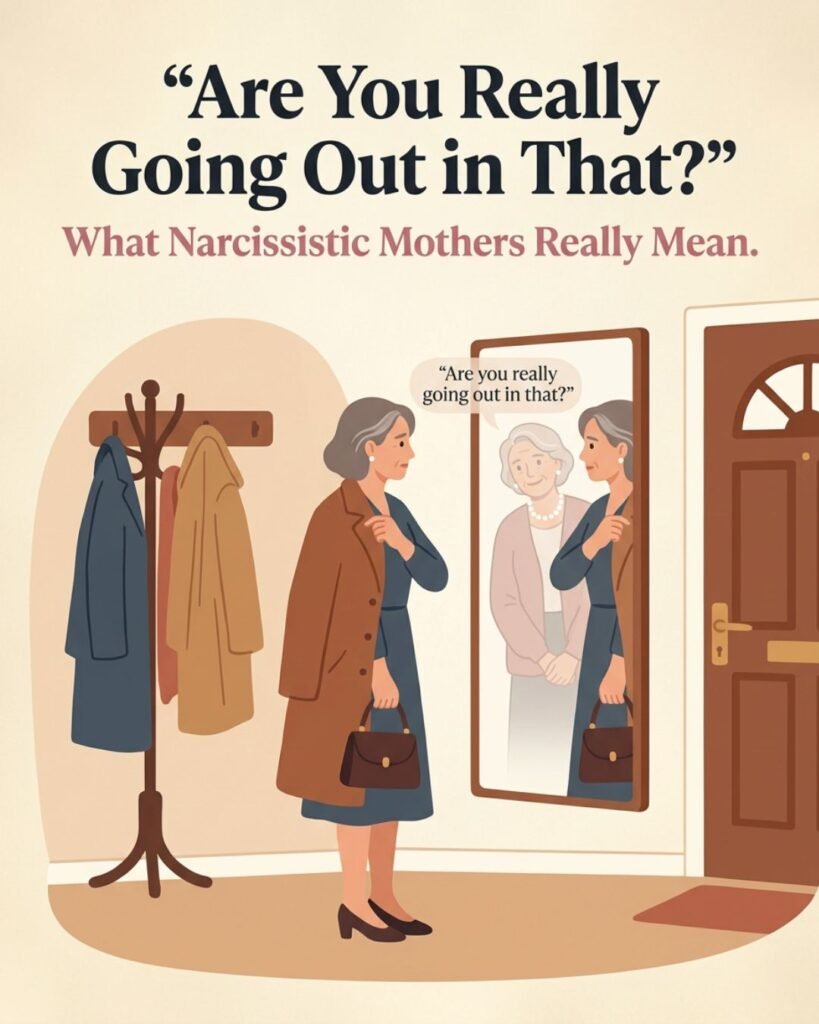
“Are you really going out in that?”
Usually said at the door, when there’s no time to change and no time to argue. You walk out feeling wrong in your own clothes, and that feeling comes with you to the party, where you spend the whole evening tugging at your sleeves and checking your reflection in every window you pass.
Comments about the body can stick for a very long time. A 2018 study in Pediatrics followed more than 500 young people from the Project EAT study for about 15 years. Those whose parents had encouraged them to diet as teenagers were, as adults, less satisfied with their bodies, and more likely to pass the same kind of talk on to their own children. The study shows a link, not proof of cause, but it’s worth knowing.
If comments about your body still echo in your head, or food has become a struggle, please talk to your doctor. The National Alliance for Eating Disorders helpline is 866-662-1235, Monday to Friday.
About Your Feelings
“You’re way too sensitive. You always have been.”
This might be the most common one of all. What it usually means is: your reaction is the problem, not what I said. It moves the conversation away from her words and onto your “flaw,” and after enough years of hearing it, many daughters stop trusting their own feelings entirely.
“I was only joking. Can’t you take a joke?”
The joke is usually at your expense, in front of people. If you laugh, she wins. If you don’t, you’re humorless. Either way, nobody talks about whether the joke was kind.
“That never happened. You have such an imagination.”
This is denial of something you clearly remember, and it’s one of the ways gaslighting works. Over time, a daughter starts to doubt her own memory, which is exactly why so many grown women keep diaries or save text messages without really knowing why. If that sounds familiar, you might recognize more in the signs of trauma from narcissistic abuse.
About Your Childhood
“You were such a difficult baby. You cried all the time.”
This one gets told at family gatherings, often with a laugh, and sometimes for decades. On the surface it’s just a story. Underneath, it can mean: you were a problem from the very beginning, and anything that went wrong between us started with you.
“I did the best I could, which is more than my mother ever did for me.”
Sometimes this is completely true, and it’s worth hearing with compassion. But when it shows up every single time you try to talk about something that hurt, it works as a door slamming shut. The conversation becomes about her childhood instead of yours, and you end up comforting her for the pain you came to talk about.
About Your Success
“Well, don’t let it go to your head.”
You got the promotion. And instead of “congratulations,” you get a warning. Often it means: your success makes me uncomfortable, especially when the attention isn’t on me.
“Your cousin Laura just bought a house, you know.”
Said right after your good news, as if by accident. The comparison doesn’t have to be cruel to work. It just has to be well-timed.
Praise With Strings Attached
“I’m so proud of you when you listen to me.”
Notice the second half of that sentence. Researchers Avi Assor and Guy Roth, working with motivation expert Edward Deci, studied what they call conditional regard, love and approval that depend on the child doing what the parent wants. As Alfie Kohn described in The New York Times, the college students in their study who grew up with this kind of approval were somewhat more likely to do what their parents wanted. But they also tended to resent their parents. And when they succeeded, the good feeling faded fast.
That last part explains a lot. Many daughters of narcissistic mothers are high achievers who never quite feel happy about anything they achieve.
Guilt and Sacrifice
“I gave up my whole life for you kids.”
Maybe she did give up a lot. Many mothers of that generation did. But when this line comes out in the middle of a disagreement, it usually means: you owe me, and the debt can never be paid. It turns love into a bill.
“One day I’ll be gone, and then you’ll be sorry.”
This one is heavy, and it’s meant to be. It usually comes out when you’ve said no to something, and it lands right on the fear every daughter carries, that she’ll regret not doing enough while she still could, so she gives in again and spends the next week wondering why she feels both relieved and resentful at the same time. What it often means is simply: do what I want, right now.
Psychologist Dr. Ramani Durvasula talks about how narcissistic mothers often lean on exactly these guilt-based appeals, especially around holidays like Mother’s Day. She also offers some practical ideas for getting through those visits, like keeping conversations simple and planning something restorative afterward.
When You Become Her Confidante
“You’re the only one who really understands me.”
It feels like closeness, especially to a young girl. But often it means the mother has turned her daughter into a kind of therapist, or even a partner in complaining about Dad. Therapists sometimes call this emotional parentification, when a child ends up taking care of a parent’s feelings.
Picture a twelve-year-old sitting on the edge of her mother’s bed late at night, listening to her cry about the marriage, and then getting up for school the next morning as if nothing happened. That girl often grows into the woman who manages everyone’s feelings at every family gathering. I wrote about that pattern in why the eldest daughter ends up managing the family.
When You Push Back
“After everything I’ve done, this is how you treat me?”
You set one small boundary, like saying you can’t come for lunch on Sunday, and suddenly you’re the villain of the story. What it often means is: your boundary is an attack on me, and I’m the one who’s hurt here.
“Fine. Do whatever you want. You always do.”
Then comes the silence. No calls for a week, or short, icy answers when you call her. Many daughters cave within days, not because they changed their mind but because the silence feels unbearable. Knowing that it’s a pattern, and that it usually passes, can make it a little easier to wait out.
“You’ve changed. Somebody’s been putting ideas in your head.”
This one tends to come out when a daughter starts therapy or simply grows more confident. The “somebody” is usually your husband or your therapist. What it really means is: I’m losing control, and I’d rather blame them than look at myself.
About Your Own Family
“Those kids walk all over you.”
Once you become a mother yourself, the criticism often moves to your parenting. Your rules are too soft, and of course she raised you much better. It means: I’m still the expert on mothering, and you’re still the child.
“Your husband will never know you the way I do.”
Said quietly, maybe in the kitchen at Christmas. It’s a way of keeping her place at the center of your life, even when you’ve built a new one.
“Nobody will ever love you the way your mother does.”
On a good day, it sounds sweet. On a bad day, especially after an argument with your partner, it can sound like a quiet warning that everyone else will eventually let you down and that the only safe place is back with her, which is a very lonely message to grow up with, even when it’s said with a smile and a hug at the end of a long visit.
Why These Words Stick for So Long
Here’s the strange part. Many women in their 50s and 60s, long after they’ve moved out, still hear their mother’s voice in their head. You try on a dress and think, “At your age?” You make a mistake at work and hear, “You always were too sensitive.” She doesn’t even have to be in the room anymore.
That happens because a child doesn’t hear these sentences as opinions. She hears them as facts about herself, and she repeats them quietly to herself long after the original speaker has stopped.
McBride’s book talks about building an “internal mother,” a kinder inner voice that comforts you the way you needed to be comforted as a girl. It sounds a little soft, maybe. But many women find it surprisingly practical.
Next time you hear the old voice, try answering it the way you’d answer a friend. “The dress looks good. You’re allowed to like it.”
What You Can Say Instead of Defending Yourself
One thing that helps many women is to stop explaining. Dr. Ramani’s advice for difficult visits includes not defending or oversharing, and you can apply that almost word for word.
When she comments on your clothes: “I like it.” Then talk about something else.
When she says you’re too sensitive: “Maybe. It still hurt.” Then let the silence sit there.
When she brings up her sacrifices: “I know you worked hard. I’ll see you on Sunday.” No arguing about who owes whom.
It feels strange at first, a bit like learning to write with your other hand. Just a tip, it helps to practice the sentences in the car before you walk in.
One Honest Note
Not every critical mother is a narcissist. Some grew up with very hard parents themselves and simply never learned another way to talk. That doesn’t make the words hurt less, but it can help you decide how close you want to be. If you’re trying to understand where these patterns come from, there’s more in the truth about narcissistic parents.
And if any of this feels painfully familiar, you might also find yourself in why children of narcissistic mothers often feel guilty for being happy. A therapist who understands family trauma can help a great deal. If the relationship involves threats or physical harm, please reach out to the National Domestic Violence Hotline at 1-800-799-7233.
You don’t have to hate your mother to protect yourself from her words. And you don’t have to keep hearing them as the truth about who you are.
Back to the Bridal Shop
Remember the woman in the sleeveless dress? Imagine her taking a breath, looking at her mother in the mirror and saying, calmly, “I love it. This is the one.” Then she turns to her friend and asks about shoes.
Her mother might sulk for the rest of the afternoon. She might bring it up again at the wedding. But the daughter walks out of that shop with the dress she wanted, and with a small, new feeling that her own opinion counts too.
That’s what changing the pattern usually looks like in real life. A hundred small moments where you quietly choose to believe yourself, and one day you notice the old voice has gotten a little quieter.