
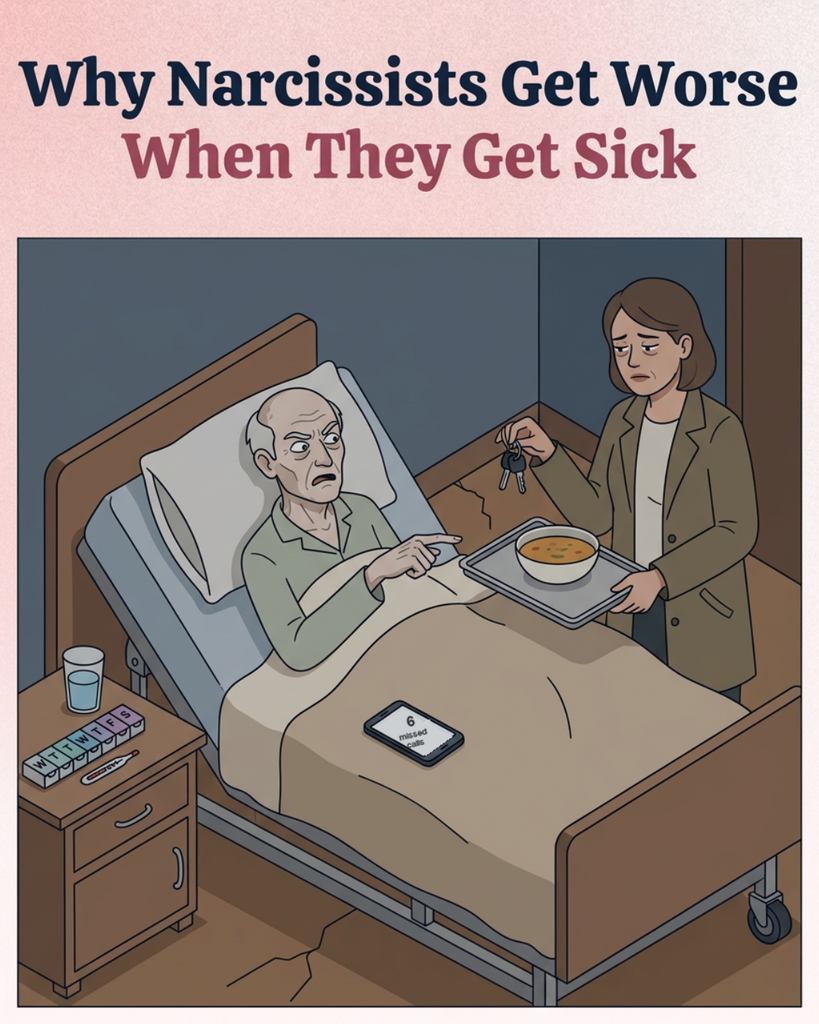
Your father has pneumonia. It’s not life-threatening, the doctor says, but he needs antibiotics and somebody to check on him every day for a couple of weeks. So you drive over after work, every day, with soup and his pills sorted into the little plastic box.
By the end of the first week he has called you six times in one afternoon. He has also told your aunt on the phone that “nobody in this family cares if I live or die.” When your brother finally stops by for twenty minutes on Sunday, your father tells him he’s the only one who really looks after him.
You stand in the kitchen holding the soup and wondering if you’re losing your mind.
You’re not. Many people who grew up with a narcissistic parent, or married someone with strong narcissistic traits, notice the same thing. When that person gets sick, the difficult parts of their personality often get louder, not softer. In this article we’ll look at why narcissists get worse when they get sick, what that looks like at home, what to rule out medically and how to protect yourself while you help. So, let’s go through it.
A Short Note Before We Start
I’m not a therapist or a doctor, and nothing here is a diagnosis. Narcissistic personality disorder is something only a professional can diagnose. I use the word narcissist the everyday way, for a person with strong narcissistic patterns.
Your parent or partner may never have been diagnosed with anything. The patterns still matter, and you don’t need a label to know how exhausting it feels.
Wait, Don’t Narcissists Mellow With Age?
This is a fair question, because the research is more hopeful than most people expect. A study that followed people for 23 years, from college into midlife, found that narcissism tends to decrease on average, and only about 3% of participants became more narcissistic over time. But entitlement, the feeling of deserving special treatment, was the most stable trait of all. I wrote more about this in does age make a narcissist more dangerous?.
So aging alone doesn’t usually make narcissism worse. Illness is a different story. A hospital stay or even a bad flu can push all the old patterns to the surface at once, and that’s what most families are reacting to.
Why Being Sick Hits a Narcissist So Hard
Narcissism, at its core, is often built around an image. The person needs to feel special and in control, and they need other people to see them that way too. Illness attacks every part of that picture.
Suddenly they can’t drive. They need help getting out of the bathtub. A young nurse calls them “sweetie” and tells them what to eat. For most of us, that’s uncomfortable. For someone whose sense of worth depends on being above everyone else, it can feel like humiliation.
There’s even some research on the stress side of this. In a 2012 study of 106 university students, men who scored high on the unhealthy parts of narcissism, like entitlement and exploiting others, had higher levels of the stress hormone cortisol, even without any stressful task. It was a small study of young people, so I wouldn’t stretch it too far. But one of the researchers made a point that fits what families describe: narcissists often turn to defensive strategies like aggression when their sense of superiority is threatened.
And few things threaten that feeling more than a hospital gown.
Fear Often Comes Out as Anger
Underneath the demands, there’s usually fear. Fear of dying, and fear of needing other people. But many narcissistic people have never learned to show fear, because showing it would mean admitting they’re vulnerable.
So it comes out sideways. Instead of “I’m scared about the biopsy,” you hear “Why are you always late? You clearly have better things to do.” Instead of “I hate needing help,” you get criticism of the way you folded the towels.
Knowing this doesn’t make the insults okay. But it can help you take them a little less personally, and that alone can make a long afternoon easier.
The Two Extremes
Psychologist Dr. Ramani Durvasula, who specializes in narcissism, describes two very different reactions. Some narcissistic people turn a minor cold into a national emergency, expecting everyone to drop everything. Others act as if they’re above the illness entirely, so they stop their medication when they feel like it and trust a neighbor’s advice over their doctor’s.
Many families see both, sometimes in the same week. Your mother insists her headache is worse than anyone’s has ever been, and two days later she refuses to take the blood pressure pills because “the doctor doesn’t know what he’s talking about.”
Dr. Ramani talks about all of this, including what it does to the family, in this video.
What It Often Looks Like at Home
Every family is different, of course. But a few patterns come up again and again.
The caregiver becomes the target. The person doing the most work, usually a daughter or a wife, gets the criticism, while the relative who visits once a month gets the praise. That can feel deeply unfair, and it often repeats roles that started in childhood.
Money and the will come up suddenly. “Maybe I’ll leave the house to your brother, since he actually cares.” If that sounds familiar, I wrote about whether parents should leave more to the child who cared for them.
Doctors and nurses get insulted or fired. Some narcissistic patients treat medical staff badly, and Dr. Ramani points out that this can actually lower the quality of care they receive, because people pull back from someone who keeps insulting them.
And the guilt gets heavier. “After everything I did for you” becomes a regular line, usually right when you’re trying to leave.
Before You Blame the Personality, Rule Out the Body
This part is important, and I’d ask you to read it carefully even if everything above sounds exactly like your family.
Not every change in an older person’s behavior is personality. A urinary tract infection, for example, can cause sudden confusion in older adults, a state doctors call delirium. According to the Alzheimer’s Society, a sudden, unexplained change, like new confusion or agitation, may be a sign of a UTI, with or without dementia, and needs medical attention right away. With the right antibiotics, it usually clears up.
Some forms of dementia also change personality. In frontotemporal dementia, early signs can include socially inappropriate behavior and less empathy, and according to the Mayo Clinic, symptoms often begin between 40 and 65, earlier than Alzheimer’s typically does.
Pain, poor sleep, depression and some medications can all make people irritable and suspicious too.
Pro tip: write down when the change started and what it looks like, with a few real examples. “Since Tuesday she’s accused me of stealing three times, and she’s never done that before” is much more useful to a doctor than “she’s been difficult.” If the behavior is new or sudden, call the doctor first and think about personality later, because an infection or a medication problem caught early is far easier to treat than one that has been quietly getting worse for a week.
How to Protect Yourself While You Help
Caring for a sick parent is hard even in a loving family. Caring for one who criticizes every spoonful of soup is something else entirely.
You’re One of Millions
According to a 2025 report from AARP and the National Alliance for Caregiving, about 63 million Americans are family caregivers, roughly 20 million more than in 2015. About one in five say their own health is fair or poor, and nearly half have faced a major financial hit like taking on debt.
If you’re exhausted, you’re not weak. You’re doing one of the hardest jobs there is, often without much help.
Don’t Wait for the Apology
This might be the hardest one. Many adult children hope that illness will finally soften their parent, that there will be a quiet moment by the hospital bed where they hear “I’m sorry” or “thank you.” Sometimes it happens, and that’s a gift.
Picture a daughter sitting by her mother’s hospital bed on a quiet Sunday. She has driven three hours. Her mother opens her eyes, looks at her and says, “Your hair looks terrible.” Then she asks where her son is.
Many readers will recognize that scene. It hurts every time.
But Dr. Ramani’s advice to caregivers is not to count on it. Give care because you’ve decided it’s right. Don’t give it to earn a thank-you. She also talks about protecting your own wellbeing first in this older but still very useful video.
Share the Load, Even If It’s Uncomfortable
If you’re the one who always ends up doing everything, there’s a reason that happens so often, and I wrote about it in why the eldest daughter ends up managing the family. Ask your siblings for specific help, like “Can you take Thursdays?” rather than “Can you help more?” Specific requests are harder to dodge.
In the U.S., the Eldercare Locator at 1-800-677-1116 can point you to local services like meal delivery and respite care, which gives you a break while someone else steps in. It’s a free government service, and a lot of people don’t know it exists.
Get Permission to Talk to the Doctors
A narcissistic parent may give the doctor one version of events and you another. “I take all my pills” can mean almost anything. If you’re the main caregiver, ask your parent, on a calm day, to sign the form at the doctor’s office that allows the staff to share information with you. Many offices have one.
It also helps to go to appointments with a short written list of what you’ve noticed at home. Doctors only see a few minutes of the person, and a narcissistic patient can be very charming for exactly those few minutes, smiling at the nurse and joking with the receptionist, before going home and telling you the whole visit was a complete waste of time.
When It’s Your Husband
Everything changes a little when the sick person is your partner. Dr. Ramani notes that a narcissistic spouse may resent depending on you and criticize the care you give, even when you’re being as kind as you can. Picture a husband recovering from a hip replacement who corrects how you hand him his water, then tells his golf friends on the phone that you’ve been “hovering.” It can be lonely in a way that’s hard to explain to friends.
If that’s your situation, try to keep at least one thing in your week that belongs only to you, even if it’s a coffee with a friend on Wednesday mornings. It matters more than it sounds.
Decide Where Your Line Is
You’re allowed to set limits, even with a sick parent. Maybe you visit every day but leave when the insults start. Maybe you handle the medications but not the finances. A boundary doesn’t make you a bad daughter, and it might be the only thing that keeps you able to keep showing up.
And if you’re still being hurt, whether that’s screaming or threats, please reach out. In the U.S., the National Domestic Violence Hotline is at 1-800-799-7233, and it covers emotional abuse from family members too.
A Few Things You Can Actually Say
In the moment, it helps to have a couple of sentences ready, because the guilt trips always seem to come at the worst time.
When the criticism starts: “I can hear you’re unhappy with the soup. I’m doing my best, and I’ll be back tomorrow.” Then go. You don’t need to defend the soup.
When they compare you to a sibling: “I’m glad he visited. I’ll see you on Thursday.” No arguing about who does more, because that’s an argument you can’t win and don’t need to.
When they threaten to change the will, or say nobody cares: “I’m here because I care about you. That’s not going to change today.” Calm, short and boring is the goal.
It feels strange at first. Most of us were trained to explain ourselves until the other person is satisfied, and with a narcissistic parent that moment never comes.
One Honest Note
It’s completely normal to feel pity and anger at the same time when a difficult parent gets sick, and then to feel guilty about the anger. You can feel sorry that they’re frightened and still be furious about how they’re treating you. Both feelings are real. If caring for them is bringing back a lot of old pain, you might recognize yourself in the quiet signs of trauma from narcissistic abuse, and it may help to talk to a therapist.
I also want to say this clearly. A narcissistic parent who is sick and scared is still a person who is suffering. You don’t have to like them, and you don’t have to sacrifice your health for them. But you also don’t have to become cruel to protect yourself. There’s more about where these patterns come from in the truth about narcissistic parents.
The Hardest Kind of Kindness
In the end, many caregivers find a quiet middle ground. They show up, do what they’ve decided to do and go home without waiting for a thank-you. It isn’t the ending anyone dreams about, but it’s one you can live with.
Maybe you bring the soup, sit for an hour and leave before the conversation turns. Maybe you call instead of visiting on the hard days. Over time, many people find they can be there without being swallowed up by it. There’s no failure in that. Most people need years to learn it.
And please, take care of your own health too. Book the checkup you’ve been postponing.
Has a difficult person in your life become harder to handle when they got sick? Let us know in the comment box below.