
It’s ten past seven on a school morning. The toast has gone stiff on the plate. You’ve got your keys in one hand and a lunch bag in the other, and your seven-year-old is flat on the hallway rug with one sock on and the other somewhere under the couch. “Shoes, please,” you say. Nothing. So you say it again, a little louder. He rolls onto his back and starts humming. By the fifth try you can hear your own mother’s voice coming out of your mouth, and he blinks up at you like you only just got home.
Maybe that’s your house. Or maybe it’s your daughter’s house on the afternoons you pick up the grandkids. Either way, you are far from the only one standing in that hallway. Child psychologists have been studying it for decades, and their work keeps landing on the same few small changes. None of them involve a louder voice, and all of them can help you get kids to listen before the morning falls apart.
So Why Is It Hard To Get Kids To Listen?
Children rarely tune us out to be mean. Their brains are still learning how to pull focus away from something fun and point it at something dull. The executive function clinic at Children’s Hospital of Philadelphia says a child glued to a tablet or a game may catch only a piece of what you said, or none of it. So when you call “Put your plate in the sink and grab your backpack” from the kitchen, your grandson may truly hear only the word “backpack.”
Then there’s the volume. Psychologist Ming-Te Wang at the University of Pittsburgh followed 967 middle schoolers and their parents for two years. In homes where shouting, cursing or insults were the go-to response, kids showed more behavior trouble over time, along with more signs of depression. Being a warm, huggy parent on the other days didn’t cancel out the shouting. Wang told his university’s news office that blowing up is “still bad” even for a supportive parent.
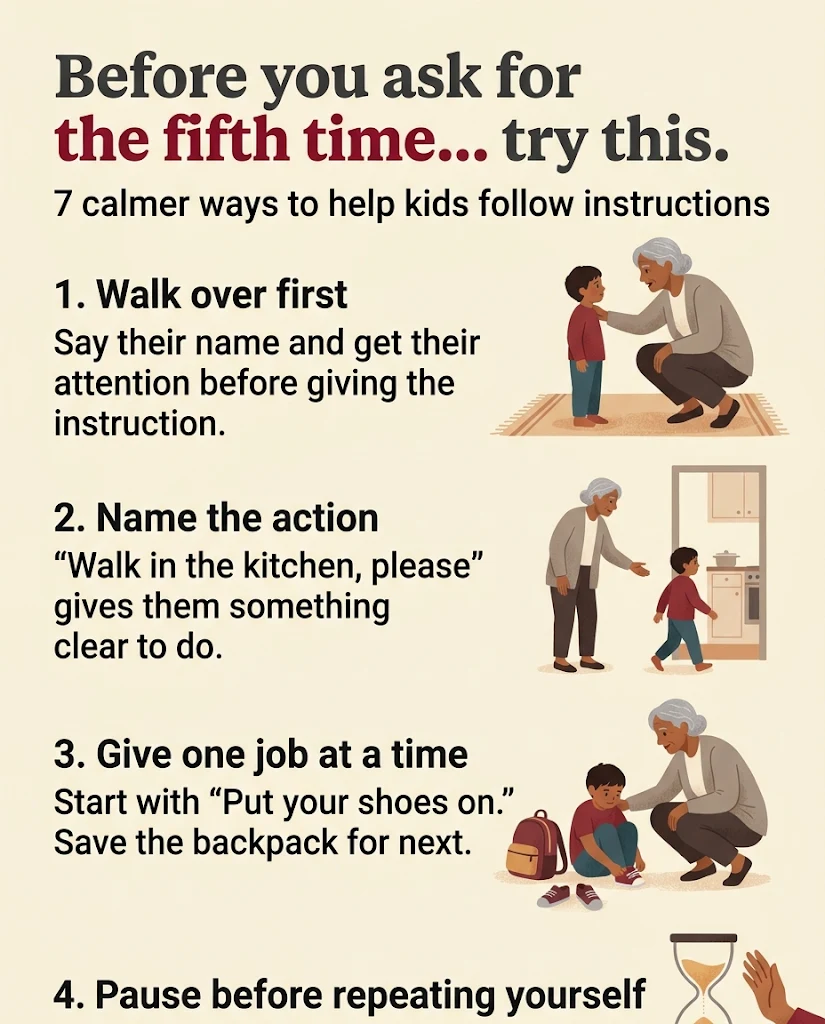
So the louder voice we all reach for doesn’t buy much. If you want to get kids to listen, these seven calmer habits are a better place to start, and you can try them tonight.
1. Walk Over Before You Say A Word
We all do the shout up the stairs. Still, words thrown down a hallway are easy for a busy child to miss. Put the dish towel on the counter, walk over and get down on one knee so you’re looking right at them. Say their name first. Then wait until their eyes actually meet yours.
The Centers for Disease Control and Prevention puts this at the top of its guide for parents of little ones. It sounds almost too simple to matter. Yet try pretending you didn’t hear Grandma when she’s down on the carpet beside you with a hand on your shoulder. Most kids can’t pull it off.
2. Tell Them, Don’t Ask Them
Plenty of us were raised to soften every request. “Would you like to brush your teeth now?” sounds polite. Then again, it hands the child an easy way out, and that way out is usually “no.”
The Child Mind Institute’s advice is to drop the question mark. “Time to brush your teeth” works fine. So does “Please hop in the bath.” You still get to say please. You just don’t leave a door open for “Nah.”
Questions are fine when you’d honestly accept either answer. A stubborn four-year-old who fights you on pajamas will often happily choose between the dinosaur pair and the striped pair. She gets a say, and you still get her into pajamas.
3. Say What You Want Instead Of What You Don’t
“Stop running!” tells a child what to quit. It says nothing about what to do next, so they may switch to skipping, hopping or sliding across the floor in their socks. Technically, they listened.
Try naming the behavior you hope to see. “Walk in the kitchen, please.” “Feet on the floor.” “Napkin on your lap.” Psychologist Kristin Carothers, formerly of the Child Mind Institute, offers a sofa example. Rather than warning a little girl about bouncing on the cushions, you simply ask her to sit on them.
Fair warning, “don’t” will still pop out of your mouth for weeks. When it does, start over halfway through. “Don’t throw your coat on the… Coat on the hook, sweetheart.” Kids don’t care that you fumbled the sentence.
4. One Job At A Time, And Have Them Say It Back
You might hold a whole grocery list in your head. A six-year-old usually can’t. “Go upstairs, change your shirt, bring down your laundry and tell your sister dinner’s ready” is four jobs in one breath. Most kids will come back down in the same shirt.
Give one task at a time. Then have them tell it back to you. The CHOP team suggests a little exchange like this one. “We’re leaving in five minutes,” you say. “So when are we leaving?” Only once they answer do you add the next piece. Yes, it’s slower the first week. But you’ll stop saying everything six times.
The same team suggests practicing at a calm hour first, maybe over dinner or in the bath. Don’t make your first attempt at 7:40 on a Monday with the bus coming.

5. Say It Once, Then Give Them A Moment
Kids need a beat to stop what they’re doing and switch over. If you repeat the request three times in ten seconds, you teach them something by accident. Pretty soon they figure out that only the third time is real.
Child Mind Institute experts say to give the instruction once and then zip it for a few seconds. Look out the window. Fold a towel. Sip your coffee. Many children start moving right around the moment you’d normally jump in again.
Still nothing? Say it one more time, calmly, and add what happens if it doesn’t get done. For example, “Please put the blocks in the bin, or we won’t have time for the park.” The CDC suggests giving just one warning, and it should be something you’re truly ready to carry out.
6. Do What You Said You’d Do
This one is hard, especially at the end of a long day. Even so, sticking to your word may matter more than anything else on this list.
In 2006, psychology professor David Wilder and his team at the Florida Institute of Technology tested a simple three-step routine with two preschoolers. First, the adult made a plain request, such as “Come here.” If the child ignored it, the adult said the child’s name, asked again and showed what to do. After ten seconds of nothing, the adult took the child gently by the hand and walked them through it, with no raised voice.
When the grown-ups used the routine every time, the two children followed directions 91% and 79% of the time. Using it only half the time dropped those numbers to 54% and 41%. And with no routine at all, the kids almost never listened.
Picture that at home. If you warn about losing tablet time and then let it slide on Tuesday, the child learns that warnings only count on some days. So before you give a direction, ask yourself whether you have the energy to see it through right now. If you don’t, it may be wiser to wait.
7. Notice When They Do Listen
Most of us speak up when kids get it wrong and stay quiet when they get it right. Try turning that around. The moment your grandson hangs up his coat without a fuss, tell him what you saw. “Thank you for hanging up your coat the first time I asked.” Carothers recommends praise that names the exact action, given right away, so the child knows what earned it.
You can also let the small stuff go. So he sighs like he’s been asked to dig a ditch while he picks up the Legos. Fine. He’s picking them up, and the CDC says that’s the part to focus on.
Rewards don’t need to cost anything, either. Carothers notes that plain time with a parent works well. A high five at the door or one more chapter of the bedtime book counts.
When It Might Be Something More
Every child zones out now and then. However, if your child has trouble with simple directions nearly every day, or it keeps getting worse, mention it to their pediatrician. Problems with attention or hearing can look a lot like stubbornness from the outside, and a doctor can help you figure out what’s really going on.
Arguing often shows up right after the ignoring stops, so our piece on what to do when your child argues with you may come in handy. And if your little one tends to quit the moment a task feels hard, read our five things to teach a child who gives up too fast.
The Child Mind Institute also put seven of its favorite tips into this short video, and it’s worth a watch before the next busy school morning.
Final Thoughts
There’s rarely one magic phrase that makes a child listen. What works is a set of small habits used again and again. Walk over. Say it plainly. Give one job, wait, and then do what you said, yes, even on the Thursday when you’re running on four hours of sleep. Kids figure out pretty quickly whose words count.
And if you yelled this morning, you’re in a very big club. Every parent and grandparent has had a morning that ended in raised voices. Tomorrow, walk over to the rug first and see what that one-sock little boy does.
What helps you get kids to listen in your house, or did your own mother have a trick that never failed? Let us know in the comment box below.