
Love can bring two people together, but when they follow different religions, everyday life can become much more complicated than either of them expected. These are the problems that many couples face but few are willing to talk about openly.
When two people fall in love, religion is usually not the first thing on their minds.
In the beginning, everything feels easy. You enjoy each other’s company, you laugh together, and the differences between you seem small.
But as the relationship gets more serious, those differences can start to feel much bigger than they did at first.
Couples who follow different religions often face problems that other couples never even think about.
These problems do not always show up right away. Sometimes they appear months or even years into the marriage, when the couple has to make decisions they never discussed before.
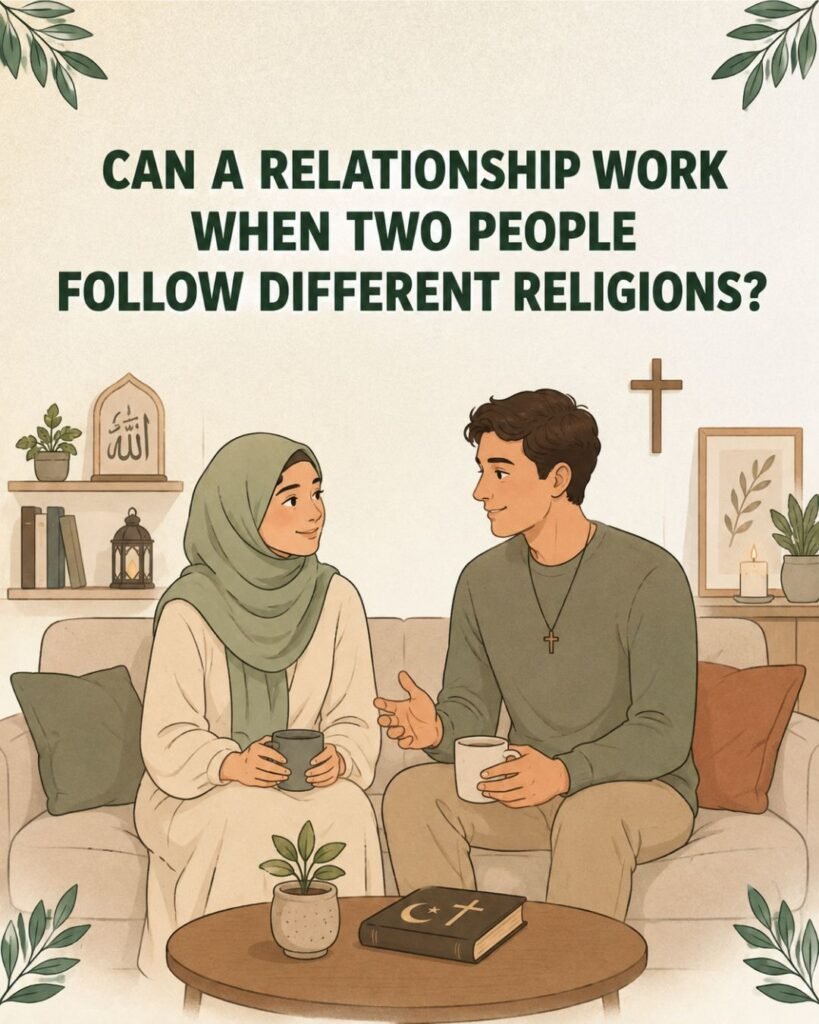
Here are five of the most common ones.
Deciding how to raise the children
This is usually the biggest problem that couples from different religions face.
Before the children arrive, both partners might say they will figure it out when the time comes.
But once the baby is born, the conversation becomes real. One parent wants to baptize the child, the other one does not. One wants to take the children to church on Sundays, the other wants to teach them something different.
Each parent feels strongly about passing on their own faith, and that is completely understandable.
The problem is that the child cannot follow two religions at the same time, and choosing one often feels like rejecting the other.
If this conversation does not happen early in the relationship, it can turn into one of the most painful arguments a couple will ever have.
In any case, couples who handle this well are the ones who talk about it honestly, before the pressure of the moment forces them to.
Dealing with holidays and traditions
Holidays are one of those things that seem simple until you realize your partner celebrates completely different ones.
You grew up with certain traditions that feel deeply personal to you. The food your family prepared, the songs, the way you spent those days together – all of that is part of who you are.
Your partner has the same kind of memories, just with different holidays and different traditions.
When December comes, one of you wants to put up a Christmas tree while the other one has no connection to that holiday at all.
Over time, figuring out which holidays to celebrate, which ones to skip, and how to divide your time between two families during the holiday season can become exhausting.
Some couples find a way to celebrate both and make it work. Others feel like they are constantly giving up something that matters to them.
The key is to respect what each holiday means to your partner, even if it means nothing to you personally.
Pressure from family members
Even when the couple is fine with their differences, the families around them often are not.
Your mother wants to know why your partner does not come to church with you. Your partner’s father makes comments about how things should be done in their family.
Relatives ask uncomfortable questions at family gatherings, and some of them do not bother hiding their disapproval.
This kind of pressure can put a heavy weight on a marriage, especially when one partner feels like they are caught in the middle.
If your family does not fully accept your partner because of their religion, it creates a tension that follows you everywhere – every holiday dinner, every family visit, every phone call.
Unfortunately, some couples handle the outside pressure well and grow stronger because of it. Others let it slowly push them apart.
The ones who survive it are usually the ones who stand together and make it clear that their marriage comes first.
Different views on how marriage should work
Religion does not just shape what you believe about God. It also shapes what you believe about roles in a marriage.
In some religions, the husband is expected to lead the household. In others, the relationship is seen as a full partnership where both people share everything equally.
One partner might expect the other to follow certain rules about food, prayer, dress, or daily routines that come from their faith.
When both people grew up with different expectations about what a marriage should look like, it can be hard to find common ground.
Small things like what you eat at home, how you spend your Sundays, or how you handle money can all be shaped by religious beliefs that neither of you questioned before.
These differences don’t always cause big fights. Sometimes they just create a quiet friction that builds up slowly over the years.
Also, couples who talk openly about their expectations from the very beginning tend to handle this much better than those who avoid the conversation.
Feeling like you are living in two separate worlds
When you follow different religions, there are parts of your life that your partner simply cannot share with you.
You go to your place of worship, and your partner stays home. The way you pray is something they do not understand, and when you fast during a time of year that has no meaning to them.
Over time, these moments can create a feeling of distance that is hard to explain.
It is not that your partner does not support you. It is that they cannot fully be part of something that is deeply important to you.
This, in turn, can make you feel alone in your own marriage, even when your partner is standing right next to you.
Some couples accept this and find other ways to feel connected. They focus on the values they do share, like kindness, honesty, and respect, instead of the rituals they do not.
In general, the couples who make it work are not the ones who ignore their differences. They are the ones who accept them and choose to love each other anyway.