
The sound comes from the living room. A sharp little clink, and then nothing at all. That second part is what makes you put down the dish towel.
Your grandson Liam is six. When you walk in, he’s sitting on the sofa with his hands folded in his lap, which he never does. Behind him, your mother’s green glass candy dish has a fresh chip in the rim. “Liam, did you touch my candy dish?” He shakes his head so fast his hair flops. “No. It was already like that.”
You know it wasn’t. He knows you know. So now the two of you are stuck in that awkward little standoff every parent and grandparent has lived through a hundred times.
Here’s what most of us were never told. The words you say before your kids lie, or before they even get the chance to, can change what comes out of their mouths. Researchers have tested this with hundreds of children, a toy they weren’t allowed to look at and a hidden camera. Some sentences made kids more honest. Others made them dig in deeper.
Why Kids Lie In The First Place
Lying is a normal stage of growing up, even when it drives us up the wall. Even toddlers try it now and then. By school age, most kids have figured out that a fast “no” can sometimes make trouble go away.
A big part of it is fear. Victoria Talwar, a psychology professor at McGill in Montreal, has spent years running what researchers call the peeking game. A child sits with a toy behind them and hears one rule: don’t turn around. Then the grown-up steps out for a minute.
In one of her studies, with 372 children, about two out of three kids turned around to look. Of the kids who peeked, roughly two out of three then said they hadn’t. The ones who stayed honest were mostly the kids who weren’t scared of what would happen next. You can read about that work in the university’s news release. Her conclusion was blunt. Fear of a punishment doesn’t make children truthful.
Another study made the same point in a sharper way. Talwar and Kang Lee, a child development researcher in Toronto, compared two schools in West Africa. One used beatings and slaps for small things, like forgetting a pencil. The other used time-outs and a stern talk. When the 3- and 4-year-olds played the peeking game, almost every peeker from the strict school lied. They also kept their stories straight much longer, according to this 2011 report.
So the harsh rules didn’t raise honest kids. They raised better liars.
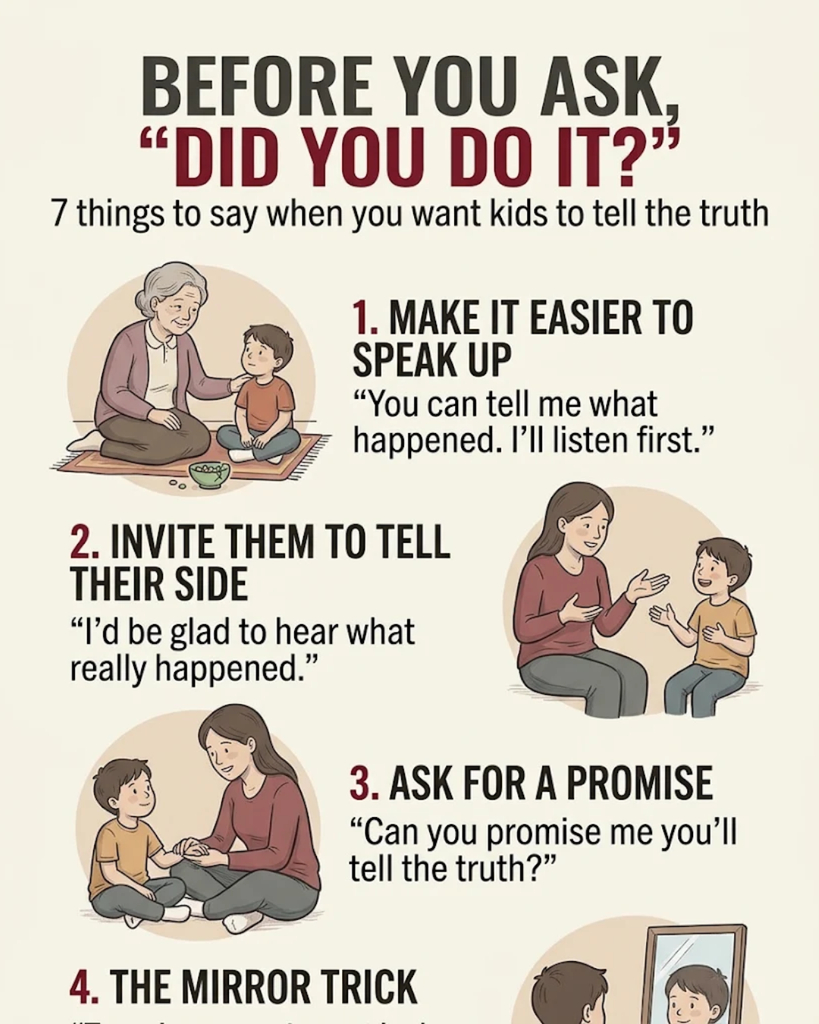
1. “You Won’t Be In Big Trouble For Telling Me”
This is the one to say before you ask anything. Kneel down, keep your voice low and go slowly. “Before you answer, I want you to know something. If you tell me the truth, you won’t be in big trouble.”
Notice the word big. You aren’t promising that nothing will happen. The candy dish still matters. But your grandson now knows the truth will cost him less than a fib.
Angela Evans, a psychologist at Brock University in Ontario, suggests making that difference real. Say the usual consequence would be two weeks without the tablet. If your child owns up, make it one week, and tell them exactly why. Her team’s 2024 study found that children respond best when they hear both halves: that honesty matters, and that it brings them something good.
2. “It Would Make Me Really Happy If You Told Me”
This one sounds almost too simple. Still, it was the most effective line in Talwar’s study of 372 children. When the adult said the truth would make them happy and pleased, more kids confessed.
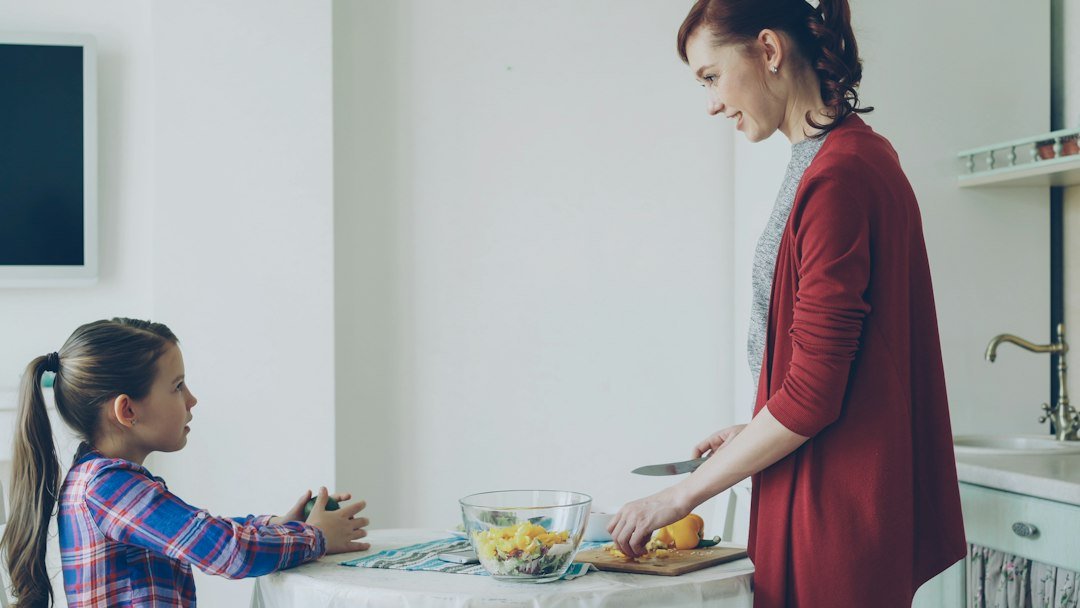
It works best with little ones. Younger children care a great deal about pleasing the grown-ups they love, so your happiness feels like a real prize. Older kids in the same study were more often honest because they had decided for themselves that lying was wrong.
Try it with your face as well as your words. Sit beside them on the sofa instead of standing over them. Then say, “You know what would make me really happy right now? If you told me what happened.”
3. “Can You Promise Me You’ll Tell The Truth?”
Asking for a promise feels old-fashioned. Yet in the Brock study of children aged 3 to 8, a promise helped the 7- and 8-year-olds more than anything else.
By that age, kids understand that a promise counts. Breaking one feels heavier than a quick fib. So before you ask about the dent in the car door or the missing five dollars from your purse, ask for the promise first. Wait until you hear “I promise.” Then ask your question.
4. “Tell Me Your Whole Name First”
This one is for the preschoolers, and it’s a little bit silly. In the same study, the 3- and 4-year-olds who looked in a mirror and said their own name, age or grade lied less. The researchers think that seeing and naming themselves made the little ones more aware of their own actions.
You don’t need a mirror in every room. Just turn it into a game. “Okay, first tell me your whole name. Middle name too.” While your granddaughter proudly says “Emma Rose Miller,” she’s thinking about herself as a person. After that, you ask about the crayon on the hallway wall.
5. “Want To Hear A Story About A Boy And A Cherry Tree?”
Sometimes a story does half the work for you. Lee and Talwar tested this with 268 children aged 3 to 7, using the same peeking game. After the kids peeked, a researcher read each child one of four classic tales.
The boy who cried wolf changed nothing. Neither did Pinocchio and his growing nose. Only the old tale of young George Washington made a real difference. In it, he admits he cut down his father’s cherry tree, and his father hugs him instead of punishing him. Kids who heard it were three times more likely to admit they had peeked, as the McGill Reporter explained.
Then the team changed the ending so young George got in trouble. After that, the story stopped working. The happy ending was the whole point.
6. “I Saw The Crumbs, So Let’s Talk About It”
Sometimes we set kids up to lie without meaning to. You watch your son eat the cookies, and then you ask, “Did you eat the cookies?” That question is a test, and children can smell a test. Plenty of them will try their luck.
Instead, tell them what you already know. “I saw the crumbs on the couch, so let’s talk about the cookies.” There’s no door left open for a fib, and no game to win. You go straight to the part that matters, which is what happens next.
7. “Thank You For Telling Me. That Took Guts.”
This last one comes after the truth, but it shapes the next time. Evans and her colleagues found that kids confessed most often after hearing a story with two parts. A character admitted the mistake, and then a parent praised the honesty.
So thank them for the confession before you deal with the mess. “Thank you for telling me. That took guts.” Say it before you talk about the glue, the broken dish or the cleanup. Your grandson will remember the thank-you far longer than the lecture.
The Little Fibs We Tell Them
There’s one more piece, and it’s a bit uncomfortable. Most of us told our kids small fibs that seemed harmless at the time. “The ice cream truck only plays music when it’s run out.” “If you don’t come right now, I’m leaving without you.”
In 2019, a team at Nanyang Technological University in Singapore asked 379 young adults about fibs like these from their childhood. Those who remembered more of them were more likely to lie to their own parents as grown-ups, according to the study summary. They also reported a harder time with social and emotional challenges. Since the study relied on memories, it couldn’t prove cause and effect. Even so, the lead researcher, Setoh Peipei, warned that a parent’s dishonesty can slowly wear down a child’s trust.
Kids copy what they watch us do. So if you want honest grandchildren, let them catch you telling the truth, especially when a small fib would be easier.
When Lying Needs A Closer Look
Most childhood lies are ordinary. However, talk to your child’s pediatrician or a family counselor if the lying is constant, if it comes with stealing or cruelty, or if it began suddenly after a big change like a divorce or a move. Sometimes a child who hides small things is carrying something heavy.
If every talk seems to turn into a fight, our guide on what to do when your child argues with you has calmer ways through those moments. For grandparents, it also helps to check the house rules with the parents first, the way we suggested in things grandparents should never do without asking.
In this short talk, Kang Lee shares what his lab learned about why kids lie, and why it isn’t always bad news.
Final Thoughts
Back in the living room, you could try again. Sit next to Liam. Tell him he won’t be in big trouble. Tell him it would make you really happy to know what happened. Then watch his shoulders drop.
“I was reaching for the red one,” he says quietly. “It slid.”
That’s all most kids need. They need a way out that costs less than the lie. The candy dish has a chip in it now, but he told you, and that’s the part you’ll both remember.
What one-liner works best in your house when you need the truth from the kids or grandkids? Let us know in the comment box below.