
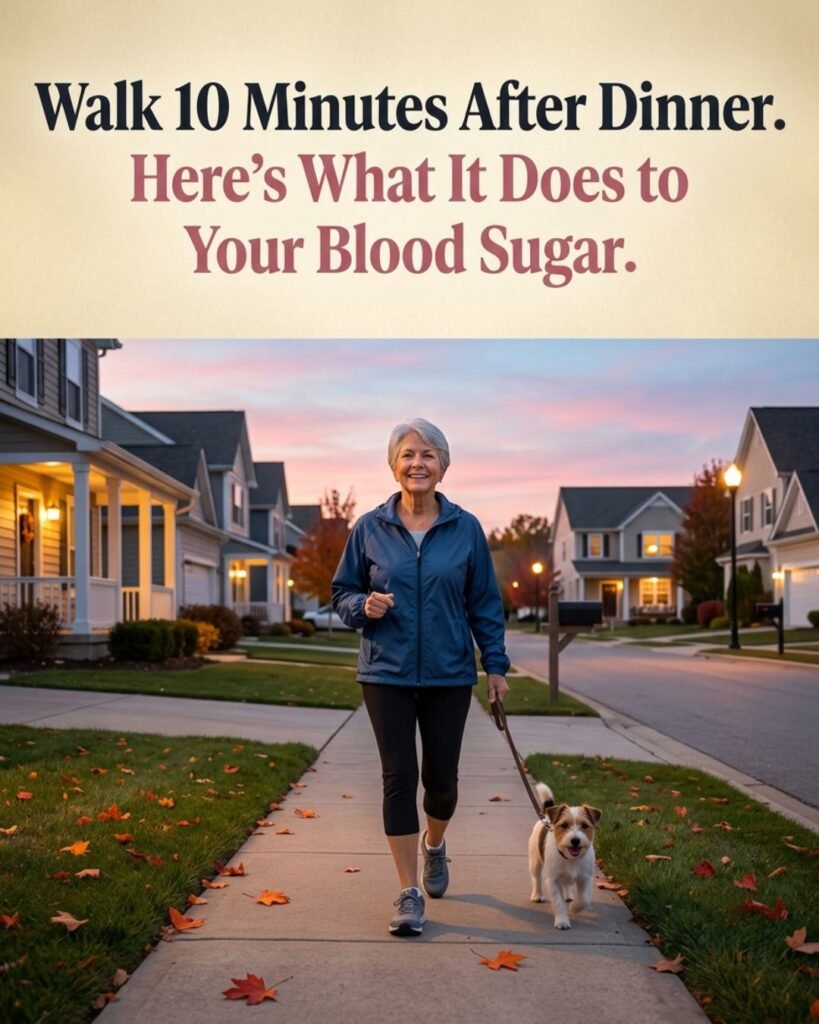
The dishes are in the sink and the couch has never looked softer. Then you glance out the window and see Margaret from next door. She’s 71, and she’s heading off on her usual loop around the block in her old blue windbreaker, the same one she’s worn every evening for as long as you can remember, rain or shine, with her little dog trotting along beside her as if the whole street belonged to the two of them.
She’s done it every night for as long as you’ve lived there. Once you asked her about it, and she just laughed. “My mother always said you walk after supper. Helps the food settle.”
It turns out her mother was onto something. Over the last decade, researchers have looked closely at what a short walk after eating does to blood sugar. The results are surprisingly strong for something so simple. Below, we’ll look at what an evening meal does inside your body, what those studies found, how long and how fast you really need to walk and who should be careful. So, let’s go through it.
What Dinner Does Inside Your Body
A plate of pasta or potatoes doesn’t stay pasta for long. Your gut turns those starches into glucose, a simple sugar that travels around in the bloodstream. Insulin, a hormone made by the pancreas, works like a key that lets that sugar out of the blood and into the body’s tissues, where it’s burned for energy or stored. In a healthy body, blood sugar rises after a meal and then comes back down within a few hours.
As we get older, that system often works less smoothly. And dinner is a tricky meal. For many of us, it’s the biggest meal of the day. It’s also the one with the most bread, potatoes, pasta or dessert. Then we sit down for the rest of the evening. We settle in front of the television with a cup of tea and maybe a few cookies, and the glucose from that meal has nowhere much to go, because the biggest muscles in the body, the ones in our legs, are doing nothing at all for the next three or four hours.
This matters because glucose trouble is very common, and it usually creeps up without any warning signs. According to the CDC, an estimated 115.2 million American adults had prediabetes in 2023. Among people 65 and older, the figure was 52.1%, more than half.
Prediabetes is the in-between zone. Your glucose readings sit above the healthy range, though they haven’t crossed the line doctors use to diagnose diabetes. According to the CDC, people in that zone face a greater chance of developing full diabetes, along with heart disease and stroke. The encouraging part is that lifestyle changes can often turn it around.
Why This Matters More After Menopause
Many women notice that their bodies handle food differently in their 50s. That isn’t your imagination. Endocrinologist Dr. Kathleen Wyne of Ohio State explains that falling estrogen around menopause may raise average blood sugar in some women.
Weight also tends to shift toward the waist after menopause, and belly fat is linked to insulin resistance. That’s when your cells stop responding to insulin as well as they used to. Your pancreas works harder to keep up, and for a while the results of routine tests may look normal, which is exactly why so many women don’t realize anything is changing until a routine blood test at the doctor’s office finally shows a number that’s higher than it should be.
One warning sign Dr. Wyne mentions is feeling tired after meals, especially ones heavy in carbohydrates. Sound familiar after Sunday lunch? Her advice is regular, moderate activity rather than intense workouts, because it helps cells respond to insulin again.
If you suspect your hormones are behind other changes too, our article on the signs of hormonal imbalance is a good place to start.
What a 10-Minute Walk Actually Does
Every step you take burns fuel, and your leg muscles grab much of it straight from the sugar circulating after a meal. According to the American Diabetes Association, muscles that are busy contracting can draw sugar in on their own, with or without help from insulin. Exercise also makes your body more sensitive to insulin, so it uses what you have better.
A study from the University of Otago in New Zealand tested this on 41 people who were already managing diabetes. For two weeks, they took one 30-minute walk daily. For another two weeks, they walked for 10 minutes after every meal. As Diabetes Self-Management reported, the short walks after meals came out ahead. Blood sugar was 12% lower on average than with the single longer walk.
And the biggest difference came after dinner. A short stroll after the evening meal brought glucose down by 22% compared with the daily 30-minute walk. The researchers pointed out that dinner was when people ate the most carbohydrates and spent the most time sitting still.
Researchers from George Washington University had found something similar a few years earlier, in older adults. Ten people aged 60 and over, who were at risk of diabetes, tried different walking routines. According to ScienceDaily, three 15-minute walks after meals worked about as well as one 45-minute walk. That held for blood sugar over a full 24 hours. The walk after dinner was the most effective of all. It kept blood sugar lower for up to three hours afterward.
Lead researcher Loretta DiPietro called the findings “good news for people in their 70s and 80s.” She did caution that the study was small and needs confirming in larger trials.
Physician Dr. Sean Hashmi explains what the evidence does and doesn’t show in this video.
Even Two Minutes Can Help
If ten minutes sounds like too much on a tired evening, take heart. In 2022, researchers at the University of Limerick in Ireland combined seven studies that compared sitting, standing and light walking throughout the day.
People in those studies took breaks of just 2 to 5 minutes every 20 to 30 minutes. Light walking breaks lowered blood sugar by about 17% compared with sitting the whole time. Standing helped too, by about 9.5%, but it didn’t lower insulin levels the way walking did.
So any movement beats none. That should come as a relief to anyone who has skipped exercise altogether because she couldn’t fit in a full half hour, since it means the few minutes you spend taking the trash out to the curb or wandering down to the mailbox are doing more good than you might think. A ten-minute walk is wonderful, but a few minutes of pottering around the kitchen still counts.
When to Start and How Fast to Go
Blood sugar usually peaks somewhere between 60 and 90 minutes after eating, according to studies cited in the same report. That’s why many experts suggest moving soon after your meal, ideally within the first half hour. That way your muscles are already working when the sugar starts to rise.
You don’t need to rush out the door the minute you put your fork down, though. DiPietro’s advice was to let the food digest a little and then get moving. Clearing the table first is fine. In fact, a lot of women find that the after-dinner routine of carrying plates and putting leftovers away already gets them moving, and the walk simply becomes the natural next step out the front door before anyone has a chance to sit down and get comfortable.
And there’s no need to power walk. The George Washington study used an easy-to-moderate pace. A good rule of thumb is simple. You should be able to talk comfortably, maybe a little breathless, but not gasping. Walking with your husband or a neighbor and chatting the whole way is perfect.
Want your evening walk to help with weight too? Our article on losing weight by walking has some practical tips.
What If You Can’t Get Outside?
Winter evenings can be dark, cold and slippery, and not every neighborhood feels safe after sunset. The good news is that the walk doesn’t have to happen outdoors.
You can do laps of your hallway or living room. You can walk up and down the stairs a few times, holding the rail. Some women put on a favorite song and dance around the kitchen while they tidy up. Honestly, that might be the most enjoyable version of all.
If you’re unsteady on your feet, try standing to wash the dishes by hand instead of sitting down right away. Even that helps a little. Another option is to hold the back of a sturdy chair and lift your knees one at a time, as if you were walking on the spot. None of these will feel like a workout, and that’s fine, because the point is simply to keep your leg muscles gently busy while your dinner is turning into sugar in your bloodstream.
Doctor Alex is a physician who makes health videos. He goes through a few simple things you can do after eating in this one.
How to Make It Stick
Knowing something is good for you and actually doing it are two very different things. Here are a few ways to turn the evening walk into a habit.
Tie it to something you already do. For example, the walk starts as soon as the last plate goes in the dishwasher. After a couple of weeks, it stops feeling like a decision.
Leave your walking shoes and a jacket by the door. It sounds silly, but small obstacles stop us more often than we’d like to admit.
Start small. Five minutes is plenty for the first week. You can add more once it feels normal.
Find company. A husband, a neighbor, a friend on the phone or a dog who stares at you until you get your coat all make it harder to skip.
And have a rainy-day plan, so a bad forecast doesn’t break the habit. Hallway laps count. And on the nights you miss it, which will happen to everyone, don’t decide the whole thing is ruined, because the habit is built over months, and one skipped evening after a long family dinner or a late night at your daughter’s house makes no difference at all.
Who Should Be Careful
A gentle stroll after dinner is about as safe as health advice gets for the average person. But there are some exceptions worth knowing.
Are you on insulin injections, or on tablets that push your pancreas to make extra insulin? Then walking can drag glucose too low. The American Diabetes Association notes that this can happen during exercise or long after it. Ask your doctor or diabetes nurse whether you’re at risk. The ADA suggests testing before activity. When the meter reads 100 or below, eat or drink something sugary that acts fast first, like half a cup of juice or four glucose tablets. Then recheck after 15 minutes.
Signs of a low include shakiness, sweating, a racing heart, sudden hunger or feeling confused. If that happens, stop, sit down and treat it right away.
If you have nerve damage in your feet from diabetes, wear supportive shoes and check your feet for blisters or sores afterward. Do you have heart problems or get dizzy easily? Then check with your doctor before starting any new routine.
Choose well-lit routes and flat paths when it’s dark, and take your phone with you. A walking buddy makes it safer and much more fun. Many women also find that a reflective vest or a small flashlight gives them peace of mind on winter evenings, when it’s dark by five o’clock and drivers coming home from work aren’t always looking out for someone walking along the edge of the road.
One Good Habit Among Many
An evening walk is a lovely habit, but it won’t replace medication your doctor has prescribed. It also won’t cancel out a huge plate of pasta followed by cheesecake every night. It works best alongside the other small choices you make every day.
What’s on the plate matters too. Dr. Wyne at Ohio State suggests choosing complex carbohydrates like beans, brown rice and whole wheat bread, which raise blood sugar more slowly than white bread or sugary desserts. Filling half your dinner plate with vegetables helps as well.
Cutting back on added sugar is one of them. We looked at what happens when you stop eating sugar for a month, and some of the changes might surprise you. Many people taking newer medicines for weight and blood sugar also ask how lifestyle fits in. We covered that in our article on the effects of GLP-1 drugs.
It’s interesting that walking after meals is a long tradition in many parts of the world. In Italy, families stroll together in the evening. In Japan, gentle daily movement is part of everyday life well into old age. You can read more in our article on Japanese longevity habits.
A short walk may also help you feel less full and heavy after a big meal. If bloating is a regular problem for you, our article on what causes a bloated stomach explains some common causes.
Have you never had a glucose test? Ask your doctor about a simple blood test at your next visit. Many people with prediabetes have no symptoms at all, so a test is the only way to know where you stand.
Final Thoughts
Margaret’s mother didn’t have continuous glucose monitors or research papers. She just knew that walking after supper made her feel better. Science has now caught up with her. It says that ten easy minutes after dinner can make a real difference to how your body handles that meal, especially as the years go by.
It doesn’t need a gym membership or special shoes. Just your front door, or even your hallway, and a few minutes before the couch claims you for the night.