
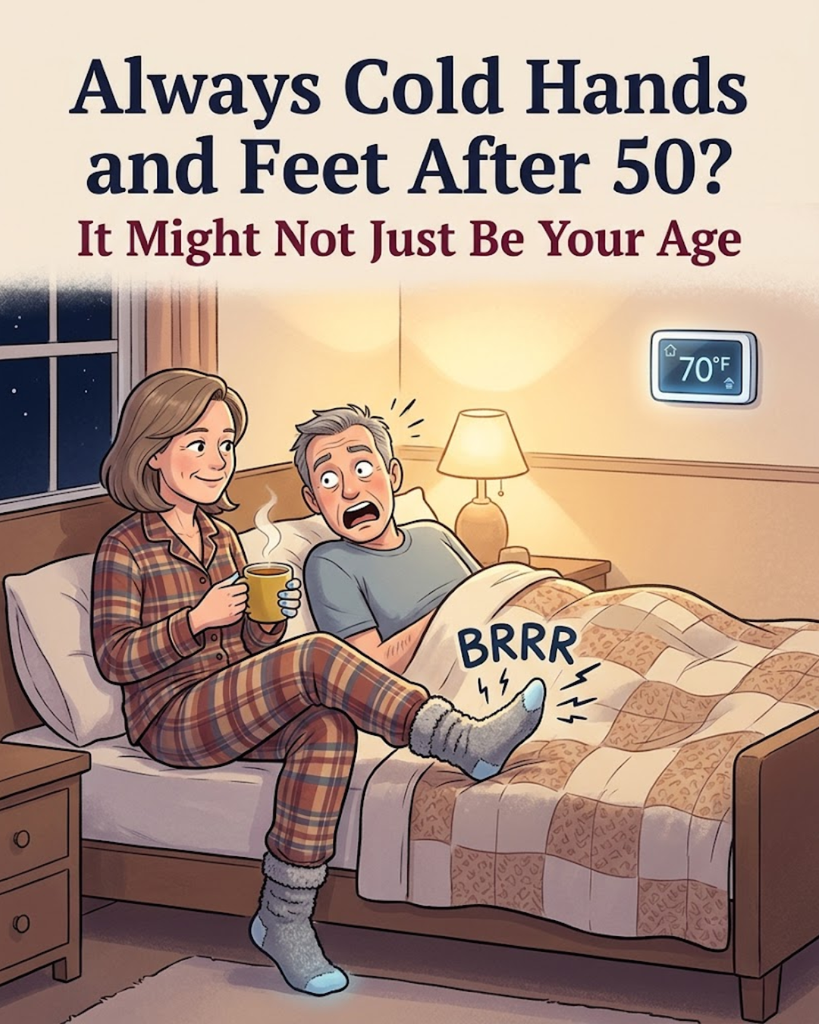
It’s ten o’clock at night, and you slide into bed in your warmest pajamas and a pair of thick socks. Your husband rolls over, your foot touches his leg, and he jumps like you’ve put an ice cube on him. “How are your feet that cold? It’s seventy degrees in here!”
You don’t know. They just are. They’ve been like that for years, and lately it seems to be getting worse. You wear gloves in the freezer aisle at the grocery store and have quietly accepted that you’ll be the only person at every summer barbecue who asks whether anyone else feels a draft.
If that sounds familiar, you’re definitely not alone. Cold hands and feet are one of the most common complaints after 50, especially among women. Most of the time the cause is harmless, but sometimes it’s your body’s way of pointing at something worth checking. In this article we’ll look at why your hands and feet are always cold after 50, which causes are normal, which ones need a doctor and what actually helps. So, let’s go through it.
First, Some of It Is Just Getting Older
As we age, our bodies get a little worse at handling cold. According to the National Institutes of Health, older adults tolerate long exposure to cold less well, and being less active means the body produces less of its own heat. Some medications and conditions like diabetes can also blunt the body’s normal response to cold.
Many people also lose some of the fat layer under the skin with age, especially on the hands, and that layer works a bit like insulation. Circulation in the smallest blood vessels can slow down too. Put all of that together, and fingers and toes are usually the first places to feel it.
Why Hands and Feet Go First
Your body has a clear set of priorities. When it senses cold, it narrows the blood vessels near the skin and in your hands and feet, so that warm blood stays around your heart and brain, which matter far more for survival than your little toe does, even if your little toe strongly disagrees at the bus stop in February.
That’s a clever system. But in some people, and more often as we age, it switches on too easily and stays on too long.
There’s one serious point here. Because older bodies don’t hold heat as well, the NIH advises keeping your home thermostat at no less than 68 to 70 degrees in winter. Even a house kept at 60 to 65 degrees can lead to hypothermia in older people. So if you’ve been keeping the heat low to save money, it’s worth reconsidering, at least in the room where you spend most of your day.
Women Really Do Feel It More
This isn’t in your head. Researchers at the University of Utah used thermal imaging to compare men’s and women’s hands, and as the Star Tribune reported, women’s hands typically ran about 2.8 degrees Fahrenheit colder than men’s.
Hormones can play a part as well, and many women notice that their sensitivity to temperature changes around menopause. If you’ve noticed several changes at once, like sleep problems and mood swings along with feeling cold, you might want to read about the signs of hormonal imbalance and bring them up with your doctor.
So the old office battle over the thermostat has a real basis. Science is on your side. Your husband isn’t imagining that you’re always cold, and you’re not imagining that he’s always warm.
When Your Fingers Turn White: Raynaud’s
If your fingers or toes don’t just feel cold but actually change color, turning white or blue and then red as they warm up, you might have Raynaud’s. According to the Mayo Clinic, the tiny vessels in your fingers and toes overreact to cold or stress and clamp down, almost shutting off the blood supply for a few minutes. As blood flow returns, the skin can throb or tingle. An episode usually lasts about 15 minutes.
Women get it more often than men. The common, milder form usually starts young, between 15 and 30, and has no underlying cause. But there’s a second form, called secondary Raynaud’s, that’s linked to other conditions like lupus or rheumatoid arthritis, and it usually appears around age 40. Smoking and some medications can also trigger it.
So if your fingers started turning white for the first time in your 40s or 50s, it’s worth mentioning to your doctor rather than just buying warmer gloves. Picture yourself taking a bag of frozen peas out of the freezer and watching two fingers go completely white. That’s exactly the kind of moment to describe at your next appointment, ideally with a photo on your phone.
Your Thyroid Might Be Running Slow
Your thyroid is a small gland in your neck that works a bit like your body’s thermostat. When it doesn’t make enough hormone, a problem doctors call hypothyroidism, everything slows down, including the way you produce heat. According to American Family Physician, clinical hypothyroidism affects about 1 in 300 people in the U.S. It’s roughly seven times more common in women than in men and more common after 65. Another 3.7% of people have a milder form called subclinical hypothyroidism.
Feeling cold all the time is one of its classic signs, along with tiredness, dry skin, constipation and weight gain. The trouble is that those symptoms are easy to blame on age or a busy life, so many women live with an underactive thyroid for years, assuming that being tired and chilly is simply what happens after 50, when a small daily pill could have made a real difference much sooner.
The good news is that a simple blood test, called TSH, can check it. If you’re always cold and also feel unusually tired, ask your doctor whether it’s time for a thyroid test.
Low Iron or Low B12
When you’re low on healthy red blood cells, a problem known as anemia, less oxygen travels around your body, and your fingers and toes are often the first places you notice it. According to WebMD, both low iron and low vitamin B12 can lead to anemia and that cold, tired feeling.
B12 deserves special attention after 50. As we get older, the body doesn’t absorb it as easily, and common medications can make it worse. WebMD lists acid reducers like omeprazole and famotidine, along with the diabetes drug metformin, among the medicines that can lower B12 levels. Low B12 can also damage nerves, causing numbness or pins and needles in the hands and feet.
If you take any of those medicines and your hands and feet are always cold or tingly, ask about a B12 test. I wrote more about what it does in what each of the B vitamins actually does.
When It’s Your Circulation
Over the years, plaque can build up inside the arteries in your legs, the same way it builds up in the arteries around the heart. Doctors call this peripheral artery disease, usually shortened to PAD, and it means less warm blood reaches your feet. According to the National Heart, Lung, and Blood Institute, nearly 10 million Americans 40 and older have it, and many don’t know.
The NHLBI’s list of symptoms includes one foot feeling colder than the other, sores on the toes or feet that heal slowly or not at all, and skin that looks pale or bluish. The most common symptom is pain or cramping in the calves when you walk or climb stairs, which goes away when you rest.
Notice the detail about one foot. If both feet are cold, it’s usually something general. If one foot is clearly colder than the other, that’s a reason to see a doctor soon, even if it doesn’t hurt, because PAD is also a sign that the arteries elsewhere in your body, including the ones feeding your heart, may be narrowing too.
When a doctor suspects PAD, the first test is usually quick and painless. It compares the blood pressure in your ankle with the blood pressure in your arm, and it takes only a few minutes in the office.
Smoking and diabetes raise the risk a lot. And walking, oddly enough, is often part of the treatment once a doctor has checked you. If you’d like to make walking a habit, I wrote about how to lose weight by walking.
When It’s Your Nerves
Sometimes the problem isn’t the temperature at all. When the nerves in your feet are damaged, something doctors call peripheral neuropathy, your feet can feel icy or numb even though they’re perfectly warm when someone else touches them. Diabetes is the most common cause, but low B12 and heavy drinking can do it too.
Picture a woman who keeps a hot water bottle on her feet every night because they always feel freezing. One morning she notices a blister on her heel and has no idea how it got there. That’s exactly how neuropathy burns happen, slowly and without any pain at all.
This one comes with an important safety warning. If your feet are numb, you may not feel heat properly. Be very careful with heating pads and hot water bottles near your feet, because people with neuropathy can get serious burns without noticing until later.
What About Supplements?
It’s tempting to grab an iron pill or a bottle of B12 the moment you read about anemia. Please don’t guess.
Too much iron can be harmful, especially for women after menopause, who no longer lose iron every month. And taking B12 without knowing whether you’re low can hide the real cause of the problem. A simple blood test tells you exactly what’s going on, and then your doctor can tell you what to take and for how long.
You’ll also find plenty of supplements online promising to “boost circulation” with ginkgo or cayenne. Honestly, the evidence for most of them is weak, and some can interact with blood thinners. I’d save your money for a good pair of wool socks and talk to your pharmacist before trying any of them.
Medications and Everyday Habits
Some heart and blood pressure medicines can be part of the story. The NHS lists cold hands and feet as a common side effect of beta blockers. Please don’t stop any medicine on your own, but do mention it to your doctor if the cold started around the time you began a new prescription.
Alcohol is another surprising one. That warm glow after a glass of wine is real, but it comes from blood rushing to the skin, which actually draws heat away from your core. Smoking narrows blood vessels and makes almost every circulation problem worse.
And then there’s simply sitting still. Many of us sit for hours reading or watching TV, and our hands and feet get colder the longer we stay put.
What Actually Helps
For most people, the fix is a mix of small habits rather than one magic trick.
Dress in layers, and keep your core warm as well as your hands. When your chest and belly are warm, your body is more willing to send blood out to your fingers and toes. A vest or a light sweater indoors can make a bigger difference than thicker gloves.
Choose wool socks over cotton ones, and mittens over gloves, since fingers stay warmer together. The Mayo Clinic also suggests wearing gloves when you handle cold food from the freezer, and warming up the car before you drive on cold mornings.
Move every hour or so, especially on long winter evenings in front of the TV. Wiggle your toes and make fists, or walk around the house for a couple of minutes. It sounds too simple, but it really helps.
Pro tip: hold a warm mug of tea in both hands for a few minutes before going outside. I personally swear by it in January, and it’s a lot more pleasant than doing jumping jacks in the hallway.
At Night
Cold feet are often worst in bed. Socks are fine, and nobody needs to see them.
A warm bath or foot soak about an hour before bed can help too. Keep an extra blanket folded at the foot of the bed, where you can pull it up without getting out from under the covers.
If your feet are numb from diabetes or neuropathy, skip the electric blanket on the high setting. Warm the bed first, then switch it off before you get in.
And yes, it’s perfectly acceptable to warm your feet on your husband. He’ll survive.
When to Call Your Doctor
Most cold hands and feet are nothing serious. Still, a few signs shouldn’t wait. But please make an appointment if you notice any of the following.
One hand or foot is clearly colder than the other. Your fingers or toes change color, turning white or blue. You have sores on your toes or feet that heal slowly, or pain in your legs when you walk that eases when you rest. You feel numbness or tingling. Or you’re always cold and also unusually tired or gaining weight.
And go to the emergency room right away if one leg or arm suddenly becomes cold, pale and painful, or if you notice confusion or slurred speech in someone who’s been in the cold. Those can be signs of a blocked artery or hypothermia, and both need urgent care.
One Honest Note
There’s an old saying, “cold hands, warm heart,” and it’s a lovely thought. But your hands and feet can also be a quiet early warning system. Many of the things that get harder with age creep up slowly, and cold fingers and toes are one of the easiest signs to ignore for years.
A blood test and a short conversation with your doctor can rule out the common causes in one visit. After that, you can go back to your wool socks with peace of mind.
What’s your favorite trick for keeping your hands and feet warm in winter? Let us know in the comment box below.