
You are standing at the sink on a Sunday afternoon, washing a pan that was already clean, while they tell the same story for the fourth time in the next room.
Their voice carries. They laugh at their own line before they even reach the end of it. Everyone in that room is smiling, and by every measure it looks like a good day. So why do your shoulders sit an inch higher than they did an hour ago? And why have you found three different reasons to stay in the kitchen?
You have spent years bracing for their bad moods. Nobody warned you that the good ones would cost you something too.
So, let’s go through 10 things that tend to happen when they’re happy, and why each one leaves you a little smaller.
Just one thing before we start. I’m not a therapist, and nobody can diagnose a person from an article – only a professional can do that. What I write about here are patterns you can notice, not labels you have to put on anyone.
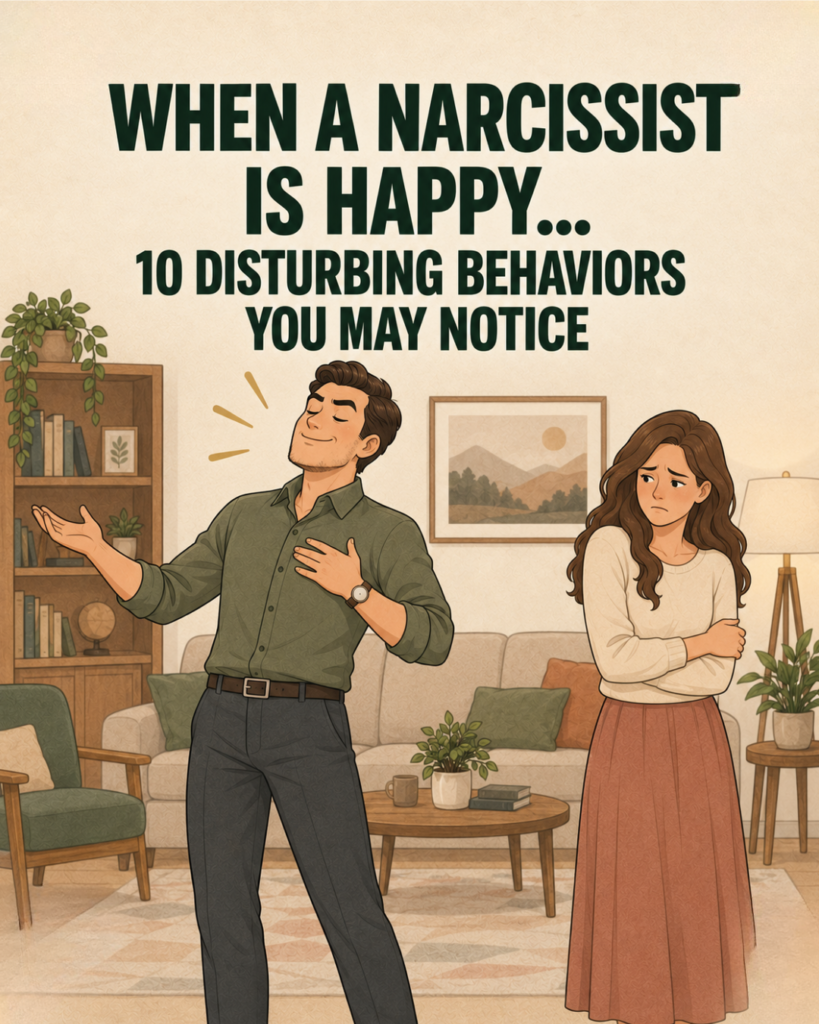
Their Good Mood Is Not The Same Thing As Your Peace
Most of us learn to read one weather pattern in a difficult person. We learn the silence, the slammed cupboard, the tone that means the evening is about to turn. So when the mood lifts, your body expects relief.
Sometimes that relief never arrives. Instead, the room fills up, and you find yourself with less space than before.
Here is the part that takes people years to name. For a self-centered person, feeling good and feeling powerful sit in the same place. Their happiness runs on attention rather than contentment, which means it needs a source. Somebody has to supply it. Usually, that somebody is standing right next to them.
The clinical picture behind this is well documented. Mayo Clinic describes a pattern that includes an unreasonably high sense of self-importance, a constant need for admiration, and difficulty caring about how anyone else feels. Notice that none of those things pause when the person is in a good mood. If anything, a good mood gives them more room to run.
10 Unsettling Things a Narcissist Does When They’re Happy (#7 Is Exhausting)
10 Things a Narcissist Does When They’re Happy
1. The Volume Goes Up, And You Go Quiet
Watch what happens to the conversation when they feel great.
Their stories get longer. Yours get shorter, or they never start at all, because every time you begin one, they find a way back to themselves. You mention your week, and somehow you are hearing about theirs. Half your sentences get finished for you, wrongly, and then they keep going as though you agreed.

After a while, you stop trying. You become the audience, and the audience does not get a turn.
Think about how little you say at their family gatherings compared with anywhere else. Call that what it is, which is worth paying attention to. Your voice stayed the same size all along. Their good moods crowded it out, one evening at a time.
2. Your Good News Becomes a Runway for Theirs
You finally have something of your own to share. Maybe it’s the promotion you worked two years for, or your daughter called to say she’s expecting. You bring it up at dinner, a little shy and a little proud.
They say “That’s great,” and within a minute you are hearing about the time they were offered something bigger, the deal they closed last month, or the news from their side of the family that came first. Your moment lasted about as long as it takes to pour a glass of water.
Nobody was rude, exactly. They even congratulated you. But somewhere between your sentence and theirs, your good news turned into a runway – a short strip of ground they used to take off with their own story.
When they’re already in a good mood, this happens even faster, because a happy narcissist is hungry for more of that feeling, and your news is just one more thing that can feed it.
After a while, you stop sharing early. You tell your sister first, or your friend from work, and you only mention it at home once it’s old news and can’t be taken anymore. That small habit – saving your happiness for safer people – is worth noticing, because it tells you a lot about where your good news is actually welcome and where it quietly gets swallowed up.
3. Big Plans That Nobody Asked You About
Then there is the spending, and along with it, all the deciding that happens without you.
A person riding high wants to prove it, and proof needs to be visible. So they book the trip, buy the thing, invite the people, and announce it all as a surprise. Your calendar changes without a conversation, and so does your money. Then your sister’s birthday lands on the same weekend as their big idea, and when you point that out, you become the one who ruined it.

I have heard a version of this story more times than I can count. Someone maxes a card on something shiny in the same month the electricity bill goes unpaid, and everyone around them has to celebrate the shiny thing anyway. Cleveland Clinic notes that this need to impress can grow strong enough to drive genuinely harmful behavior, which affects the person and everyone standing near them.
You are allowed to notice the cost, even when the plan is genuinely exciting. Excitement and pressure can arrive in the same envelope.
4. The Warmest Words You Will Ever Hear
This next part is the one that confuses good people the most.
When they are happy, the love talk gets big. You hear that they could not have done it without you, that you are the reason, the rock, the best thing. After months of feeling invisible, those words land like rain on dry ground.
And then a thought forms, quietly, somewhere behind your ribs. Maybe they changed, and maybe this is who they were underneath the whole time.

That thought is where a lot of people lose another two years.
The warmth is real in the moment, and it belongs to the mood. When the mood drops, the warmth goes with it, and you are left holding sentences that no longer match the person saying them. Psychology Today has written about the intense early rush that some people use to pull a partner close, a pattern often called love bombing, and the same rhythm shows up years into a relationship whenever the good mood returns.
5. The Audience Has to Grow
Something else happens when the mood is high. One person stops being enough.
Suddenly they are inviting people who have not been over in a year. They post more. The dinner has to be at the busy restaurant with the good lighting, never the quiet place around the corner. Good news becomes a campaign, and the campaign needs witnesses.
Even old arguments come back, though rarely for the reason you hope. The friend they dropped two years ago receives a warm message, and the relative they refused to speak to at Christmas gets tagged in an old photo. It looks like growth from the outside, and sometimes people around you will tell you so.
Watch how long it lasts. Reconciliation that runs on a good mood usually ends when the mood does, and they drop the same people again. Therapists describe this hunger for attention and reaction as narcissistic supply, a need that other people have to keep filling because the person cannot fill it from the inside.
That is why the celebration never quite feels like a celebration. From where you are standing, it feels closer to recruitment.
6. Their “Jokes” Get Sharper
When they’re on a high, especially with other people around, the teasing starts.
It’s about your cooking – “Don’t worry, we’ll order pizza later.” It’s about your memory, your driving, your age, the way you laugh. Each line gets a laugh from the table, and they glance around to collect it like coins, already looking for the next one before the first laugh has even finished.
And if you don’t laugh? Then you’re “too sensitive.” You “can’t take a joke.” Suddenly the problem isn’t the comment, it’s your face.
Here is what makes this one so hard to call out. Their good mood gives them cover. Nobody can say they were being mean, because they were smiling the whole time and everybody was having fun. A remark that would sound cruel in an argument sounds almost affectionate at a party.
But you know the difference between being teased by someone who loves you and being used as material. Real teasing leaves you feeling included. This kind leaves you feeling smaller and a little embarrassed, and it usually aims at the exact things you already feel unsure about.
You’re allowed to not find it funny. A calm “That wasn’t funny to me,” said later and in private if that feels safer, isn’t you ruining anything.
7. You Are Expected To Match Their Mood on Command (And It’s Exhausting)
They come home glowing about something at work. Within four minutes, they want to know why you are so quiet.
Why the long face? Do you always have to bring the mood down? Can you not be happy for me for one evening?

Now you are apologizing for having a normal Tuesday. Your tiredness has become a problem to solve, and the solution is that you should perform. Cheer, mirror, match the energy, and do it quickly, or the good day becomes your fault.
That demand is exhausting in a way that is hard to describe to friends. On paper, nothing bad happened. Nobody shouted. Somebody just came home happy. Yet you end the evening feeling like you failed a test you never agreed to take.
8. The Story Gets Rewritten With Them as the Hero
Listen to how they tell your shared stories when they’re in a good mood and have an audience.
The house renovation you planned, budgeted and managed while working full time? Retold at the party, it becomes their vision. The hard year when money was tight and you picked up extra shifts? Now it’s the year they “held everything together.” The move, the wedding, the months your mother was sick – every story slowly bends until they are standing right in the middle of it, with everyone else, including you, pushed out toward the edges.
Your part shrinks. Sometimes it disappears completely.
You were there. You remember it differently, and you remember it in detail, because you were the one doing the work. But correcting them in front of everyone would “ruin the mood,” and you already know how that evening would end. So you smile and refill the drinks.
Over the years, this does something quiet to your own memory. When you hear one version told confidently enough times, you start to wonder if you’re the one remembering it wrong. That’s why it matters to hold onto your own account, even if you never say it out loud at the table. You don’t need them to agree. You just need to keep knowing what actually happened.
9. The Kids In the House Are Learning the Same Weather
If children live in that house, they are learning this rhythm too, and they learn it fast.
They can tell from the sound of the front door which version of the evening is coming. Performing comes next, because a bit of cheer keeps the room warm. Then they go quiet when the mood drops, because quiet is safest. Nobody teaches them any of this directly, yet by nine years old they can read a room better than most adults at work.
You may recognize the same skill in yourself, learned in a different kitchen a long time ago.
That is the part worth interrupting, and confrontation has nothing to do with it. Explaining the pattern to them over dinner would only confuse things. You interrupt it by staying steady whether the mood is up or down, so at least one adult in that house behaves like solid ground.

10. The Morning After Belongs to You
There is a second act to all of this, and it usually arrives around eleven the next morning.
The mood has dropped, and the people have gone home. Now somebody has to deal with the leftovers, and that somebody is rarely the one who threw the party. So you handle the card statement, the apology to your sister, the friend who felt talked over, the mess in the kitchen that nobody else sees as a mess.

They wake up light. You wake up doing repairs.
Over a few years, this becomes its own quiet job. You start managing the fallout so smoothly that nobody notices it happening, least of all them. Meanwhile, your own week keeps getting pushed to Thursday, then to next month, then into a general someday that never seems to land.
Try counting it sometime, for your own information rather than to build a case. Just count how many hours in a normal month go to cleaning up after somebody else’s good time, and let the number sit with you for a while.
Why You Keep Explaining It to Yourself
Let me name the thing you probably do in the car.
You build their case for them. Their childhood comes up first, then the time they drove four hours to help you move. You remind yourself that plenty of people talk a lot, that plenty of people love a party, that you might be too sensitive about all of it.
By the time you park, you have argued yourself out of your own experience.
Understanding someone is a good instinct, and it is worth keeping. Still, understanding a person explains their behavior without qualifying them for unlimited access to your life. Both things can sit next to each other. You can know exactly why they are the way they are and still decide that certain rooms cost you too much.
In a useful conversation with a psychologist, Cleveland Clinic also warns about how casually people throw the word narcissist around now, and that caution seems fair. Only a professional can diagnose anyone. What you can do, without any label at all, is track what repeatedly happens to you in that person’s company.
What the Pattern Actually Tells You
Forget the diagnosis for a minute and look at the evidence you already have.
Ask yourself how you feel two hours after you leave, rather than during the visit. Notice whether you rehearse conversations before they happen. Check whether your good news gets space, or whether it becomes a runway for theirs.
If you leave every gathering smaller than you arrived, that is information. It stays true whether or not anyone gives the pattern a name, and it stays true even when the person was in a wonderful mood the whole time.
Here is the quiet standard worth holding onto. With the right people, you do not have to shrink to make room. Their good day has space in it for yours.
Where You Go From Here
Nobody is asking you to make a speech or stage a confrontation. Most of the useful changes are small enough that nobody notices them for a while.
Start by keeping your own weather. When they walk in glowing, and you are tired, let yourself be tired. You are allowed to say that you had a long day and still be glad for them, without turning your face into a performance.
Then slow the yes. When the big plan lands on you at nine in the evening, try telling them you will check the calendar tomorrow. That one sentence buys you a night of clear thinking, and it costs almost nothing.
Keep one thing that stays yours. A friend they barely know, a Saturday morning walk, money in an account with your name on it. People who take up all the air tend to spread into whatever space you leave empty, so leaving a little of it locked matters more than it sounds.
Write things down while they are fresh. A note on your phone with the date and two sentences about what happened will do. Memory bends under pressure, and a person who tells you that you remember everything wrong loses most of their power once you have a record of ordinary days in your own words.
Tell one person the unedited version. Skip the funny version you use at work, and skip the softened one you tell your mother. Someone who hears what actually happens on the ordinary days will help you keep your own account of it straight.
If any of this has moved past exhausting and into something that frightens you, please talk to someone trained for it. The National Domestic Violence Hotline answers calls and chats around the clock, and their advocates help with situations that involve no physical violence at all.

The part nobody puts in the caption
You spent a long time believing that things would settle once they were finally happy. That was a reasonable hope, and holding it does not make you naive.
What you know now is simpler and heavier. Their mood was only ever their mood, so waiting for a good season to fix your peace kept you in the same chair for years.
You can put the pan down and walk back into that room as a person with your own week, your own news, and your own tired Sunday face, and let their good mood belong to them.
Whatever happens after that, you will at least be standing in your own life again while it happens.
Which of these 10 did you recognize first?