
You remember the argument clearly. You remember where you were standing, what he said, even the look on his face. And then, two days later, he looks at you completely calm and says, “That never happened.” Not angry, not nervous, just calm. And for a second, you actually start to wonder if you made the whole thing up.
If you’ve lived with a narcissist, worked for one, or grew up with one, you probably know that feeling very well. They have a way of talking that leaves you confused, guilty and somehow always apologizing, even when you came into the conversation with a perfectly fair complaint.
The good news is that once you learn their language, it loses a lot of its power. In this article I’ll go through 15 things narcissists often say, what usually sits behind those words, and how you can answer without getting pulled into the same circle again. So, let’s go through it.
Before We Start
First of all, a quick but important note. Narcissistic personality disorder is a real mental health diagnosis, and only a professional can make it. According to the Cleveland Clinic, somewhere between 0.5% and 5% of people in the U.S. may have it. In this article I use the word “narcissist” the everyday way, for someone with strong narcissistic behavior.
Also, almost everybody has said one or two of these sentences at some point. You might have said “you’re too sensitive” to your sister once, in a bad moment. That doesn’t make you a narcissist. What matters is the pattern. When the same phrases show up again and again, always in a way that protects them and leaves you feeling small, that’s when it’s worth paying attention.
When They Want To Win You Over
These usually come at the very beginning, when everything still feels exciting.
1. “I’ve Never Met Anyone Like You.”
This is one of the sweetest sentences in the whole list, and that’s why it’s on it. In the beginning, many narcissists shower their new partner with attention, gifts and big words. Soulmate, perfect, my everything. People often call this love bombing.
It feels wonderful, of course it does, especially if you’ve just come out of a lonely marriage or a hard divorce and you haven’t felt really seen by anyone in years, so you’d have to be made of stone not to enjoy a little of that attention. But real love usually grows slowly, step by step, as two people actually get to know each other. When someone tells you after two weeks that you’re the love of their life, they don’t really know you yet. They know the feeling you give them.
2. “My Ex Was Crazy.”
Usually you hear this one early, maybe on the second or third date. And at first it can even make you feel special, because you’re so different from that terrible ex.
Pro tip: listen carefully to how someone talks about every past relationship. If all of their exes were crazy, all of their old bosses were idiots, and all of their former friends betrayed them, there’s one person who was there every single time. Funny, isn’t it? One day you might be the next “crazy ex” in someone else’s story.
When They Want You To Doubt Yourself
This is where things start to get confusing. These phrases slowly make you question your own memory and feelings.
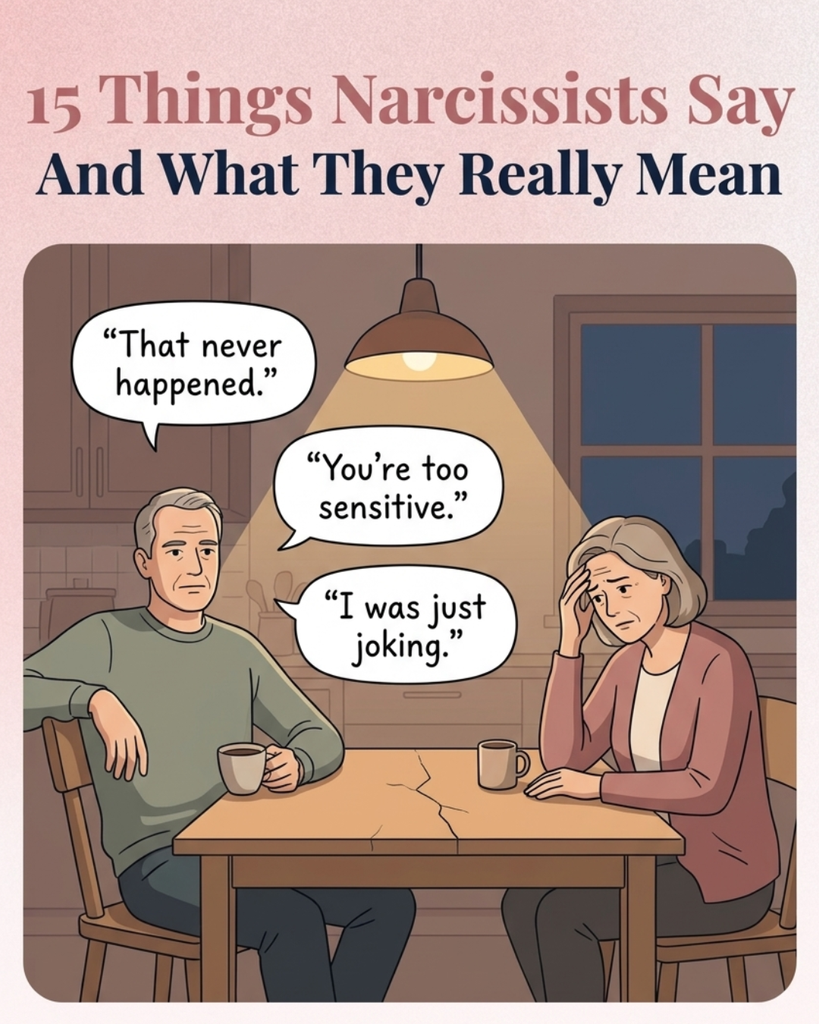
3. “That Never Happened.”
This is the classic one, and probably the most painful. Usually it means something like, I know it happened, but I’m not going to talk about it, and if I deny it firmly enough you’ll drop it.
This is what people call gaslighting, making someone doubt their own memory and their own mind. In a study of women who had lived through domestic abuse, sociologist Paige Sweet found that all 43 women she interviewed described some form of gaslighting, and all but three said their partners called them “crazy.” So if this sounds familiar, you are very far from alone.
Just a tip. Don’t argue about the past for hours. You won’t win, because the facts were never really the point. A calm “I remember it differently” is enough, and then you can end the conversation.
4. “You’re Too Sensitive.”
What it usually means is, your reaction is the problem, not what I did. It’s a very clever move, because suddenly the conversation is about your feelings instead of their behavior.
Think about it. Did you get upset over nothing, or did you get upset because he made fun of your weight in front of his friends? Those are two very different things, and if you’re honest with yourself, you probably already know which one it was, because you’ve replayed that moment in your head on the drive home, in the shower and at two in the morning more times than you’d like to admit. Being hurt by something hurtful isn’t being too sensitive. It’s being a normal human being.
5. “I Was Just Joking.”
A narcissist can say something cruel, watch it land, and then, the moment you react, pull out this line. Now you’re the one with no sense of humor.
Real jokes are funny to both people. If his “jokes” always seem to be about your cooking, your body, your family or your intelligence, and they always happen when other people are listening, that’s not humor. That’s a way to hurt you while keeping clean hands.
6. “You’re Crazy” or “You Need Help.”
When a narcissist runs out of arguments, this is often where they go. Instead of answering your question, they question your mind.
Sometimes they even say it to other people. “She’s been so emotional lately, I’m worried about her.” It sounds caring, but the goal is usually to make sure that if you ever tell anybody what’s going on at home, they won’t believe you. Many women have found out, years later, that their husband had been quietly telling the family this story the whole time.
When They Want To Avoid The Blame
A narcissist rarely says “I was wrong.” Instead, you’ll hear things like these.
7. “I’m Sorry You Feel That Way.”
It sounds like an apology, and that’s exactly why it works so well. But look closely and you’ll notice that there’s nothing in there about what they actually did. They’re not sorry for their words. They’re sorry you have feelings about them.
Most of the time it means, I want this conversation to end, and I’m not taking any responsibility. If you’ve heard this one a hundred times, you’re not imagining the pattern. A real apology names what happened, and it usually comes with some kind of change, not just new words.
8. “Stop Living In The Past.”
This usually comes out when you bring up something they did that still hurts, especially something they never apologized for.
What it really means is, I don’t want to be held responsible for anything I did before today. And there’s a quiet second message hiding in it, too. If the past doesn’t count, then they can do the same thing again next week, and it won’t count either.
Moving on is healthy when something has been talked about and repaired. Being told to move on from something that was never addressed is a different story.
9. “Why Are You Attacking Me?”
You came to them with a simple complaint. “It hurt me when you didn’t come to my mom’s birthday.” Ten minutes later you’re the one apologizing, and they’re the poor victim of your attack. Psychologist Jennifer Freyd has a name for this pattern, DARVO, which stands for Deny, Attack, and Reverse Victim and Offender.
Research by Freyd and her colleagues found that people who faced more DARVO when they confronted someone tended to blame themselves more afterward. Which makes sense, doesn’t it? If you’ve ever walked away from a conversation thinking “maybe it was my fault after all,” this might be why.
10. “Fine, I’m The Worst Person In The World.”
This sounds like a confession, but it rarely is. It’s more like a performance. You gently mention one thing that bothered you, and they jump to the most dramatic version possible, so now you have to comfort them.
Suddenly you’re saying “No, no, you’re not the worst, I didn’t mean that,” and somehow the original problem has disappeared completely. It’s a smart move. Next time, try not to rescue them. A quiet “I didn’t say that. I said this one thing hurt me” keeps the conversation where it belongs.
When They Want To Keep Control
And finally, the phrases that keep you in your place, usually when they feel you slipping away.
11. “After Everything I’ve Done For You.”
Ah, the guilt card. This one comes out the moment you say no, set a limit, or want something for yourself. Suddenly you’re reminded of the car they helped you buy in 2011, the dinners they cooked, the time they picked you up from the airport, all of it listed like an invoice that somehow never gets paid off, no matter how many birthdays you organized, how many hospital visits you made or how many times you bit your tongue to keep the peace.
What it usually means is, you owe me, so you’re not allowed to say no. Many people who grew up with narcissistic parents heard this sentence for their entire childhood, and some still feel guilty every time they make their own choice, even in their fifties and sixties. Kindness given freely doesn’t come with a bill. If it does, it wasn’t really a gift.
12. “Everyone Agrees With Me.”
Everyone? Really? Your sister, your coworkers, the whole church group?
This one is meant to make you feel alone and outnumbered. Sometimes they really have been talking about you behind your back, but often “everyone” turns out to be one friend or nobody at all. The easiest answer is a calm, “Then they can talk to me themselves.” Watch how fast the topic changes. Usually it takes about two seconds.
13. “You Always…” or “You Never…”
“You never appreciate me.” “You always ruin everything.” These big words leave no room for the times you did appreciate them, or the hundred evenings you didn’t ruin.
They’re meant to turn one small moment into a judgment of your whole character. The easiest way to handle them is to bring it back to the actual situation. “I’m happy to talk about what happened tonight. But always and never, no.”
14. “I’m Not Angry.”
Said, of course, while slamming the kitchen cabinets. Or with that cold silence that fills the whole house for three days.
This is often the beginning of the silent treatment, one of the most common punishments narcissists use. It means, I’m angry, and I want you to work hard to figure out why and fix it. Many people end up walking on eggshells, trying to guess what they did wrong. As I wrote in my article about why narcissists provoke you on purpose, your reaction is often exactly what they’re after. You don’t have to chase it.
15. “No One Else Would Put Up With You.”
This is one of the cruelest things in the whole list, and it usually comes out when they feel they’re losing control. Maybe you’ve started seeing friends again, or talking about leaving.
What it really means is, I’m scared you’ll realize you deserve better. People who are confident in a relationship don’t need to convince their partner that no one else would want them. If you’ve heard this sentence, please know it says much more about them than it does about you.
Why Do They Talk Like This?
Under all that confidence, most narcissists carry a very fragile sense of who they are. Being wrong, being criticized, or simply not being the center of attention can feel almost unbearable to them. So the language they use has one main job. It protects their image, even if the price is your peace of mind.
That’s also why logic rarely works. You can bring dates, screenshots and witnesses, and they will still find a way to turn it around. Not because they don’t understand you, but because admitting you’re right feels like losing, and for someone whose whole sense of self depends on always being the one who is smart, right and in control, losing even a small argument about who forgot to pay the water bill can feel like a real threat.
How To Respond Without Getting Pulled In
Other than that, here are a few things that tend to help, whatever phrase they choose. Keep your answers short and calm. Long explanations just give them more material to twist. Trust your memory, and if it helps, write things down with dates so you can look back when you start doubting yourself. Talk to someone outside the situation, like a friend, a support group or a therapist, who can tell you honestly whether what you’re hearing makes sense.
And remember that you don’t have to win every argument to protect yourself. Sometimes the strongest answer is to end the conversation and walk into another room. If you want more ideas, I wrote about the 12 things narcissists hate the most, and calm, boring answers are right near the top.
When It’s Time To Get Help
Living with this kind of language for years can leave real marks, like anxiety, self-doubt, and that constant feeling that you’re doing something wrong. If you recognize yourself in these quiet signs of trauma from narcissistic abuse, talking to a therapist who understands emotional abuse can make a big difference.
And if the words ever turn into threats, or you feel afraid in your own home, please reach out. You can call the National Domestic Violence Hotline at 1-800-799-7233, or visit thehotline.org, to talk to someone confidentially about your situation.
The Bottom Line
Narcissists often say one thing and mean something else entirely. “That never happened” means I don’t want to talk about it. “You’re too sensitive” means my behavior is off-limits. And “No one else would put up with you” means I’m scared of losing control. Once you start hearing what’s really behind the words, they lose a lot of their power. You stop arguing about the past, you stop apologizing for your feelings, and you start trusting yourself again, which is honestly the thing they fear most.
Which of these phrases have you heard the most? Let us know in the comment box below.