
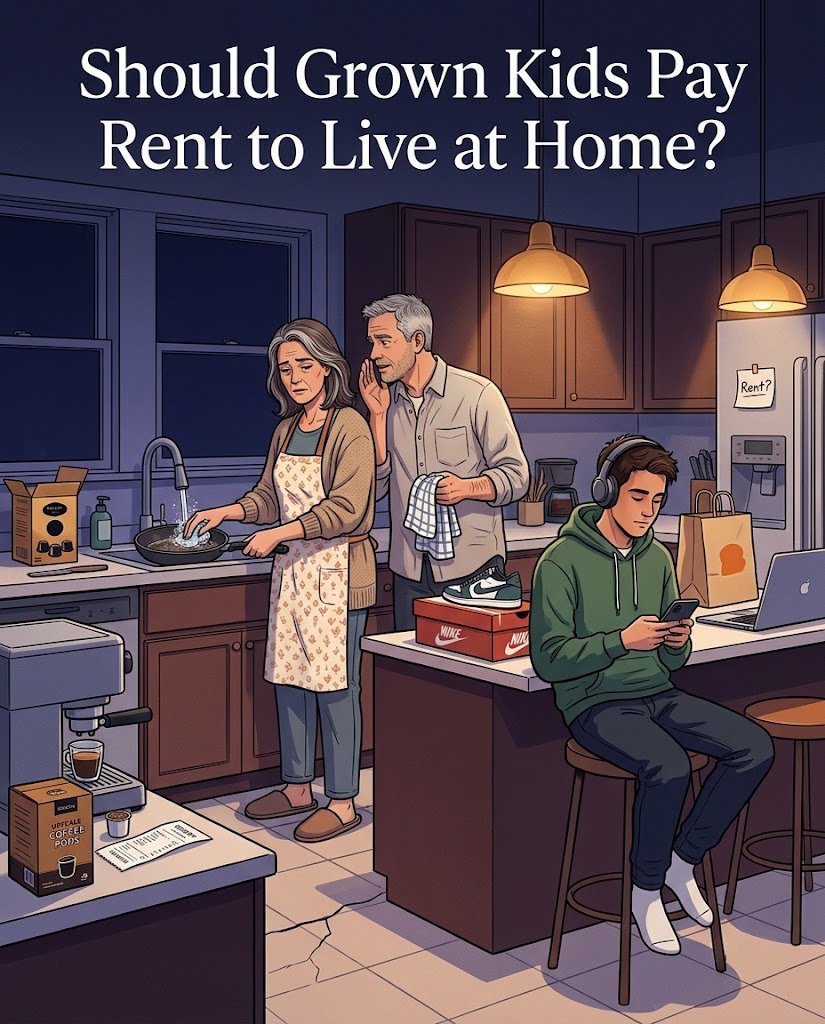
Your son moved back home after college “just for a few months.” That was a year and a half ago. He has a job now, a decent one actually, and every Friday there’s a new pair of sneakers or a food delivery bag on the kitchen counter. Meanwhile you’re still buying his shampoo, his cereal and those expensive coffee pods he likes, and every time you put them in the shopping cart you do the quiet math in your head and then decide, again, that it’s probably not worth the argument.
One evening your husband says it out loud while you’re doing the dishes. “He should be paying something.” And part of you agrees with him. Another part of you feels terrible even thinking about charging your own child to live in the house he grew up in.
If you’re stuck somewhere between those two feelings, you’re definitely not the only parent. In this article I want to go through how common this is today, the honest arguments for and against charging rent, how much makes sense, and how to bring it up without starting a war at the dinner table. I also added two short videos from The Ramsey Show where real parents called in with this exact question. So, let’s go through it.
More Young Adults Live At Home Than You Think
First of all, this isn’t some strange situation only your family is going through. According to the National Association of Home Builders, 32.5% of Americans between 18 and 34 lived with their parents in 2024, based on Census data. That’s about one in three. And it actually went up from the year before because rents and home prices are so high.
The good news is that most of them already help out in some way. A Pew Research Center report found that 65% of young adults living with their parents pay for things like groceries or utility bills, and 46% put money toward the rent or mortgage. Even better, 74% of parents who live with a young adult child said it had a positive effect on their relationship.
So it’s not all sneakers and food delivery. But it’s also not always fair, and that’s where the question comes in.
The Case For Charging Rent
The main argument is pretty simple. Out in the real world nobody gets a free room, and the sooner a young adult gets used to paying for a roof over their head, the easier the move out will be. Financial creator Vivian Tu, known online as Your Rich BFF, told The Motley Fool that parents should charge rent even when they don’t need the money, because otherwise a lot of that paycheck just disappears on things that won’t matter in a year.
Another thing is the cost itself. An extra adult in the house means more groceries, more hot water, higher electric bills and more gas in the car. If you’re living on a pension or trying to save for retirement in your late fifties, those extra hundreds of dollars a month are real money.
Pew found that 59% of parents with a child between 18 and 34 helped them financially in the past year, and 36% of those parents said it had hurt their own finances at least a little. Among lower-income parents, it was almost half.
And let’s be honest, there’s also the feeling. Many moms tell themselves they don’t mind, and then one day they’re scrubbing a frying pan that’s been sitting in the sink since Tuesday and realize they mind quite a lot. A small rent can take away some of that quiet frustration, because at least it feels like a deal between two adults instead of one person carrying everything.
The Case Against It
That being said, there are good reasons not to charge rent too, or at least not right away.
Some young people come home with a clear plan. Maybe your daughter is paying off student loans as fast as she can, or saving for a down payment on her first apartment. Charging her $500 a month might just slow her down. It could keep her in your guest room longer, which is the opposite of what everybody wants.
Even Dave Ramsey, who is not exactly known for being soft on grown kids, once told a father that charging his high school son $20 or $25 a month was “a little over the top,” according to his syndicated column. The boy was mature and motivated. Dave’s advice was basically to keep doing what they were doing and tell him how proud they were. Of course, that was a teenager still in school, not a 29-year-old with a full-time job.
And there’s a bit of good news for worried parents. Researchers at Boston College’s Center for Retirement Research looked at parents in their 50s and 60s whose kids moved back home, and found no real difference in their health, wealth or well-being compared with other parents. The one thing that did show up was that these parents were more likely to plan to keep working past 65.
It Depends A Lot On Why They’re Home
I personally think this is the most important question, much more important than the actual number.
Saving For Something Real
If your child is home to pay off debt or save for a place of their own, and you can actually see the savings account growing, a small rent or no rent at all can make a lot of sense. You’re helping them get somewhere. Just agree on a rough timeline, so “a few months” doesn’t turn into four years.
Going Through A Hard Time
A divorce, a lost job, a health problem. Sometimes adult kids come home because life knocked them down for a while. In those cases, rent can wait until they’re back on their feet. What helps more is a gentle plan, like “let’s talk again in three months and see where you are.”
Obviously, nobody wants to hand a rent bill to a daughter who just left her marriage with two suitcases. Give her some time. Rent can come later.
Just Comfortable
And then there’s the third situation, which is the hardest one to admit. Your child has a job, has no real plan to leave, and honestly, why would they? The food is free, the laundry gets done, and the Wi-Fi is fast.
This is where rent, or at least a clear contribution, can really help. On one episode of The Ramsey Show, a mother called in with a question about her will, and it came out that her two sons, both 34 and both working full time, were still living at home. Dave didn’t hold back. He told her to have them move out. He said he was “serious as a heart attack,” and suggested a six-month plan with clear steps along the way. You can watch that call here.
What If They Don’t Have A Job?
This is a different story. You can’t charge rent to someone with no income, at least not in money.
But you can expect something. A full day of job searching, sending applications, maybe a part-time job while they look for a better one. And help around the house, a lot of it. Some parents agree on a simple rule. If you’re home all day, dinner is your job. It’s amazing how fast some young people find work after two weeks of cooking for the whole family.
If months go by and nothing changes, though, it might be worth asking if something else is going on. Depression and anxiety can look a lot like laziness from the outside, and a gentle “Are you okay?” might help more than a deadline.
How Much Should You Charge?
There’s no magic number, and it really depends on where you live and what your child earns. A small town in Ohio is not San Diego. That said, here are a few ways families usually figure it out.
Some parents ask for a share of the actual costs, for example the extra on the grocery bill and part of the utilities. Others pick a percentage of the paycheck, often somewhere around 10% to 20%, so it grows as the job gets better. And some just pick a round, modest number. One Texas family went viral on TikTok with their plan. They decided on $200 a month if their 19-year-old daughter bought her own food, or $300 if they kept feeding her.
Whatever you choose, it should be less than a real apartment. The whole point is to help them practice, not to make money off your own kid.
The Savings Trick Many Parents Use
Here’s an idea I really like. You charge rent, every month, on time, just like a landlord would. But instead of spending it, you quietly put it in a savings account. When your child finally moves out, you give it all back to them for the deposit and the first month’s rent on their new place.
They learn the habit of paying rent, and they leave with money in their pocket. Vivian Tu mentioned this same idea for parents who don’t actually need the money. Just a tip. Some parents keep it a surprise until moving day. Imagine your son’s face when you hand him an envelope with $3,600 he forgot he even had.
Rent Isn’t The Only Way To Help
Money isn’t the only kind of contribution. If your daughter is between jobs or still in school, she can do the grocery shopping every Saturday, cook dinner twice a week, mow the lawn or drive Grandma to her appointments. Some families mix it, a smaller rent plus a list of chores everybody agrees on.
What matters is that everyone living in the house adds something. An adult child who does nothing at all, and pays nothing at all, usually doesn’t feel very good about it either, even if they’d never admit it.
How To Bring It Up Without A Fight
Well, try not to do it in the middle of an argument about the dishes. Pick a calm moment, maybe a weekend breakfast, and talk to them like an adult, not like a teenager who’s in trouble.
Explain why. Is it about the bills? About helping them learn? About saving for their future? When kids understand the reason, it feels much less like a punishment. Then agree on the details together. How much, which day of the month, what it covers, and roughly how long the arrangement will last. Pro tip: write it down, even just one page on the fridge. It sounds a bit formal, but it saves a lot of “I never agreed to that” later.
It also helps to agree on the house rules at the same time. Guests, noise late at night, cleaning up after yourself. Paying rent doesn’t mean they get to live like it’s a hotel. And not paying rent definitely doesn’t mean that either.
When Your Child Says It’s Unfair
Not every adult child takes this well. In another call to The Ramsey Show, a father from Louisiana explained that he charges his daughter $300 a month. She’s in her early 20s, works as a registered nurse, has no debt and is finishing graduate school. Still, she told him he was “stealing” from her. The tension had started to hurt their relationship.
The hosts didn’t think the parents were doing anything wrong by setting terms. Co-host John Delony’s main advice was simple, though. Sit down and have an honest conversation with her, face to face. You can listen to that call here, it’s a really good one for parents.
If your child pushes back, try not to take it personally. Hear them out, explain your reasons again, and remember that a little grumbling about $300 now is a lot better than a 35-year-old who has never paid a bill in their life.
Don’t Forget About Yourself
Many of us are in the middle of a lot right now. Helping grown kids, maybe helping our own aging parents, and trying to save for our own future at the same time. As I wrote in my article about the child who cares for the parents, money inside families can get complicated very fast, and it’s usually the parents who quietly pay the price.
Think about where you want to be in ten years. If the answer is retired, healthy and not worried about every bill, then the money you spend today on a grown child who can afford to help is money that’s not going toward that, and nobody, not even your kids, will give those years of saving back to you later.
Asking your adult child to contribute is not selfish. It’s okay to protect your own retirement and your own peace in your own home. You can love your child completely and still say, “From next month, we need $250 from you.”
The Bottom Line
Should adult children pay rent to live at home? In many families, yes, at least something, especially if they have a steady job and no real plan to move out. The amount should be fair and lower than a real apartment. It also helps a lot to explain why, write it down and maybe even save it for them. If they’re home to pay off debt or get through a hard time, it’s fine to go easy for a while. Either way, a clear agreement is much kinder than months of quiet resentment over the coffee pods.
Do you think adult children should pay rent to live at home? Let us know in the comment box below.