
It’s Sunday lunch at your mother’s house. Your brother mentions that he might get a promotion at work, and your mother puts down her fork, smiles at him for a long moment and tells the whole table she always knew he’d go far. A few minutes later you mention that you finally finished the course you’ve been taking at night for two years.
“Well,” she says, passing the potatoes. “Let’s see if it actually leads anywhere this time.”
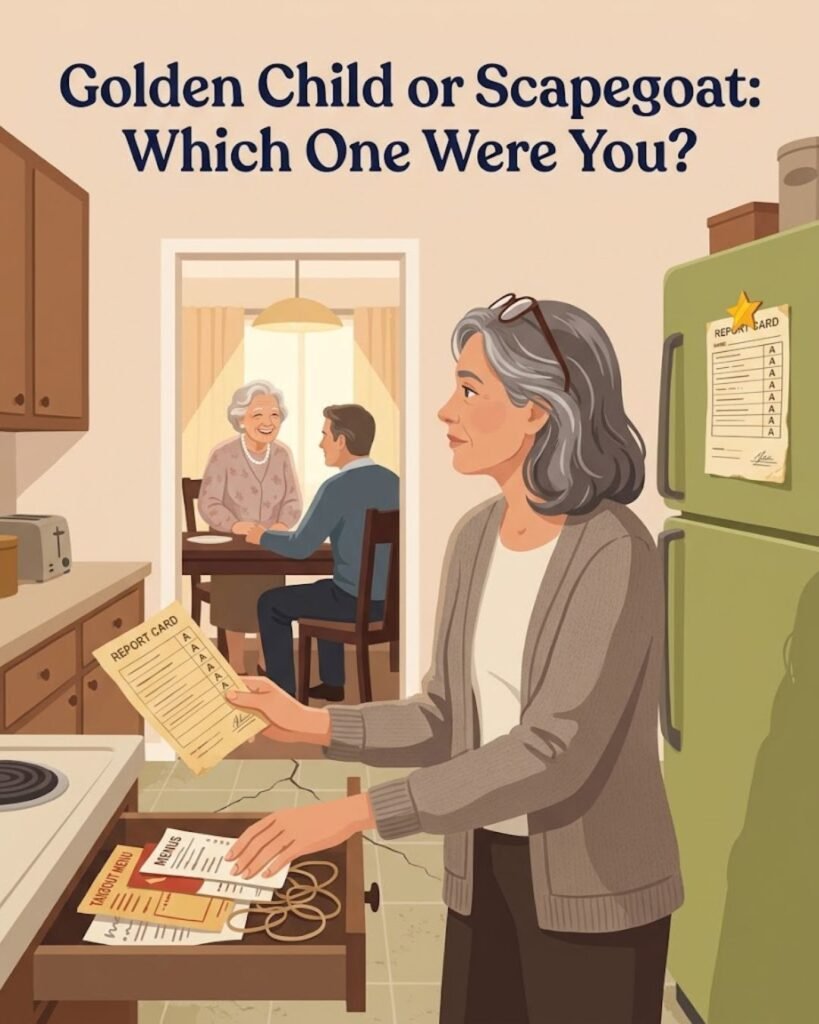
Nobody else at the table seems to notice. Your brother keeps eating. And you sit there at 52 years old feeling exactly the way you felt at nine, when his report card went on the fridge and yours went in a drawer.
If that scene feels a little too familiar, you probably already know the words people use for it. Usually one child is the “golden child” and another one is the “scapegoat.” In this article we’ll look at where those labels come from, what research says about favoritism, the signs of each role, and what both of them tend to carry into adult life. So, let’s go through it.
First, a Short Honest Note
I’m not a therapist, and nothing here is a diagnosis. “Golden child” and “scapegoat” aren’t official clinical terms, and narcissistic personality disorder is something only a professional can diagnose. I use the word narcissistic here the everyday way, for a parent with strong narcissistic patterns.
Your mother or father may never have seen a doctor about any of it. The patterns still matter, and you don’t need a label to know how it felt.
Where These Labels Come From
The idea of children falling into fixed roles is older than most people think. Family therapist Sharon Wegscheider-Cruse usually gets the credit for describing these “survival roles” in 1976, while working with families affected by alcohol and drug addiction. She noticed that children in those homes tended to take on parts like the hero, the scapegoat, the lost child and the mascot, each one helping the family cope with the problem nobody dared to name.
Later, therapists started seeing the same roles in families with a narcissistic parent. The “hero” in those families often became the golden child, the one whose achievements made the parent look good. The scapegoat stayed the scapegoat.
It’s important to say that this is a way of understanding families, not a scientific test. Real families are messier. But many readers who grew up in difficult homes recognize themselves in these roles almost immediately.
Favoritism Is More Common Than Anyone Admits
Before we talk about narcissistic families, it helps to know that a bit of favoritism happens almost everywhere. In a 2010 study from Cornell and Purdue, about 70% of mothers in their 60s and 70s could name the adult child they felt closest to. Only 15% of the grown children believed their mother treated everyone equally.
And in January 2025, a large review published in Psychological Bulletin looked at 30 studies with 19,469 people in total. According to the American Psychological Association, both mothers and fathers were more likely to favor daughters, and they also tended to favor children who were responsible and organized. The less-favored siblings, on the other hand, tended to have poorer mental health and more strained family relationships.
Lead researcher Alexander Jensen was careful to point out that the research is correlational. In other words, it doesn’t explain why parents do it. Fair enough.
But there’s a big difference between a mother who quietly finds one child easier and a parent who builds the whole family around a winner and a loser. The first is ordinary and human. The second is what this article is really about.
You Might Have Been the Golden Child If
The golden child usually doesn’t feel golden from the inside. Mostly, they feel watched.
Maybe you were the one who got the new clothes while your sister got your old ones, and you knew it wasn’t fair but didn’t know what to do about it, so you just said thank you and wore them to school while she walked next to you in last year’s coat with the broken zipper. Maybe your mistakes were always somebody else’s fault. You dented the car at seventeen. Somehow, by dinner, the story was about the neighbor who parked too close.
Your parent may also have shown you off. Your grades or your piano recital came up with every relative who visited, as if they belonged to your parent rather than to you, and you could feel the pressure of that long before you had a word for it. And on the days you didn’t perform, the warmth disappeared fast, so you learned to keep performing.
Many golden children also remember serving as the measuring stick. Your parent said “Why can’t you be a bit more like your sister?” to your sibling, while you stood right there wishing the floor would open.
You Might Have Been the Scapegoat If
The scapegoat is the child who gets the blame. Something went wrong in the house, even something that had nothing to do with you. Somehow it ended up being your fault.
Maybe your family called you “too sensitive” or “dramatic,” usually right after you reacted to something that would upset anybody. Your parent played down your achievements and somehow remembered every one of your mistakes for decades. Relatives may have heard a version of you from your parent long before they actually got to know you.
Picture a family birthday party. You bring a cake you spent all afternoon on. Your father takes one bite and says, loud enough for the aunts to hear, “Your brother’s wife makes it with real butter.” Everyone laughs a little. You laugh too, because not laughing would make you “difficult” again.
And very often the scapegoat is the one who sees the family most clearly. That’s not an accident. In many families, the child who notices what’s wrong gets pushed into this role. So does the child who says it out loud.
A Quick Way to Tell Which One You Were
Sometimes it helps to stop thinking about labels and just remember a few ordinary moments.
Think about the day something broke in your house, a vase or a window or the good serving dish. Who did your parent look at first? Now think about holidays today. When you all arrive, whose news gets asked about, and whose news gets a polite nod before the conversation moves on? Who gets the phone call when your mother is lonely, and who gets the phone call when she needs someone to drive her to the doctor on a Tuesday morning?
If you were usually the one looked at first, you know.
If you were usually the one asked about first, you probably know too. And if you can’t think of a single time anybody looked at you at all, keep reading, because there’s a third option further down that a lot of people forget.
One more thing. Your siblings may answer these questions very differently than you would. That doesn’t mean one of you is lying. Children in the same house often live in surprisingly different families.
The Gold Was Never Free
Scapegoats often assume the golden child had it easy. Sometimes that’s partly true, at least on the outside. But the love the golden child received usually came with conditions, and they knew it.
Research hints at this too. A later Purdue study following 725 adult children from 309 families found that the ones who felt emotionally closest to their mother reported more depressive symptoms, partly because they felt responsible for caring for her emotionally as she aged. And the 2010 study found that unequal treatment hurt every sibling, favored or not.
Former golden children often describe a constant fear of falling off the pedestal, and a quiet guilt about the sibling who got the opposite treatment. Some also struggle to know who they are without someone’s approval.
Imagine being 45 and still calling your mother first after every job interview, not because you want her advice but because you need to hear that you’re still the good one, and then feeling flat for the rest of the day if she sounds distracted on the phone. That’s a lot to carry, even with the nicer bedroom growing up.
Dr. Ramani Durvasula, a psychologist who specializes in narcissism, talks about the anxiety and guilt of the golden child role in this video.
What the Scapegoat Carries Into Adulthood
The scapegoat usually carries the heavier load. Years of blame can turn into self-doubt, trouble making decisions, anxiety and the feeling that something is wrong with you even when nothing is, and that feeling can follow you into job interviews and even the doctor’s office, where you find yourself apologizing for taking up the nurse’s time. If that sounds familiar, I wrote more about quiet signs of unresolved trauma from narcissistic abuse.
Many scapegoats also end up with partners or bosses who treat them the same way, because it feels strangely normal. Others keep going back to the family again and again, hoping that this time somebody will finally see them.
But there’s another side to this, and it doesn’t get mentioned enough. Scapegoats often grow up with a lot of empathy and a very good radar for people who aren’t safe. Many become the kind of parents they never had, which is a remarkable thing to pull off. Dr. Ramani covers both sides in this one.
What If You Weren’t Either?
Not everybody fits neatly into one box. Some children become the “lost child.” That’s the quiet one who stays out of the way, and nobody notices much, good or bad. Others become the family clown, cracking jokes whenever the tension gets too high at the dinner table.
If you were an only child, you may have had both roles. Sometimes in the same afternoon. Praised when you made your parent proud, blamed the moment you didn’t.
The lost child, in particular, often doesn’t realize anything was wrong until much later. They weren’t yelled at much and they weren’t praised much either. They just learned to need very little, and many of them still find it hard to ask anyone for anything at 60.
When the Roles Switch
Roles can also change. A golden child who gets divorced or simply starts saying no can lose the crown very quickly. Sometimes the parent suddenly turns warm toward the scapegoat for a while, usually when they need something from them.
That switch can be confusing for both siblings. It’s also a pretty clear sign that the roles were never really about who either of you was.
It Often Comes Back When a Parent Gets Older
These old roles have a way of returning just when everyone thought they were over. When a narcissistic parent needs care, the scapegoat is often the one doing the driving to appointments and the paperwork, while the golden child gets the thank-you. It’s no surprise that the eldest daughter so often ends up managing the family.
Money and the will can bring it all back too. If that’s something your family is facing, I wrote about whether parents should leave more to the child who cared for them.
Finding Your Way Out of the Role
Here’s the good news. A role your family gave you as a child doesn’t have to be the one you live in at 50 or 70. It takes some work, though, and it looks a little different depending on where you stood.
If You Were the Golden Child
Start by noticing how much of your life revolves around keeping someone pleased. Practice disappointing people in small, safe ways and see that the world doesn’t end. And if you can, tell your sibling you saw what happened to them. You don’t have to fix the past. Just saying “I know it wasn’t fair” can mean more than you’d expect.
It’s also worth looking honestly at your own family now. Without meaning to, some former golden children repeat the pattern with their own kids or grandkids. If you notice one of them always getting the benefit of the doubt, that’s your cue to slow down.
If You Were the Scapegoat
Try to separate the story your family told about you from the person you actually are. Write down your achievements, even the small ones nobody clapped for. That sounds silly, but it helps. Many people in this role also find that guilt follows them into every happy moment, and I wrote about why in why children of narcissistic mothers often feel guilty for being happy.
A therapist who understands family trauma can make a real difference here. You don’t have to go through it alone.
You’re also allowed to decide how much of the old family you take part in. Shorter visits or a hotel instead of your old bedroom are both fine. So is leaving before dessert.
And if someone is still hurting you, whether it’s a parent or a partner who stepped into the same role, please reach out for help. In the U.S., the National Domestic Violence Hotline is available at 1-800-799-7233, and it covers emotional abuse as well as physical abuse.
You Were a Child
Whichever role you had, somebody handed it to you. You didn’t choose to be the favorite, and you didn’t earn the blame. A lot of narcissistic parents grew up in exactly the same kind of house, which explains a great deal but excuses none of it. If you want to understand that side better, there’s more in the truth about narcissistic parents.
I personally think the most hopeful moment in these stories is when two siblings finally compare notes as adults and realize the same parent played them both. They don’t have to become best friends. But that one honest conversation often changes how both of them see the whole family.
Which role did you grow up in? Let us know in the comment box below.