
It’s ten past seven on a school night. Your granddaughter has a poster due tomorrow, the glue stick just died, and she is sobbing at the kitchen table with green marker on her chin. Every part of you wants to grab the scissors and finish it yourself. Ten quiet minutes, one neat poster, and everybody gets to bed.
Most of us have sat at that table. And most of us have rescued at least once, because watching a child struggle feels awful. Still, the people who study mentally strong kids keep landing on the same idea. Toughness doesn’t arrive with the birth certificate. It grows in small evenings like this one, and it grows best when the adults nearby drop a handful of very ordinary habits.
What Mentally Strong Kids Have In Common
Scientists at Harvard’s Center on the Developing Child looked back over decades of work on children who came through hard times in good shape. One thing showed up again and again. These kids had at least one grown-up who stayed close and dependable, as the center explains in its short resilience guide. A parent counts. So does a grandmother, an uncle or a coach who never misses a Tuesday.
The same researchers say some stress is actually useful. A child who meets a problem she can handle, with a calm adult standing by, walks away a bit sturdier. Clear every bump out of her path, though, and she never gets the practice. That is where the 10 mistakes below come in. They all feel kind in the moment. Each one also quietly takes away a chance to grow.
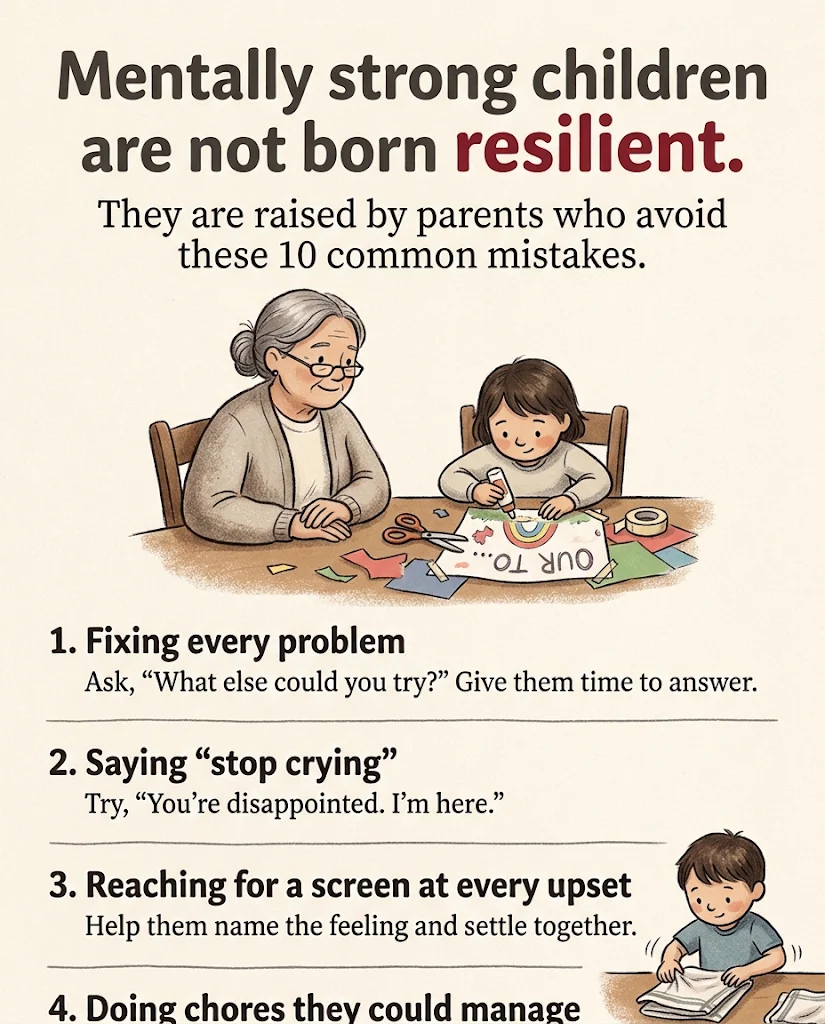
1. Swooping In To Fix Every Problem
Back to that poster. When we finish it for her, she gets a tidy poster and a silent lesson: hard stuff belongs to grown-ups. When we keep our hands in our lap, she gets a lumpy poster and a different lesson. She can figure things out.
So instead of taking over, ask one question. “What else could hold it down if the glue is gone?” Maybe she digs tape out of the junk drawer. Maybe she staples it crooked. Either way, the fix was hers. Next year the problem will be bigger, and she will already know she has handled one before.

2. Telling Them To Stop Crying
“You’re fine, stop crying” slips out of almost every parent at some point. Usually it happens in a parking lot, with love and a full shopping cart. Psychologist John Gottman spent years watching how families react to a child’s sadness and anger. Some parents waved the feelings away. Others named the feeling, listened for a minute and then helped the child work out what to do next. He called that second style emotion coaching.
The gap showed up years later. On the Gottman Institute blog, he describes two children with the same IQ at age 4 who had very different school results by age 8, depending on which kind of parent raised them. The coached kids could hold their attention longer. Sadness wasn’t treated as a problem in their house, so they burned less energy fighting it.
Out loud, it sounds like this: “You’re sad we have to leave the park. I get it. You can be sad and still put your shoes on.”
3. Handing Over The Phone At Every Meltdown
Picture the checkout line. Your grandson starts to wail about a candy bar, two strangers turn around, and your phone is right there in your purse. Two taps and the noise stops.
Pediatrician Jenny Radesky and her team at the University of Michigan tracked 422 children between 3 and 5 for about six months. Kids whose parents often reached for a phone or tablet to settle them had more trouble with their moods as time went on. The link was strongest in boys and in children who already had fiery tempers, according to Michigan Medicine. Her point was simple. A screen ends the noise, but the child misses the lesson.
Radesky suggests a few swaps instead. Try a tight hug, a silly song, a ball of putty to squeeze, or just saying out loud what your grandson seems to feel. A tablet on a six-hour drive is fine. As the go-to fix for every upset, it costs more than it saves.
4. Letting Your Worries Become Their Worries
An anxious child is hard to watch. So we help. We order for her at restaurants. Birthday parties come off the calendar because she gets nervous. Then, for the ninth time that afternoon, someone answers “Are you sure the dog won’t bite?”
Eli Lebowitz, a psychologist at the Yale Child Study Center, calls this accommodation. His team built a program called SPACE that teaches parents to slowly cut back on those rescues while staying warm. They tested it on 124 anxious children aged 7 to 14. Kids whose parents went through 12 SPACE sessions improved about as much as kids who sat through 12 sessions of standard therapy themselves, the journal’s publisher announced. In the SPACE group, only the parents went to the sessions.
The message parents practice sounds something like, “I know this feels scary, and I know you can handle it.” Then they step back a little, one situation at a time.
5. Doing The Chores They Could Do Themselves
It’s faster to fold the towels yourself. Neater, too. But that basket of laundry may be one of the cheapest skill builders in your house.
In Australia, Deanna Tepper and her colleagues at La Trobe University asked the parents of 207 children, ages 5 to 13, about chores and about how their kids handled focus and memory. Children who did more age-fitting jobs, like setting the table or putting away their own clothes, tended to have stronger working memory and an easier time ignoring distractions. A survey like this can’t prove the chores caused it, as the British Psychological Society pointed out. Still, the link makes sense. Clearing a table takes planning, patience and remembering where the forks live.
A 4-year-old can match socks. An 8-year-old can empty the dishwasher. By 12, most kids can cook one simple dinner a week, with you nearby and your hands off the pan.
6. Filling Every Hour Of The Week
Monday is swim. Tuesday is tutoring. Wednesday is piano, and Saturday is a soccer tournament two towns over. Some families barely see their own kitchen table on a weeknight.
The American Academy of Pediatrics wants children to get far more plain, unplanned play. In its 2018 report on play, the group urged doctors to write an actual prescription for it. The report mentioned a study of 3- and 4-year-olds who were nervous about starting preschool. Kids who spent 15 minutes playing with teachers or classmates calmed down about twice as much as kids who listened to a story, as HealthyChildren.org described.
Boredom has a job to do. A kid with an empty Saturday afternoon builds a fort out of couch cushions, argues with her brother about the rules, and sorts it out. Nobody put that on the calendar, and it may be the best practice she gets all week.
7. Expecting Straight A’s And Perfect Manners
Thomas Curran of the London School of Economics and Andrew Hill of York St John University combined decades of surveys from college students in the US, Canada and Britain. Students today feel far more pressure from their parents than students did in 1989. Their sense of what parents expect rose by about 40%, the APA reported. That pressure tracked closely with perfectionism, which is tied to anxiety and depression.
Curran doesn’t blame parents. He says they are reacting to a world that feels harsh and competitive. His advice is to keep the focus on learning and growing, and less on test scores.
At home, that might mean asking “What was the hardest question on the test?” before you ask about the grade. It might mean telling your kids about a time you flopped at something and lived. Once a child believes mistakes are survivable, she will try harder things.
8. Giving In So The Whining Stops
You said no to the second cookie. Then came the begging, the sighing and the slow slide to the kitchen floor. Five minutes later you handed it over, because you were worn out and the phone was ringing.
We have all done it. The trouble is what the child takes away. Whining pays off, and a “no” from Mom is really a “maybe” if you keep at it. Kids who learn this tend to fall apart harder later, because a teacher or a boss won’t give in.
Mentally strong kids usually grow up with adults whose no stays a no. It doesn’t need to sound harsh. “I hear you. The answer is still no. You’re allowed to be mad about it.” After that, let them be mad, and skip the debate.
9. Accepting Every Excuse
The teacher was unfair. That ref was blind. Besides, the other kid started it. Sometimes those things really are true. Still, when every bad grade comes with someone else’s name on it, a child stops looking at her own part.
You don’t need a lecture here. Ask a quieter question: “What part of this was yours?” Then help her pick one small change for next time, like starting the book report on Sunday instead of Wednesday night. Owning a slice of the problem is what gives her a way to fix it.
10. Running Yourself Into The Ground
This one surprises people. In 2024, the Surgeon General at the time, Vivek Murthy, released an advisory about the stress parents carry. Almost half of parents, 48%, said their stress feels completely overwhelming on most days. For other adults, the figure was 26%, according to the HHS advisory page. Murthy wrote that how parents are doing and how kids are doing go hand in hand.
Children copy the way we handle pressure far more than the speeches we give about it. A mother who never sits down shows them that rest is weakness. A grandmother who says, “I’m going for a walk, and I’ll come back calmer,” shows them something better. If your own stress has turned into a sadness that won’t lift, talk with your doctor. Your kids should see you ask for help, too.
Where To Start This Week
Raising mentally strong kids doesn’t mean fixing all ten at once. Pick one. Maybe it’s the phone at meltdowns, or maybe it’s the towels. Then watch for a month. If your child seems worried most days, starts refusing school, or stays down for weeks, bring it up with the pediatrician. Some struggles need more than a patient grandma, and a doctor can check for that.
For more, read our piece on what to teach a child who quits too fast. You might also like our look at what parents in the ’70s got right, along with our tips for a child who argues back.
This short video from Harvard’s Center on the Developing Child shows how good experiences and caring adults help tip a child toward bouncing back.
Final Thoughts
Go back to the kitchen table one more time. The glue stick is dead, and the tears are real. This time you pull up a chair and ask what else might work. She finds the tape. The poster ends up a little crooked, with one corner already peeling.
She carries it into school the next morning anyway and tells her teacher she fixed it herself. That is how mentally strong kids get made. Nobody hands it to them. They build it out of small, messy wins like this one, with a calm grown-up sitting close by.
Which of these habits was hardest for you to give up as a parent or grandparent? Let us know in the comment box below.