
It’s a Saturday in 1976. You finish your cereal, pull your bike out of the grass, and your mother calls after you as the screen door bangs shut. “Be back when the porch light’s on.” Nobody checks on you for six hours. You eat a baloney sandwich on the Hendersons’ back steps, build a dam in the creek, and come home with scraped knees and a story nobody asked to hear.
Ask almost anyone who grew up back then and they’ll describe a morning like that. Today, plenty of young mothers would panic at the idea, and a nervous neighbor might call the police. Yet a lot of what ’70s parenting looked like, the boredom, the chores, the long hours outdoors, now has research on its side. Some of it was a bad idea, of course. But plenty of it deserves a comeback.
What Changed Since We Were Kids
In 2023, Boston College play researcher Peter Gray teamed up with David Lancy and David Bjorklund to gather decades of findings in The Journal of Pediatrics. Their conclusion was hard to ignore. Over the same years that children lost the freedom to roam, play and run small errands alone, anxiety and depression among young people kept climbing. The biggest loss of freedom began in the 1980s, they wrote.
The authors don’t claim that play cures everything. Still, their point is simple. Children who solve their own small problems grow up believing they can handle bigger ones. Kids raised on ’70s parenting got a lot of practice at that, mostly because no adult had the time to hover.
The trip to school tells the same story. Back in 1969, close to half of American children between 5 and 14 walked or rode a bike to class. By 2009 the figure had dropped to 13 percent, according to an analysis of federal travel surveys by the National Center for Safe Routes to School.
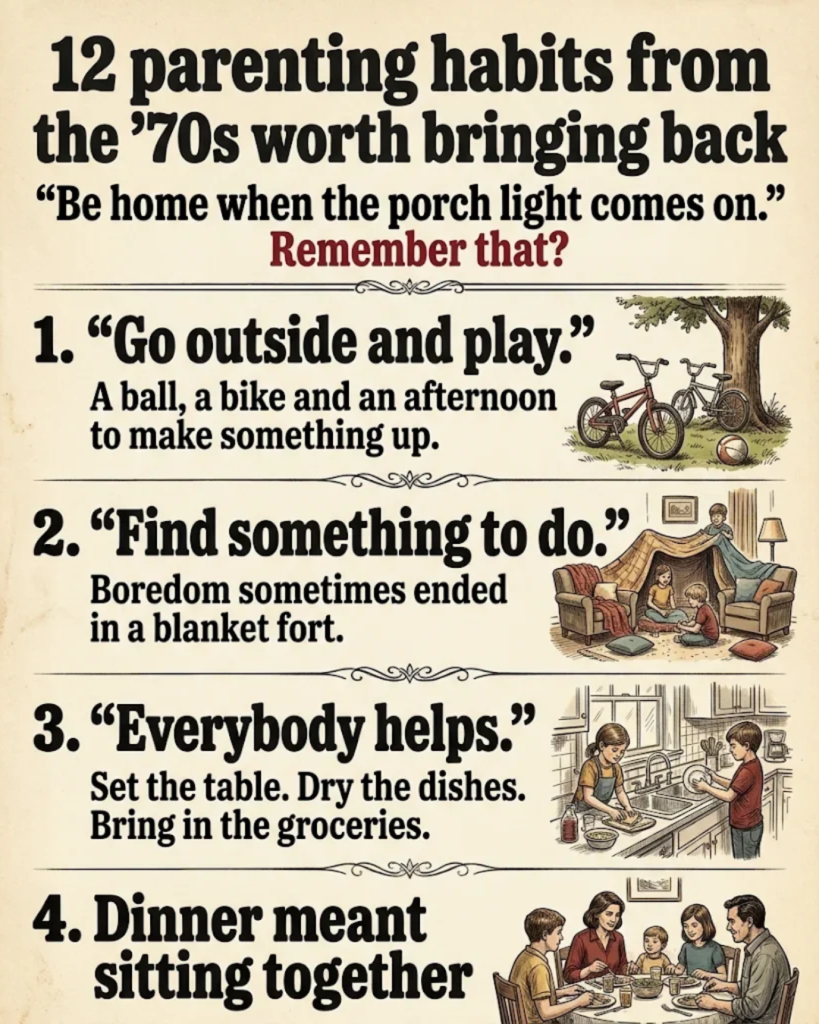
12 Habits From ’70s Parenting Worth Bringing Back
1. Sending Them Outside To Play
In most houses, the rule after breakfast was short. Go outside. Kids made up games with whatever was lying around, a ball, a rope, a stick, an empty lot behind the gas station. Somebody always got their feelings hurt, and somebody always invented a new rule to patch things up.
That kind of play, with no coach and no parent keeping score, is exactly what Gray’s team believes children are missing. A modern version can be small. Open the back door, agree on a time to come in, and stay in the kitchen.
2. Letting Them Go Places Alone
A nine-year-old in 1975 could pedal across town to the library. Many twelve-year-olds today aren’t allowed to visit a buddy two streets over. Back in 2008, a newspaper writer named Lenore Skenazy told readers she had allowed her son, then 9, to find his own way home on the subway. Strangers online called her “America’s worst mom.” Years later she cofounded a nonprofit called Let Grow, which nudges parents to hand children more freedom, a little at a time.
Begin with something easy. Let your grandson walk the dog around the block, or send him into the bakery while you wait in the car.
3. Letting Them Be Bored
Nobody in 1974 felt sorry for a bored child. “Go find something to do” was the whole answer, and somehow we did. We read cereal boxes, built forts out of couch cushions, and invented games with a deck of cards missing three kings.
Boredom may push the mind to wander somewhere useful. British psychologist Sandi Mann had one group of volunteers copy numbers out of a phone book for a while. Afterward, those volunteers thought up more uses for two foam cups than people who had skipped the dull task, as The Psychologist reported.
4. Dinner At The Table, Every Night
Dinner was at six, and you were there. The TV stayed off, or at least the sound did. Dad asked about school, your brother kicked you under the table, and you ate the liver and onions because nothing else was coming.
Researchers at the University of Montreal followed a group of Quebec children from babyhood. When family meals at age 6 were warm and regular, the kids at 10 were fitter, drank less soda and showed less aggression and acting out, the team reported in a 2017 study. Professor Linda Pagani said the meals seem to count on their own, apart from everything else going on at home.
5. Real Chores, Starting Young
In ’70s parenting, chores weren’t up for debate. Children set the table, hauled out the trash, raked leaves and dried every dish. Nobody handed out stickers for it.
Marty Rossmann, a family education professor at the University of Minnesota, found that the young adults doing best in their mid-20s had usually started helping at home at age 3 or 4. A later study of almost 10,000 American kids tied kindergarten chores to better friendships and more confidence by third grade, as Psychology Today explained. A toddler can carry the napkins to the table. That counts.
6. One TV, And Everybody Watched Together
Most families owned one television, and it sat in the living room. Saturday mornings had cartoons. Sunday night meant the whole family on the couch for the same program, arguing over who got the good chair.
Screens now travel in every pocket, so sharing them takes effort. Try one movie night a week, with a bowl of popcorn and the phones in a basket by the door.
7. Letting Kids Settle Their Own Squabbles
When two kids fought over a swing in 1977, the grown-ups usually stayed on the porch. Sometimes the fix was clumsy. Still, the kids sorted it out, and by next week they were friends again.
Stepping back is harder than it sounds. Unless someone is getting hurt, give it five minutes before you walk over. Most fights fizzle on their own, and the children learn something no lecture could teach them.
8. A Short And Steady “No”
Our parents didn’t hold family meetings about bedtime. “No” was a full sentence, and it didn’t arrive with three paragraphs of reasons. Kids pushed back, of course, then went to bed anyway.
Today’s parents explain everything, partly because they want children to feel heard. That’s a kind instinct. Even so, a calm no, said once and kept, can make a child feel safer than a long negotiation.
9. Sending Them On Errands
Remember being handed a few dollars and a handwritten list for the corner store? Milk, bread, a pack of gum for the walk back. The man at the register knew your mother, and you knew to bring home the change.
Small errands teach money, manners and memory in one trip. Even a seven-year-old can pay at the checkout while you stand a few feet away.
10. Thank-You Notes And Phone Manners
After every birthday, someone sat you down at the kitchen table with a pen and a stack of cards. When the phone rang on the wall, you answered with your family’s name and wrote the message on the notepad beside it.
Those little routines taught kids how to talk to adults. A thank-you note to Grandma still works today, and she will keep it in a drawer for years.
11. Fixing Things Instead Of Tossing Them
Jeans got patches on the knees. Socks got darned. Dad fixed the lawn mower in the driveway while you handed him the wrong wrench. Very little went in the trash if somebody in the house could repair it.
Kids who watch a parent fix something learn that broken doesn’t always mean finished. Next time a button pops off a coat, sew it back on together.
12. Parents Who Kept Their Own Lives
Mom had bowling on Tuesdays. Dad played cards with the neighbors on Fridays. The kids were loved, but they weren’t the center of every weekend plan, and nobody felt guilty about it.
Children who see their parents with friends and hobbies learn what a full grown-up life looks like. Young parents today often feel they owe every free hour to their kids. A night out with friends is no betrayal. It sets a good example.
What We Should Leave In The Past
Not every part of ’70s parenting deserves a comeback. Plenty of us rode in the back of a station wagon with no seat belt, or in the open bed of a pickup. Adults smoked in the car with the windows rolled up. Some kids got spanked for things that called for a talk.
Today’s parents are right about car seats, bike helmets and a gentler voice. The goal is to mix the best of both. Keep the safety rules, then add back the freedom, the boredom and the dinner table.
Where Grandparents Come In
If you raised children in the 70s or 80s, you already carry a lot of this know-how. Your grown kids may not want advice, though, so it helps to show rather than tell. Teach your granddaughter to sew a button. Take her to the store and let her pay. Bring a deck of cards on your next visit and leave the tablet in the bag.
We wrote earlier about small ways children feel truly loved, and many of them grow from the same habits. Time, attention and a bit of trust matter more than any toy. If you miss those years, you might also enjoy our look back at Christmas in the ’70s.
In this short TEDx talk, Peter Gray explains why free play matters so much and how children slowly lost it.
Final Thoughts
’70s parenting wasn’t perfect, and nobody wants the smoky car rides back. Still, those parents gave their kids something that’s hard to buy today. They handed them time alone, small jobs, a seat at the dinner table, and the trust to find their own way home.
You can bring some of that back this week. Send the kids outside. Hand them a dish towel. Let them be bored for an afternoon and see what they build.
Which habit from your own childhood would you love to see young parents try again? Let us know in the comment box below.