
If you grew up with a difficult parent, or you have spent thirty years married to someone who never once said sorry, there is a hope you probably carry somewhere quietly. Maybe age will do it. Maybe when they get older and slower and a little frightened, something will soften.
It is a reasonable hope. And the internet will tell you two completely opposite things about it.
One side says people mellow with age, so be patient. The other side says age makes them worse, more dangerous, more cunning, and you should brace yourself.
Neither answer is right, and I think the truth is more useful than both of them. There is a large body of research on exactly this question, and what it found is genuinely surprising. But there is also a reason why so many people swear their difficult parent got harder to deal with after seventy, and that reason is real too.
So, let’s go through the eight things that actually happen when a narcissist gets older, starting with what the research found.
One thing first, because it matters. This article is about difficult, self-centered, draining people, which most of us have met. It is not a diagnostic tool. Narcissistic personality disorder is a clinical diagnosis made by a professional, and calling a family member a narcissist because they are exhausting is not the same thing as them having it.
8 Things That Happen When a Narcissist Gets Older
1. They Soften, But Only A Little
In 2024, the American Psychological Association published a very large piece of work on this question. Researchers at the University of Bern and the University of Münster pulled together 51 separate longitudinal studies, covering 37,247 people aged 8 to 77, some of them followed for decades.
They measured three different flavors of narcissism. Agentic, which is grandiosity and the hunger for admiration. Antagonistic, which is arrogance, entitlement, and coldness. And neurotic, which is hypersensitivity and emotional volatility (full breakdown of the three types here).
Here is what they found. All three go down as people age.
Not up. Down.
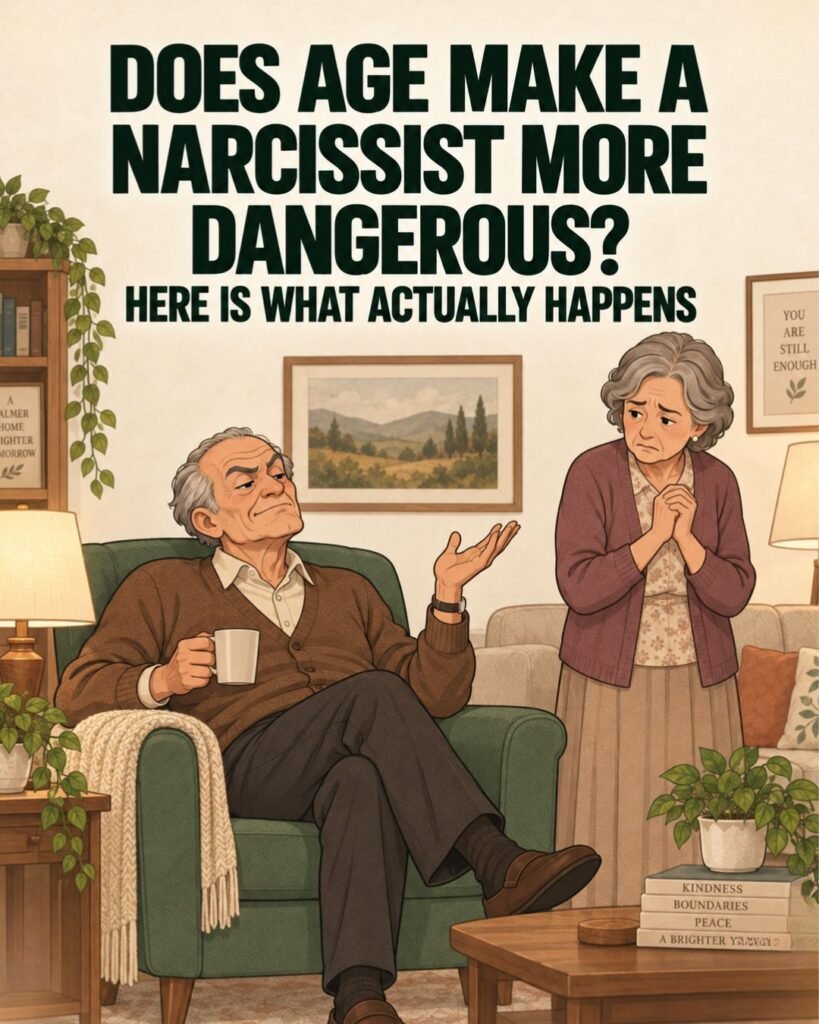
The drop was small for agentic narcissism and moderate for the antagonistic and neurotic kinds. But the direction was consistent, and that is a lot of people across a lot of years pointing the same way.
So the popular claim that age turns these people into something worse is, at the level of the average, simply not supported. If anything, the opposite is true. Most people become somewhat more generous and more agreeable as the decades pass.
I know that this is not what many of you experienced, and I am not going to leave it there. Because the same research contains the explanation for why your experience was different.
2. They Stay The Most Difficult Person In The Room
The researchers measured two separate things, and the second one is the part everybody skips.
The first is how much narcissism declines on average. The second is what they call rank-order stability – whether a person keeps their position relative to everyone else. And on that measure, narcissism turns out to be remarkably stable across a whole lifetime.
In plain language: the most self-centered kid in the class is very likely still the most self-centered person in the room at seventy. Their score came down. Everybody else’s came down too. The gap stayed.
So the softening is real, but it is measured against their own younger self, not against normal people. A ten percent improvement on a very high starting number still leaves you with someone difficult.
And remember the smallest decline was in agentic narcissism, the grandiosity and the need to be admired. That is exactly the part you feel at family dinners.
A separate long-running study followed a group of college students from 1992 and checked back in on them at around age 41. Vanity, entitlement, and leadership had all come down. But the people who scored highest at eighteen were still the ones with the most unstable relationships two decades later.
Also, and this is worth saying plainly, an average is not a promise. A meta-analysis describes what tends to happen across tens of thousands of people. It says nothing at all about your mother.
3. A Real Personality Disorder Rarely Fades
There is an important line here that most articles blur completely, and blurring it is how people end up with the wrong expectations.
Nearly everybody shows narcissistic behavior sometimes. We brag. We fish for compliments. Sometimes we turn a conversation around to ourselves when we should be listening. That is just being a person.
Narcissistic personality disorder is something else. It is a persistent pattern that runs through someone’s whole life and damages their relationships and their functioning, and it is diagnosed by a clinician, not by a blog post or a social media video. Psychology Today put the distinction well when it noted that narcissism is a trait rather than a behavior that simply changes over time.
And the research on personality disorders in later life is much less encouraging than the research on the ordinary trait. Personality disorders do not reliably fade with age, and some work suggests older adults with NPD may communicate with more aggression and disagreeableness rather than less.
So both things can be true at the same time. Ordinary narcissistic traits soften across the population. A genuine personality disorder often does not.
If the person in your life sits in that second group, the hope that time will fix it is probably not a hope worth holding onto. That is a hard sentence to write. But false hope keeps people waiting for an apology that is never coming, and I would rather be honest with you than comforting.
4. You End Up Seeing Them Far More Often
This is the part I think explains most of the gap between the research and what people actually live through.
Think about what is different when a difficult parent turns seventy-five.
You are now the one making decisions about their health. Contact that you had carefully limited for twenty years suddenly becomes constant, because somebody has to go to the appointments. Your siblings are back in the picture with opinions. Money and inheritance enter the conversation. You may be doing physical care for a person who never once cared for you properly.
And it is rarely shared out evenly. In most families, one person ends up carrying it, and I wrote before about why the eldest daughter so often ends up managing the whole family. If that is you, this whole article probably lands close to home.
None of that requires them to have changed at all. The same behavior, aimed at you five times a week instead of twice a year, in a situation where you cannot walk out, will feel dramatically worse.
There is another layer on top of that. Their tools change. A parent who used to control through money or through their position in the family cannot do that anymore. So they use what they have left, which is frailty, illness, and guilt.
That is not a new personality. That is the same person, with a smaller toolbox, using the last tool in it.
5. They Lose Their Audience And Push Harder For Attention
Something else happens around this age, and it is worth understanding rather than just enduring.
A person whose whole sense of self was built on being admired needs a supply of admiration. Work provides it. Looks provide it. Status, money, being the one everyone listens to at the table – all of it provides it.
Retirement takes the first one. Time takes the second. Old friends die, adult children move away or quietly reduce contact, and the room gets smaller every year.
For most people, this stage of life is uncomfortable but survivable, because they have other things holding them up. Real friendships. A marriage that works. Grandchildren who genuinely want to see them.
For someone who spent decades pushing people away while demanding to know why nobody cares, there is very little left. And the reaction to that emptiness is usually not reflection. It is a harder push for attention from whoever is still in reach, which is normally the one child who kept answering the phone.
The distance did not appear out of nowhere either. There are usually years of small reasons behind it, and I went through the most common reasons why grown children stop visiting their parents in an earlier article.
If that child is you, then yes, it will feel like they got worse. From where you are standing, they did.
6. Guilt Becomes Their Main Tool
You will recognize the lines.
I will not be here forever. Nobody visits me. I gave up everything for you, and look how you repay me. Do you want to give me a heart attack?
It is worth being fair here, because two things can produce those sentences. An eighty-year-old who is genuinely lonely and genuinely frightened of dying might say all of them and mean every word. That is not manipulation; that is old age, and it deserves compassion.
The difference is what happens next. Real distress can be comforted. You sit down, you listen, and the person feels better.
Manipulation cannot be satisfied. You give the visit, you make the phone call, you cancel your plans, and within a day the complaint returns unchanged, usually a little bigger. The goal was never comfort. The goal was compliance.
Watch which one you are dealing with over a few months, and you will know. And it is possible for it to be a mixture of both, which is honestly the hardest version to live with.
7. They Become Kinder To Your Children Than They Were To You
Here is a situation that comes up constantly, and almost nobody talks about how strange it feels.
Your difficult parent becomes a grandparent, and they are warm. Patient, even. They buy the gifts, they get down on the floor, they say the encouraging things. Things that were never once said to you.
Two feelings arrive at the same moment, and they do not sit well together. One is relief, because your child is being treated kindly. The other is something closer to grief, because you are watching proof that they were capable of it the whole time.
That second feeling is not jealousy, and you do not need to be ashamed of it. It is old, delayed sadness finally arriving, and it can knock you sideways at a birthday party for no visible reason.
There are usually two explanations, and they are not the same. Sometimes it is genuine. People do soften with age; the research says so, and a grandparent relationship carries none of the daily pressure that parenting carried. A good grandparent is an enormous gift to a child, and I have written about the real power grandparents have in a family. Sometimes, though, it is an audience, and the affection has an edge to it that you can feel even if you cannot prove it.
Watch for whether the child is being enjoyed or being used. A grandparent who tells stories about your child is normal. One who works to become the favorite, who criticizes your parenting to your kid, or who asks the child to keep small secrets from you, is doing something else.
8. They Use Family History As A Weapon
One thing an older difficult person genuinely does have that a younger one does not is the archive.
They know which aunt stopped speaking to which cousin in 1997. They know your sister’s weak spot. And there is the story about you from when you were nineteen, the one that lands badly in front of the right people.
At a wedding, at Christmas, at somebody’s funeral, that archive comes out. Usually not as a shout. As a small comment dropped at exactly the right moment, or a story pulled up that just happens to leave you looking bad while everyone else laughs.
And they have age on their side, which people mistake for wisdom. A room will generally assume that the oldest person at the table means well.
You cannot really win that fight in the moment, and trying usually makes you look like the difficult one, which is often the point. What works better is deciding beforehand how long you are staying and leaving when you said you would, rather than staying to defend yourself.
How To Protect Yourself Without Becoming Cruel
I want to be careful in this section, because a lot of what gets written about this topic tips over into contempt, telling readers their elderly parent is evil and deserves to sit alone. That does not help anybody, and it leaves the reader carrying a load of anger that is heavier than what they came in with.
The real difficulty is the pity. You look at a frail old person, and something in you wants to give in, even when you know better. Dr. Ramani Durvasula, a clinical psychologist who has spent her career on this subject, talks through exactly that feeling in the short video below, and it is worth ten minutes of your time.
A lot of this also comes down to guarding your own energy, which I covered more generally in my article on how to protect yourself from negative energy.
What Actually Works
Decide the amount of contact in advance, when you are calm, and not in the middle of a phone call that is going badly. A weekly call of twenty minutes that you can sustain for years is worth more than a guilty three-hour visit followed by two months of avoiding them.
Separate the caregiving from the relationship. You can arrange good medical care, manage the practical things properly, and still not offer emotional intimacy to someone who has never handled it well. Those are two different jobs, and you are allowed to do only one.
Learn a few calm responses and use the same ones every time. Arguing is what feeds this, and there are better ways of dealing with people who have disrespected you than trying to win the exchange.
Stop waiting for the apology. This is the hardest one. Many people stay in the fight for decades because they are still hoping to hear one sentence acknowledged. If it has not come by now, plan your life as if it will not come, and grieve that properly. Frailty is not remorse, and neither is illness.
Get your own support. A therapist who understands family dynamics, or a support group, or even one honest friend. You need somewhere to put this that is not your marriage or your children.
And keep some compassion, mainly for your own sake. You can feel sorry for a frightened old person and still not answer the phone at eleven at night. Those two things sit together perfectly well.
The Honest Answer
So, does age soften a narcissist?
On average, yes, a little. The research is detailed, and it is based on a lot of people. But the softening is small; it is measured against their own worst self rather than against a normal person, and their position relative to everyone around them barely moves at all. A genuine personality disorder may not shift in the slightest.
Meanwhile, your side of it changes enormously. More contact, less escape, harder decisions, and a person reaching for guilt because everything else has been taken from them.
Which means the useful question is probably not whether they will change. It is what you want the next ten years to look like for you, given that they probably will not. Years of this take a real physical toll, and it is worth understanding how energy-draining habits and people affect your health.
That is a much harder question. It is also the only one you have any control over.
If you are living through this with a parent or a partner, tell me about it in the comments below. A lot of readers here are dealing with exactly the same thing and thinking they are the only one.