
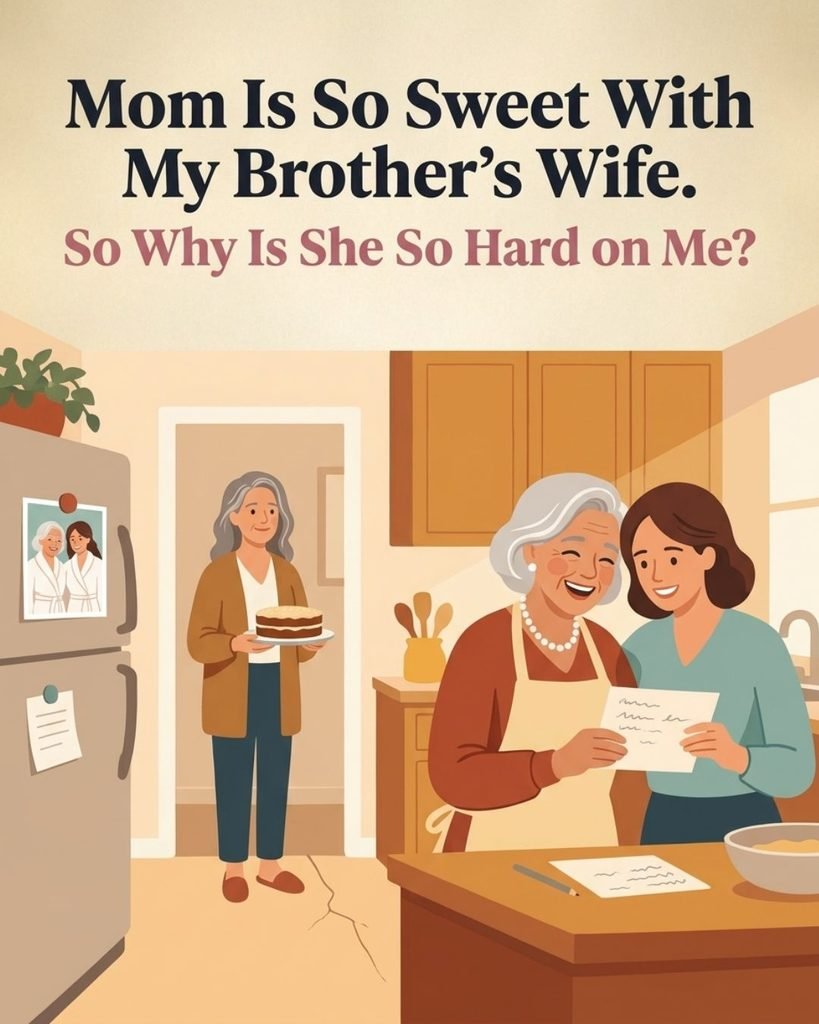
It’s Sunday afternoon, and your son’s wife is in the kitchen with your mother. They’re laughing about something, comparing recipes, and your mother is telling her what a wonderful job she’s doing with the kids.
Then you walk in with the dessert you made, and your mother looks up and says, “Oh. You’re still wearing your hair like that?”
Nobody else notices. Your sister-in-law keeps chopping parsley. But you stand there holding the cake and wondering how your mother can be so warm with someone she’s known for eight years and so prickly with the daughter she raised.
If you’re a daughter, that scene might feel painfully familiar. And if you’re a mother, you might recognize yourself in it too, maybe a little uncomfortably. In this article we’ll look at why some mothers get along better with their daughter-in-law than with their own daughter, what research says about tension between mothers and daughters, and what both sides can do about it. So, let’s go through it.
First, This Is More Common Than You’d Think
Mothers and daughters are often the closest pair in a family, but they’re also the pair with the most friction. In a 2009 study published in Psychology and Aging, Kira Birditt and colleagues at the University of Michigan looked at 474 pairs of parents and adult children. According to the study’s press release, both mothers and fathers reported more tension with their daughters than with their sons. And grown children of both sexes reported more tension with their mothers than with their fathers.
The researchers’ explanation was simple. Daughters and mothers tend to be in closer, more frequent contact, so there are simply more chances to rub each other the wrong way.
What makes the daughter-in-law situation interesting is that in-law relationships usually go the other way. Cambridge psychologist Terri Apter, who studied in-law families for her 2009 book What Do You Want From Me?, found that more than 60% of women described their in-law relationships as stressed, compared with about 15% of men, as The Week reported. So when a mother gets along beautifully with her daughter-in-law, it’s actually a bit unusual, and there’s usually a reason.
Why It Happens
There’s rarely one single cause. But a few patterns come up again and again, and most mothers will recognize at least one of them if they’re honest with themselves.
There’s No History
A daughter-in-law arrives as a grown woman. She didn’t slam doors at fifteen, and she didn’t say the hurtful thing in 1994 that nobody ever quite forgot.
With a daughter, every conversation carries decades of history. Birditt’s team found that past relationship problems were one of the common sources of tension between parents and grown children. With a daughter-in-law, you start with a clean page, and neither of you has to carry around the memory of the summer she was sixteen and told you she couldn’t wait to move out, or the Christmas you said something about her boyfriend that she still brings up after a glass of wine.
You Expect Less, So You Forgive More
Most mothers don’t expect a daughter-in-law to call every day or think exactly the way they do. So when she does something kind, it feels like a lovely surprise.
With a daughter, you simply expect the same kindness. And when she doesn’t do it, it feels like a failure.
That isn’t fair, of course, and most mothers don’t do it on purpose. But expectations quietly shape almost everything in a relationship.
The Same Words Land Differently
Linguist Deborah Tannen, who spent years studying how mothers and daughters talk for her book You’re Wearing That?, found that a few topics cause most of the trouble: hair, clothes and weight. According to an interview with Voice of America, she found that daughters often hear criticism in their mothers’ comments, while mothers feel they’re only showing that they care.
Here’s the interesting part for this topic. Most mothers would never comment on their daughter-in-law’s hair. It would feel rude. But with a daughter, the same comment feels like part of the job.
So the daughter-in-law gets the polite version of you, and your daughter gets the honest one. Guess which one feels warmer.
Daughters Say What They Think
A daughter-in-law is usually on her best behavior, at least for the first ten or fifteen years. She’ll smile at your stories even when she’s heard them before, and she probably won’t tell you that your casserole is too salty.
Your daughter will. She knows she’s allowed to. That honesty is actually a sign of closeness, because she feels safe enough with you to be herself, but it doesn’t always feel like closeness in the moment, especially when she rolls her eyes at your advice about her kids in front of the whole family.
She’s Working Hard to Be Liked
Many daughters-in-law put real effort into the relationship, especially early on. They remember birthdays and ask for your recipes. A daughter, on the other hand, may feel she doesn’t need to prove anything, because she’s already family.
So the daughter-in-law gets credit for every small effort, while the daughter’s efforts blend into the background of a lifetime.
Unsolicited Advice
The Michigan study also found that unsolicited advice and basic personality differences caused more lasting hurt than arguments about money or lifestyle. Mothers tend to give much more advice to daughters than to anyone else, usually because they want to help. But advice nobody asked for often sounds like “you’re doing it wrong.”
Sometimes You See Yourself in Her
This one is harder to admit. A daughter can be a mirror. When a mother sees her own impatience or her own stubbornness in her daughter, it can be irritating in a way that has more to do with the mother than with the daughter.
A daughter-in-law doesn’t carry your face or your habits. She’s easier to like simply because she isn’t a reflection of you.
The Grandchildren Factor
If your son has children, his wife is usually the one who decides how often you see them. Many grandmothers, consciously or not, put extra care into that relationship because they know how much depends on it.
That’s understandable, and often wise. Respecting her rules is one of the things grandparents should never skip. But a daughter can notice that her mother is careful and gentle with her sister-in-law, and quick and blunt with her, and wonder why she doesn’t get the same care.
How It Feels From the Daughter’s Side
For many daughters, this is a quiet, lonely kind of hurt. It’s hard to complain about it without sounding jealous or petty. “Mom likes my sister-in-law” isn’t something you can bring up at Thanksgiving.
Picture a daughter scrolling through her mother’s Facebook page and seeing photo after photo of her mother and her brother’s wife at the spa and out for lunch. Then she remembers that her mother canceled their lunch last month because she was tired.
It’s even harder when someone says the comparison out loud. “Why can’t you be more relaxed, like Jenna?” That sentence can stay with a daughter for years.
And for the daughter-in-law, it isn’t always comfortable either. She may feel caught in the middle or worry that her husband’s sister resents her. If you’re curious about that side of the family, I wrote about things mothers-in-law do that daughters-in-law never forget.
And If You’re the Daughter-in-Law
Being the favored one isn’t always easy either. Some daughters-in-law feel guilty, or sense that their husband’s sister is cool with them for reasons they don’t understand.
If that’s you, one small thing helps a lot. Don’t let yourself be used as the example. If your mother-in-law says, “Jenna never forgets to call,” you can simply say, “Oh, Sarah calls you way more than I do.” It takes ten seconds and can quietly build a bridge with your sister-in-law.
When It’s Something More Serious
In most families, this is ordinary friction. But sometimes there’s a darker pattern.
In families with a narcissistic mother, a daughter can end up in the role of the one who’s always wrong, while the mother may treat a newcomer like a daughter-in-law as the perfect one, at least for a while. If that sounds familiar, you might recognize more in why children of narcissistic mothers often feel guilty for being happy. I’m not a therapist, and this isn’t a diagnosis, but the pattern is worth knowing about.
Psychologist Harriet Lerner, author of The Dance of Anger, talks about difficult mother-daughter relationships in this long but very thoughtful conversation. It’s one to save for a quiet evening.
Is It Actually a Problem?
Not always. A mother who gets along well with her daughter-in-law is a gift to the whole family, especially to the grandchildren. Nobody should feel guilty about that warmth.
It becomes a problem when the daughter starts to feel replaced, or when the mother uses the good relationship with one to criticize the other. Nobody needs to like the daughter-in-law any less. The real work is bringing some of that same patience home to your daughter.
And it’s worth remembering that warmth isn’t a pie. A mother doesn’t have less love for her daughter because she enjoys her son’s wife. Sometimes she just finds one relationship easier, the way we all find some conversations easier than others.
What Mothers Can Do
First of all, try an experiment. For one month, talk to your daughter the way you talk to your daughter-in-law. Ask about her day without offering advice, and skip the comments about her hair and clothes entirely.
Many mothers are surprised by how much changes in a few weeks.
Picture a mother who decides, just once, not to mention her daughter’s new haircut at all, and instead asks how the big project at work went. Her daughter talks for twenty minutes. On the way out, she hugs her mother a little longer than usual. Neither of them says anything about it, but both of them notice.
Make time that’s just for the two of you. Not a family dinner, but a coffee or a walk where nobody else is around to compare with.
And never use the daughter-in-law as an example. Even a gentle “Jenna always calls on Sundays” lands like a slap.
If there’s a particular moment you regret, say so. “I think I was too hard on you about that” can open a door that’s been closed for years. Birditt’s research found that avoiding conflicts doesn’t work as a long-term strategy, so a calm, honest conversation is usually better than another year of silence.
What Daughters Can Do
Tannen’s advice to daughters is to remember that a mother’s criticism is often her clumsy way of caring. That doesn’t make it pleasant. But it can make it a little easier not to take every comment as a verdict.
It also helps to say what you need, plainly and without blame. “Mom, I’d love it if we could have lunch, just us, once a month.” That’s much easier to say yes to than “You always spend time with her instead of me.”
Just a tip. Try not to turn your sister-in-law into the enemy. She usually didn’t ask for the role, and she may become a real ally once you stop seeing her as competition. Some of the closest friendships in big families start exactly that way, over a sink full of dishes after a long holiday dinner.
And if you’re the daughter who always ends up doing the practical work, like the doctor’s appointments and the holiday planning, while your sister-in-law gets the fun outings, you’re not imagining it. I wrote about that pattern in why the eldest daughter ends up managing the family.
A Few Sentences That Can Help
Sometimes it helps to have the words ready.
For a mother: “I realize I give you a lot of advice. I’m going to try to listen more.” Or simply, “I love spending time with you. Can we do this more often?”
For a daughter: “When you compare me to Jenna, it really hurts. I don’t think you mean it that way, but it does.”
For both: “Can we try to start over a little?”
None of these will fix everything in one afternoon. But each one makes the next conversation a bit easier, and that’s how most families actually heal, slowly and in small pieces.
There’s Good News Too
Mother-daughter relationships often soften with time. In research from Purdue University, Karen Fingerman found that most relationships between aging parents and their grown children actually improved as the parents got older, even when their health declined. Many parents and children said they felt closer and talked more.
So if things are tense right now, it doesn’t mean they’ll stay that way. Many daughters who fought with their mothers all through their twenties and thirties find, somewhere in their fifties, that they finally understand her a little better, often around the time their own daughter starts rolling her eyes at them in exactly the same way.
One Honest Note
Some daughters have spent a lifetime trying to earn their mother’s warmth, and watching it go easily to someone else reopens an old wound. If that’s you, your feelings make sense, and it might help to talk to a therapist about them. And some mothers truly don’t realize they’re doing it until someone points it out kindly.
Both of those things can be true in the same family.
If you’re a mother reading this and feeling a little defensive, that’s normal too. The fact that you read this far says you care about getting it right.