
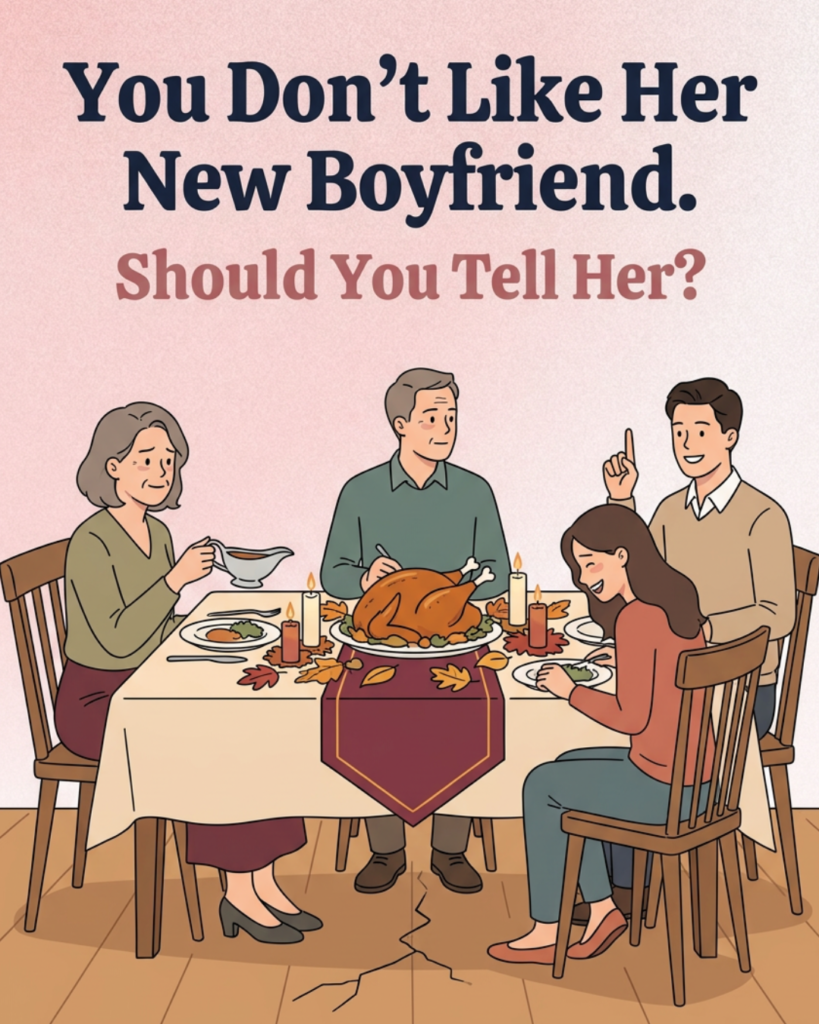
It’s Thanksgiving, and your daughter has brought her new boyfriend for the first time. He’s polite enough. He compliments the stuffing. But twice during dinner he corrects her in front of everyone, once about a movie and once about her own job, and both times she laughs it off and goes quiet.
On the drive home you rehearse it in your head. “Honey, I just think you deserve someone who…” Then you stop, because you can already see her face, and you know exactly how that conversation could go.
So should you say something or not? It’s one of the hardest questions parents of adult children face, and there’s no single right answer. In this article we’ll look at whether you should tell your grown child you don’t like their partner, what research says about disapproving parents, how to say it if you decide to, and when it stops being a matter of taste and becomes a real worry. So, let’s go through it.
First, What Kind of “Don’t Like” Is It?
Before you say a word, it helps to be honest with yourself about what’s actually bothering you. There’s a big difference between a partner you find annoying and one who genuinely worries you.
When It’s Mostly About You
Perhaps he talks too loudly at dinner, or she votes differently than you do. Or you simply pictured someone different, someone more like the nice boy from church or the girl your son dated in college, and this person doesn’t fit the picture you’ve been carrying around for years.
Those feelings are real, and you’re allowed to have them. But they’re about your taste, not your child’s safety. And in most of these cases, saying something out loud costs far more than it gains.
When Something Really Worries You
It’s a different story if you’ve noticed your child pulling away from friends or changing in ways that don’t feel like them. We’ll come back to that, because it needs a very different approach.
A Few Questions to Ask Yourself
Would you honestly like anyone your child brought home? Some parents wouldn’t, and it’s worth admitting that to yourself, at least quietly.
Is your child happier or less happy since this person came along? Not quieter or busier, but happier. That’s often a better guide than your own first impression.
And what do their friends think? Friends usually see a partner in everyday life, while you see them at a holiday dinner when everyone is nervous. If the friends love him, it’s worth giving him another look.
What Research Says About Disapproving Parents
You’ve probably heard of the “Romeo and Juliet effect,” the idea that parental disapproval only pushes a couple closer together. It comes from a 1972 study by Richard Driscoll and colleagues, which found that couples who felt more interference from their parents reported more love over time. According to a review in In-Mind magazine, later research by psychologist H. Colleen Sinclair and her team didn’t support that idea very well.
What they found more often was the opposite, sometimes called the social network effect. Couples whose family and friends approve of them tend to report more love and commitment, and disapproval is linked to lower satisfaction and a higher chance of breaking up. But there’s an important detail. When friends approved and only the family disapproved, the results looked a lot like full approval. The negative effect showed up mainly when both friends and family were against the relationship.
So your opinion matters, but probably less than you’d like it to, especially if your child’s friends like the partner. And couples who see relationships as something you work on, rather than something that’s simply meant to be, tended to hold up well even under disapproval.
In other words, telling your daughter you don’t like her boyfriend is unlikely to end the relationship by itself. It’s much more likely to affect your relationship with her.
The Real Risk: Losing Your Child
This is the part many parents don’t think about until it’s too late. Family rifts are much more common than most of us realize. When Karl Pillemer, a sociologist at Cornell University, asked more than 1,300 Americans about it while researching his book Fault Lines, more than a quarter of them said they no longer spoke to someone in their own family. Roughly one in ten had no contact with a parent or a grown child.
And marriage seems to be a turning point. Psychologist Joshua Coleman, who studies family estrangement, surveyed 1,632 estranged parents through the University of Wisconsin Survey Center. According to his account in the New Zealand Herald, 70% of them didn’t become estranged from their adult child until after that child got married.
Coleman’s advice is blunt. Don’t criticize the partner, because criticism tends to get passed along, and it can become proof that you can’t be trusted. The partner, whether you like it or not, often becomes the gatekeeper to your child and to your future grandchildren.
That doesn’t mean you have to pretend. But it does mean that every comment about the partner has a price, and you should decide whether it’s worth paying before the words leave your mouth, because unlike most things you say in a family, these tend to get repeated and brought up again years later at exactly the wrong moment.
If You Decide to Say Something
Sometimes staying quiet feels wrong, and that’s fair. If you’re going to speak up, how you do it matters more than what you say.
Before you start, decide what you hope will happen. Do you want them to break up? Think more carefully? Or simply know you’re there?
Only the last one is fully in your hands.
Say It Once, in Private
Pick a calm moment when it’s just the two of you, maybe on a walk or over coffee. Not at the holiday table, and definitely not in front of the partner. Then say it once. A concern repeated every week turns into a campaign, and your child will start defending the partner just to defend themselves.
Talk About What You Saw, Not Who They Are
“He’s arrogant” invites an argument. “At dinner, I noticed he corrected you twice, and you got quiet. How did that feel for you?” invites a conversation. The first is a verdict on a person your child loves. The second is a real observation and a real question.
Then actually listen to the answer. You might learn something you didn’t know, like the fact that he’s been under a lot of stress at work, or that she’s already been thinking about the same thing.
Then Let It Go
This is the hard part. Once you’ve said it, your child gets to decide what to do with it. You can make it clear that your door is always open, something like, “Whatever you decide, I’m on your side, and I’ll always be here.” And then you go back to being their parent, not their judge.
That means the next time he comes for dinner, you pass him the potatoes and ask about his week.
It’s not easy. It’s still worth it.
Stay Close, Whatever Happens
The best protection you can give your child is a relationship where they can still come to you. Keep calling, keep inviting them for dinner and keep a little time that’s just the two of you, like a monthly lunch. If the relationship does go wrong someday, you want to be the first person they call, not the last.
Picture your daughter, a year from now, sitting in her car outside your house after a bad fight, deciding whether to come in. Everything you say today shapes whether she walks up to your door.
What If Your Child Asks What You Think?
This is a different situation, and in a way an easier one. If your son sits down at the kitchen table and asks, “Mom, what do you honestly think of her?” he’s inviting your opinion.
Even then, it helps to ask one question back. “Do you want my honest opinion, or do you need me to listen right now?” Sometimes a grown child just needs to talk through their own doubts, and your opinion can wait.
If they really want it, be honest but kind, and stick to things you’ve actually seen. Then add something positive too, if you can find it. “She’s clearly smart, and I can see she makes you laugh. I’ve just noticed she gets very upset when you see your friends.” That’s a sentence your child can actually think about, instead of defending against.
A Few Things That Almost Always Backfire
Ultimatums are the big one. “It’s him or us” rarely ends with the child choosing the parents, and even when it does, the resentment can last for years.
Hints are another trap, even though they feel safer. A sigh when his name comes up, or a joke about “your friend” instead of using his name. Your child notices every one of them, and hints often hurt more than one honest conversation would, because there’s nothing to answer.
Recruiting the rest of the family is another. When your son finds out that his sister and his aunt have both been “talking about her,” he’s likely to pull away from all of them at once.
And if they do break up, please resist the urge to say “I never liked him anyway.” Your child might get back together with him next month, and they’ll remember that sentence. They might also simply feel embarrassed for having loved someone you saw through, which is a lonely feeling.
When It’s More Than Just Not Liking Them
Everything above changes if you think your child might be in a controlling or abusive relationship. Then it isn’t a matter of taste anymore.
Some signs worth paying attention to, according to the parent guide from loveisrespect, include a partner who is extremely jealous or possessive, constant texting or checking in, and a child who pulls away from friends or seems anxious and depressed. Mood swings and changes in how they dress can also be a sign.
Here’s the surprising part. Even in this situation, the advice from experts is not to attack the partner. Loveisrespect’s guidance for parents is to take your child seriously, be supportive and never put the partner down. A controlling partner often works hard to cut someone off from family, so the most protective thing you can do is to stay close and keep the door open.
What You Can Say Instead
Keep it short and about your child, not the partner. “You seem tired lately. Is everything okay?” Or, “I miss you. Can we have lunch, just us?”
If they open up, listen. Don’t jump in with “I knew it.” Just let them talk.
And make one thing very clear, maybe more than once over the months: “Whatever happens, you can always come home. No questions, no lectures.” A child who knows that is much more likely to reach out when they’re ready.
Katie Hood’s TED talk explains the difference between healthy and unhealthy love very clearly, and it’s a good one to watch, maybe even with your child.
Please don’t push your child to leave suddenly without a plan. Leaving an abusive partner can be the most dangerous time. The National Domestic Violence Hotline at 1-800-799-7233 also helps worried friends and family, and their first piece of advice is simply to listen.
If They Marry Them Anyway
Sometimes the person you didn’t like becomes your son-in-law or daughter-in-law. At that point, the kindest thing you can do for your child is to give that relationship a real chance.
Invite them both, and remember their birthday. Small, steady warmth often softens both sides over the years, and the opposite is just as true. Many parents admit, ten years later, that the son-in-law they couldn’t stand turned out to be the one who drove them to every hospital appointment. There are some things mothers-in-law do that daughters-in-law never forget, and most of them start with a comment that seemed small at the time.
Once grandchildren arrive, the stakes get even higher. Your child and their partner decide how the kids are raised and how often you see them, and that’s true even if you think you know better. Respecting their rules is one of the quickest ways to earn trust, and ignoring them is one of the quickest ways to lose it. I wrote about some of those rules in things grandparents should never do without asking.
If your son seems to have changed after the wedding, it’s not always the new wife’s doing. I wrote about some of the other reasons in why some sons change completely after they get married.
One Honest Note
Sometimes the problem isn’t the partner at all. Watching someone else become the most important person in your child’s life can be hard in a way nobody really warns you about, especially if you’re the one who sat up through every fever and every heartbreak for thirty years. That’s a real loss, and it’s okay to grieve it a little.
And if you grew up with a mother who disapproved of everyone you ever loved, you know exactly how it feels from the other side. Many of us still remember every critical word said about our husbands. If that’s part of your story, you might find something familiar in the truth about narcissistic parents.
So, should you tell them? Sometimes, yes, once and gently. Most of the time, it’s wiser to stay close and save your words for the day they’re really needed.
Your child doesn’t need you to love their partner. They need to know you love them, no matter who they choose.
Have you ever told your child you didn’t like their partner, and how did it go? Let us know in the comment box below.