
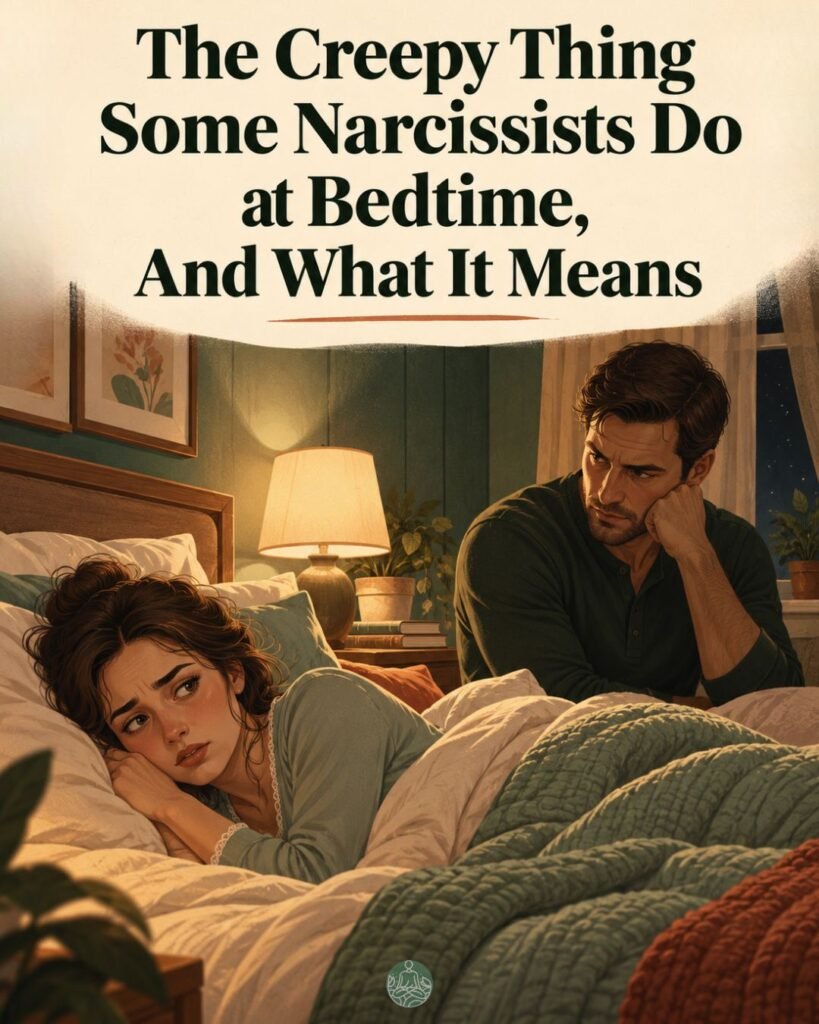
The day is finally over. You have locked the door, switched off the downstairs lights, and brushed your teeth. Your eyes are heavy, your shoulders have dropped for the first time since morning, and you are about two minutes from sleep.
Then it starts.
We need to talk. Why are you being like this? Or a sigh from the other side of the bed, just loud enough that you have to ask what is wrong. Suddenly it is half past one, and you are wide awake, your heart going like a drum.
If this happens once in a while, it is probably just a tired marriage. If it happens most nights, and it seems to arrive exactly when you are closest to sleep, it might be something else entirely.
I want to be careful with this subject, because there is a lot written about it online and some of it is badly exaggerated. So, let’s go through what is actually true, what is not, and how to tell the difference.
One thing first, as always. I am not a therapist, and nobody should diagnose a partner from an article. The patterns below matter, whatever label you put on the person.
First, What Is Actually True
You will see claims that every narcissist does this, every single night. That is not true, and I am not going to pretend it is. There is no research showing a universal bedtime routine that all difficult people follow.
But here is what is true, and it is more serious than most of those articles admit.
Deliberately keeping a partner from sleeping is a recognised form of abuse. DomesticShelters, one of the largest domestic violence resources in the United States, describes sleep deprivation as a deliberate abuse tactic, used to control, disorient, and weaken the person on the receiving end.
Researchers have documented it too. In one study, women whose abusive partners disturbed their sleep all described changing their own sleeping patterns just to reduce the threat they faced at home. A follow-up concluded that sleep deprivation was clearly a direct strategy of abuse, and that it also quietly wore down the women’s physical and mental resilience.
So the thing is real. It is just not universal, and it is not always what is happening.
Why Bedtime, Of All Times?
If somebody wanted to start a fight they were sure to win, bedtime would be the obvious moment.
You are tired, so you are slower. Your guard is down, because the day is supposed to be over. And you want one thing more than anything else, which is permission to sleep.
That last point is the lever. A person who desperately wants to sleep will agree to almost anything that makes the conversation stop. Sorry, you are right. I will do better… can we please just go to sleep now?
Then the next day arrives, and the apology you gave at one in the morning has quietly become the agreed version of what happened. You do not really remember saying it. They remember it perfectly.
The timing has a practical advantage too. Nobody else is awake. There are no witnesses, nobody to call, and nowhere to go, unless you get dressed and drive somewhere just to end the conversation.
What It Can Look Like
When somebody uses sleep as a weapon, it rarely looks dramatic. It looks like a series of small things, each one easy to explain away on its own.
A heavy emotional conversation that apparently cannot wait until morning, started just as you turn the light off. A fight about something trivial the moment your head hits the pillow. Loud sighing, slammed drawers, a bright phone scrolling right beside your face.
In more serious cases, it becomes physical. One survivor described to DomesticShelters how her husband would turn on every light in the bedroom and pull the covers off her when she tried to go to bed before him.
And then, often, they go to sleep perfectly easily afterwards, while you lie there staring at the ceiling. That contrast is one of the most common things people describe, and it is part of what makes it feel so deliberate.
The individual moments are small. The pattern is what gives it away.
Why Exhaustion Makes You Easier To Control
This is the part people underestimate.
Sleep is not a luxury. It is when your brain processes the day, steadies your emotions, and restores your ability to think clearly. Lose it night after night, and you lose some of all three.
Psychologists at UC Berkeley found that after even one bad night, people became less able to read their partner’s emotions, had less empathy, and handled conflict worse. Now stretch that across months.
A chronically exhausted person second-guesses their own memory. They apologise faster and argue less. And they struggle to see a pattern that would be obvious to anybody well-rested. That is exactly why people have used sleep as a pressure tactic for so long, and not only in relationships.
So if you have started to feel foggy, confused, and unsure of yourself, it may not be a flaw in your character. It may be months of broken sleep.
But Not Every Late-Night Fight Is A Tactic
I have to be fair here, because this is where a lot of online writing goes wrong.
That same Berkeley research, by Amie Gordon and Serena Chen, found that ordinary couples simply fight more, and worse, after a bad night’s sleep. Even relatively good sleepers were more likely to argue the day after a poor night. And research from Ohio State found that when both partners were short on sleep, their arguments turned more hostile.
In other words, tired people are worse at getting along. All of them. Plenty of couples who love each other very much have their worst arguments at eleven at night, not because anybody is plotting anything, but because both of them are running on empty and it is the only moment they have alone together all day.
That is why I will not tell you that every bedtime argument is abuse. Most are not. The question is not whether it happens. It is how, how often, and what happens when you try to stop it.
Why It Is So Hard To See From The Inside
If this pattern is so recognisable, why do people live with it for years without naming it?
Partly because exhaustion itself hides it. The very thing being done to you is the thing that stops you from thinking clearly about it, which is an unusually effective trap.
Partly because each night looks different. One night it is a question about your friend, another a complaint about money, another a silence you cannot explain. Nothing links them together except the hour.
And partly because the explanation that comes to mind first is always the one that blames you. I must have said something. I’m just too sensitive, and I’m really tired.
That last one is especially slippery, because you are tired. So the tiredness gets the blame, rather than whatever keeps causing it.
Writing things down, even briefly, breaks the spell. A pattern that is invisible across forty separate nights becomes obvious on one page.
How To Tell The Difference
Ask yourself a few honest questions.
Does it happen occasionally, or almost every night? Ordinary couples have bad nights. A pattern that arrives reliably, night after night, is something else.
What happens when you say Let’s talk about this tomorrow? In a normal relationship, the other person usually accepts that request, even if grudgingly. When somebody is using sleep deliberately, asking to stop makes it worse. The conversation escalates precisely because you tried to end it.
Can you leave the room? If you go to sleep on the sofa and they follow you, wake you, or make you pay for it the next day, that tells you a great deal.
And how do you feel the next morning? Confused about what was actually said, apologising for things you cannot quite remember agreeing to, and more exhausted than the night before? That is worth paying attention to.
What Actually Helps
If this sounds like an ordinary tired marriage rather than something darker, a few changes can make an enormous difference.
Four Things Worth Trying
Agree on a no-serious-talk rule after a certain hour. Both of you, together, while you are calm and awake. Anything important waits until the next day, and the researchers who study couples and sleep suggest exactly this kind of raincheck.
Say the sentence and mean it. I want to talk about this properly, and I will tomorrow at breakfast. Then actually bring it up at breakfast, so the other person trusts that tomorrow is real.
Protect your sleep as though it matters, because it does. If a room is not restful for you, it is reasonable to sleep somewhere else for a few nights while things settle. Protecting your own energy like this is not cold, and I wrote about it in how to protect yourself from negative energy.
And keep a simple note of what happens. Dates, times, what was said. Not to use against anybody, but because exhaustion blurs memory, and a written record lets you see a pattern clearly when your tired brain cannot.
If You Might Be The One Starting It
I want to say something to a different reader for a moment, because an honest article should.
Some people reading this will recognise themselves on the other side. Not as somebody controlling a partner, but as somebody who saves every difficult conversation for bedtime, because it is the only time the house is quiet and the only time you have each other’s full attention.
That is completely understandable. It is also not working.
If your partner is exhausted, they cannot really hear you, and the research suggests you will both handle the conversation worse than you would at breakfast. So the thing you most need to say lands at the one moment it is least likely to be understood.
Try moving it earlier. A walk after dinner, or ten minutes before the television goes on. You will probably find the same conversation goes far better when neither of you is fighting to stay awake.
When This Is More Serious
Now the part I will not skip, even though it is uncomfortable.
If your partner physically stops you from sleeping, follows you when you leave the room, threatens you, or controls your money, phone, or movements, this is no longer a relationship problem you can fix with better communication. It is coercive control.
And sleep deprivation in that context deserves serious attention. A University of Worcester study of survivors found it was a powerful method of control with lasting effects on health, and suggested it may be a warning sign of higher risk, because the pattern resembled those seen in relationships that ended in the worst possible way.
So I want to say something plainly. You may see articles on this topic end with a single word of advice: run. Please do not do that without help. Advocates are clear that abuse tends to escalate, and that the period when somebody leaves or pushes back carries the highest risk. Leaving is often exactly the right answer. It just needs a plan.
Talk to a trained advocate first. In the United States, the National Domestic Violence Hotline is 1-800-799-7233, and most countries have their own. They can help you plan a safe way out.
You Are Not Imagining It
If you have spent years lying awake at two in the morning wondering whether you are the problem, I hope this helps you see things a little more clearly.
Sometimes a late-night fight is just two exhausted people who love each other badly for an hour. That is fixable, and a simple rule about not talking after ten o’clock can change a marriage.
And sometimes it is a pattern, designed to keep you tired, confused, and easier to manage. That is not something you caused, and it is not something you have to keep living with.
Either way, you deserve to sleep. That is not too much to ask of anybody who says they love you.
Does this happen in your house? Tell me in the comments whether your worst arguments tend to start at night. You do not have to share details. I think a lot of people are about to realise they are not the only ones.