
Nobody notices the day it starts.
There is no single moment when getting out of a low armchair becomes difficult. It happens so gradually, over so many ordinary evenings, that one day you simply realise you have started putting a hand on the arm of the chair to push yourself up, and you cannot for the life of you remember when you began doing it or why you never noticed at the time.
Then the stairs. Then the jar that will not open. And one afternoon you turn to reverse the car into a tight space and your neck does not go quite as far as it used to, and you find yourself relying on the mirrors instead.
Here is the part I want you to hear, because it changes everything else in this article. Most of these things do not get harder simply because we get older. They get harder because we stop practising them.
Getting up from the floor is a skill. So is balance. And like any skill, it fades when you stop using it. It often comes back surprisingly well when you start again.
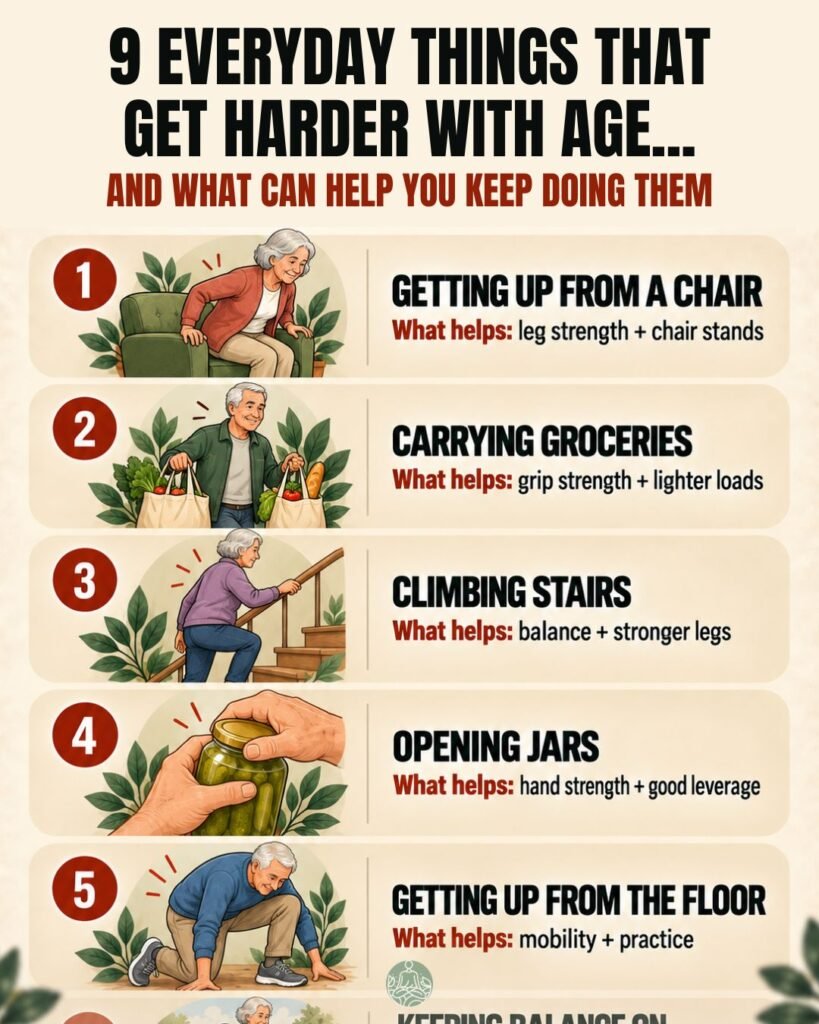
So, let’s go through nine everyday movements worth protecting, and what actually helps with each.
Before You Start, A Word About Safety
A few of the sections below mention simple tests you can try at home. Please be sensible about them.
If you have a heart condition, osteoporosis, a joint replacement, dizzy spells, or you have had a fall recently, talk to your doctor before you try anything new. Do any balance test next to a kitchen counter or a sturdy chair you can grab. And do not get down on the floor unless you are confident you can get back up, or somebody is with you.
None of these tests is a diagnosis. They are simply a way of noticing where you are, so you know what to work on.
1. Getting Up From A Low Chair
This is usually the first one people notice, and it is one of the most useful to fix.
Standing up from a chair uses the large muscles at the front of the thighs and around the hips, the same ones that carry you up the stairs every evening and catch you in that split second when you trip on the edge of a rug. Muscle mass naturally declines as we age, and these particular muscles tend to lose ground fastest of all when we spend most of the day sitting down.
The good news is that the fix is the problem itself. Practise standing up.
Sit on a sturdy chair, cross your arms over your chest, and stand up without using your hands. Sit back down slowly. Do it several times, a few days a week.
If that is too hard at first, use your hands, or use a higher chair, and work down over time. You are not trying to impress anybody. You are trying to keep a movement that you will want to still have at ninety.
2. Carrying The Shopping
Carrying two heavy bags from the car to the front door asks a surprising amount of the body.
Your grip holds the handles. Your arms and shoulders take the weight. Meanwhile, your core stops you from tipping sideways, and your legs carry the whole lot up the path.
When any of those weakens, people start making more trips with lighter loads, or quietly asking somebody else to do it for them. That is perfectly fine now and then. But if you stop carrying anything heavy altogether, week after week, the ability to do it drains away so gradually that you only notice when you genuinely need it, and it is no longer there.
So keep carrying, sensibly. Split the load evenly between two hands rather than hauling everything on one side, stand tall, and walk steadily. Carrying groceries is, in its own quiet way, one of the most complete strength exercises there is.
3. Climbing The Stairs
Stairs are an honest little test of three things at once. Strength, balance, and endurance.
You need leg strength to lift your body each step. You need balance, because for a moment you are standing on one leg. And you need some stamina, particularly if there are a lot of them.
The worst thing you can do is start avoiding them. Choosing the lift every time, or moving your bedroom downstairs long before you actually need to, quietly removes one of the best everyday exercises that most homes come with free of charge.
Use the handrail, take your time, and keep climbing. If your knees complain, it is worth getting them properly checked rather than just avoiding stairs for good. Knee trouble is not only an older person’s problem. I shared my own story about knees that aged far too early.
4. Getting Up From The Floor
This one becomes more valuable every single year, and it is the one most people quietly lose first.
Think about how rarely you actually get down on the floor as an adult. Children do it constantly, dozens of times a day, without a second thought. For many grown-ups, it is almost never, perhaps once a year to fish out something that rolled under the sofa – and a movement you never practise is a movement your body gradually forgets how to do, until one day getting down there feels like a genuinely daunting project that needs planning.
It matters for a very practical reason. If you ever fall, being able to get yourself back up can make an enormous difference to what happens next.
The same Brazilian research group behind the balance study below also developed a simple sitting-rising test, getting down to the floor and back up using as little support as possible. They found that lower scores were associated with a higher risk of dying over the following years.
Practise it safely, with a sturdy chair or sofa beside you to hold. Get down, then get back up, however you need to. Over weeks, try to use a little less support each time. In some cultures, people sit on the floor for meals every day of their lives, which I touched on in the Japanese longevity habits that can add years to your life.
5. Opening Jars And Packages
A tight jar lid is annoying at any age. But when it happens regularly, pay attention. Grip strength turns out to tell us a lot.
A large international study called PURE followed nearly 140,000 people across seventeen countries. For every five-kilogram drop in grip strength, the risk of dying from any cause rose by about 16 percent, and grip strength predicted death more reliably than systolic blood pressure did.
Your hands are not really the point, exactly. Grip strength seems to act as a kind of window into how much muscle the whole body is managing to hold onto, which is why researchers find it so useful as a quick measure.
So keep your hands working. Squeeze a soft ball or a rolled-up towel while you watch television. Carry things. Do the gardening, the kneading, the wringing out of cloths. And open your own jars, even if it takes two attempts.
6. Standing On One Leg
Most of us rarely think about balance until we lose it.
In 2022, a team of researchers published a study in the British Journal of Sports Medicine that followed 1,702 adults aged 51 to 75. Each was asked to stand on one leg, without support, for ten seconds. About one in five could not do it.
Over the following years, the people who failed were nearly twice as likely to die as those who passed.
I want to put that in fair context, because a headline like that can frighten people unnecessarily. The people who failed tended to be older and less healthy to begin with. In absolute terms, 7.5 percent of those who failed died during the study. Among those who passed, it was 4.6 percent. It is a meaningful difference, but most people who struggle with this test are not in immediate danger.
The researchers also noted that balance tends to hold up well until our fifties and then declines much more quickly. That is exactly why it is worth practising now, before it slips. Stand on one foot while you brush your teeth, holding the sink if you need to. That alone, twice a day, adds up.
7. Walking On Uneven Ground
A flat kitchen floor and a gravel path are two completely different jobs for the body.
On uneven ground, every single step lands slightly differently from the one before. Your ankles adjust, your eyes read the ground a few feet ahead, and dozens of tiny balance muscles you have never once thought about work constantly and silently to keep you upright.
Here is the trap. When people start to feel unsteady, they naturally stick to smooth, flat surfaces. Pavements, shopping centres, the treadmill. It feels safer, and in the short term it is.
But handling uneven ground is exactly the skill that stops a fall on a kerb, a cracked pavement or a tree root. Avoid it long enough, and it fades.
So when you feel steady, walk in the park, on grass, on a gentle trail. Wear shoes with good grip, and go with somebody if you feel unsure. Let your body keep practising a skill it will need.
8. Turning To Look Behind You
You notice this one in the car, usually while reversing into a tight space.
Turning your head to look over your shoulder needs movement in your neck, your upper back, and your shoulders all working together at once. Years of sitting at desks, looking down at phone screens, and holding the same position for hours at a time can gradually stiffen all three without you noticing until the day it matters.
It matters beyond driving. Turning to look quickly is part of how you stay safe crossing a road, or spot a bicycle coming up behind you.
Gentle, regular movement helps. Slowly turn your head to each side a few times a day, as far as feels comfortable, never forcing it. Roll your shoulders. Stretch your arms overhead now and again. If turning causes sharp pain, tingling, or numbness, that deserves a proper check from your doctor rather than a stretch.
9. Getting Going After Sitting Too Long
You get up after a long film or a car journey, and for the first few steps you feel about twenty years older than you did two hours earlier.
That stiffness after stillness is common, and it tends to build up the longer we stay in one position. Joints and muscles simply like to move.
The fix is not a big workout. It is interrupting sitting more often.
Stand up every half hour or so if you can. Walk to the kitchen during the advert break. Circle your ankles while you sit. On long journeys, stop and walk around for a few minutes.
Small, frequent movement does more for stiffness than one long walk at the end of an otherwise motionless day. What you eat can play a part too, and I covered that in anti-inflammatory foods your body will thank you for.
Why Practice Beats Worry
It is easy to read a list like this and feel slightly alarmed. That is not the point of it.
The encouraging thing about all nine is that they respond to practice. And they respond at almost any age. Researchers have shown again and again that people well into their seventies and eighties can build muscle and improve their balance when they start working on it.
It does not happen overnight, and it does not need to be intense. What matters most is doing a little, regularly, and keeping at it.
So rather than testing yourself anxiously and worrying about the result, pick the one or two that feel hardest and practise them gently for a few weeks. Then notice what has changed.
Use It, Or Slowly Lose It
Look back at the nine, and you will notice a pattern.
Almost none of them need a gym, special equipment or a big change to your life. They need you to keep doing ordinary things, a little more deliberately than before.
Stand up without your hands. Carry your own shopping. Take the stairs. Get down on the floor now and then. Open the jar. Stand on one foot while the kettle boils.
The body is remarkably good at keeping whatever it is regularly asked to do, at almost any age. It is just as good at quietly letting go of whatever it is not.
Which of these nine have you noticed getting harder? Tell me in the comments below. And if you try the one-leg test by the kitchen counter tonight, let me know how you got on.