
It’s a gray afternoon in late October. You’re at the kitchen counter with a bag of yellow onions for tonight’s soup, and the first one fights you. The skin comes off in tough, crackly sheets, so you have to dig at it with your thumbnail. Then you remember your grandmother, wooden spoon in hand, frowning at an onion just like this one. “We’re in for a long one this year,” she’d say.
Plenty of us grew up with women like that. Most of them never checked the TV forecast in the fall. Instead, they watched the onions, the squirrels and the fog over the field, and they had an opinion by Halloween. Those old signs of a hard winter got passed from kitchen to kitchen, and many of them ended up on one famous list. Dick Goddard, a weatherman on Cleveland television, put 20 of them together, and the Farmers’ Almanac printed his list in its 1978 edition.
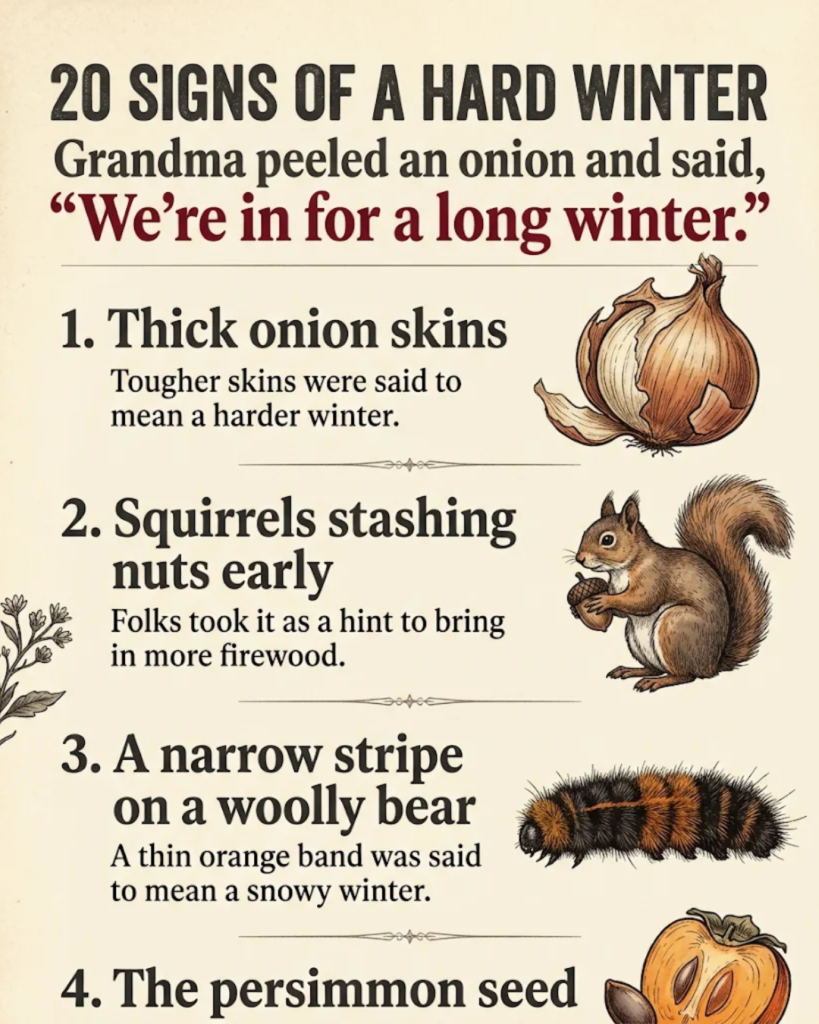
So here are those 20 old signs of a hard winter again, grouped the way you’d actually notice them, from the kitchen out to the night sky. After that, we’ll check what scientists make of them, and what the official forecast says for the months ahead.
Five Clues Hiding In The Kitchen And Garden
The onion comes first, of course. Old-timers believed a tough, heavy skin meant the plant was bracing for cold, while a thin one was good news. Corn got checked like that too. When the husks wrapped the ears tight and thick, farmers expected a rough season.
Oak trees were the next thing people looked at. If acorns rained down on the car roof all September and crunched under your shoes on the sidewalk, people took it as a warning. Squirrels would need every one of them, the thinking went.
In the Ozarks and across the South, people would cut a persimmon seed open with a small kitchen knife. Inside, the little white sprout has a shape. A spoon shape told them to find the snow shovel, since it pointed to heavy, wet snow. If you saw a knife, the cold would be sharp enough to slice through your coat. Everybody hoped for the fork, which stood for a soft winter and only a dusting of powder.
The fifth clue hung from the trees. People noticed where hornets built their gray paper nests. When a nest sat high up in the branches, they figured the snow would pile up deep. If the hornets built down low, under the porch roof or in a bush, people expected less snow.
Five Clues From The Animals In The Yard
Squirrels get blamed for a lot, but here they played forecaster. Grandmothers watched them from the window over the sink. When the squirrels started burying nuts early and their tails looked extra bushy, the family brought in more firewood.
People kept an eye on raccoons as well. Picture the raccoon that raids your garbage cans at night. If it had a thick tail with dark, crisp rings, people said cold weather was close. On the farm, people also checked the cows. Extra hair growing thick at the back of a cow’s neck was worth mentioning at supper.
Pigs had their own job. Farmers swore that pigs dragged sticks and straw around the pen before a mean winter, as if they were making a bed.
Every fall, little fuzzy caterpillars cross driveways and sidewalks, and most of us call them woolly bears or woolly worms. Each one is black on the head and tail, with a reddish brown strip around its waist. Folks claimed a fat brown strip promised an easy winter, and a skinny one meant trouble. Kids still pick them up, let them curl into a ball, and count the stripes.
Five Clues From The Small Creatures At Your Door
A few of the clues came right inside the house with you. Mice working hard to find a gap under the back door were one. Crickets chirping by the fireplace before the first frost were another.
Spiders counted too. People said a long, icy winter sent them into the corners of the living room and made them spin webs much wider than usual. Many women noticed it first in the garage or the basement, where the webs stretched between the shelves.
Ants got watched closely, mostly on the patio and along the sidewalk cracks. Ants walking in one neat line, instead of wandering every which way, were supposedly getting ready for a long cold spell. Beekeepers believed something close to that about their bees. If the bees shut themselves inside the hive early in the fall, winter was going to bite.
Five Clues You Spot By Looking Up
The last group needs you to look up. A pair of woodpeckers pecking away at one trunk together was one sign. A snowy owl turning up farther south than normal, and earlier than normal, was another.
Geese and ducks heading south ahead of schedule worried people too. When the honking flocks passed over the house in September, people took it as a hint to get the boots down from the attic.
People also kept track of the fog. A summer with lots of misty August mornings was supposed to bring a snowy winter, and some folks even kept a tally on the kitchen calendar. The last clue was a hazy ring around the moon, and people believed that seeing it often meant snow would keep coming all winter.
What Scientists Say About These Signs Of A Hard Winter
Here’s the part your grandmother might not like. Most of these clues tell you more about the past than about the future.
The caterpillar idea got its big moment in the fall of 1948. A New York museum scientist in charge of insects collected woolly bears at a state park north of the city and averaged the brown sections on their backs. He shared his winter forecast with a New York newspaper and kept doing it for eight more years. Later, the Iowa Department of Natural Resources called his methods loose at best. Insect experts at Iowa State University say the bands mostly reflect how old the caterpillar is and how damp its summer was.
The North Carolina State Climate Office went further. Since 1978, the mountain town of Banner Elk has held a Woolly Worm Festival each October, and the winning worm becomes the official winter forecaster. A volunteer there claimed the winners get it right 84.5 percent of the time. Yet when the climate office checked three years of the worms’ weekly calls, they matched the real weather only 40 to 50 percent of the time. That’s about as good as tossing a coin.
Acorns tell a similar story. Michael Snyder, a forester who was then running Vermont’s forests and parks department, wrote in Northern Woodlands that a big acorn year depends on earlier weather and the tree’s stored energy. In other words, a heavy crop looks backward, not ahead. Karen Stauderman, a horticulture agent with the University of Florida extension, wrote that no science stands behind the persimmon seed trick, although she admits it’s fun to guess.
What The Official Forecast Says For This Winter
Real forecasters start with the water temperature in the Pacific Ocean. On October 15, 2026, the Climate Prediction Center at the National Oceanic and Atmospheric Administration said a strong El Niño is underway. It will likely hang on through spring 2027. An El Niño happens when the Pacific near the equator runs warmer than usual, and that warm patch pushes storm tracks around over the United States.
Because of that, NOAA leans toward a warmer than normal season across the northern states, the West and much of the East. California and the Southwest have better odds of a wet winter, while parts of the Great Lakes and the northern Rockies may stay on the dry side. Still, a mild season can throw one nasty storm at you. A single January ice storm can knock the power out for days.
Getting Your Home Ready Before The First Freeze
Either way, the to-do list at home doesn’t change much. Clear out the hall closet so the boots and scarves have a home, and our list of things to declutter before winter can help. Then check the batteries in the flashlights and put a spare blanket in the trunk.
Your body needs some care too. If your fingers turn to ice the minute the weather changes, our piece on cold hands and feet after 50 explains what might be going on. Split, sore fingertips are another winter complaint, so we also wrote about cracked fingertips in the cold.
Wet snow is heavy, and lifting shovelful after shovelful in the cold makes the heart work much harder. If you have heart trouble or high blood pressure, ask your doctor whether you should be doing it at all. If you or your husband feels a squeeze in the chest or starts gasping for air out in the driveway, put the shovel down and phone 911 or your local emergency line.
Jerry Martz, chief meteorologist at WBNS 10TV in Columbus, dug into the woolly bear legend in this short report.
Final Thoughts
The old signs of a hard winter came from people who spent their days outside. They noticed the onions, the birds and the fog because getting ready in time really mattered to them. Science says most of those clues look backward. Even so, there’s something lovely about a grandmother cutting a persimmon seed at the table and calling the season.
So keep the folklore for fun, and keep an eye on the real forecast as well. In the meantime, fill the pantry, dig out your warm gloves from last year, and enjoy the first snow when it finally comes.
Which of these old signs did your family swear by? Is there one your mother or grandmother still checks every fall? Let us know in the comment box below.