
Nobody loses money in one big dramatic moment. Well, occasionally somebody does, but that is not how most ordinary households end up quietly short at the end of the month, looking at the bank balance and wondering, with a genuinely puzzled frown, where on earth it all went when nothing unusual seemed to happen.
It goes in small amounts. Four dollars here, twelve there, a fee you did not notice on a statement you only skimmed, a charge that quietly renewed itself while you were busy doing something else entirely, and another one that crept up by two dollars last spring without anybody bothering to tell you it was going to happen.
None of them is big enough to worry about on its own. That is exactly why they work. You would argue with a hundred-dollar charge. Nobody argues with $7.99.
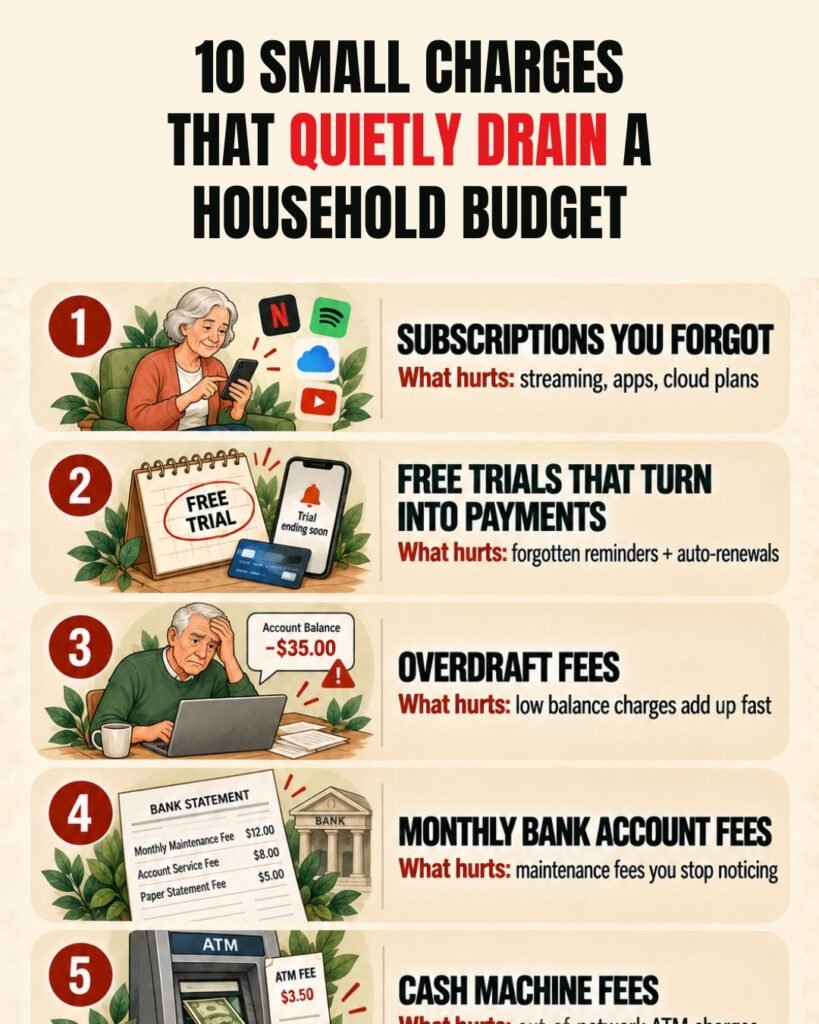
But add them up across a year, and the total can be genuinely startling. So, let’s go through ten of the most common ones, where they hide, and what you can do about each.
One quick note first. I am not a financial advisor, and this is general information rather than advice about your own situation. For anything significant, talk to somebody qualified.
Why Small Charges Are So Easy To Miss
Before the list, one study that explains the whole problem better than anything I could write.
Researchers at C+R Research asked a thousand people a simple question: roughly how much do you spend on subscriptions each month? The average guess was $86.
Then they walked each person through every category, one by one. Streaming, music, apps, memberships, delivery services. When everything was added up properly, the real average came to $219 a month, about two and a half times what people had guessed.
And 42 percent of them admitted they were still paying for a subscription they no longer used.
That gap is the whole story. It is not that people are careless. It is that small, automatic, recurring charges slip right past the part of the brain that normally notices spending, because you never actively decide to pay them. They just happen.
1. Subscriptions You Forgot You Had
This is the big one, so it goes first.
The streaming service you signed up for to watch one particular series three years ago and never quite got round to cancelling. The app you downloaded in January full of good intentions. A magazine, a cloud storage plan, a premium version of something you use perhaps twice a year.
Each one feels trivial. Together they can quietly add up to a car payment.
The fix is to look, properly, once. Go through three months of bank and card statements and write down every single recurring charge. Then ask one question about each: have I used this in the last month?
If the answer is no, cancel it. You can always sign up again later, and most people never do.
2. Free Trials That Quietly Become Payments
Free for thirty days, then $12.99 a month. You fully intend to cancel. Then life gets busy in the way it always does, with work and the children and a hundred other small things competing for your attention; the thirty days slip past, and the first payment goes out quietly without you ever seeing it happen.
You are far from alone. One recent survey found that around 70 percent of people had forgotten to cancel a free trial at least once.
A simple habit fixes this completely. The moment you start a free trial, set a reminder on your phone for two days before it ends. Not the day it ends, because by then it is often too late to cancel in time.
Better still, if a service makes you enter card details just to try it, ask yourself whether you really want it that much.
3. Overdraft Fees
Of everything on this list, this one probably stings the most, because it tends to hit the people least able to afford it.
You spend slightly more than you have, the bank covers it, and then it charges you for the privilege. At many large banks, that fee is still around $35 at a time.
You may have read that these fees were being capped at $5. A federal rule to do that was finalised in early 2025, but Congress overturned it later that year, so it never took effect. Supporters of the repeal argued the rule exceeded the agency’s authority, while consumer groups said it would have saved households billions.
Whatever your view of that, the practical point is the same. Check whether your bank lets you turn overdraft coverage off, so a card is simply declined instead. Many banks also offer free alerts when your balance drops low, which is an easy thing to switch on today.
4. Monthly Bank Account Fees
Some current accounts charge a monthly maintenance fee, often a few dollars, unless you meet certain conditions like a minimum balance or a regular deposit.
Plenty of people pay this for years without ever realising it, because it comes out quietly on the same day every month and after a while it simply looks like part of the furniture on a statement, a line you scroll straight past on your way to the balance at the bottom.
Check your last statement for anything labelled as a service or maintenance fee. If you find one, call the bank and ask how to avoid it. Often a small change, like setting up a direct deposit, removes it entirely.
And if they will not help, remember that many banks and credit unions offer accounts with no monthly fee at all. Switching is more hassle than it should be, but it is usually a one-afternoon job.
5. Cash Machine Fees
Take money out of a machine that does not belong to your bank, and you can be charged twice. Once by the machine’s owner, and once by your own bank for using somebody else’s machine.
That can easily add up to several dollars just to reach your own money. Which is irritating.
The fixes are straightforward. Find out which machines are free for your bank and use those. Take out a little more each time so you visit less often. Or ask for cash back when you pay at the supermarket, which is usually free.
6. Interest On A Card Balance
This is the quietest and most expensive charge on the list.
If you pay your credit card off in full every month, you usually pay no interest at all. Carry a balance from one month to the next, and interest starts building on it, often at a high rate.
The trouble is that it does not feel like spending. There is no moment where you hand money over. It just appears on the statement, month after month, quietly making every single thing you originally bought on that card gradually more expensive than the price you thought you were paying at the till.
If you are carrying a balance, the single most useful thing is simply to know the interest rate and the amount you paid in interest last month. Most statements show it. Seeing that number written down tends to change behaviour faster than any advice.
7. Late Payment Fees
Miss a due date by a single day and many cards, loans and utility bills add a fee.
It is rarely because people cannot pay. Usually they simply forgot. Or the bill arrived while they were away. Or the date shifted, and nobody noticed.
Automatic payments solve most of this. Set up at least the minimum payment to go out automatically on every card and bill, and then pay extra by hand whenever you can.
And if you do get charged a late fee for the first time, ring up and ask them to remove it. A polite request from a customer with a good record is granted more often than you might expect.
8. The Loyalty Penalty
This one genuinely surprises people, and it is one of the most expensive items on this list.
Car insurance, home insurance, broadband, mobile phone contracts. You sign up at a good introductory price, the contract renews automatically each year, and quietly, the price creeps upward.
Meanwhile, brand-new customers walking in off the street get offered the good deal you had when you first joined. So the longer you stay loyal, the more you can end up paying for exactly the same thing.
The fix is to treat every renewal notice as a prompt to shop around. Get two or three quotes, then ring your current provider and ask whether they can match them. Often a single phone call brings the price straight back down, and it takes about twenty minutes a year.
9. Delivery And Service Fees
Food delivery apps are wonderfully convenient. They are also stacked with small charges that are easy to miss.
A delivery fee. A service fee. Sometimes a small order fee on top, if you did not spend enough. Menu prices that are often a little higher than in the restaurant itself. Then the tip.
By the end, a twenty-dollar meal can quietly cost thirty-five, and because it arrives at your door with no queue and no effort, the real cost never quite registers.
You do not have to give it up. Just look at the full total on the final screen before you press order, and compare it to picking the meal up yourself. Once or twice a week, that difference adds up surprisingly fast.
10. Devices Left On Standby
This one is not a fee exactly, but it drains the budget in precisely the same quiet way.
Televisions, game consoles, microwaves, printers, and chargers left plugged in often keep drawing a small amount of power all day and all night, even when nobody is using them. People sometimes call it phantom power.
On its own, any single device uses very little. Across a whole house, with a dozen gadgets all running around the clock, every hour of every day, all year long, it becomes a noticeable slice of the electricity bill, and you are paying for all of it in exchange for absolutely nothing at all except a little red light glowing in the corner.
A power strip with a switch makes this easy. Plug the television and its gadgets into one strip, and switch the whole lot off at night with a single click.
Not Every Regular Charge Is A Leak
I want to be fair here, because an article like this can tip into making people feel guilty about everything they pay for.
A subscription you genuinely use every day is not a leak. It is a choice, and often a good one. If a streaming service is how you relax after a long day, that is money well spent.
The same goes for delivery on a night when you are exhausted. Sometimes the fee is worth it, and paying it deliberately is completely different from paying it without noticing.
That is really the whole point. The problem is never the charge itself. It is the charge you did not choose, did not notice, or stopped wanting a long time ago.
So the aim is not to cut everything. It is to make sure every regular payment leaving your account is one you would happily sign up for again today, knowing exactly what it costs.
If the answer is yes, keep it without a second thought. If you hesitate, that hesitation is worth listening to.
Why These Charges Are So Hard To Stop
You might wonder why, if these charges are so obviously wasteful, we do not just cancel them.
Part of it is simple inertia. Doing nothing is always the easiest option, and a charge that continues by default will usually keep continuing.
Part of it is design. Signing up often takes one click, while cancelling can mean hunting for a hidden page or sitting on hold. A federal rule meant to make cancelling as easy as signing up was struck down by a court in 2025, so for now that imbalance remains.
Knowing this helps. When you feel that small resistance to cancelling, recognise it for what it is. It is not a sign you want the thing. It is the friction doing its job.
The Twenty-Minute Check
You do not need to fix all ten today. Here is the one thing I would suggest doing this week instead.
Sit down with a cup of tea and your last three months of bank and card statements. Go through them slowly with a highlighter and mark every charge you do not immediately recognise, every recurring payment that comes out on the same date, and every fee of any kind, however small it looks, because the small ones are exactly the ones this whole article is about.
That is it. Just look. Most people find two or three things they did not know about. Some find far more.
Then cancel one, call about another, and switch off overdraft coverage if you want to. Small actions, done once, that keep paying back every month for years.
Money worries take a real physical toll. I went through it in the warning signs your heart is under too much stress.
Small Leaks Sink Big Ships
There is an old saying about exactly this. Beware of little expenses, because a small leak will sink a great ship.
None of these ten charges will ruin anybody on its own. That is precisely what makes them dangerous. They are small enough to ignore and regular enough to add up, and the companies charging them know exactly how that works.
So take twenty minutes. Find the leaks. Plug the easy ones first.
Which of these ten did you find in your own statements? And has anybody here ever been caught by the loyalty penalty on their car insurance? Tell me in the comments below.