
Every December there’s a moment when you open the box of decorations and something small stops you.
Maybe it’s a glass ornament with half its paint gone, or one of those tiny plastic bulbs from your mother’s ceramic tree that somehow survived forty years of moving and ended up in your own box, rolling around between the extension cords and a roll of tape nobody remembers buying.
You hold it for a second.
And suddenly you’re nine again. You’re sitting on the shag carpet in a living room that smelled like pine needles and somebody’s cigarette, waiting for the Christmas special to start while your mother calls from the kitchen that if anybody so much as touches a present before morning, Santa is going to hear about it.
If you grew up in the 1970s, the holidays looked very different from what your grandkids know today. A lot of it was lovely. Some of it was, let’s be honest, a little bit dangerous. I only found out how dangerous while looking up the facts for this article.
Here are 12 details that anyone who was there will remember. So, let’s go through it.
The Wish Book Came in the Mail
First of all, the countdown didn’t start in December. It started the day the Sears Wish Book landed in the mailbox, sometimes as early as late summer, and from then on it lived on the coffee table or under your bed, depending on how seriously you took it.
And we took it very seriously. Kids circled what they wanted in pen and folded down the corners of pages so no grown-up could possibly miss the hint, as this short history of the Wish Book describes. By 1968 the catalog had grown to 605 pages, and 225 of them were toys. That’s a lot of circling.
You and your sister probably fought over who got it first. Then you circled the same doll on the same page, and your mother sighed. Subtle, we were not.
Honestly, flipping through those pages was half the fun. Maybe more than half, since most of what you circled never showed up under the tree anyway.
The Tree Was Real, and So Were the Risks
In most houses the tree came home tied to the roof of the station wagon. Then came the yearly argument about whether it was straight. It never was. Somebody lay on the floor turning the screws on the stand while somebody else stood in the doorway saying “a little to the left,” and that went on for a good twenty minutes before anybody touched a single ornament.
Tinsel, One Strand at a Time
Then came the tinsel, and in many families there were rules about tinsel. Your mother wanted it hung one strand at a time, carefully, so it dripped down like icicles. Your little brother wanted to throw it at the tree in clumps. You know who won that fight every year.
After Christmas, a lot of mothers took the tinsel off and saved it. It went back in the box draped over a piece of cardboard, ready for next year. That seemed a bit odd even back then. But there was a reason the old tinsel felt so heavy and hung so nicely.
For decades, it was made with lead. According to Mental Floss, the FDA reached an agreement with manufacturers in 1972 to stop making lead tinsel. Plastic took its place. The plastic kind was lighter and slid off the branches. Maybe that explains why your mother held on to the old stuff for so long. A 1959 newspaper had even told parents that tinsel was “fairly safe” if a child swallowed it. It wasn’t.
Angel Hair and Hot Bulbs
Angel hair was another one. It was spun glass that you stretched over the branches so the tree looked like it was sitting in a soft cloud, and it left your hands itching for the rest of the evening.
Nobody thought twice about it.
The lights were big too. Those large colored bulbs got hot enough that you could warm your fingers on them, and on some of the newer strings one bad bulb meant a whole section went dark. So somebody ended up on the floor testing bulb after bulb, muttering words you weren’t supposed to repeat at school. Getting down on that floor is one of those things that get harder with age, by the way. Just a tip, if you still have a string like that in the attic, it’s probably time to retire it.
Your Mother’s Ceramic Tree
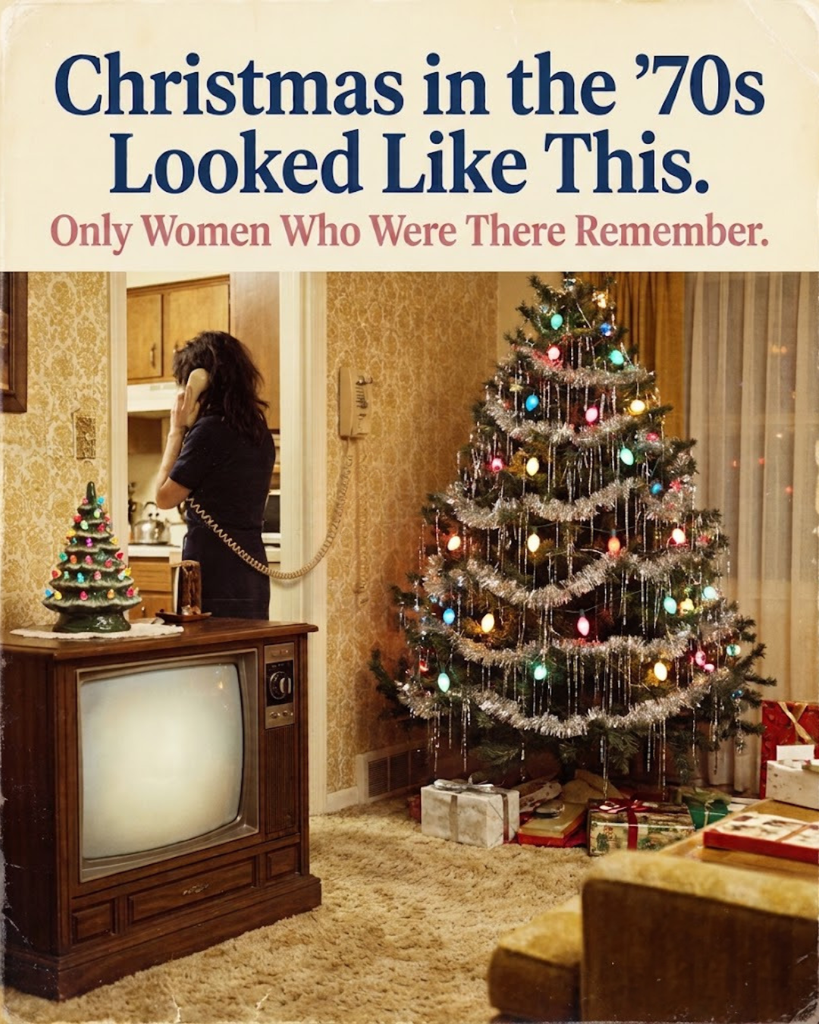
If your mother or grandmother didn’t have a ceramic Christmas tree, someone on your street did. It sat on a side table or on top of the TV. One light inside made all the little plastic bulbs glow at once.
What a lot of people forget is that many of those trees were homemade. As the American Ceramic Society explains, craft shops in the 1960s and 1970s ran workshops where women made and painted their own trees from store-bought molds, then sat around a long table on weeknights comparing glazes and catching up on neighborhood news while the trees waited their turn in the kiln. One mold company, Atlantic Mold, copyrighted an early tree design in 1958. It sold thousands of those molds to studios across the country. So if the bottom of your mother’s tree says 1958, that’s the date of the mold. She probably made it years later.
The trees went out of style in the 1980s. I personally think they deserve a comeback. Judging by how many people go looking for them every December, I’m not the only one.
The Year the Lights Went Out
This one surprises people who were too young to notice it. In the fall of 1973 the Arab oil embargo hit. Gas prices jumped and there were long lines at the pumps.
On November 25, 1973, President Nixon went on television and asked Americans to cut back, including on Christmas lights. In the address, he talked about curtailing “ornamental outdoor lighting for homes” and said the White House was planning to cut its own Christmas lighting too. And it did. That year, as NPR reported, the National Christmas Tree wasn’t strung with lights at all and was only lit by floodlights from the base.
So in a lot of neighborhoods the big displays disappeared. Families settled for a single string over the front door, or a candle in the window. It was a strange, quiet Christmas.
It happened again a few years later. In 1979 and 1980, President Carter left the national tree dark to honor the Americans being held hostage in Iran.
What Was Under the Tree
The toys of the ’70s were wonderful and a little weird. In 1973 Kenner brought out Baby Alive, a doll that “ate” packets of food mixed with water and then, well, needed her diaper changed, which was exactly the part the TV commercials made sure to show and exactly the part most mothers would have happily skipped. She cost $10.87, according to Mental Floss, and every girl who got one remembers the smell of that food mush. Mothers remember buying refills.
Then there was 1975, the year grown adults paid real money for a rock in a cardboard box. The Pet Rock came with a little training manual and a nest of straw, and the Strong National Museum of Play notes that more than a million were sold before Christmas. The inventor, Gary Dahl, paid about a penny per stone. Somebody in your family definitely gave one to the uncle who had everything.
If you want to see how the whole country reacted, NBC News has a short clip about it, with real footage from that fall.
The boys had their own list. In 1976 it was Stretch Armstrong, the rubbery muscleman you could pull to about four times his size, and according to MeTV’s year-by-year list he was filled with corn syrup. Some brothers found that out with a pair of scissors.
Mothers were not amused.
The Empty Box of 1977
Now this one is my favorite. Star Wars came out in the summer of 1977 and every kid wanted the toys. Kenner simply couldn’t make them in time. So what did they do? They sold an empty box. The “Early Bird Certificate Package” cost $7.99 and held a cardboard display stand, some stickers, a fan club card and a certificate you mailed in, and the first four figures arrived sometime between February and June of 1978, as Mental Floss describes. Parents bought hundreds of thousands of them. Kenner had capped it at 500,000.
The same fall, Atari launched its home video game system at $199.99. Using the BLS inflation calculator, that’s more than $1,000 in today’s money. Which is probably why your brother got one and you got a sweater.
You Had One Chance to Watch It
There was no recording anything. No streaming, no “we’ll watch it tomorrow.” The Christmas specials aired once a year, on one night, and if you missed it, you waited twelve months and listened to the kids at school talk about it at recess the next day while you nodded along and pretended you’d seen it too.
So the TV Guide got circled just like the Wish Book. Kids were bathed and in pajamas early, and somebody, usually Dad, stood next to the set holding the antenna at exactly the right angle while everybody yelled “don’t move!” A Charlie Brown Christmas came around every year, and so did Rudolph.
Then, on December 10, 1974, ABC aired The Year Without a Santa Claus. That’s the one with the Heat Miser and the Snow Miser. Half of you are singing their songs in your head right now. Don’t deny it.
And in 1977 there was Bing Crosby’s Merrie Olde Christmas, which aired on November 30. As MeTV recalls, Crosby had died on October 14, a few weeks before it was shown. The special included his famous duet with a very young David Bowie. Many families watched it knowing he was gone. It felt different.
Here’s that duet, from the official Bing Crosby channel. Play it once and tell me you’re not back in that living room.
The Long-Distance Call to Grandma
If Grandma lived in another state, Christmas meant the phone call, and the phone call was a production.
Long distance was expensive, and the first minute cost the most. Calls got cheaper late at night and on weekends, so families planned around the rates. One man writing about growing up in that era remembered his family waiting until 10 p.m. on Sunday to call relatives. Even then, an hour-long call cost about $17. That was real money back then.
On Christmas Day, everybody lined up in the kitchen next to the phone on the wall. It had a cord stretched so far it reached the stove. “Say Merry Christmas to Grandma. Quickly, it’s long distance.” You said hello, told her what you got, and handed the phone to your sister before you’d even finished. Your father watched the clock the whole time.
Today your grandkids video-call from the car. They have no idea.
And if somebody did talk too long, you heard about it when the bill came in January. Every family had that one aunt.
The Food Nobody Makes Anymore
The ’70s holiday table had its own personality. There was always a Jell-O mold with fruit floating in it, sometimes with little marshmallows. It wobbled every time someone bumped the table. There was a cheese ball rolled in chopped nuts. Somebody always brought Chex party mix that had spent the whole afternoon in the oven, and the house smelled of butter and Worcestershire sauce for two days.
And then there was the fruitcake.
I’ll admit it, I never understood fruitcake. Not then, not now. It got passed from one relative to the next. I’m fairly sure some of those cakes were older than the kids eating them.
If you add the cookies and the candy dish, it’s honestly amazing anybody slept. These days we know a lot more about what all that sugar does. If you’re curious, I wrote about what happens when you stop eating sugar for a month. But nobody was counting anything in 1976. The kids sat at the card table in the corner and the grown-ups sat at the real table. That was that.
One Honest Note
Not every ’70s Christmas was a postcard. Divorce was becoming much more common during that decade, and money was tight in a lot of houses. Some kids spent the holidays tiptoeing around a parent who drank too much, or one who turned every family gathering into a test that somebody, usually the same child every year, was going to fail no matter how hard she tried.
If that was your childhood, this kind of nostalgia can sting a bit. You’re allowed to love the tinsel and the TV specials and still remember that the house didn’t feel safe. Both can be true. I wrote more about growing up with a difficult parent in the truth about narcissistic parents, if that’s closer to what you lived through.
Why These Small Things Stay With Us
It’s funny what the memory keeps. Most of us can’t remember a single present we got in 1975. But we remember the itch of the angel hair, and the sound of the phone being passed from hand to hand in the kitchen while someone said “hurry up” in the background.
Maybe that’s because none of it was really about the stuff. It was about the people in the room. And if you’re a grandmother now, you might feel the urge to recreate some of it for your grandkids. That’s lovely, of course. Just check with their parents first, especially about sugar and late nights. There are some things grandparents should never do without asking, and this is one of them.
Holidays change. Your grown kids may build their own traditions. Some may even skip the big family Christmas altogether, which more couples are doing now, as I wrote in why more couples skip Christmas with their parents. That can hurt. But the ceramic tree in your attic and the tinsel your mother saved are still yours, and so are the stories.
Tell them to the grandkids. They’ll roll their eyes at the empty Star Wars box, and then they’ll ask to hear it again.
What’s the one ’70s Christmas detail from your house that nobody else seems to remember? Let us know in the comment box below.