
It’s 3:15 and you’re third in the pickup line. Your phone buzzes with a work email, so you thumb out a reply while the school doors open. Your son climbs in, drops his backpack on the floor and says, “Mom, guess what happened at lunch.” You say “Mm-hm” and keep typing.
Nothing bad happened in that car. Still, he noticed. Kids keep a quiet tally of moments like these, and the good news is that the moments that make your child feel loved are just as small. Most of them take less than a minute. Several cost nothing at all, and none of them need a perfect day.
Researchers have followed children for decades to see what stays with them. Here is what they found, plus ten everyday habits you can start this week, whether you’re raising little ones or helping with the grandkids.
Why It Matters To Make Your Child Feel Loved Early
In the early 1950s, a group of healthy young men at Harvard rated how warm and close they felt to their parents. About 35 years later, researchers Linda Russek and Gary Schwartz pulled their medical records. Of the men who hadn’t described a warm bond with their mother, 91% had a serious diagnosis by midlife, such as heart disease, high blood pressure or a drinking problem. Among the men who had felt that warmth, the figure was 45%. You can read the summary on PubMed. The pattern looked much the same for fathers.
That study had limits, of course. Everyone in it was a male college student, and it measured feelings, so it can’t prove cause. Yet a far bigger study from 2019 points the same way.
A team at the Johns Hopkins Bloomberg School of Public Health, led by Christina Bethell, looked at survey answers from more than 6,000 adults in Wisconsin. People marked which of seven good things they remembered from growing up. Those who marked six or seven had 72% lower odds of depression or long stretches of poor mental health, compared with people who marked two or fewer. That held up even for adults who had a rough childhood. The university’s write-up lists all seven, and several of them appear below as simple ways to make your child feel loved.
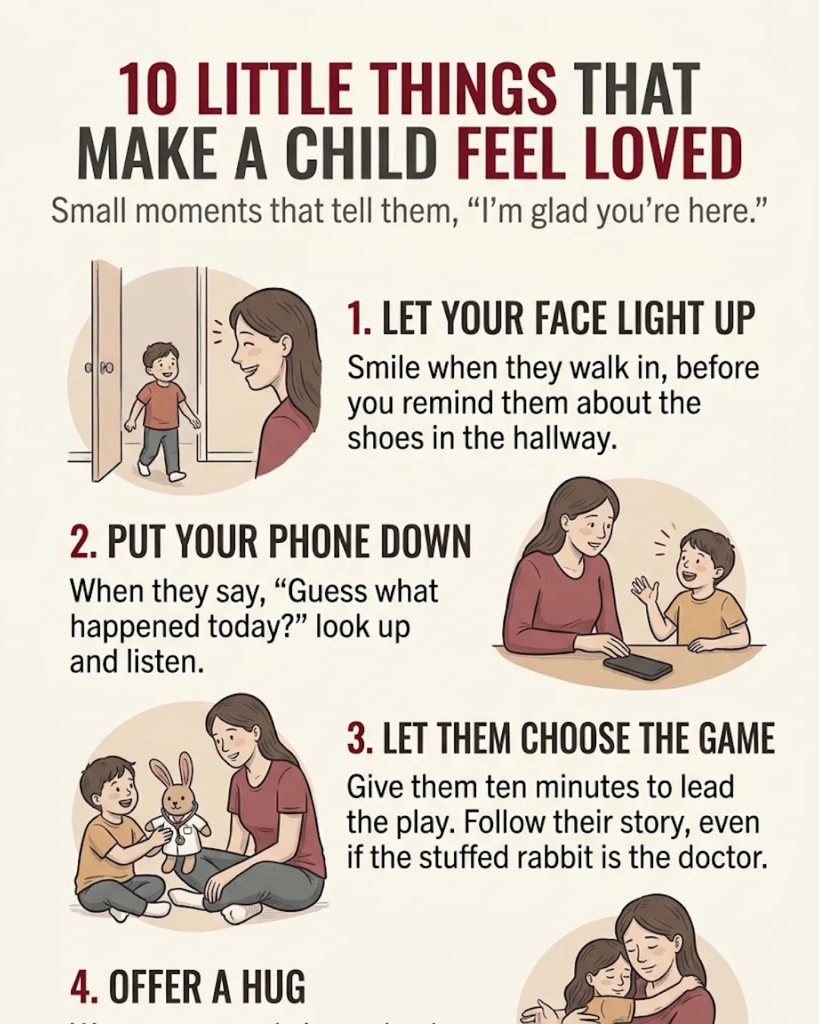
1. Let Your Face Light Up First
In 2000, the novelist Toni Morrison sat on Oprah Winfrey’s couch and admitted something about raising her own sons. When they walked into a room, she used to check whether they had combed their hair or buckled their pants. She thought that was love. Then she realized what they actually saw was a critical face.
Her question has stayed with millions of parents since: when a child walks in, does your face light up? Oprah later named it one of the greatest lessons from her show, as her site recalls. So try it tonight. When your daughter comes down for breakfast, look up and smile before you mention the shoes in the hallway. The shoes can wait thirty seconds.
2. Turn The Phone Over
Back to that pickup line. In a 2017 study in the journal Child Development, Brandon McDaniel and pediatrician Jenny Radesky asked parents from 170 two-parent homes how often a phone, tablet or laptop cut into time with their kids. Almost half said it happened three or more times on a normal day. Even small amounts lined up with more whining, sulking, tantrums and restlessness in their young kids, according to Michigan Medicine’s release.
The study couldn’t show which came first. Still, the researchers’ advice was simple. Pick a few phone-free stretches, like dinner or the first half hour after work, and guard them. Put the phone face down in another room if you have to. When your son starts telling you about lunch, he’ll see your eyes instead of the top of your head.

3. Give Them Ten Minutes Where They’re The Boss
Pediatricians have a name for this one: special time. The American Academy of Pediatrics suggests 10 to 15 minutes of play, two or three times a week, where your child picks the game and you follow along. There are no phones, no lessons and no corrections. Their guide for doctors even suggests naming it after the child, like “Roberto’s Time.”
Set a kitchen timer so they can see it. Then sit on the floor and let your five-year-old decide that the stuffed rabbit is the doctor and you’re the patient with a broken tail. Don’t steer the story. Also, keep it going on hard days, since the AAP says this time shouldn’t depend on good behavior.
4. Hug More Than Seems Necessary
Worried about spoiling a baby with cuddles? A Duke University study suggests you can relax. Joanna Maselko and her colleagues used records from 482 people. When each one was 8 months old, a psychologist had watched the mother during a routine checkup and rated her warmth, from “negative” all the way up to “extravagant.”
Decades later, around age 34, those same babies took a mental health checklist. The adults whose mothers had shown the most affection reported less distress, less hostility and, most of all, less anxiety, as Duke’s Global Health Institute explained. So scoop up the toddler. Rub your teenager’s shoulders while she does homework, if she’ll let you. A quick squeeze on the way out the door counts too.
5. Look At The Bird They’re Pointing At
A toddler points at a pigeon on the sidewalk and shouts “Bird!” You can keep walking, or you can stop, crouch down and say, “Yes, a gray bird. He’s looking for crumbs.” Harvard’s Center on the Developing Child calls these tiny exchanges serve and return, because they bounce back and forth like a tennis rally. Its page for parents says this kind of back and forth helps build strong connections in a young brain.
Older kids serve too. A ten-year-old who says “Guess what Marcus did today” is tossing you the ball. So ask what Marcus did, and then ask what happened next.
6. Let Them Talk About Feelings Without Fixing
The first item on the Hopkins list was simple: being able to talk with your family about your feelings. That sounds easy until your daughter comes home crying because her best friend sat with someone else at lunch. Every part of you wants to solve it. Call the friend’s mom, suggest a new friend, tell her it won’t matter in a year.
Try waiting instead. Sit on the edge of her bed and say, “That really hurt, huh?” Then stay quiet for a while. Kids open up more when the grown-up in the room can stand a little silence. Once she’s done, she might ask for ideas, and then they’ll land better.
7. Show Up When Things Go Wrong
Another item on that list was feeling that your family stood by you during hard times. Children remember who came to the hospital, who sat in the bleachers after the bad game and who skipped the “I told you so” after the failed math test.
This counts most when your child is the one who messed up. Picture your teenager calling at 11 p.m. because the car slid into a ditch. Your first words decide whether they’ll call next time. “Are you hurt?” goes a long way. The lecture about speeding can come tomorrow, over coffee, once everyone has slept.
8. Go Back After You Yell
Every parent loses it sometimes. You snap about the spilled juice, the slammed door, the shoes again. What happens afterward counts more than the shouting itself, says clinical psychologist Becky Kennedy, who calls repair the one skill she’d tell any parent to work on.
Repair isn’t a quick “sorry, but you made me so mad.” Instead, you go back, name what you did and own it. “I yelled at you earlier. That wasn’t okay, and it wasn’t your fault. I’m working on staying calmer.” Kennedy says it’s never too late, either. Grown children can hear those words at 35 and still feel something ease inside them.
9. Keep A Tradition That Belongs To You Two
The Hopkins team also asked whether people enjoyed taking part in traditions. Big holidays count. So do the tiny rituals that only your family knows about.
Maybe it’s pancakes shaped like the first letter of their name every Saturday. Or it’s the diner you visit after every report card, good grades or bad, where you both order the same thing. A grandmother might play the same silly song in the car on the first day of school, year after year, until the kids groan and then sing along anyway.
10. Bring Other Caring Adults Into Their World
This last one is a gift for grandparents, aunts and family friends. One of the seven experiences in the Hopkins study was having at least two adults outside the parents who took a real interest in you. So the grandmother who asks about the science fair, or the uncle who teaches fishing, is doing far more than babysitting.
If you’re the grandparent, keep showing up. Send a postcard. Ask about the friend whose name you heard last week. And if you’re the parent, make room for these people, even when it means a messier schedule. Kids who feel loved by several adults have more people to call when life gets hard.
When To Ask For Help
Sometimes love isn’t the missing piece. If your child seems withdrawn for weeks, stops eating or sleeping well, or pulls away from friends they used to enjoy, talk with their pediatrician or a family counselor. A sudden change in mood deserves a closer look, and asking early is what a caring parent does.
For more on everyday talk at home, see our piece on what to do when your child argues with you. You may also like our list of things grown children wish their parents would stop saying, which shows how long a few careless words can stay with a person.
In this TED talk, Becky Kennedy shows how to repair things with a child after a hard moment.
Final Thoughts
Go back to that pickup line one more time. Your son climbs in and says, “Mom, guess what happened at lunch.” This time the phone goes in the cup holder, face down. You turn around, and your face does the work before you say a word.
“What happened?”
That’s the whole secret. The ways to make your child feel loved are mostly small and mostly free, and you get dozens of chances every single day. Missing one isn’t a disaster. You’ll get another one at dinner.
Which small habit made you feel loved as a child, or works best with your kids and grandkids now? Let us know in the comment box below.