
It’s Thanksgiving, and the turkey is already carved. Your daughter is 41 now, with reading glasses pushed up into her hair. Somebody mentions the old piano recitals, and she laughs a little too loudly. “Well, Mom made it to exactly zero of mine. She was at Kevin’s game.” Then she reaches for the gravy as if nothing happened.
Honestly, you can’t even place which year that was. She can. She remembers a blue dress with itchy lace at the collar, seat C in row three sitting empty, and Aunt Linda driving her home in a car that smelled like cigarettes. That gap between your memory and hers is where most of the things children never forgive really live. They’re rarely the big dramas. Mostly it’s the little stuff, on repeat, until a kid quietly made up her mind about what it meant.
Nobody here is out to shame anyone. Every parent gets tired, short and unfair sometimes. Still, some patterns cut deeper than others, and grown kids bring up the same ones again and again. If you spot yourself in a few of them, you’re in a good spot, because you can still do something about it.
Why Some Childhood Hurts Last So Long
In 2015, the University of Cambridge’s Centre for Family Research teamed up with the charity Stand Alone to survey more than 800 adults who had cut ties with family. Their Hidden Voices report found that most people who walked away from a parent did it in their late 20s or early 30s. These were not 15-year-olds stomping up the stairs. They were grown adults, often with jobs and kids of their own, who had finally run out of hope.
When the researchers asked what they wished had been different, the answers were simple. They wanted a parent who felt warmer, closer and loving with no strings attached. Most of the things children never forgive come down to one feeling: being unseen.
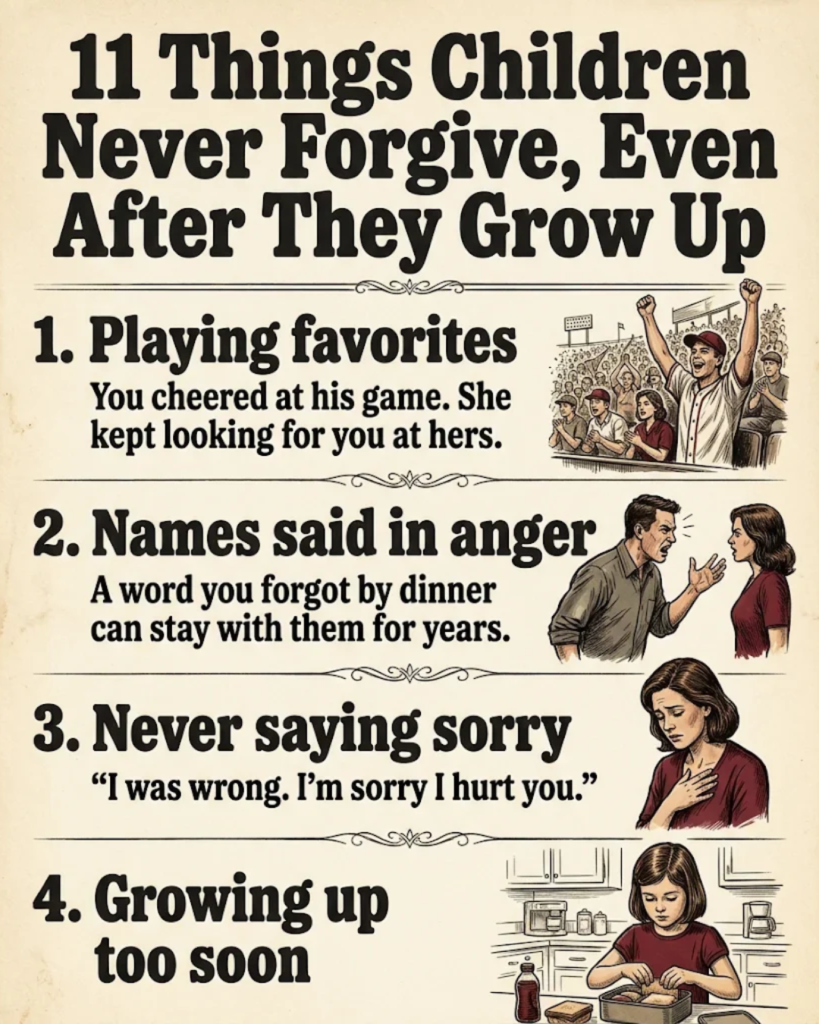
1. Playing Favorites at the Dinner Table
Most parents swear they love their kids the same. Ask them over a second cup of coffee, though, and plenty will admit one kid was simply easier to raise. A 2025 analysis led by Alexander Jensen at Brigham Young University pooled data from 19,469 people across 30 studies and 14 data sets. Parents leaned a little toward daughters and toward kids who were tidy and responsible, according to the American Psychological Association, which published the work.
The children who got less warmth tended to have poorer mental health and rockier family ties later on. So watch the small things. Who gets the long, excited phone call about a promotion, and who gets “that’s nice, honey”? Whose calls do you pick up on the first ring? Grown kids notice that at 30, and they still notice it at 55. We looked at this more closely in our piece on the golden child and the scapegoat.
2. Names Said in Anger
“Lazy.” “Stupid.” “Can’t you do one thing right?” A parent might say it once on a bad Tuesday and forget it by dinner. A child can hear it for 40 years.
In 2023, Shanta Dube of Wingate University and a team from University College London looked at 166 studies on adults yelling at and belittling kids. Parents made up about three out of four of the adults doing it. The review, summed up by ScienceDaily, linked this kind of talk to more anger, depression and substance use later in life. Dube has also said many adults have no idea how harsh they sound, especially when that’s how they were raised themselves.
3. Never Once Saying Sorry
Some parents can admit to burning the roast but never to hurting a child. They change the subject. Or a new bike shows up in the driveway the next morning, and that’s supposed to cover it.
Kids notice. A grown son may stop bringing up the past, yet that doesn’t mean he’s let it go. More often, he gave up waiting somewhere around his thirtieth birthday. What helps is shorter than most parents expect: “I was wrong. I’m sorry I did that to you.” Leave off the “but” at the end.
4. Making Them the Grown-Up Too Soon
Picture a ten-year-old girl packing her little brother’s lunch because Mom is still in bed. Or a boy who sits up past midnight while his father cries about the divorce. Teachers love these kids and call them mature. Underneath, they’ve figured out that nobody is coming to pack their lunch.
Therapists call this parentification. Of course, a kid who folds towels and watches a sibling for an hour after school is fine. It turns into a problem when the child is the one Mom cries to every night, or the one paying the electric bill at 14, and it goes on for years. Ask one of those kids, now 45, to spend a Sunday doing nothing. See how long she lasts before she’s scrubbing out the fridge.
5. Putting Them in the Middle of a Divorce
“Ask your father where the check is.” “Your mother never cared about this family.” A nine-year-old shouldn’t have to carry that between two houses in a backpack, right next to his pajamas.
Joshua Coleman is a psychologist in the San Francisco Bay Area who works mostly with parents whose grown kids have cut them off. He told CBC Radio that divorce sits behind most of the cases he sees. A child may end up blaming one parent, or competing with new partners and stepsiblings for attention. Even adult children feel that pull. So save the complaints about your ex for a friend or a counselor.

6. Making Them Feel Replaced
Coleman knows this one firsthand. In his mid-30s he remarried and had twins. His older daughter, from his first marriage, slowly began to feel pushed aside and unimportant. In her early 20s she stopped speaking to him.
A new marriage, a new baby or even a new grandchild can stir up the same thing. Your oldest won’t be counting hours with a stopwatch. She’s watching for smaller signs, like whether her bedroom turned into the nursery before anyone asked her. Keep her old Christmas stocking on the mantel. Call her on a random Wednesday with nothing to report.
7. Promises That Never Happened
“We’ll go to the lake next summer.” “I’ll be there Friday, I promise.” Then the lake trip never comes, and Friday slips by too.
Missing one trip because the car broke down is fine. A long string of broken promises teaches a child that your words don’t count for much. Twenty years later, that same kid might not mention her wedding until the venue is booked. So if Friday isn’t going to happen, call on Wednesday and give the real reason. A clear no stings for an afternoon. A maybe that quietly dies sticks around a lot longer.
8. Laughing at Their Feelings
Your seven-year-old sobs because her goldfish died, and somebody says, “It’s just a fish.” A teenager admits he’s nervous about a dance, and his dad repeats it to the whole table at dinner.
Neither moment seems cruel at the time. Yet a child learns fast which feelings are safe to bring home. If sadness gets mocked, they’ll keep it to themselves. Plenty of grown kids say this is why they still don’t call home when life falls apart. Back then, three words would have been enough: “That sounds hard.”
9. Sharing Their Private Business
You tell your sister about your son’s breakup because you’re worried. By Easter, the whole family knows, and he walks into a room full of pitying looks.
Children of any age want to control their own stories, whether that’s a bad grade, a health scare or a shaky marriage. Once they feel that anything they tell you will spread, they’ll tell you less. Before you repeat something, ask yourself whether they’d be fine hearing you say it.
10. Hugs That Had to Be Earned
Some kids only got hugs after an A. Others heard “I’m proud of you” exactly once, at graduation. Kids in those homes figure out early that the hug comes after the trophy, never before it.
Fast forward 30 years and you get the woman with two degrees who still feels like someone is about to grade her. You can still close part of that gap now. Tell your grown daughter you enjoy her company. Say it on an ordinary Tuesday, when she hasn’t done anything special. For more ideas, see our list of quiet ways children feel truly loved.
11. Insisting It Never Happened
The hardest one may come last. A grown child finally works up the nerve to say, “It hurt when you did that.” The parent answers, “That never happened,” or “You’re too sensitive,” or “I did my best.”
Coleman is blunt about this. He told CBC there is “almost always a kernel of truth” in a child’s complaints, even when they sound unfair. You don’t have to agree with every detail. Still, denying the whole memory tells your child their pain doesn’t count, and that can shut the door for good. Our article on why grown children quietly stop visiting shows how this plays out over the years.
Can Things Children Never Forgive Still Be Repaired?
Often, yes, though slowly. Coleman didn’t win his daughter back with one heartfelt letter. After a couple of years apart, he kept showing up for talk after talk. He listened to her anger, took responsibility and didn’t defend himself. “It wasn’t just one conversation,” he told CBC. Little by little, they started talking like a father and daughter again.
Maybe there’s a grown child you haven’t really talked to in a while. Begin with something tiny. Write a short note that names what you did, with no excuses tucked inside. Then give them room. If things feel stuck, a family therapist can help both of you say hard things without the old fights taking over.
In this conversation on Oprah’s YouTube channel, Coleman and two other experts talk about estrangement and the slow work of finding a way back.
Final Thoughts
Go back to that Thanksgiving table. Your daughter just told you about the empty seat at her recital. You could say, “Oh, that was ages ago.” Or you could put your fork down and say, “I should have been there, and I wasn’t. Tell me about the dress.”
The things children never forgive usually aren’t about one bad day. They’re about a kid in row three, waiting year after year for somebody to walk in. And as long as you’re both still here, you can still turn around and look.
Which of these did you live through as a child, or which one are you working on now? Let us know in the comment box below.