
Sunday lunch at your sister’s house. Everyone is laughing, the roast smells wonderful, and the kids are fighting over the last bread roll. Then your brother-in-law walks in from the garage. He doesn’t say a word. His jaw is tight, though, and your stomach flips. For the rest of the afternoon you keep glancing at him. Halfway home, a headache settles behind your left eye, and you can’t say where it came from.
If that sounds familiar, you are far from alone. Some of us notice every shift in a room, and we feel it in our own bodies. The popular word for people like this is “empath.” Below are seven signs you are an empath, what scientists have found so far, and a few small habits that help when other people’s moods start piling up on you.
Where The Word Empath Came From
Psychiatrist Judith Orloff did more than anyone to make the word familiar. She sits on the clinical faculty at UCLA and wrote The Empath’s Survival Guide in 2017. Her interest started in childhood. She grew up as an only child in a family full of doctors, and a trip to the shopping mall could leave her anxious and worn out. Her parents, both physicians, told her to toughen up. In an interview with LA Parent, she said it took her years to understand that she was taking on the stress of the people around her.
Here’s the honest part. “Empath” is a popular term, and doctors don’t use it as a diagnosis. Even Cleveland Clinic psychologist Chivonna Childs admits nobody can yet say for sure that empaths exist as a separate group. What science does study is a trait called sensory processing sensitivity. Psychologist Elaine Aron began studying it in the early 1990s and gave us the phrase “highly sensitive person.”
In 2014, a team led by Bianca Acevedo put 18 married adults inside a brain scanner. Their study showed each person photos of their own spouse and of strangers, some smiling and some sad. The more sensitive volunteers had stronger activity in brain areas linked to awareness and empathy. The biggest response came when they saw their partner happy. Their best guess? About one person in five carries this trait.
Signs You Are An Empath In Everyday Life
Not every one of these signs you are an empath will fit your life, and that’s okay. Read them slowly and notice which ones make you nod.
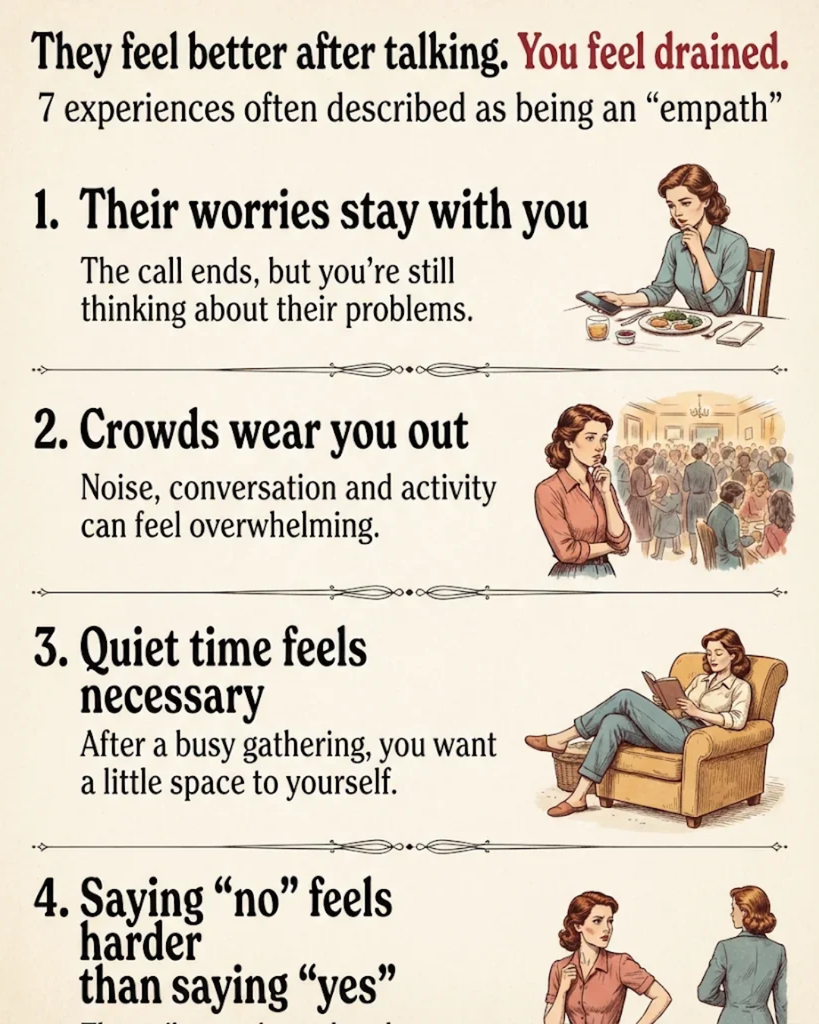
1. Other People’s Moods Move Into You
A friend calls in tears about her son. You talk for an hour, and she feels better when she hangs up. Then you sit at the kitchen table, fork in hand, and can’t eat a bite of your pasta. Her worry has become your worry. Dr. Childs puts it plainly: people like this tend to take on the feelings of others and feel them more deeply. The good moods travel too, which is why a grandchild’s giggle can lift your whole week.
2. Forty Minutes Into The Wedding, You Want To Leave
Weddings, school concerts, the supermarket on a Saturday morning. Other people seem to enjoy the buzz. Around minute forty, the DJ turns it up, Uncle Ray starts telling the same fishing story louder, and the room seems to shrink. Then you find yourself hiding in the bathroom or “checking on the car.” Orloff counts sensitivity to noise, smells and nonstop talking among the traits she sees most often in her patients. Afterward, you may need the rest of the day to feel normal again.
3. You Hear The “I’m Fine” That Isn’t
Your daughter says “I’m fine” on the phone, and you know right away that she isn’t. A salesman smiles at you, and something in your gut says to keep your wallet closed. Childs describes this as trusting your instinct at a higher level than most people. Lots of empaths say they spot a lie before the other person has even finished the sentence.

Four More Clues, Mostly From Home And Family
4. Strangers Tell You Their Life Story
You sit down at the doctor’s office, and within five minutes the woman next to you is telling you about her divorce. It happens at the bus stop, in line at the pharmacy, even at the hairdresser. Something about the way you listen tells people it is safe to talk. Sometimes that feels lovely. At other times it leaves you carrying problems that were never yours.
5. You Need Quiet Time To Refill
After a family holiday, some people want to keep the party going. You want a hot bath, a closed door and no talking for a while. That isn’t rudeness. Orloff writes that sensitive people need extra time to wind down after a full day. Part of you is still back at the table, replaying Aunt Linda’s comment about the gravy. Childs also mentions needing time by yourself after being around people as one of the classic signs.
6. “No” Gets Stuck In Your Throat
Your neighbor asks you to watch her dog again. Your cousin needs a ride to the airport at 5 a.m. You say yes to both, even though your back hurts and you had plans. Because you can feel how disappointed people will be, refusing them feels worse than wearing yourself out. Orloff has written that empaths often give too much. Keep that up for a year and you start to resent the very people you love. Our article on protecting your peace without a fight has a few gentle ways to push back.
7. Sad Scenes Stay With You For Days
You read about a missing toddler two states away, and at 2 a.m. you’re still lying there, picturing the mother’s kitchen. When a sitcom character makes a fool of herself at a wedding, your cheeks go hot and you reach for the remote. Funny enough, Childs uses that exact TV example. Some people even notice a friend’s headache or upset stomach showing up in their own body after a visit.
What Happens When You Feel Too Much
There’s a sweet side to all this. In most families, the empath is the one who remembers birthdays, drops off soup when someone has the flu, and gets the 11 p.m. call when a marriage falls apart. Still, there is a price when the giving only flows one way.
That worn-down feeling has a name. Cleveland Clinic psychologist Susan Albers calls it empathy fatigue. In an interview, she described it as tiredness of both body and mind that makes it harder to care at all. She sees it in people looking after aging parents or small children, and in anyone who watches sad news day after day. That flat, numb feeling is a form of self-protection, she explains.
How do you know you’ve hit the wall? You snap at your husband over small things. Your sister’s name pops up on your phone and you let it ring. Sleep stops helping. If that sounds like your life lately, it may be time to talk with your doctor or a therapist. Sometimes what feels like sensitivity is partly anxiety or an old hurt, and a counselor can help you untangle the two. Our piece on everyday things that can trigger anxiety is a good place to start.
Simple Ways To Protect Your Energy
Did you nod along to three or four of these signs you are an empath? A few small habits can make daily life much easier. Sensitivity is part of who you are, so the aim is to care for others without losing yourself.
Start with short exits. At your nephew’s birthday party, slip out to the porch for five minutes with a glass of water. At the mall, plan your route, buy what you need, and leave before you feel frazzled. Orloff notes that many empaths calm down faster outdoors. Ten minutes on a park bench, watching ducks squabble over bread, can do more than an hour of scrolling.
Next, practice one small no each week. It can be as simple as “I can’t drive you Saturday, but I can call you Sunday.” Childs also advises spending more time with people who ask how you are doing, and less time in friendships where you only listen. Notice who leaves you lighter and who leaves you drained.
Finally, give your own feelings a name. When a heavy mood lands on you, ask yourself a quiet question: is this mine, or did I pick it up from someone else? That small check helps many sensitive people let go of moods that never belonged to them. It also explains why a grounded empath can stand up to a narcissist far better than a drained one.
If you want to hear Orloff explain these ideas herself, her talk at Google covers the science, the struggles and her own childhood in under an hour.
Final Thoughts
Feeling a lot is no flaw. It’s the reason your friends call you first and your grandchildren crawl into your lap when they are upset. Still, you deserve the same soup and the same late-night phone call you give everybody else. Once you know the signs you are an empath, you can stop blaming yourself for being “too sensitive” and start giving yourself the quiet time you need.
Which of these seven signs sounds most like you? Has anyone ever told you that you feel things too much? Let us know in the comment box below.